
7 Features to Look for in a White-Label SMS Platform: Updated for 2026
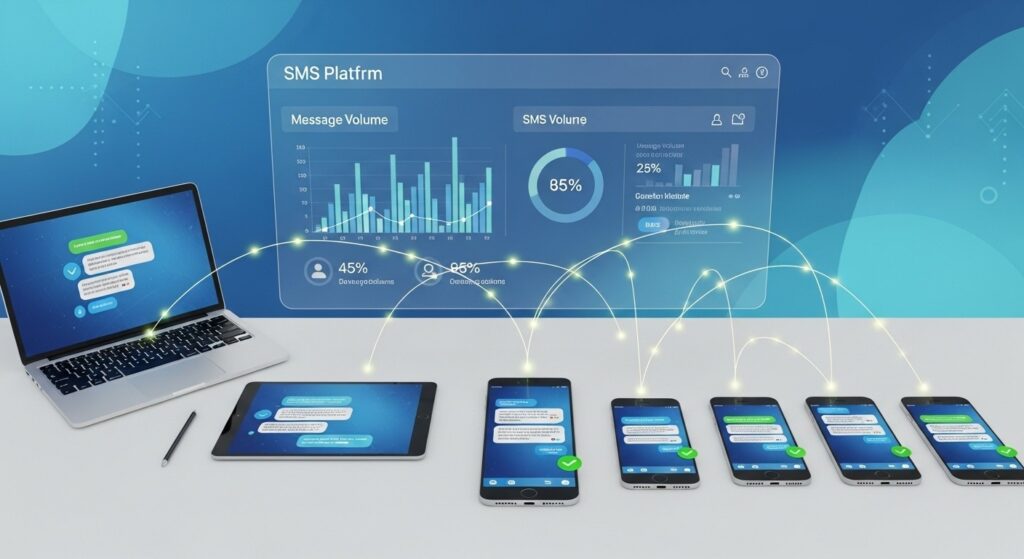
White-label SMS platforms have evolved, and resellers who choose the right partner can capture recurring revenue while meeting stricter compliance requirements.
- 10DLC registration is now mandatory for all A2P business messaging, with unregistered traffic blocked by carriers.
- AI-powered automation and chatbots are becoming standard features that drive engagement and reduce support overhead.
- New TCPA rules requiring one-to-one consent take effect in January 2026, demanding robust compliance tools.
- Integration capabilities with CRMs and collaboration platforms like Microsoft Teams directly impact customer retention.
Choose a white-label SMS platform built for 2026 compliance and feature expectations, or risk losing ground to competitors who did.
Selecting the right white-label SMS platform determines whether your business texting offering becomes a profitable revenue stream or a support headache. Platforms that dominated just two years ago may now lack critical compliance features or the AI capabilities that clients expect in 2026.
For MSPs, system integrators, and VARs building SMS reseller businesses, the most effective platforms offer compliance automation alongside the branding flexibility that lets you position the solution as entirely your own. The gap between basic SMS providers and comprehensive white-label platforms has widened, making your platform choice more consequential than ever.
This guide examines the seven essential features that separate market-leading SMS platforms from outdated alternatives. We’ll cover everything from mandatory compliance requirements to the AI-driven capabilities reshaping client expectations, helping you evaluate potential partners with confidence.
Which 7 Features Does Every White-Label SMS Platform Need in 2026?
Before diving into the details, here’s your quick reference checklist:
- Ease of Use – Intuitive interfaces that reduce onboarding time and support costs
- Integration Capabilities – Deep connections with CRMs, collaboration tools, and custom applications
- Customization and Branding – Complete white-label control over every customer touchpoint
- 10DLC Compliance Automation – Streamlined brand and campaign registration with Authentication+ support
- TCPA Compliance Tools – One-to-one consent management, flexible opt-out processing, and quiet hours enforcement
- AI and Automation – Intelligent chatbots, predictive analytics, and automated workflows
- Analytics and Reporting – Real-time dashboards, A/B testing, and conversion tracking
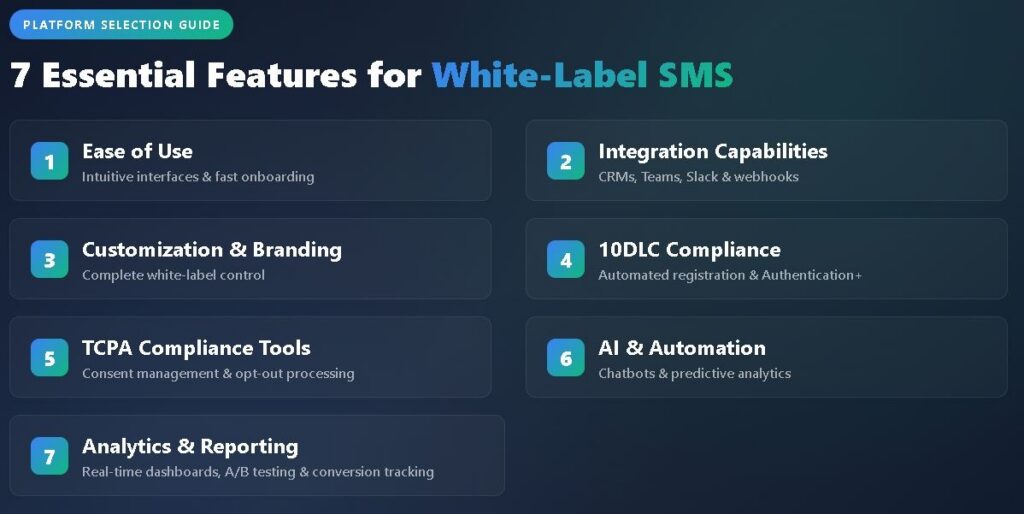
Each of these features impacts your ability to win clients, maintain compliance, and build recurring revenue. Let’s explore what to look for in each category.
What Are the Core Features of a Modern SMS Platform?
The foundation of any successful business texting offering lies in getting the basics right. Before evaluating advanced capabilities, ensure your platform delivers on the fundamentals that impact daily operations and customer satisfaction.
Modern white-label SMS platforms must balance sophistication with simplicity. Your team needs powerful tools, but your clients need interfaces they can navigate without extensive training. The best platforms achieve both through thoughtful design and comprehensive documentation.
1. How Important Is Ease of Use?
A user-friendly interface determines how quickly you can onboard new clients and how much ongoing support they’ll require. Platforms that demand extensive technical knowledge create bottlenecks in your sales process and increase your support costs.
Look for platforms offering visual campaign builders, drag-and-drop workflow creation, and pre-built templates that accelerate deployment. Mobile accessibility through iOS and Android apps ensures clients can manage their messaging from anywhere, which has become an expectation rather than a bonus feature.
Comprehensive documentation is essential. Platforms with thorough onboarding resources and searchable knowledge bases reduce your team’s burden while helping clients become self-sufficient faster. When evaluating providers, request access to their documentation and training materials before committing.
2. Why Do Integration Capabilities Matter So Much?
SMS reseller tools that operate in isolation create friction for clients who are accustomed to unified business systems. Your platform should seamlessly connect with the tools your customers already use, transforming business texting from a standalone channel into an integrated communication hub.

Essential integrations for 2026 include:
- CRM systems: HubSpot, Salesforce, Zoho, Pipedrive
- Collaboration platforms: Microsoft Teams, Slack, Google Chat
- Webhooks: Real-time data synchronization with custom applications
- Contact management: Automatic sync across multiple devices and users
The depth of integration matters as much as breadth. Surface-level connections that only transfer contact names provide less value than deep integrations enabling click-to-call functionality, automated message triggers based on CRM events, and unified conversation histories across channels.
3. What Customization and Branding Options Should You Expect?
White-label SMS solutions succeed when clients never realize a third party powers the platform. Complete branding control means incorporating your logos, color schemes, and domain across every touchpoint your customers experience.
Customization extends beyond visual elements. The ability to create tailored pricing packages, build custom workflows, and configure feature access by user role lets you differentiate your offering in ways competitors can’t easily replicate. Platforms that limit customization force you into commodity competition, where price becomes the only differentiator.
Consider whether the platform supports shared number capabilities that allow multiple users to monitor and respond from the same business number. This functionality proves essential for teams collaboratively handling customer service or sales inquiries.
What Compliance Features Should Your White-Label SMS Platform Include?
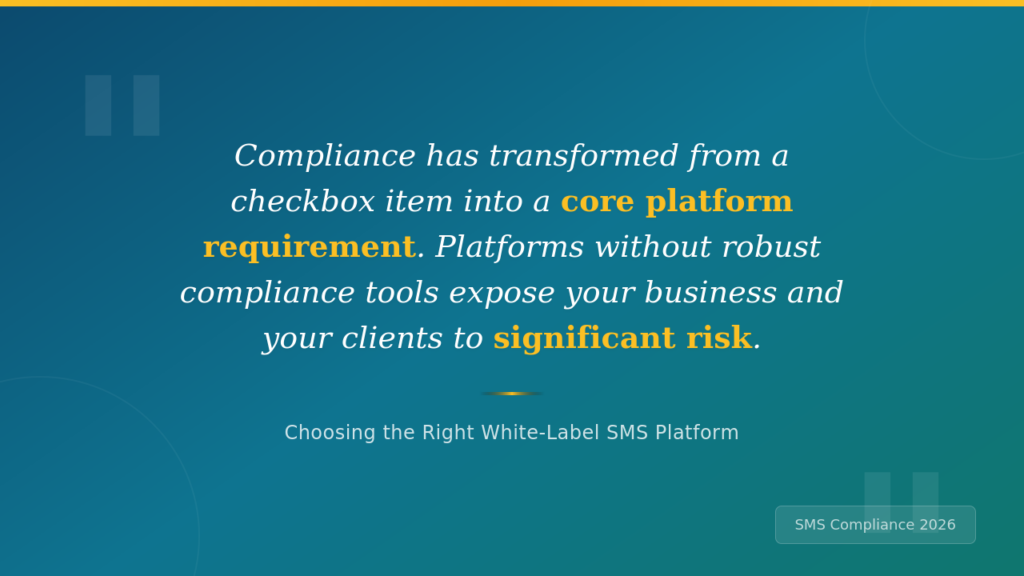
Compliance has transformed from a checkbox item into a core platform requirement. The regulatory landscape for business texting has tightened, and platforms without robust compliance tools expose both your business and your clients to significant risk.
4. Is 10DLC Registration Really Mandatory Now?
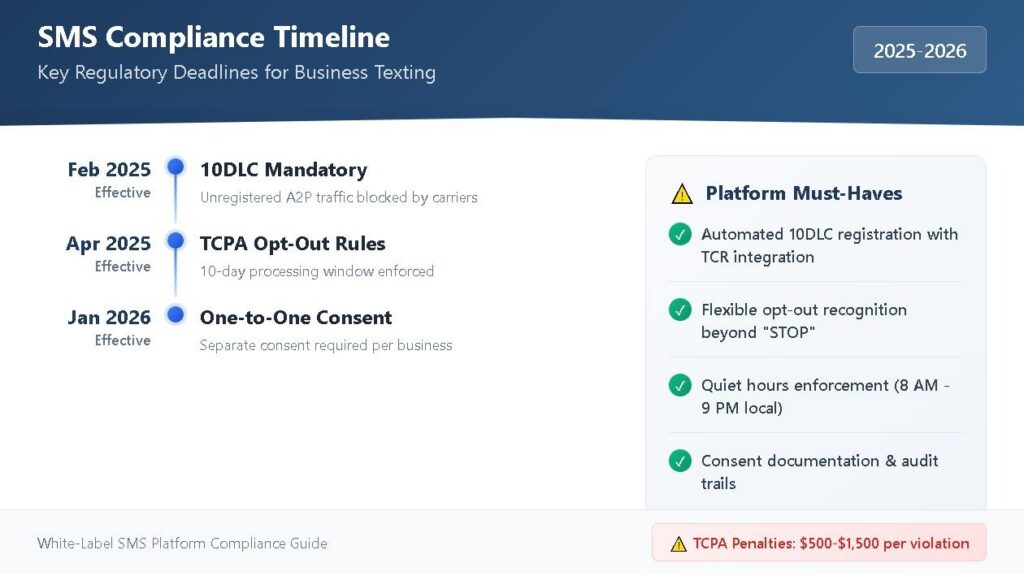
Yes, and the consequences for non-compliance have become severe. As of February 2025, U.S. carriers block unregistered A2P traffic from 10-digit long codes. Messages from unregistered campaigns simply don’t reach recipients, making 10DLC registration the baseline requirement for any legitimate business texting operation.
The registration process involves two components: brand registration (verifying your client’s business identity) and campaign registration (documenting the specific messaging use case). Platforms that automate this process save you considerable time while reducing rejection rates caused by incomplete or inaccurate submissions.
Authentication+ requirements introduced in 2025 add another verification layer using tax IDs, company registration documents, and domain-based email verification. Your platform should guide clients through these requirements rather than leaving them to navigate complex carrier documentation independently.
5. What TCPA Changes Take Effect in 2026?
The one-to-one consent rule is the most impactful TCPA change affecting business texting. Effective January 26, 2026, marketers must obtain separate, explicit consent from each consumer for each business that will contact them. Blanket consent covering multiple affiliates or partners no longer satisfies regulatory requirements.
Additional TCPA changes requiring attention include:
- Flexible opt-out recognition: Consumers can revoke consent through various methods, including email, voicemail, and informal messages like “leave me alone,” not just standard keywords like STOP.
- 10-day processing window: Businesses must honor opt-out requests within 10 business days.
- Quiet hours enforcement: Messages are prohibited before 8 AM or after 9 PM local time.
Platforms with built-in compliance automation handle these requirements without manual intervention. Automatic opt-out processing, quiet-hour scheduling based on recipient time zones, and consent documentation features protect your clients while reducing your support burden.
How Do State-Level Regulations Affect Platform Selection?
State-specific regulations add complexity that varies by geography. Florida’s Telephone Solicitation Act limits message volume and restricts outreach after 8 PM. California’s Consumer Privacy Act requires opt-in consent for most SMS marketing and mandates specific data handling procedures.
Your platform should provide tools that automatically account for these variations. Geographic-based rule enforcement ensures messages comply with local regulations without requiring your clients to become compliance experts themselves.
What Advanced Functionalities Separate Leading Platforms?
Basic messaging capabilities have become table stakes. The platforms commanding premium positioning and stronger margins differentiate through advanced functionalities that deliver measurable business value for your clients.
6. How Are AI and Automation Reshaping Business Texting?
Modern platforms leverage artificial intelligence for personalized message generation, optimal send-time prediction, and conversational chatbots that handle routine inquiries without human intervention.
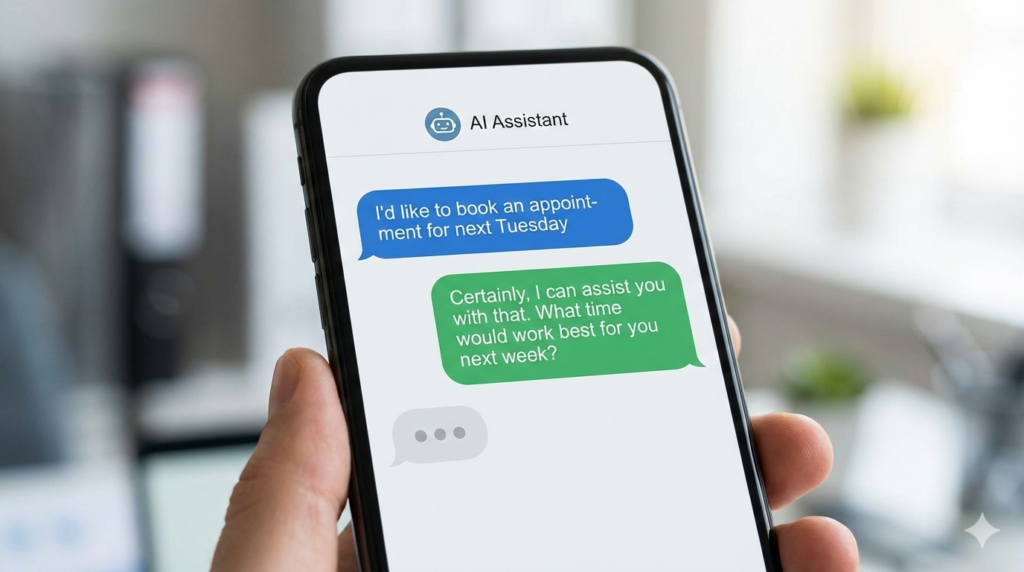
Chatbots emerging in 2026 use natural language processing to understand context and intent, not just keyword matching. They can qualify leads, book appointments, answer FAQs, and escalate complex issues to human agents, all within the native SMS thread. For clients with high message volumes, this automation reduces response times while freeing staff for high-value interactions.
Predictive analytics is another AI application gaining traction. Platforms analyzing engagement patterns can recommend optimal message timing, content variations likely to perform better with specific segments, and early warning indicators for subscriber churn.
7. Why Does Analytics Depth Matter for Retention?
Reporting capabilities influence whether clients perceive your platform as valuable enough to keep. Basic delivery confirmation no longer impresses. Clients expect comprehensive analytics showing campaign performance, engagement trends, and actionable insights.
Look for platforms with real-time dashboards, customizable report builders, and A/B testing tools that let clients systematically optimize their messaging strategies. The ability to track metrics like response rates, click-through rates, and conversion attribution helps clients demonstrate ROI, which strengthens their commitment to your platform.
Export capabilities for external analytics tools extend the value for data-savvy clients who want to combine SMS metrics with other business intelligence.
White-Label SMS Platform Comparison: What Criteria Should Guide Your Decision?
Evaluating potential platforms prevents costly mistakes. Use this framework to compare options across the dimensions that most impact reseller success:
| Feature Category | Essential Requirements | Premium Differentiators |
| Compliance | 10DLC automation, TCPA consent management, opt-out processing | State-level regulation handling, audit trails, proactive compliance alerts |
| Branding | Logo/color customization, custom domain | White-label mobile apps, branded documentation, custom feature naming |
| Integrations | Major CRMs, Microsoft Teams, Slack | Webhook support, API access, custom integration development |
| Automation | Scheduled messages, auto-responders | AI chatbots, predictive send times, behavioral triggers |
| Analytics | Delivery reports, basic engagement metrics | A/B testing, custom dashboards, conversion tracking |
| Support | Email/ticket support, knowledge base | Dedicated account management, reseller training programs, Tier 2/3 escalation |
| Scalability | Multi-client management, tiered pricing | Geo-redundant infrastructure, volume discounts, enterprise SLAs |
What About Emerging Technologies Like RCS?
Rich Communication Services is the next evolution in business messaging, offering app-like experiences within native messaging apps. RCS supports high-resolution media, interactive carousels, and verified sender credentials that increase trust.
While RCS adoption is accelerating (research projects that there will be 200 billion RCS business messages by 2029), SMS remains the universal fallback, ensuring message delivery regardless of recipient device capabilities. Platforms positioning for the future will support both channels, using RCS where available while maintaining SMS reliability.
Frequently Asked Questions About White-Label SMS Platforms
What margins can resellers expect from white-label business SMS?
Margins typically range from 40–70% depending on your pricing strategy, volume commitments, and the comprehensiveness of services you bundle. Platforms that offer wholesale pricing with no minimum commitments provide flexibility, while those with volume tiers reward growth with progressively better economics.
How long does 10DLC registration take for new clients?
Brand registration typically processes within a few days when information matches IRS records. Campaign registration adds another one to two weeks, depending on use case complexity and current review backlogs. Platforms with direct TCR integration streamline this timeframe.
Can white-label SMS integrate with existing UCaaS offerings?
Yes, business SMS integrates naturally with VoIP, UCaaS, and contact center solutions. This integration increases average revenue per customer while positioning you as a comprehensive communication provider rather than a single-service vendor.
What happens if a client violates TCPA regulations?
Liability primarily falls on the sending business, though platforms without adequate compliance tools may share responsibility. TCPA violations carry penalties of $500–$1,500 per message, making compliance automation essential. Choose platforms that document consent, automatically enforce quiet hours, and process opt-outs immediately.
Choosing the Right White-Label SMS Partner for 2026
The white-label SMS platform you select shapes your ability to capture the growing demand for business texting while maintaining compliance and delivering genuine value to clients. Platforms built for 2026 requirements, including mandatory 10DLC registration, evolving TCPA rules, and AI-driven client expectations, position resellers for sustainable growth.
Features that seemed advanced two years ago have become baseline requirements. Compliance automation, deep CRM integration, and comprehensive analytics now determine whether clients view your offering as professional-grade or outdated. The platforms investing in AI capabilities, RCS readiness, and robust compliance tools will command the market while others struggle to keep pace.SkySwitch offers a comprehensive white-label business SMS solution designed for resellers navigating these demands. With proven compliance tools, extensive integration capabilities, and dedicated partner support, SkySwitch enables you to deliver exceptional SMS solutions under your own brand. Get started today and explore how the right platform partnership can transform your business texting offering into a profitable growth engine.

Jessica is a marketing and sales strategist with deep expertise in VoIP telecommunications. As a Marketing Director, she specializes in channel marketing, account management, and product marketing within the communications industry. Jessica is passionate about helping partners grow through compelling messaging and hands-on support.