
Launching a VoIP Reseller Brand: White-Label Setup Guide

White-label VoIP setup enables MSPs and resellers to launch branded communication services without infrastructure investment.
- Market opportunity: The VoIP services market is accelerating, creating plenty of opportunities for strategic resellers.
- Business control: Complete pricing autonomy, customer ownership, and up to 70% profit margins.
- Rapid deployment: Most white-label VoIP setups can be launched within 30 days to several months with proper partner support.
Focus on comprehensive UCaaS platforms rather than basic VoIP to maximize customer value and retention.
Businesses continue to abandon traditional phone systems for modern cloud communications. With the VoIP services market growth projected to reach $752.41 billion by 2034 at a compound annual growth rate of 15.8%, managed service providers (MSPs) and IT resellers face an amazing opportunity to capture this market through white-label VoIP setup.
As more companies embrace hybrid work models, the demand for flexible, scalable communication solutions continues to accelerate. Rather than building expensive infrastructure from scratch, smart resellers are leveraging white-label VoIP platforms to launch branded telecommunication services quickly and profitably. This approach allows resellers to focus on customer relationships while their technology partners handle the complex backend operations. The SkySwitch VoIP reseller program is one example of that model.
What Is White-Label VoIP Setup?
White-label VoIP setup refers to the process of partnering with an established VoIP technology provider to offer communication services under your own brand name. Unlike traditional reselling arrangements, where customers recognize the underlying provider, white-label solutions enable complete brand control and customer ownership.
The core components of white-label VoIP branding include customizable user interfaces, personalized billing portals, branded customer support experiences, and marketing materials that exclusively feature your company’s identity. This approach transforms third-party technology into what appears to be your proprietary communication platform.
For VoIP business partners, this model eliminates the barriers traditionally associated with telecommunications services. Instead of investing millions in network infrastructure, regulatory compliance, and software development, resellers can launch comprehensive communication solutions within weeks rather than years.
The difference lies in the relationship structure. Traditional VoIP reselling often limits pricing flexibility and customer data access, while white-label arrangements provide complete autonomy over business operations, customer relationships, and revenue strategies.
Why Choose White-Label Over Traditional VoIP Reselling?
The advantages of white-label VoIP extend beyond cost considerations. Brand ownership is the primary differentiator, as customers associate their communication services directly with your company rather than recognizing you as a middleman.
Revenue control enables resellers to set competitive pricing that aligns with their market positioning and profit objectives. Rather than accepting predetermined commission structures, white-label UCaaS platforms allow complete pricing autonomy.
Customer relationship ownership provides invaluable business intelligence and retention opportunities. When customers experience service issues or require upgrades, they contact your support team directly, strengthening brand loyalty and creating upselling opportunities that traditional reselling models don’t offer.
Market differentiation becomes achievable through customized service packages and specialized industry focus. While traditional resellers offer identical products with limited variation, white-label partners can develop unique value propositions tailored to specific business segments or geographic markets.
7 Must-Have Features in Your White-Label VoIP Setup
Selecting the right platform requires evaluating capabilities that directly impact your ability to deliver exceptional customer experiences and operate efficiently.
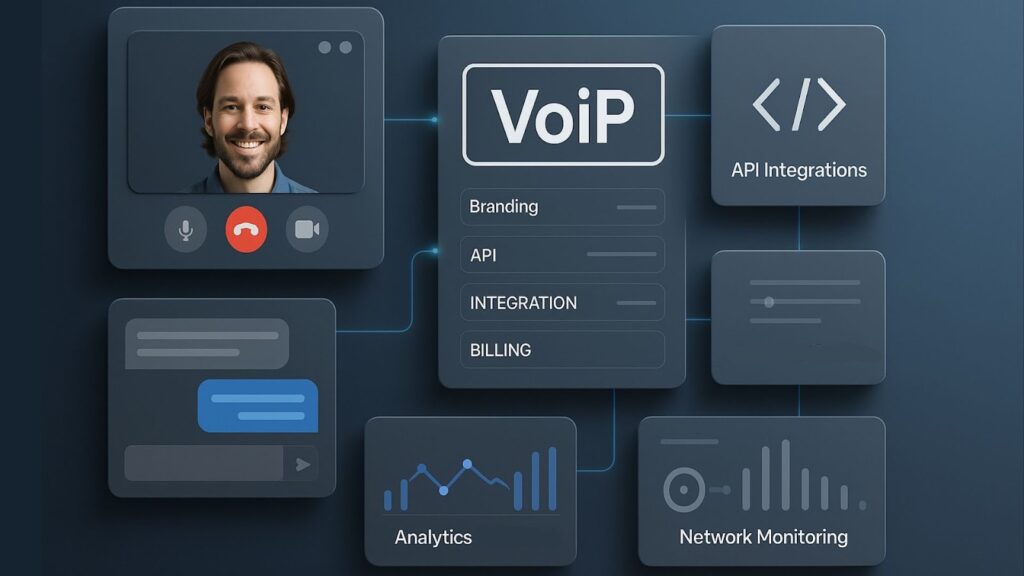
1. Comprehensive Branding Capabilities
Your platform should support complete visual customization across all customer touchpoints, including logos, color schemes, domain names, and user interface elements. Look for providers offering branded mobile applications and customer portals that reinforce your company’s identity.
2. Reliable Infrastructure and Uptime
Geo-redundant networks with automatic failover capabilities ensure service reliability that protects your reputation. Seek providers maintaining service level agreements guaranteeing 99.99% or higher uptime performance.
3. Integration Capabilities
Modern businesses require communication platforms that integrate with existing applications. Essential integrations include CRM systems, productivity suites, billing platforms, and industry-specific software that your target customers already utilize.
4. Scalable Billing Systems
Automated billing capabilities with customizable pricing structures, usage tracking, and invoice generation streamline operations while reducing manual administrative overhead. Advanced platforms include tax compliance automation and revenue reporting tools.
5. Training and Support Resources
Comprehensive reseller onboarding programs, ongoing technical training, and accessible knowledge bases accelerate your time to market while ensuring your team can deliver expert customer support.
6. API Access and Customization
Robust application programming interfaces enable advanced customizations and integrations that differentiate your services from those of your competitors. APIs also facilitate automated provisioning, billing, and customer management.
7. Quality Monitoring Tools
Real-time network performance monitoring, call quality analytics, and diagnostic capabilities enable proactive issue resolution and demonstrate service value to customers through detailed reporting.
Step-by-Step White-Label VoIP Setup Process
The following five-phase process provides a proven framework for launching your branded communication services efficiently while minimizing common pitfalls that derail new reseller ventures.

Market Research and Niche Selection
Success begins with identifying the most promising opportunities within your addressable market. Research local business demographics, existing telecommunication providers, and underserved market segments that align with your capabilities.
Focus on industries experiencing rapid growth or technological transitions that create communication modernization opportunities. Small to medium businesses with 10-500 employees typically represent the best target market for white-label VoIP resellers, as these organizations seek cost-effective, scalable solutions without requiring extensive technical expertise.
Evaluate competitor offerings and pricing strategies to identify differentiation opportunities. Consider factors like industry specialization, geographic coverage, and service packages that could provide competitive advantages in your target market.
Provider Evaluation and Partnership
Thorough evaluation of potential white-label partners determines your long-term success. Begin by assessing technical infrastructure capabilities, including network redundancy, data center locations, and service reliability track records.
Review the provider’s reseller support structure, including onboarding processes, training programs, and ongoing technical assistance. The best white-label UCaaS providers offer comprehensive support ecosystems that enable reseller success rather than simply providing technology access.
Examine financial arrangements, focusing on pricing transparency, contract flexibility, and revenue-sharing models. Avoid providers requiring lengthy commitments or imposing restrictive terms that limit your business growth.
Platform Configuration and VoIP Branding
Once you’ve selected a provider partnership, the platform configuration transforms generic technology into your branded solution. Work closely with your provider’s implementation team to customize user interfaces, customer portals, and administrative dashboards with your visual identity.
Configure billing systems to reflect your pricing and service packages. Establish automated provisioning workflows that enable rapid customer onboarding while maintaining quality control over service delivery.
Develop branded marketing materials, including website content, sales presentations, and customer documentation that position your services as proprietary solutions rather than resold offerings.
Pricing Strategy Development
Effective pricing strategies balance competitiveness with profitability while considering your target market’s value perception. Research local market rates for comparable services, but avoid competing solely on price, which erodes margins and commoditizes your offering.
Consider value-based pricing models that emphasize business benefits like productivity improvements, cost savings, and operational flexibility rather than focusing exclusively on per-seat costs. Bundle complementary services to increase average revenue per customer while providing comprehensive solutions.
Build pricing flexibility into your service packages to accommodate different customer segments and usage patterns. Tiered service levels enable customers to start with basic packages and upgrade as their communication needs evolve.
Marketing and Launch Preparation
Successful white-label VoIP setup requires marketing strategies that establish credibility and generate qualified leads. Develop educational content that demonstrates your communication expertise while positioning your services as essential business tools.
Leverage digital marketing channels, including search engine optimization, pay-per-click advertising, and social media marketing, to reach target customers actively researching communication solutions. Content marketing focused on business communication trends establishes thought leadership and generates organic lead flow.
Establish referral programs and partnership opportunities with complementary service providers who serve your target market. Business relationships with IT consultants, office equipment dealers, and managed service providers can provide valuable lead sources.
Reseller Onboarding Best Practices
Effective reseller onboarding programs accelerate time to market while ensuring sustainable success. Most comprehensive programs require 30+ days to complete, depending on your existing telecommunications experience and commitment level.
Technical training should encompass platform navigation, customer provisioning, troubleshooting procedures, and billing management. Look for providers offering hands-on training environments where you can practice customer scenarios before launching your services.
Sales training components include market positioning, competitive differentiation, objection handling, and proposal development. The most successful UCaaS resellers understand how to articulate business value rather than simply explaining technical features.
Ongoing support requirements include technical assistance, billing support, and customer escalation procedures. Establish clear communication channels with your provider’s support teams to ensure rapid issue resolution that protects customer satisfaction.
Revenue Potential and Growth Strategies
White-label VoIP offers substantial revenue opportunities for resellers who execute effective growth strategies.

Typical profit margins vary for established resellers, although initial margins may be lower during the customer acquisition phase. Revenue growth accelerates as customer bases expand and service packages mature through feature additions and premium offerings.
Customer retention strategies are vital for long-term profitability. Monthly recurring revenue models create predictable income streams, but success depends on delivering consistent service quality and proactive customer support that prevents competitive threats.
Expansion opportunities include adding complementary services like contact center capabilities, business SMS, and collaboration tools that increase average revenue per customer while strengthening competitive positioning.
White-Label VoIP Setup Checklist

Pre-Launch Requirements:
- Market research and target customer identification completed
- Provider partnership agreement signed and onboarding initiated
- Platform branding and customization implemented
- Pricing strategy developed and billing systems configured
- Sales and technical training completed
- Marketing materials created and website launched
Technical Setup:
- Customer provisioning workflows tested and documented
- Support procedures established and staff trained
- Integration testing completed for required business applications
- Quality monitoring and reporting systems activated
- Backup and disaster recovery procedures verified
Business Operations:
- Legal agreements and service terms finalized
- Insurance coverage reviewed and updated as needed
- Financial tracking and reporting systems implemented
- Customer onboarding processes documented and tested
- Escalation procedures established with provider support teams
Frequently Asked Questions
How long does white-label VoIP setup take?
Most white-label VoIP setups require a month to three months from the initial partnership agreement to customer launch. Timeline variations depend on customization complexity, staff training requirements, and marketing preparation needs. Resellers with existing telecom experience often complete setup faster than those new to communication services.
What ongoing support do VoIP business partners receive?
Reputable white-label providers offer comprehensive ongoing support, including technical assistance, billing support, customer escalation procedures, and regular training updates. Support quality impacts reseller success, so evaluate provider support capabilities carefully during selection.
How much can I charge for white-label VoIP services?
Pricing flexibility is a key white-label advantage, allowing resellers to set rates based on market conditions and value positioning. Pricing varies based on features, market positioning, and competitive landscape, while enterprise solutions can command premium pricing based on feature complexity and support requirements.
Launch Your White-Label VoIP Business with a Proven Platform
White-label VoIP is a transformative opportunity for MSPs and resellers seeking to capitalize on the explosive growth in business communication services. With 67% of US firms now offering work location flexibility, demand for modern communication solutions continues to accelerate across all business segments.
Success requires selecting the right technology partner, executing thorough market research, and developing comprehensive service strategies that prioritize customer value over simple cost competition.
SkySwitch provides comprehensive white-label UCaaS solutions designed specifically for MSPs and resellers who want to build profitable, sustainable communication businesses. Get started today to discover how our turnkey platform can accelerate your entry into this lucrative market.

Jessica is a marketing and sales strategist with deep expertise in VoIP telecommunications. As a Marketing Director, she specializes in channel marketing, account management, and product marketing within the communications industry. Jessica is passionate about helping partners grow through compelling messaging and hands-on support.