
Why Business Voice Calling Still Matters in 2026

Voice calls remain the top customer communication channel, with 65% of customers preferring phone-based support.
- AI-powered voice tools now offer real-time transcription, sentiment analysis, and automated call summaries that eliminate administrative busywork.
- SMB voice solutions through white-label UCaaS give resellers healthy margins while delivering enterprise-grade call quality to small businesses.
- Unified platforms combining voice, video, and messaging create seamless internal and external communication without the complexity of managing multiple tools.
Partner with a turnkey UCaaS provider to offer modern business voice calling under your own brand and tap into a market projected to exceed $1.5 billion by 2030.
We’re surrounded by chat apps, instant messaging, and email threads that stretch for miles. Yet when something truly matters, people still pick up the phone. Business interaction trends continue, as 65% of consumers still prefer phone-based communication for customer service, making voice calls the most popular and practical channel.
For resellers serving SMBs, understanding why business voice calling continues to dominate is essential for effectively positioning your services. AI-powered features and cloud-based platforms are making crystal-clear, feature-rich calling accessible to businesses of all sizes. Your clients aren’t choosing between old and new technology; they’re choosing effective communication that builds relationships, closes deals, and solves problems faster than any text-based alternative.
What Makes Business Voice Calling Essential for Effective Communication?
The human voice carries something that text can’t replicate. Tone, inflection, pacing, and emotional nuance all travel through a phone call, creating connection and understanding that typed words struggle to achieve. Approximately half of all online messages are misinterpreted, while senders believe their intended tone will be understood 90% of the time. Voice eliminates this gap entirely.
Business voice calling accelerates resolution. A quick phone conversation can accomplish what might take a dozen email exchanges, and the immediate back-and-forth allows for clarification and negotiation in real time. For SMBs where every minute counts, this efficiency translates directly to productivity and customer satisfaction.
Why Are Businesses Increasing Investment in Voice Technology?
Market trends confirm what many resellers already see in the field: businesses are doubling down on voice. According to research, 68% of European businesses plan to increase investments in voice-centric cloud communications over the next two years, a trend mirrored across North American markets. This momentum is an embrace of modern UCaaS for business that combines traditional voice reliability with cloud-based flexibility.
The SMB telecom voice and data services market is projected to reach $1.5 billion by 2030. For resellers, these numbers represent a worthwhile opportunity. Your clients need voice solutions, and they’re looking for trusted partners who can deliver enterprise-quality calling without enterprise complexity or pricing.
How Is AI Transforming Business Voice Calling?
Artificial intelligence has changed what’s possible with business phone systems. Features that seemed like science fiction a few years ago are now standard offerings that SMBs expect from their communication platforms. For resellers, understanding these capabilities helps you position voice solutions as productivity tools rather than basic utilities.
What AI-Powered Features Should Your Clients Know About?
Modern cloud-based voice solutions include AI capabilities that save time and improve outcomes. Real-time transcription converts spoken conversations to searchable text, making it easy for teams to reference important details without rewinding recordings. Call summaries automatically capture key points and action items, eliminating the need for manual note-taking during customer interactions.
Sentiment analysis provides another layer of intelligence by detecting emotional cues in conversations. Managers can identify calls that may need follow-up or coaching opportunities for their teams. When combined with CRM integrations, these features create a comprehensive view of customer relationships that inform better business decisions.

AI also powers intelligent call routing that goes beyond simple auto attendant functions. Modern systems analyze caller history, time of day, and agent availability to connect customers with the right person faster. The result is shorter wait times, higher first-call resolution rates, and improved customer satisfaction scores.
How Does Voice AI Improve SMB Operations?
Small and medium businesses often lack dedicated support staff, making efficiency critical. AI-powered voice tools act as force multipliers, handling routine tasks so limited teams can focus on high-value interactions. Consider these practical applications:
- Automated appointment reminders reduce no-shows and free staff from manual outreach.
- Voicemail transcription lets team members scan messages quickly from any device.
- Real-time coaching prompts help sales representatives navigate conversations more effectively.
- Post-call summaries automatically populate CRM records with conversation highlights.

These capabilities were once exclusive to large enterprises with flexible IT budgets. White-label UCaaS platforms now make them accessible to resellers serving SMBs, creating differentiation opportunities in competitive markets.
Why UCaaS for Business Delivers Superior Voice Quality
Call quality directly impacts business outcomes. Dropped calls, choppy audio, and echo frustrate customers and undermine professionalism. Modern UCaaS platforms address these concerns through infrastructure investments that traditional phone systems can’t match.
What Technical Elements Ensure Crystal-Clear Calls?
Geo-redundant network architecture distributes call processing across multiple data centers, ensuring that localized outages don’t disrupt service. When one node experiences issues, calls automatically route through alternative paths without interruption. This redundancy eliminates the single points of failure that plague legacy systems.
Quality of Service (QoS) monitoring continuously analyzes call quality metrics, including latency, jitter, and packet loss. When the system detects degradation, it can adjust routing in real time to maintain call clarity. For resellers, these capabilities translate to fewer support tickets and happier customers.
HD voice technology delivers richer audio than traditional phone lines, capturing more of the frequency range present in human speech. Conversations sound more natural, reducing listener fatigue during extended calls. Combined with noise cancellation that filters background distractions, these features create professional calling experiences regardless of where team members work.
How Does Cloud Infrastructure Support Remote and Hybrid Teams?
The shift toward distributed workforces has made mobility essential for effective communication. UCaaS platforms deliver consistent calling experiences across devices, whether team members use desk phones, laptops, or smartphones. A call started on a desktop can transfer seamlessly to a mobile device as an employee heads to a meeting, without disruption or quality loss.
Mobile and desktop softphone applications maintain full functionality regardless of location. Call history, voicemail, presence information, and messaging all sync across devices, ensuring team members stay connected and accessible. SMBs with limited IT resources don’t have to manage separate communication systems for office and remote workers.
What Should Resellers Know About SMB Voice Tools?
Serving the SMB market requires understanding what these businesses need and what they don’t. SMBs want sophisticated capabilities without the complexity that accompanies enterprise solutions. They need reliable voice calling that integrates with their existing workflows and scales as they grow.
Which Features Matter Most to SMB Buyers?
When evaluating white-label UCaaS opportunities, focus on capabilities that solve real problems for small business owners:
- Simple setup and management through intuitive portals that don’t require technical expertise
- Flexible scaling that allows adding or removing users without lengthy contracts or hardware purchases
- Business SMS integration for customer communication on their preferred channels
- Call analytics that provide visibility into communication patterns and team performance
- CRM integrations that automatically connect voice interactions with customer records
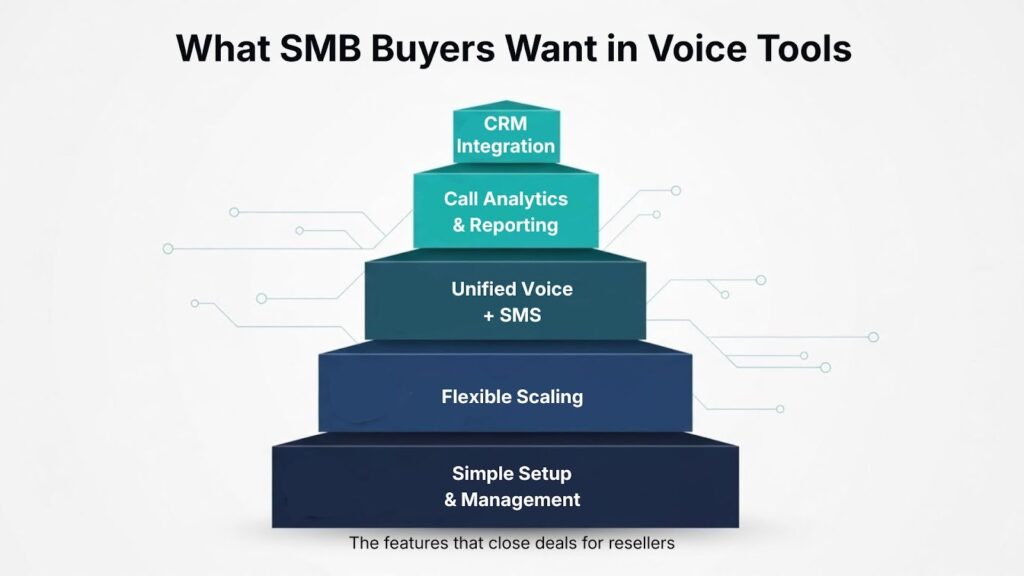
These features differentiate modern UCaaS platforms from basic VoIP services. Your clients are investing in productivity tools that help their businesses operate more effectively.
How Do SMB Voice Tools Support Customer-Facing Operations?
Small businesses often compete against larger companies for the same customers. Professional voice capabilities level the playing field by delivering experiences that meet or exceed enterprise standards. Auto attendants professionally greet callers and efficiently route them. Call queues manage busy periods without sending customers to voicemail. Call recording supports quality assurance and training efforts.
For customer-facing teams, features like click-to-call from CRM records and automated call logging streamline workflows. Representatives spend less time on administrative tasks and more time helping customers. The cumulative effect of these efficiencies compounds over time, improving customer satisfaction while reducing operational costs.
How Does White-Label UCaaS Create Value for Resellers?
The white-label model transforms how resellers approach voice services. Rather than acting as intermediaries for someone else’s brand, you deliver comprehensive communication solutions under your own identity. This ownership creates deeper customer relationships and better margins than traditional agent or referral arrangements.

What Business Benefits Does White-Label Voice Reselling Offer?
Partnering with the right UCaaS vendor provides several compounding advantages. Recurring revenue from subscription-based services creates predictable income streams that grow as you add customers. Healthy margins typically ranging from 50–70% reward your sales and support efforts appropriately.
Brand equity accumulates with each successful implementation. Customers associate quality communication services with your company, not a distant provider they’ve never met. This relationship ownership protects against competitive poaching and creates upselling opportunities as customer needs evolve.
Technical complexity stays with your platform partner while you focus on customer relationships. Infrastructure management, software updates, security patches, and feature development happen behind the scenes. You deliver the benefits without maintaining the underlying technology.
How Do You Position Voice Services for Maximum Impact?
Effective positioning starts with understanding customer pain points. Many SMBs struggle with communication fragmentation, using separate tools for voice, video, messaging, and collaboration. Highlighting the consolidation benefits of unified platforms addresses this frustration directly.
Cost comparisons against legacy phone systems often reveal significant savings, but don’t lead with price alone. Emphasize productivity gains, mobility benefits, and professional features that help businesses compete more effectively. Price-focused buyers tend to churn when cheaper options appear; value-focused buyers become long-term partners.
Frequently Asked Questions About Business Voice Calling
Why do customers still prefer phone calls over chat or email? Voice communication conveys tone and emotion that text can’t replicate, reducing misunderstandings and building stronger relationships. Phone calls also resolve issues faster through real-time dialogue, eliminating the back-and-forth delays common with written communication.
What AI features are most valuable for SMB voice systems? Real-time transcription and call summaries save administrative time, while intelligent routing improves customer experiences by connecting callers with the right team members faster. Sentiment analysis and CRM integration help businesses understand and serve customers more effectively.
How does UCaaS differ from traditional business phone systems? UCaaS delivers voice, video, messaging, and collaboration through a cloud-based platform accessible from any device. Unlike premise-based systems, UCaaS requires no hardware investment, scales instantly, and receives automatic updates with new features and security improvements.
Start Delivering Modern Business Voice Calling to Your Clients
The opportunity in business voice calling continues to grow as SMBs seek effective communication solutions that match their evolving needs. AI-powered features, cloud infrastructure, and unified platforms have transformed what’s possible, and your clients are actively looking for partners who can guide them through this transition.
SkySwitch provides resellers with everything needed to deliver enterprise-grade voice capabilities under their own brand. From comprehensive onboarding and training to ongoing support and a geo-redundant network infrastructure, the platform handles technical complexity while you build customer relationships and recurring revenue. Get started today and discover how white-label UCaaS can transform your business.

Jessica is a marketing and sales strategist with deep expertise in VoIP telecommunications. As a Marketing Director, she specializes in channel marketing, account management, and product marketing within the communications industry. Jessica is passionate about helping partners grow through compelling messaging and hands-on support.