
Top 6 Voice API Use Cases for Resellers & MSPs in 2025

Voice APIs enable resellers to offer programmable voice solutions that drive client retention and unlock new revenue streams.
- Six use cases include automated provisioning, real-time dashboards, CRM integration, intelligent call routing, E911 management, and contact center enhancement.
- The telecom API market is projected to reach $687.83 billion by 2030, as businesses demand more integrated communication solutions.
- White-label resellers report doubling their voice revenue by leveraging comprehensive voice API features for custom client solutions.
Implementing voice API positions resellers as strategic technology partners rather than commodity service providers.
The demand for programmable voice solutions has exploded across every industry, and smart resellers are capitalizing on this trend to differentiate their offerings and increase client lifetime value. With the global telecom API market expected to reach $687.83 billion by 2030, growing at an impressive 14.22% CAGR, there’s never been a better time to understand how voice API use cases can transform your reselling business.
Whether you’re an MSP looking to expand into modern UCaaS solutions or a system integrator seeking to add more value for existing clients, voice APIs provide the programmable foundation that businesses need.
What Are Voice API Use Cases, and Why Do They Matter?
Voice API use cases are specific business scenarios where programmable voice capabilities solve real operational challenges for clients. Unlike traditional phone systems that offer fixed functionality, voice API features allow developers and resellers to create custom communication workflows that integrate seamlessly with existing business applications.
These programmable voice solutions provide a set of protocols and tools that enable applications to control voice communications. When your client’s CRM system needs to automatically dial prospects, or their helpdesk software requires intelligent call routing based on customer data, voice APIs make these integrations possible without complex telecommunications infrastructure.
The business value becomes clear when you consider that companies using integrated solutions report higher productivity compared to those managing disconnected systems. For resellers, offering these telecom API capabilities means positioning yourself as a strategic technology partner who solves complex business problems, not just another voice service provider.
Voice API features also enable rapid deployment of new functionality. What previously required months of custom development can now be implemented in days or weeks, allowing your clients to respond quickly to changing business requirements while you maintain strong recurring revenue relationships.
What Are the Top 6 Voice API Use Cases for Maximum Business Impact?
These six use cases represent high-impact scenarios where programmable voice capabilities deliver measurable business results for clients. Each addresses common operational challenges while creating opportunities for deeper integration and recurring revenue growth.
Use Case 1: Automated Customer Provisioning and Phone Management
Managing phone system setups and user provisioning traditionally consumes significant time and resources for both resellers and their clients. Voice APIs transform this process by enabling automated workflows that handle everything from number assignment to feature configuration without manual intervention.
With programmable voice, you can build systems that automatically provision new employees when they’re added to HR systems, assign appropriate phone numbers based on department or location, and configure calling features according to role-based templates. This automation reduces setup time from hours to minutes while eliminating errors that lead to service calls.
Clients experience faster employee onboarding, consistent service delivery, and reduced administrative overhead. For resellers, automated provisioning means you can handle larger client volumes without proportionally increasing support staff, improving your profit margins while delivering superior service quality.
Use Case 2: Real-Time Call Analytics and Custom Dashboards
Traditional phone systems provide basic call reports, but voice APIs enable sophisticated real-time analytics that drive business intelligence. By subscribing to live call data streams, you can build custom dashboards that surface actionable insights about communication patterns, customer behavior, and operational efficiency.
These voice API features allow the creation of executive dashboards showing key performance indicators, department-specific views of communication metrics, and predictive analytics that help clients optimize staffing levels during peak call periods. The data integration possibilities are virtually unlimited when APIs provide access to comprehensive call metadata.
For professional services firms, these analytics reveal billing opportunities by tracking billable communication time. Retail operations can correlate call patterns with sales performance, while healthcare providers can monitor compliance-related communication requirements. The result is deeper client relationships built on measurable business value rather than just communication service delivery.
Use Case 3: CRM Integration and Click-to-Call Functionality
The most immediately valuable voice API use cases involve seamless integration between communication systems and customer relationship management platforms. Click-to-call functionality eliminates the friction of manual dialing while ensuring all customer interactions are properly logged and tracked.
Advanced implementations include screen pop functionality that displays customer information when calls are received, automatic call logging with outcome tracking, and integration with sales workflows that trigger follow-up activities based on call results. These features transform how sales and support teams interact with customers.

The ROI for these integrations is often substantial and measurable. Companies implementing integrated communication solutions experience improved workflow efficiency and reduced time spent switching between applications. Support organizations achieve faster resolution times and higher customer satisfaction scores through immediate access to relevant customer history.
Use Case 4: Intelligent Call Routing and Automation
Modern businesses require sophisticated call handling. Voice API use cases in this category leverage real-time data to make intelligent routing decisions based on caller information, agent availability, skills matching, and business rules that adapt throughout the day.
These programmable voice solutions can query CRM systems to identify VIP customers and route them immediately to senior agents, check inventory systems to route product inquiries to specialists with relevant expertise, or integrate with workforce management tools to optimize agent utilization across multiple communication channels.
The automation extends to callback management, where APIs can schedule callbacks during optimal windows, send confirmation messages, and reschedule automatically if agents become unavailable. This level of sophistication transforms customer experience while reducing operational costs through more efficient resource utilization.
Use Case 5: E911 Location Management and Compliance
Regulatory compliance around emergency calling creates ongoing administrative burdens for businesses with multiple locations or remote workers. Voice API features enable automated location tracking and E911 address management that adapts dynamically as employees move between offices or work remotely.
These systems can integrate with employee badge systems, Wi-Fi network data, or mobile device locations to automatically update E911 information without manual intervention. For businesses with complex facility layouts, APIs enable zone-based location tracking that provides first responders with precise floor and room information during emergencies.
For resellers, offering these capabilities demonstrates expertise in regulatory requirements while providing measurable risk reduction for clients.
Use Case 6: Contact Center Enhancement and Queue Management
Contact center operations benefit tremendously from voice API use cases that optimize agent productivity and customer experience. These programmable voice implementations can dynamically adjust queue priorities based on customer value, estimated wait times, and agent skill availability.
Advanced features include callback queue management that preserves customer position while allowing them to disconnect, integration with customer effort scoring systems that route frustrated callers to specialized agents, and real-time sentiment analysis that triggers supervisor notifications for escalating situations.
The business impact includes reduced abandoned call rates, higher first-call resolution percentages, and improved agent satisfaction through better workload distribution. These metrics translate directly to revenue protection and growth opportunities that justify technology investments while strengthening client relationships.
How Do Real Resellers Leverage Voice API Features?
Complete Computers demonstrates the transformative power of voice API. When their clients shifted from on-premise solutions to cloud-based systems, owner David Spears leveraged programmable voice capabilities to deliver enterprise-level functionality with local support expertise.
The company’s implementation enabled remote management of 90% of support tasks, including system monitoring and configuration changes. These voice API features allowed Complete Computers to double its voice revenue while expanding from one technical resource to four or five team members who can independently manage client implementations.
Charleston Telecom Solutions provides another compelling example of voice API use cases driving business growth. When their previous provider experienced frequent outages, they migrated to a platform with robust APIs that enabled backup systems and seamless customer transitions. The programmable voice capabilities allowed them to maintain service continuity while offering enhanced features that were previously unavailable.
Both cases highlight how voice API features help resellers deliver superior value while building more resilient, scalable businesses. The combination of technical capabilities and strategic implementation positions these companies as indispensable technology partners.
How Do Voice API Features Drive Long-Term Business Growth?
Resellers who master programmable voice solutions create significant competitive advantages through deeper client integration, recurring revenue growth, and market differentiation that’s difficult for competitors to replicate.

Client retention improves dramatically when communication systems integrate tightly with core business processes. Companies are far less likely to switch providers when doing so would disrupt critical workflows and require extensive reconfiguration of integrated systems. This integration creates natural barriers to competitive displacement while opening opportunities for expanded service delivery.
The revenue implications are equally compelling. Rather than competing solely on price for basic voice services, resellers offering sophisticated voice API features can command premium pricing based on delivered business value. Custom implementations and ongoing optimization services provide additional revenue streams that grow along with client businesses.
Market positioning transforms when you can demonstrate measurable business outcomes rather than just technical specifications. Clients view API-enabled resellers as strategic technology partners who understand their business challenges and can provide solutions that drive operational improvements and competitive advantages.
Frequently Asked Questions About Voice API Implementation
What programming knowledge is required to implement voice API use cases? Most modern voice APIs use REST protocols that work with standard web development tools and languages. While basic programming knowledge is helpful, many platforms provide extensive documentation, code examples, and even no-code configuration options that make implementation accessible to technically-minded resellers.
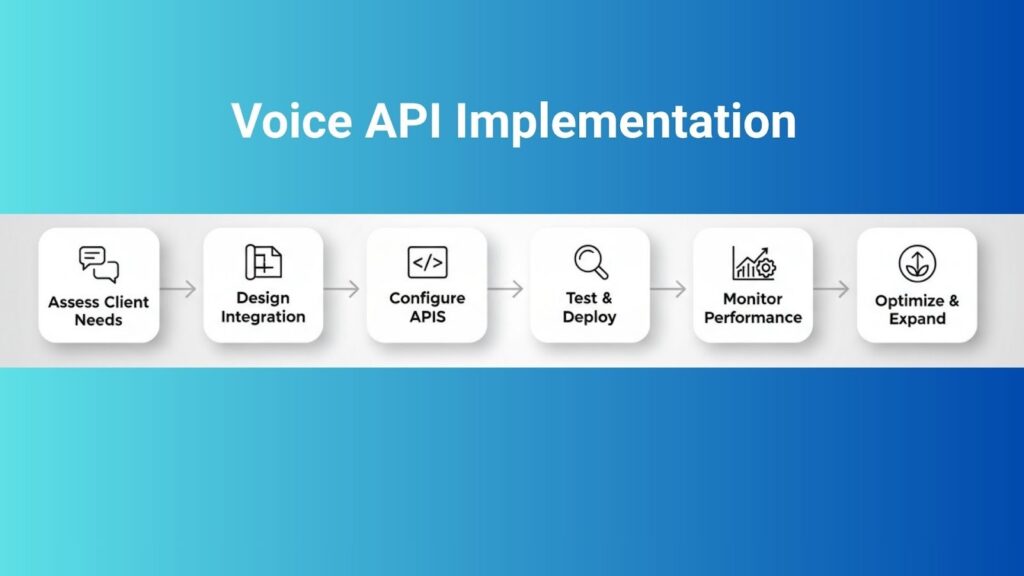
How quickly can voice API features be deployed for new clients? Implementation timelines vary based on complexity, but simple integrations like click-to-call functionality can often be deployed within days. More sophisticated automated workflows may require several weeks for custom development and testing, but the investment pays dividends through improved operational efficiency and client satisfaction.
What’s the typical return on investment for voice API implementations? ROI varies based on use case and client size, but many businesses report productivity improvements within the first year. Cost savings from automation, improved customer satisfaction, and enhanced employee efficiency typically justify implementation costs while providing ongoing value for years.
Transform Your Reselling Business with Strategic Voice API Implementation
Voice APIs are the foundation for building deeper client relationships, commanding premium pricing, and creating sustainable advantages. The businesses that embrace these programmable voice solutions will establish market leadership positions that become increasingly difficult for competitors to challenge.
SkySwitch provides the platform, training, and ongoing support you need to implement sophisticated programmable voice solutions that delight clients and grow your revenue. Get started today and discover how easy it is to position yourself as a strategic technology partner who delivers measurable business value through advanced communication solutions.

Jessica is a marketing and sales strategist with deep expertise in VoIP telecommunications. As a Marketing Director, she specializes in channel marketing, account management, and product marketing within the communications industry. Jessica is passionate about helping partners grow through compelling messaging and hands-on support.