
UCaaS for Resellers: Launch Checklist for 2025

The UCaaS market is exploding with 15.1% CAGR growth reaching $85B in 2025, creating massive opportunities for resellers.
- Market drivers include AI integration, hybrid work demands, and enterprise digital transformation
- Successful launches require 90-day structured planning covering technical setup, partner selection, and go-to-market strategy
- Top resellers achieve healthy margins through white-label platforms with comprehensive support
Start planning now to capture market share before competition intensifies in this $173B opportunity by 2030.
The unified communications market has reached a tipping point. Research shows the UCaaS market will reach $85.19 billion in 2025, growing to $172.69 billion by 2030 at a 15.1% CAGR. For managed IT services providers, system integrators, and technology resellers, this represents one of the most significant revenue opportunities available today.
What makes 2025 particularly compelling for UCaaS resellers is the convergence of several market forces. Remote work has permanently shifted business communication needs, artificial intelligence is transforming collaboration tools, and organizations are consolidating vendors to streamline operations. Companies that position themselves as comprehensive communication providers now will capture disproportionate market share as demand accelerates.
The opportunity extends beyond simple revenue growth. The UCaaS for resellers market provides the sticky, recurring revenue model that transforms traditional one-time service relationships into long-term partnerships. However, success demands systematic planning, strategic partner selection, and flawless execution.
How Do You Build the Foundation for UCaaS Reseller Success?
Successfully building UCaaS for resellers starts long before your first customer conversation. The foundation you establish during the planning phase determines whether you’ll capture significant market share or struggle to gain traction.
The global UCaaS market is driven primarily by organizations seeking integrated communication solutions. This growth creates unprecedented opportunities for reseller programs that can effectively bridge the gap between complex technology and real business needs.
What Market Research Should You Complete Before Launch?
Understanding your addressable market represents the first step in completing any reseller program. Start by analyzing your existing customer base to identify immediate UCaaS opportunities. Most managed IT services companies discover that a significant portion of their clients can benefit from upgraded communication solutions, particularly those still relying on legacy phone systems or disconnected collaboration tools.
Develop detailed buyer personas for your target customers. Small businesses typically prioritize cost savings and simplicity, while mid-market companies focus on scalability and advanced features. Understanding these distinctions helps you craft targeted messaging and select appropriate service packages that resonate with specific market segments.
Create realistic revenue projections based on market penetration rates and average customer lifetime value. Successful resellers typically achieve meaningful conversion rates within their existing customer base during the first year, with new customer acquisition providing additional growth opportunities. These projections should factor in ramp time, competitive pressures, and seasonal buying patterns.
How Should You Structure Your Financial Investment Strategy?
UCaaS reseller programs require upfront investment in training, marketing, and sometimes minimum commitments. However, the financial barriers are significantly lower than building communication infrastructure from scratch. Most white-label platforms allow resellers to start with minimal capital while providing enterprise-grade technology that would otherwise cost millions to develop independently.
Calculate your break-even timeline based on realistic customer acquisition projections. Factor in onboarding costs, marketing investments, and the learning curve associated with selling new services. Many successful resellers achieve profitability within the first year when following structured launch processes.
Establish pricing strategies that balance competitiveness with healthy margins. The UCaaS market typically supports attractive margins for resellers, but success depends on effective positioning and comprehensive service delivery. Consider tiered pricing models that allow customers to start small and expand over time, maximizing lifetime value.
How Do You Prepare Your Team for UCaaS Sales Success?
Your team’s expertise directly impacts customer confidence and sales success. Identify who will lead UCaaS sales, technical implementation, and customer support. Often, the most successful launches involve dedicating specific team members to becoming UCaaS specialists rather than treating it as an add-on responsibility that competes with existing priorities.

Plan for comprehensive training on both technical aspects and sales methodology. Understanding how to position UCaaS benefits, handle common objections, and demonstrate ROI scenarios becomes crucial for conversion success. The best reseller programs provide structured training curricula that prepare teams for real-world customer interactions, including role-playing exercises and certification requirements.
Develop internal expertise that builds credibility with both customers and prospects. Team members should understand not just what UCaaS does, but how it transforms business operations, improves productivity, and delivers measurable ROI.
What Technical Infrastructure Do You Need for UCaaS Reselling?
The technical foundation of your UCaaS reseller program determines operational efficiency and customer satisfaction. While white-label platforms handle core infrastructure, resellers must integrate billing systems, establish support processes, and ensure seamless customer experiences that reflect their brand standards.
Successful implementation requires understanding both the technical requirements and business implications of different platform choices. According to recent industry analysis, organizations increasingly demand integrated solutions that combine voice, video, messaging, and collaboration tools in unified interfaces.
How Do You Integrate Platforms with Existing Business Systems?
Implementing UCaaS for resellers includes connecting your CRM for lead management, integrating billing systems for automated invoicing, and establishing customer portal access for self-service options that reduce support overhead.
Evaluate integration capabilities during the platform selection process. Look for APIs that connect with popular business management tools like ConnectWise, Autotask, or QuickBooks. Automated provisioning and billing integration reduce administrative overhead while minimizing errors that can damage customer relationships and create costly manual interventions.
Test all integrations thoroughly before launch to identify potential issues. Many resellers discover integration challenges only after onboarding their first customers, leading to manual workarounds that reduce profitability and scalability. Comprehensive testing prevents these problems while building confidence in your operational procedures.

What Quality Assurance Processes Should You Establish?
Comprehensive testing procedures include voice quality testing across different network conditions, video conferencing functionality, mobile app performance, and integration features. Document any limitations or configuration requirements that could impact customer satisfaction or require additional support resources.
Create standardized deployment procedures that ensure consistent service delivery. Develop checklists for customer onboarding, number porting, and feature activation. Standardization reduces errors while enabling efficient scaling as your customer base grows, particularly important given the recurring revenue model that depends on customer retention.
Implement monitoring tools that provide visibility into service performance and customer usage patterns. Understanding how customers use different features helps identify upselling opportunities while ensuring proactive support for potential issues. Many resellers implement usage analytics to guide customer success conversations and identify expansion opportunities.
How Should You Structure Support and Escalation Procedures?
Design support processes that maintain your brand reputation while leveraging platform provider expertise. Determine which support issues your team will handle directly versus those requiring escalation to the platform provider. Clear escalation procedures prevent customer frustration while building internal expertise over time.
Establish service level agreements (SLAs) that align with your platform provider’s capabilities. Realistic SLA commitments build customer confidence while protecting your business from unrealistic expectations. Resellers sometimes offer tiered support options that match different customer segments and price points, creating natural upselling opportunities.
Create knowledge bases and documentation that enable efficient issue resolution. Well-documented procedures reduce resolution times while ensuring consistent customer experiences regardless of which team member handles support requests. Standardization becomes particularly important as you scale beyond initial team members.
7 Critical Steps in Your UCaaS Checklist
Successful UCaaS launches follow proven methodologies that maximize early adoption while building momentum for sustained growth. This comprehensive UCaaS checklist provides the specific actions needed to launch your reseller program effectively.
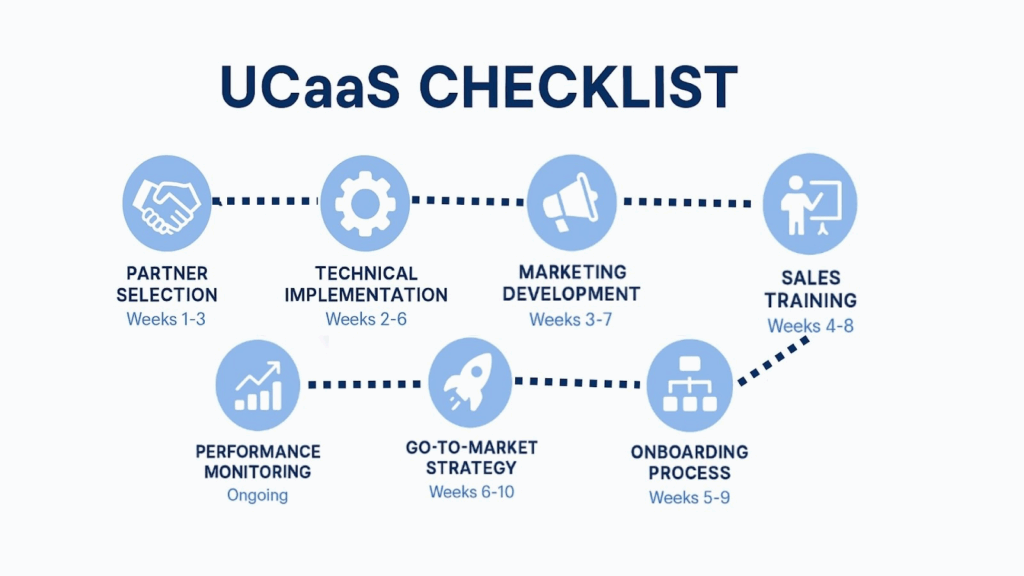
1. Partner Selection and Contract Negotiation (Weeks 1-3)
Choose your UCaaS platform provider based on technology capabilities, support quality, and business terms that enable profitable growth. Evaluate factors including network reliability, feature breadth, pricing flexibility, and training programs. The right partner becomes a strategic extension of your business rather than just a technology vendor that competes for your attention.
Negotiate contract terms that support your growth trajectory. Seek volume discounts that activate as you scale, flexible minimum commitments during initial ramp periods, and co-marketing support that amplifies your reach.
Review SLAs carefully to understand support boundaries and escalation procedures. Ensure alignment between your customer commitments and platform provider capabilities. Document any limitations that could impact your service delivery or customer satisfaction, particularly during high-growth periods when support demands increase.
2. Technical Implementation and Testing (Weeks 2-6)
Complete platform integration with your existing business systems, including CRM, billing, and customer management tools. Many resellers underestimate integration complexity and face delays that impact launch timelines and early customer experiences.
Establish your branded customer portal and configure service packages that align with your market positioning. Create standardized configurations for different customer segments to streamline sales and deployment processes. Document all configuration options and their business impact for sales team reference, enabling consultative selling approaches.
Test scenarios that match your target customers’ use cases to identify potential issues before they impact your clients. Include testing under various network conditions and device configurations.
3. Sales Team Training and Certification (Weeks 4-8)
Structured training programs include understanding technical benefits, ROI calculations, competitive positioning, and objection handling. Sales teams need confidence in the technology before they can effectively communicate value to prospects who may be skeptical of new solutions.
Develop sales tools, including demonstration scripts, ROI calculators, competitive comparison sheets, and customer success stories. Standardized tools ensure consistent messaging while giving sales teams confidence during customer interactions.
Create certification processes that validate sales team readiness before customer interactions begin. This preparation improves close rates and customer satisfaction by ensuring professional, knowledgeable interactions.
4. Marketing Collateral and Brand Development (Weeks 3-7)
Design comprehensive marketing materials that effectively position your UCaaS offering within your existing brand. Consider service overview documents, technical specification sheets, case studies, and digital marketing assets. Consistent branding across all materials reinforces your position as a credible communication provider.
Develop customer-facing materials that simplify complex technical concepts into business benefits. Focus on ROI, productivity improvements, and competitive advantages rather than technical specifications. Most buyers care more about business outcomes than technical features, particularly decision-makers who may lack technical backgrounds.
Create digital marketing campaigns that reach your target audience through appropriate channels. This includes website updates, social media campaigns, email marketing, and possibly paid advertising. Coordinate marketing launch with sales team readiness to maximize conversion opportunities and avoid wasted marketing investment.
5. Customer Onboarding Process Design (Weeks 5-9)
Establish standardized onboarding procedures that ensure consistent customer experiences while minimizing implementation timelines. Document each step from initial order through full system activation, including responsible parties, expected timelines, and success criteria.
Design customer communication templates for each onboarding phase, including welcome emails, technical setup instructions, training session scheduling, and go-live confirmation. Professional communication throughout onboarding builds customer confidence while reducing support inquiries that can strain resources during growth periods.
Create customer training materials and procedures that ensure effective system adoption. Many UCaaS implementations fail not because of technical issues but because users don’t understand how to leverage available features.
6. Go-to-Market Strategy and Customer Targeting (Weeks 6-10)
Develop targeted campaigns for your existing customer base, focusing on those most likely to benefit from UCaaS solutions. Analyze customer characteristics, including current phone systems, remote work patterns, and growth trajectories, to prioritize outreach efforts. Existing relationships provide the highest conversion probability and shortest sales cycles.
Create new customer acquisition strategies that leverage UCaaS as a differentiator in competitive situations. Many businesses evaluate communication solutions during broader technology upgrades, creating opportunities for comprehensive service providers to win larger engagements. Position UCaaS as part of broader digital transformation initiatives.
Design referral programs that incentivize existing customers to recommend your services. Satisfied UCaaS customers often become strong advocates when properly motivated through referral incentives or service credits. Word-of-mouth referrals typically convert at higher rates than other lead sources.
7. Performance Monitoring and Optimization (Ongoing)
Implement metrics tracking that provides visibility into sales performance, customer satisfaction, and business profitability. Key metrics include conversion rates, average deal size, customer acquisition costs, and customer lifetime value.
Establish regular review processes with your platform provider to optimize service delivery and identify new opportunities. Successful resellers maintain close relationships with platform providers to stay informed about new features, market trends, and competitive developments that could impact their business. Create feedback loops that capture customer satisfaction data and translate insights into service improvements.
How Do You Scale and Optimize After Launch?
The initial launch represents just the beginning of building a successful UCaaS reseller business. Sustained growth requires continuous optimization, strategic expansion, and deepening customer relationships that transform one-time buyers into long-term advocates who drive referral business.

What Customer Success Strategies Drive Retention and Growth?
Developing comprehensive customer success programs impacts retention rates and expansion opportunities. Most UCaaS customers start with basic configurations and gradually add features as they recognize value and become more comfortable with the technology. Proactive customer success initiatives identify opportunities while preventing churn that can devastate recurring revenue models.
Implement regular check-ins that focus on usage optimization rather than just technical support. Many customers underutilize available features simply because they don’t understand the business benefits or implementation procedures. Strategic guidance helps customers maximize their investment while creating natural upselling opportunities that increase lifetime value.
Track customer health metrics, including usage patterns, support ticket frequency, and payment history, to identify at-risk accounts before problems escalate. Early intervention often resolves issues that might otherwise lead to customer churn, protecting valuable recurring revenue streams.
How Should You Expand Your Service Portfolio?
UCaaS resellers typically expand their service portfolios over time to address adjacent customer needs and increase average revenue per customer. Consider adding contact center solutions, business SMS services, or advanced collaboration tools that complement core UCaaS offerings.
Managed IT services providers often find natural synergies between UCaaS and network services, cybersecurity solutions, or cloud infrastructure. Bundled service offerings provide additional value while making it more difficult for competitors to displace your customer relationships. Integrated solutions also command premium pricing compared to point solutions.
Many resellers develop specialized offerings for specific industries or use cases based on patterns they observe across their customer base. Vertical specialization often enables premium pricing while reducing competitive pressure.
Frequently Asked Questions
How long does it typically take to launch a UCaaS reseller program?
Most resellers can complete their launch within 30-90 days when following structured processes. However, the timeline varies based on integration complexity, team training requirements, and internal approval processes. Successful launches typically involve several weeks of planning and preparation, followed by implementation and testing, and final validation before customer onboarding begins.
What initial investment is required to start reselling UCaaS?
Initial investment varies based on platform provider requirements and business scale. Many white-label programs require upfront fees and minimum commitments, though some providers offer lower barriers for qualified partners. Factor in training costs, marketing investments, and several months of operating expenses during the ramp period. The recurring revenue model typically recovers initial investment within the first two years.
How do I differentiate my UCaaS offering in a competitive market?
Successful differentiation focuses on service delivery, vertical expertise, and comprehensive support. Many resellers succeed by specializing in specific industries, offering superior customer service, or bundling UCaaS with complementary services. Your existing customer relationships and market reputation often provide the strongest competitive advantages.
What ongoing support should I expect from my UCaaS platform provider?
Quality platform providers offer comprehensive support, including technical assistance, sales training, marketing resources, and customer success guidance. Look for providers that assign dedicated account managers, provide regular training updates, and offer escalation procedures for complex customer issues. The level of ongoing support often determines long-term partnership success more than initial technology capabilities.
Reach Recurring Revenue Growth Through UCaaS for Resellers
The UCaaS market presents an unprecedented opportunity for resellers willing to invest in proper planning and execution. With the current market growth, early movers who establish strong positions now will benefit from sustained demand and recurring revenue growth that transforms their business models. The resellers who thrive treat UCaaS as a core business transformation that positions them as strategic communication partners.
The UCaaS checklist provided here offers a proven framework for successfully launching your reseller program. However, execution quality matters more than perfect planning. Start with thorough preparation, but don’t delay launch waiting for perfect conditions. Market momentum favors those who act decisively while maintaining a focus on customer success and operational excellence.
SkySwitch provides the white-label platform, training, and ongoing support needed to build a thriving communication business. Our proven methodology has helped hundreds of resellers successfully launch and scale their UCaaS operations, making us a leading choice in the UCaaS for resellers marketplace. Get started today to begin your journey toward recurring revenue growth and market leadership.

Jessica is a marketing and sales strategist with deep expertise in VoIP telecommunications. As a Marketing Director, she specializes in channel marketing, account management, and product marketing within the communications industry. Jessica is passionate about helping partners grow through compelling messaging and hands-on support.