
3 Ways AI is Transforming White-Label UCaaS for SMBs

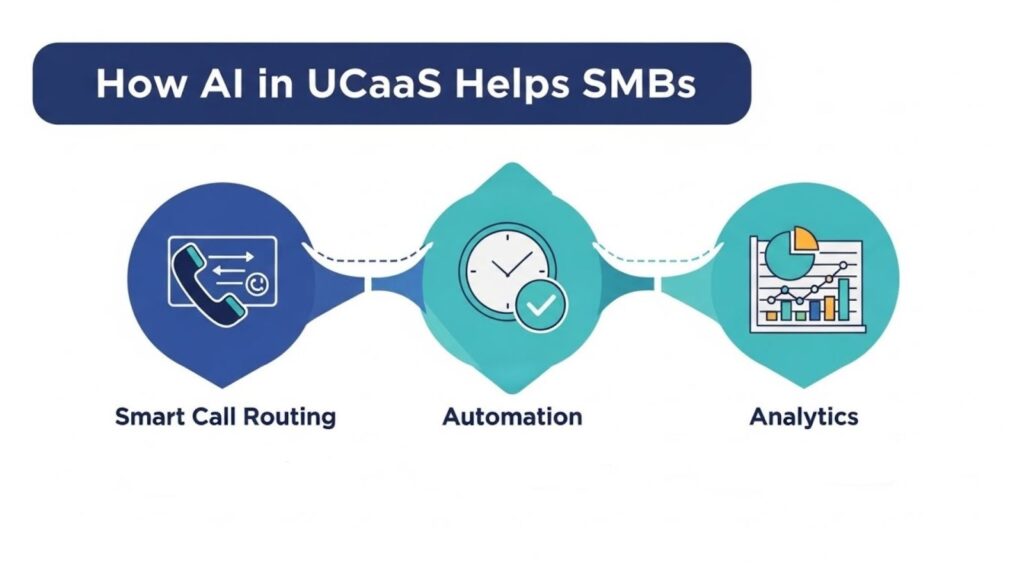
AI-powered features are reshaping how resellers deliver UCaaS to small and medium businesses, creating new opportunities for differentiation and revenue growth.
- Smart call routing uses machine learning to match callers with the right agent faster, reducing wait times and improving customer satisfaction for SMB clients.
- UCaaS automation handles repetitive tasks like transcription, scheduling, and follow-ups, freeing up time for higher value work.
- AI-driven analytics give resellers and their customers real-time insights into call quality, team performance, and communication patterns.
For MSPs and resellers, offering AI-enhanced UCaaS solutions builds stickier client relationships and opens doors to premium pricing tiers.
Small and medium businesses are adopting cloud communications at a pace that would have seemed impossible just a few years ago. According to McKinsey’s latest research, 88% of organizations now use AI in at least one business function, and that adoption curve is accelerating fastest in the SMB segment. For resellers building a white-label UCaaS practice, this shift creates a compelling opportunity. The businesses you serve are actively looking for communication tools that work smarter, and AI in UCaaS delivers exactly that.
The conversation around AI in business communications has moved well beyond hype. SMB owners are asking specific questions about what AI can actually do for their phone systems and collaboration tools. They want to know if automated transcription will save their staff time and whether intelligent routing can reduce customer wait times.
By partnering with a platform that bakes AI capabilities into its core offering, you can position yourself as the expert who brings these solutions to market without building the technology from scratch. The result is a stronger value proposition, healthier margins, and clients who stick around longer because switching would mean losing features they rely on.
Why Does AI in UCaaS Matter for SMB-Focused Resellers?
The SMB market has always been price-sensitive, but that sensitivity is shifting. Business owners still care about cost, but they are increasingly willing to pay more for solutions that save time or improve outcomes. AI-enhanced communication tools fit that criteria perfectly because they address pain points that SMBs experience daily.
Consider the small healthcare practice that misses calls because staff are busy with patients. Or the regional insurance agency where agents spend hours each week manually logging call notes into their CRM. Or the growing e-commerce company whose support team struggles to route customer inquiries to the right person. These are real problems, and AI tools solve them in ways that traditional phone systems can’t.
For resellers, the opportunity goes beyond closing individual deals. When you deliver AI-powered UCaaS features that become embedded in your clients’ workflows, you create switching costs that protect your recurring revenue. A business that has trained its team on AI-assisted call handling, or that relies on automated transcription for compliance documentation, is not going to rip that out lightly. This stickiness is one of the most valuable aspects of selling AI in UCaaS to the SMB market.
The competitive landscape is also shifting in ways that favor resellers who move quickly. Large enterprise vendors have been talking about AI for years, but their solutions often come with enterprise price tags and implementation complexity that SMBs can’t stomach. White-label platforms give you access to the same underlying technologies at price points that make sense for smaller organizations. That gap between enterprise capability and SMB affordability is where resellers can thrive.
3 Ways AI Is Transforming White-Label UCaaS
AI is showing up across the entire UCaaS stack, but three capabilities stand out as valuable for SMB clients and particularly differentiated for resellers. These are the features that your competitors may not yet be offering and that your prospects are asking about.
1. Smart Call Routing That Learns
Traditional call routing relies on static rules. Calls come in, they get directed based on preset criteria like time of day or caller ID, and hopefully they land with the right person. Smart call routing powered by AI takes a different approach by analyzing multiple data points in real time and making dynamic decisions about where each call should go.
Modern intelligent routing systems examine factors like caller history, the reason for the call, agent availability, skill levels, and sentiment indicators from previous interactions. The system learns which agents perform best with certain types of inquiries and adjusts routing accordingly. For an SMB running a small support team, callers reach the right person faster, resolution times drop, and customer satisfaction scores climb.

When a returning customer calls, the system can recognize them and route to the agent who handled their last inquiry. When call volume spikes, intelligent routing distributes load more evenly. When a VIP client reaches out, the system can prioritize their call without manual intervention. These capabilities were once reserved for large contact centers with dedicated IT teams. Now they are accessible to businesses with ten or twenty employees.
For resellers, smart call routing becomes a powerful differentiator during the sales process. You can demonstrate tangible improvements over whatever basic phone system the prospect is currently using. The conversation shifts from “how much does this cost per seat” to “how much time and frustration will this save my team?” That reframing is worth pursuing because it moves you away from commodity pricing and toward value-based conversations.
2. UCaaS Automation for Everyday Tasks
The day-to-day reality of business communication involves a lot of repetitive work. Calls need to be logged. Voicemails need to be transcribed. Meetings need to be scheduled. Follow-ups need to be sent. Each individual task takes only a few minutes, but they add up fast. UCaaS automation uses AI to handle these tasks in the background, giving employees their time back for work that actually requires human judgment.
Automated transcription is a notable example. Instead of listening to a voicemail and typing out notes, users can read a transcription and quickly scan for key information. Instead of taking notes during a call, they can rely on AI-generated summaries that capture action items. For industries with compliance requirements like healthcare or financial services, these transcriptions create an automatic documentation trail.

Scheduling automation eliminates the back-and-forth that accompanies meeting coordination. AI assistants can check calendars, propose times, send invitations, and handle rescheduling without human involvement. For sales teams, this removes friction from the buying process and helps deals move faster.
The impact on productivity is substantial. Generative AI increased issue resolution by 14% per hour and reduced handling time by 9% at a company with 5,000 customer service agents. Broader studies show employees using AI report an average 40% productivity boost across knowledge work tasks. For an SMB where every employee wears multiple hats, those percentage gains translate directly to capacity. Teams can handle more customers, close more deals, or simply leave the office at a reasonable hour because they’re not buried in administrative work.
Resellers benefit from automation because it gives you something concrete to sell beyond basic dial tone. When you can show a prospect that your UCaaS platform will automatically log calls to their CRM, transcribe customer interactions, and generate performance reports without manual effort, you are offering genuine operational improvement.
3. AI-Powered Analytics and Insights
Data has always been available in business phone systems, but making sense of it required either dedicated analysts or expensive third-party tools. AI-powered analytics automatically surface insights and present them in ways that non-technical users can understand and act upon.

Modern AI analytics can identify patterns in call data that humans would never spot manually. They can flag when call quality degrades before customers start complaining. They can highlight which agents might benefit from additional training. They can reveal peak calling periods that suggest staffing adjustments. They can even analyze conversation content to detect customer sentiment and predict churn risk.
For SMBs, this level of visibility was previously out of reach. A twenty-person company doesn’t have a business intelligence team to build dashboards and run queries. But with AI-powered analytics built into their UCaaS platform, they can access the same insights that large enterprises use to optimize their operations.
Analytics also resonates with MSPs who serve clients across multiple industries. When you can show a prospect dashboards that reveal exactly how their communication systems are performing, you demonstrate expertise and build trust. When you can proactively identify issues before they become problems, you position yourself as a strategic partner rather than a commodity vendor. This consultative approach justifies premium pricing and deepens client relationships over time.
Quality of service monitoring deserves specific mention here. AI-driven QoS tools can detect latency, jitter, and packet loss issues in real time, often pinpointing whether the problem originates in the customer’s local network, at the demarcation point, or within the ISP infrastructure. This diagnostic capability saves enormous amounts of troubleshooting time and helps resellers maintain their reputation for reliable service.
What Does AI in UCaaS Mean for MSPs and Resellers?
The rise of AI in UCaaS creates implications for how resellers position themselves in the market.
- AI features provide natural upsell opportunities. Many platforms offer tiered pricing where basic seats include standard functionality and premium seats unlock AI capabilities. Once a client experiences the productivity gains from AI automation, moving them to a higher tier becomes easier.
- AI capabilities can differentiate you from competitors still selling basic VoIP. The white-label UCaaS market has many players, and not all have invested in AI development. By partnering with a platform that prioritizes these features, you gain access to technology your competitors may not offer.
- AI tools can improve your own operations as a reseller. The same analytics that help your clients can help you understand which customers are thriving and which might churn. Automation can streamline your provisioning and billing processes.
- AI helps with recruiting and retention. Talented salespeople and technicians want to work with modern technology. When you can offer a platform that incorporates the latest AI advances, you attract better people.
For resellers focused on building profitable UCaaS practices, AI in UCaaS is a generational opportunity. The technology is maturing fast, SMB demand is growing, and the window to establish yourself as an AI-forward provider is still open.
Frequently Asked Questions
How does AI improve call quality for SMB customers?
AI-powered quality of service monitoring continuously analyzes call data to detect issues like latency, jitter, and packet loss in real time. These systems can identify whether problems originate in the customer’s local network, their internet service provider, or elsewhere in the call path. This diagnostic precision means faster troubleshooting and fewer frustrated customers.
Which AI VoIP tools are most valuable for small businesses?
The most impactful AI VoIP tools for SMBs are automated transcription, intelligent call routing, and analytics dashboards. Transcription saves staff time and automatically creates documentation trails. Intelligent routing ensures callers reach the right person quickly. Analytics provide visibility into communication patterns and team performance that would otherwise require expensive tools.
Can resellers offer AI features without technical expertise?
Yes. Modern white-label UCaaS platforms handle the technical complexity on the backend. Resellers don’t need to understand machine learning algorithms or maintain AI infrastructure. The platform provider develops, deploys, and maintains these capabilities while resellers focus on selling, supporting, and building relationships.
How do AI for MSPs offerings compare to enterprise solutions?
White-label AI for MSPs offerings provide many of the same capabilities as enterprise solutions at appropriate price points and complexity levels. The underlying technologies are similar. The difference lies in packaging, pricing, and implementation requirements. SMB-focused offerings can be provisioned quickly and managed through intuitive portals.
Take Your UCaaS Practice to the Next Level
AI is changing what SMBs expect from their business communication systems. Smart call routing, task automation, and intelligent analytics are moving from nice-to-have features to baseline requirements. For resellers, the opportunity is differentiated offerings, stickier client relationships, and premium pricing potential.
SkySwitch provides the white-label UCaaS platform that makes this possible, combining AI-enhanced features with the onboarding support, billing tools, and brandable partner resources you need to build a thriving practice. Get started with SkySwitch and discover how AI-powered UCaaS can transform your reseller business.

Jessica is a marketing and sales strategist with deep expertise in VoIP telecommunications. As a Marketing Director, she specializes in channel marketing, account management, and product marketing within the communications industry. Jessica is passionate about helping partners grow through compelling messaging and hands-on support.