
Benefits of UCaaS for Any Organization

UCaaS delivers measurable ROI for businesses of all sizes through consolidated communications, AI automation, and flexible scaling.
- Organizations report cost savings after migrating to cloud-based unified communications platforms.
- AI-powered features like real-time transcription and intelligent routing are boosting productivity by 45%.
- Hybrid and remote teams gain seamless connectivity across devices, locations, and time zones.
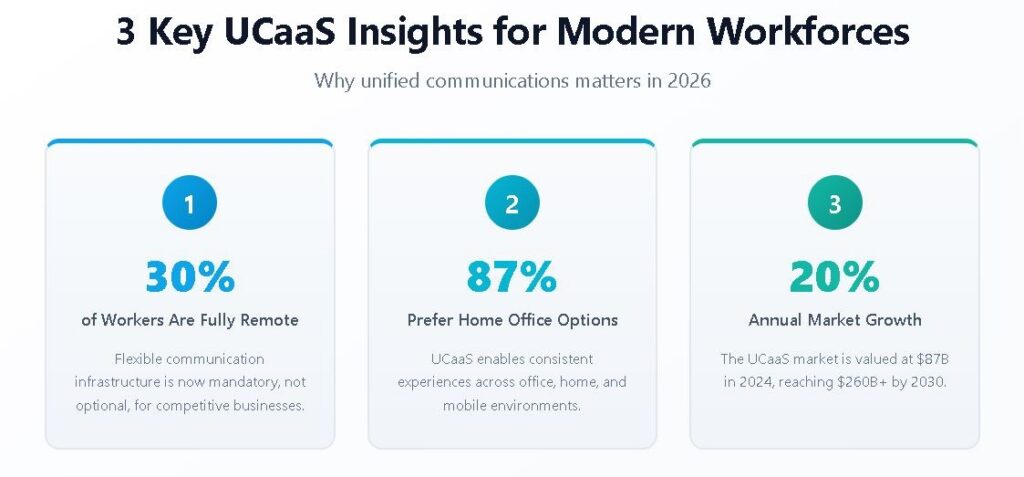
- Resellers can capitalize on a market valued at $87.39 billion in 2024 and growing at nearly 20% annually.
If your clients haven’t adopted UCaaS yet, they’re leaving productivity, cost savings, and competitive advantages on the table.
The UCaaS market continues its expansion, with the global market valued at $87.39 billion in 2024 and projected to reach over $260 billion by 2030. This trajectory signals a massive opportunity for resellers positioning themselves to meet demand. The organizations you serve adopting unified communications are gaining clear advantages in productivity, cost control, and workforce flexibility that their competitors can’t match.
Still, some prospects hesitate. They might believe UCaaS is designed for enterprise organizations or assume their current tech stack is sufficient. Others face procurement resistance rooted in outdated cost assumptions. When you encounter this pushback, having concrete evidence of the benefits of UCaaS can transform skeptical conversations into closed deals.
How Do the Benefits of UCaaS Differ from Traditional Communications?
Unified Communications as a Service combines multiple communication functions into a single cloud-delivered platform. This consolidation includes voice calling, video conferencing, team messaging, SMS, file sharing, and collaboration tools, all accessible from any device with an internet connection.
With UCaaS, a third-party provider manages the entire infrastructure, handling maintenance, updates, security patches, and scaling. Your clients get enterprise-grade communications without the capital expenditure, technical complexity, or ongoing management burden of on-premises systems.
This delivery model addresses common pain points that businesses experience with fragmented communication tools. Rather than juggling separate systems for phone service, video meetings, and team chat, employees access everything through a single interface. The resulting benefits of UCaaS are streamlined workflows, reduced training requirements, and the elimination of context-switching that drains productivity throughout the workday.
How UCaaS Supports Modern Workforce Requirements
Today’s workforce operates across multiple locations, time zones, and devices. Approximately 30% of the workforce is operating remotely on a full-time basis, and more than 87% of people prefer an in-home office. These continuing trends have made flexible communication infrastructure mandatory rather than optional.
UCaaS platforms provide consistent experiences whether employees work from headquarters, home offices, client sites, or while traveling. Mobile apps mirror desktop functionality, allowing team members to take business calls, join video meetings, and collaborate on projects from smartphones and tablets. This mobility maintains business continuity regardless of where work happens.
The technology also supports the bring-your-own-device policies that most organizations now embrace. Employees can use personal devices for business communications while keeping work and personal conversations separate. This flexibility improves satisfaction and productivity while reducing hardware costs for employers.
What Are the Top 6 Unified Communication Benefits for Organizations in Any Industry?
Understanding specific benefits of UCaaS helps you effectively position hosted phone service and unified communications. These benefits apply across industries and organization sizes, giving you versatile talking points for virtually any prospect conversation.
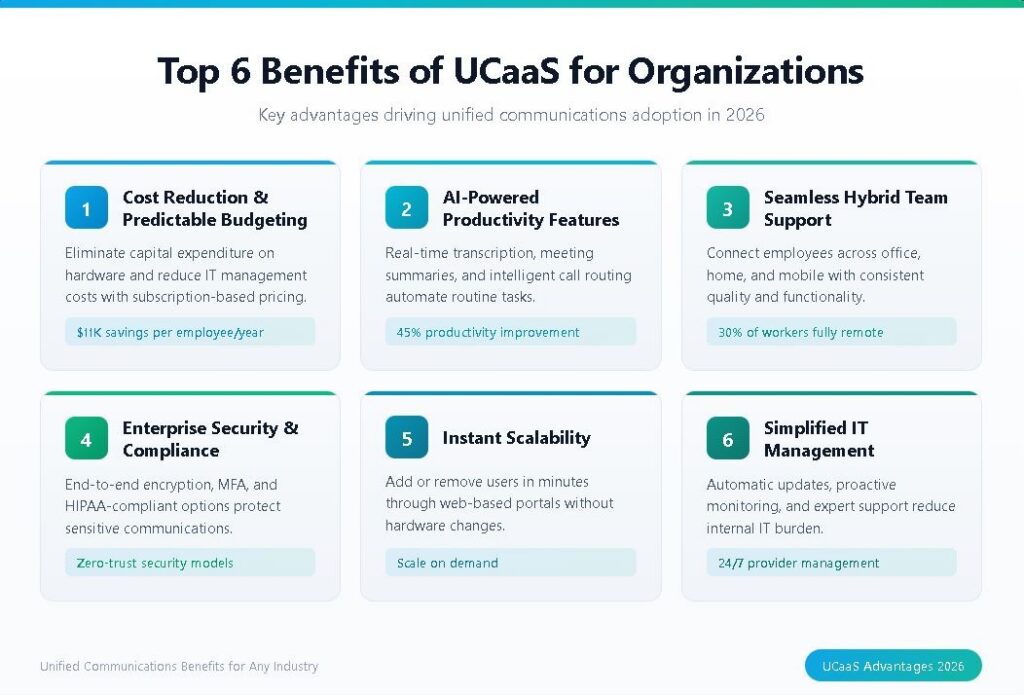
1. Cost Reduction and Predictable Budgeting
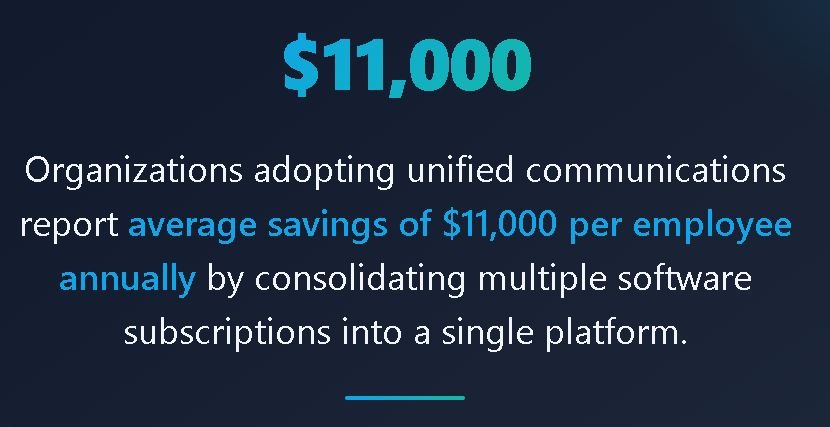
Organizations adopting unified communications report average savings of $11,000 per employee annually by consolidating multiple software subscriptions into a single platform.
Additional savings come from multiple sources. Businesses eliminate capital expenditure on PBX hardware, servers, and the specialized cooling and power infrastructure these systems require. They reduce or eliminate costs for dedicated IT staff managing communication systems. Monthly subscription pricing replaces unpredictable maintenance and upgrade expenses with fixed, scalable costs that finance teams can accurately forecast.
The subscription model also provides flexibility that traditional systems can’t match. Businesses pay for what they use and can adjust capacity up or down without penalty. This elasticity proves especially valuable for organizations with seasonal fluctuations, those experiencing growth, or companies navigating uncertain market conditions.
2. Enhanced Productivity Through AI-Powered Features
Artificial intelligence has transformed UCaaS into a productivity engine. Modern unified communications solutions include AI capabilities that automate routine tasks, surface actionable insights, and help teams work smarter rather than harder.
Real-time transcription captures every word of calls and meetings, eliminating manual note-taking and ensuring nothing important gets missed. AI-generated meeting summaries highlight key decisions, action items, and follow-up requirements, saving participants time while improving accountability. Intelligent call routing directs incoming calls to the right person or department based on caller intent, availability, and historical patterns, reducing wait times and improving customer experience.
These AI enhancements deliver measurable unified communication benefits. Industry data shows AI-based transcription tools have improved meeting productivity by 45% across enterprises, while AI-driven analytics for call quality and sentiment analysis boost operational efficiency. For your clients, this translates to fewer hours spent on administrative tasks and more time focused on revenue-generating activities.

3. Seamless Support for Hybrid and Distributed Teams
Hybrid work has made robust communication infrastructure essential for business success. UCaaS platforms excel at connecting employees across office, home, and mobile environments with consistent quality and functionality.
Video conferencing capabilities rival standalone meeting platforms while integrating directly with voice, messaging, and collaboration tools. Team members can start a chat conversation, escalate to a voice call, and transition to a video meeting without switching applications or losing context. This fluid communication style mirrors natural conversation patterns and removes friction from collaboration.
Presence indicators show colleague availability in real time, eliminating the frustration of calling coworkers who are already engaged or away from their devices. Employees can set status messages, enable do-not-disturb modes, and manage their availability across all communication channels from a single control point.

4. Enterprise-Grade Security and Compliance
As communication platforms become mission-critical infrastructure, security has moved to the forefront of purchasing decisions. Leading UCaaS providers invest heavily in protecting business communications through multiple security layers.
End-to-end encryption protects voice calls, video meetings, and messages from interception. Multi-factor authentication prevents unauthorized access to communication accounts. Advanced threat detection uses AI to identify suspicious patterns and block attacks before they impact users. Zero-trust security models continuously verify users and devices rather than assuming trust within network boundaries.
Compliance capabilities address industry-specific requirements for healthcare, financial services, legal, and government organizations. HIPAA-compliant platforms enable secure patient communication. Call recording, archiving, and audit trail features support regulatory requirements and legal discovery needs. These built-in compliance tools often exceed what organizations could achieve with self-managed systems.
5. Scalability That Grows with the Business
Traditional phone systems force businesses into difficult decisions about capacity. Overbuilding wastes money on unused resources, while underbuilding creates bottlenecks during growth or seasonal peaks. The benefits of UCaaS eliminate this planning challenge entirely.
Adding new users takes minutes rather than weeks. Businesses can provision accounts, assign phone numbers, and enable features through web-based administration portals without hardware installation or vendor service calls. Removing users works just as easily, with immediate cost savings rather than stranded equipment.
This scalability extends to features as well as capacity. Organizations can start with basic voice and messaging capabilities, then add video conferencing, contact center features, or advanced analytics as needs evolve. The platform grows with the business without requiring migration to a new system or significant additional investment.
6. Simplified IT Management and Reduced Complexity
Managing communication infrastructure traditionally required specialized expertise and significant time investment. UCaaS transfers this burden to providers with dedicated teams and purpose-built operations.
Software updates happen automatically, ensuring users always have access to the latest features and security patches. The provider monitors system health around the clock and addresses issues proactively rather than waiting for user complaints. When problems do occur, expert support teams resolve them quickly without requiring your clients to maintain specialized telecom knowledge internally.
This simplification matters especially for small and mid-sized businesses without dedicated IT staff. Owners and managers can focus on running their businesses rather than troubleshooting cloud phone systems. For larger organizations, IT teams can redirect energy from maintaining communication infrastructure toward strategic initiatives that drive competitive advantage.
How Do You Calculate VoIP ROI and the Financial Impact?
The VoIP ROI calculation extends beyond direct cost savings to encompass productivity improvements, risk reduction, and strategic flexibility. Building a complete picture helps clients understand the full value proposition.
Direct savings typically include the elimination of legacy phone line charges, reduced long-distance and international calling costs, and consolidation of multiple software subscriptions. Organizations often discover they were paying for redundant tools providing overlapping functionality. UCaaS combines these capabilities in a single platform at a lower total cost.
Productivity gains prove harder to quantify but often deliver greater value than direct savings. When employees spend less time switching between applications, fewer meetings run over because of technical difficulties, and information flows more freely across teams, the cumulative impact on output can be substantial.
Building the Business Case for Prospects
Help your clients build compelling internal business cases by focusing on their pain points and existing costs. Start by identifying what they currently spend on phone service, video conferencing, team chat, and other communication tools. Many organizations have never totaled these costs across departments and vendors.
Next, document time lost to communication friction. How often do employees struggle to reach colleagues? How many meetings start late because of technical issues? How much time do managers spend coordinating across incompatible systems? Converting these inefficiencies to dollar values demonstrates hidden costs that justify UCaaS investment.
Finally, consider risk and opportunity costs. What would a communication system outage cost in lost productivity and missed business? What opportunities go uncaptured because remote workers lack effective collaboration tools? These considerations often matter more than line-item cost comparisons.
Frequently Asked Questions
How quickly do organizations typically see ROI after implementing UCaaS? Most organizations begin realizing returns immediately through reduced monthly communication costs. Full ROI typically occurs within 6–12 months, though businesses migrating from expensive legacy systems or consolidating multiple platforms may see faster payback. The subscription model means there’s no large upfront investment to recover before reaching positive returns.
Can UCaaS work for businesses with limited technical resources? Absolutely. UCaaS actually reduces technical requirements compared to traditional phone systems. The provider handles infrastructure management, maintenance, and updates. Web-based administration portals make user provisioning and basic configuration accessible to non-technical staff. Many small businesses successfully manage their UCaaS deployments without dedicated IT personnel.
What happens to existing phone numbers when switching to UCaaS? Number porting allows businesses to keep their existing phone numbers when migrating to UCaaS. The process typically takes a few weeks, and the provider handles the technical coordination with previous carriers. Clients maintain continuity with customers and partners without distributing new contact information.
How does UCaaS handle network outages or internet disruptions? Quality UCaaS providers build redundancy into their platforms through geo-distributed data centers and automatic failover capabilities. If one data center experiences issues, traffic routes to backup facilities without user intervention. Mobile apps continue functioning over cellular networks even when the office internet goes down. Call forwarding rules can automatically redirect calls to mobile devices during outages.
Position Your Business for the UCaaS Opportunity
The unified communications benefits we’ve covered represent table stakes for competitive businesses in 2026. Organizations that haven’t adopted these capabilities are operating at a disadvantage against competitors who have embraced modern communication infrastructure. This gap creates an opportunity for resellers who can deliver effective solutions.
Your prospects need partners who understand both the technology and the business outcomes it enables. When you can articulate how the benefits of UCaaS address specific pain points, demonstrate clear ROI calculations, and provide confidence through reliable platform performance, you position yourself as a trusted advisor rather than just another vendor.
SkySwitch provides the white-label UCaaS platform and support infrastructure you need to capture this opportunity. With comprehensive features, geo-redundant networks, and extensive partner resources, you can deliver enterprise-grade solutions under your own brand while maintaining healthy margins. Get started with SkySwitch to explore how our reseller program can accelerate your UCaaS business growth.

Jessica is a marketing and sales strategist with deep expertise in VoIP telecommunications. As a Marketing Director, she specializes in channel marketing, account management, and product marketing within the communications industry. Jessica is passionate about helping partners grow through compelling messaging and hands-on support.