
Adding Communications Services for MSPs: A UCaaS Playbook

Adding communications services for MSPs works when you treat voice as a productized service line with defined bundles, pricing, support boundaries, and a migration runbook.
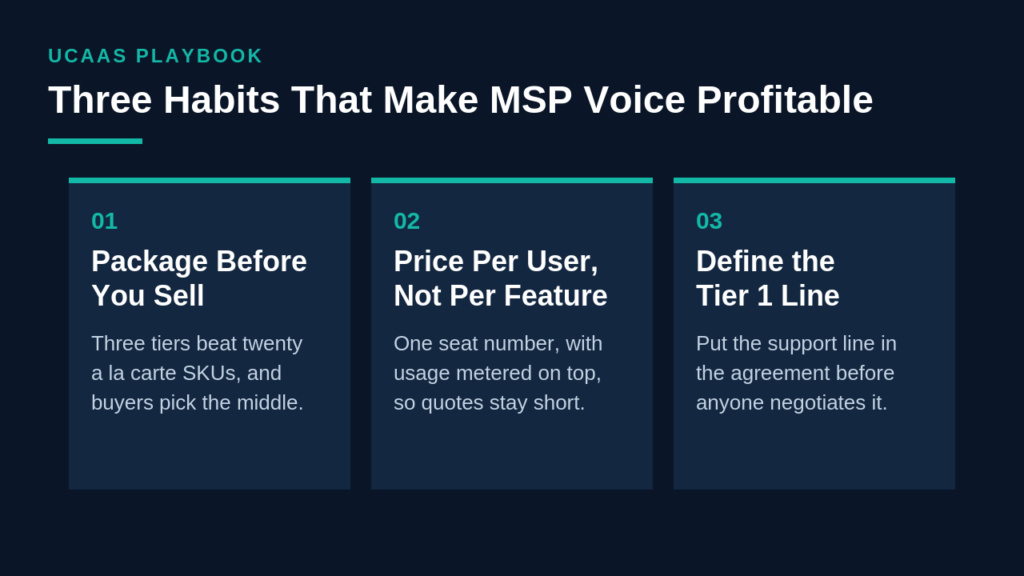
- Package before you sell. Three tiers built around customer archetypes close faster than 20 à la carte SKUs.
- Price per user, not per feature. Usage items layer on top of one seat number, so the quote stays a single line.
- Write down who owns support. The Tier 1 boundary is the biggest margin variable in a voice practice.
- Plan the port first. Porting and network readiness are where cutovers slip, and both are fixable early.
Build your bundle structure, pricing floor, and support runbook before your first customer signs because retrofitting all three after 30 accounts is painful.
Most MSPs add voice services the same way. A client asks whether you can “handle the phones too,” you say yes, and six months later, you’re troubleshooting a system you never productized. That works exactly once. Building communications services for MSPs into a real service line takes the discipline you applied to RMM, backup, and security.
Kaseya’s survey of 1,000-plus providers found that 71% of MSPs name customer acquisition as their biggest challenge, and the share reporting clients who spend more than $25,000 a year fell from 75% to 41%. When logos get harder to win and contracts shrink, growth comes from going deeper in accounts you already hold. Voice is usually the widest gap, and a white-label UCaaS platform closes it without making you a carrier.
Why Are Communications Services for MSPs a Natural Portfolio Extension?
Voice fits your business better than almost any other adjacent service, and the reason is structural. You already sell to the person who signs off on the phone system, you manage the network the calls ride across, and you bill monthly. Demand cooperates too: the global UCaaS market reached $90.3 billion in 2025 and is forecast to grow at a 17.12% compound annual rate through 2034.
Why the Revenue Model Fits Your Business
MSP recurring revenue from voice grows without a new sales cycle attached. A 40-person client who hires 15 people next year simply has 15 more seats on the same agreement, and a customer running phones, messaging, and contact center through you is far less likely to shop your IT contract. That’s also why reselling beats referring. Agent models pay a commission and leave you no control over pricing or branding, while reselling under your own brand puts the margin and the renewal in your hands. Our reseller partner program overview covers how the wholesale model works.
How Do You Package UCaaS for MSPs Into Bundles People Actually Buy?
Packaging is where new voice practices lose momentum. Launch with a feature menu, and you’ll rebuild every quote from scratch, adding days to the sales cycle and hours to provisioning. Define a few repeatable customer types instead, and build one bundle for each. Our guide to reselling UCaaS and VoIP covers broader evaluation criteria, but packaging is yours to decide.
Start With Three Tiers and Resist the Fourth
Three tiers give buyers a comparison without decision paralysis, and most land on the middle one, which is the point. Anchor each feature set to what that archetype actually uses rather than what sounds impressive on a slide. A four-person law office and a 60-seat dispatch operation need different things, and pretending otherwise produces a middle tier nobody can price.

A Sample Bundle Structure You Can Copy
Here’s a starting structure that maps to how small and midsize businesses buy. Adjust the names to fit your brand.
| Tier | Best fit | Core inclusions | Usage add-ons |
| Essential | Small offices, 5 to 25 seats | Unlimited domestic calling, voicemail transcription, desktop and mobile apps, auto attendants, basic queues | Extra DIDs, toll-free |
| Professional | Multi-site teams, 25 to 100 seats | Essential plus business SMS and MMS, call recording, video meetings, CRM integration, fax | Message volume, storage |
| Premier | Support desks, clinics, dispatch | Professional plus omnichannel contact center, queue reporting, quality monitoring, SD-WAN | Agent seats, AI minutes |
Quoting Rules That Protect Margin
Keep the seat price as one number and let usage sit clearly on top. Every extra line item is another thing a prospect can question, and every unpriced exception is margin you’ll find missing at renewal. Enforce two rules from day one: no tier gets built for one customer, and no discount gets approved without a term commitment.
What Pricing Model Fits MSP Recurring Revenue?
Pricing communications services for MSPs looks simple until you factor in delivery costs. The seat cost from your platform provider is the easy part. What erodes profitability is password resets, routing changes, moves and adds, and the two hours a technician spends on a call quality complaint that turns out to be the client’s own switch.
Per-User Pricing Is the Safest Default
Per-user pricing tracks how your customers grow and how your costs grow, which is why it dominates managed services. Per-device pricing makes sense where handset counts diverge sharply from headcount, but that’s the exception. Apply whichever you pick consistently because mixed models make forecasting and renewals painful.
Build the Floor Before You Build the Price
Calculate true delivery cost per seat, including platform cost, expected support hours, provisioning labor, and overhead, then set your floor above it and price to value. Bundling desk phones into the monthly seat price rather than selling them upfront improves cash predictability and makes the account stickier. Meter usage items like message volume and AI minutes as overage above an included allowance.
How Do You Launch Communications Services for MSPs in 30 Days?
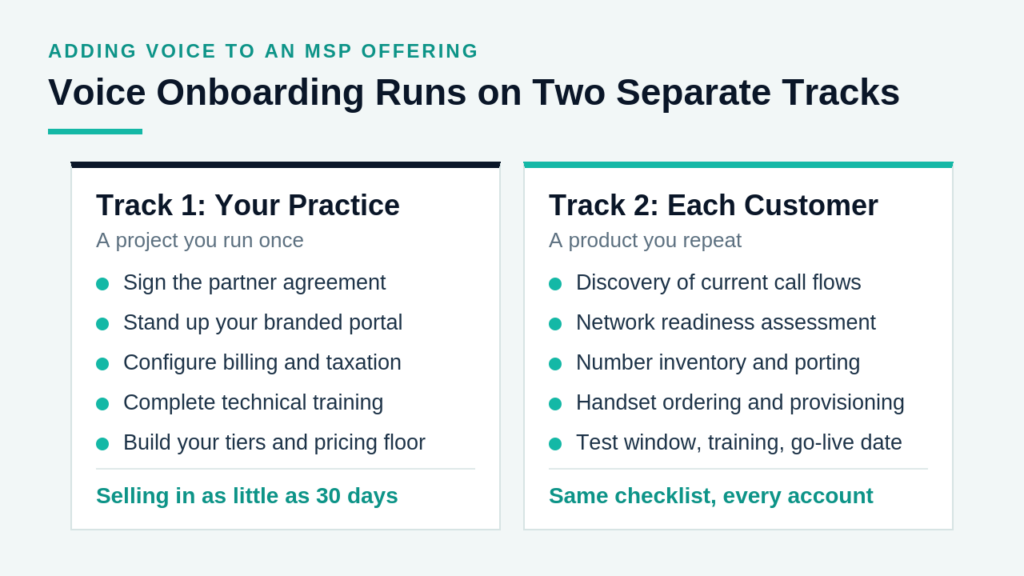
Onboarding runs on two tracks, and confusing them is a common early mistake. There’s getting your own practice operational and the process you run for each customer afterward. The first is a project. The second is a product.
Getting Your Practice Operational
With a committed team, a white-label partner can get you selling in as little as 30 days. That timeline covers signing the agreement, setting up your branded portal, configuring billing, and enough technical training to provision your first customer. Full certification runs longer, but you don’t need it finished before your first quote goes out. Our structured onboarding process shows how that sequencing works.
A Repeatable Customer Onboarding Runbook
Write customer onboarding as a checklist and don’t deviate: discovery of current call flows, network assessment, number inventory, port submission, handset provisioning, extension and queue build, a test window, user training, and a go-live date. Anything left to memory becomes a variable, and variables make voice feel harder than it is.
Who Owns Support After the Cutover?
Support scope separates a voice practice that prints margin from one that eats your technicians. Clients will call you because your logo is on the invoice. What matters is what happens next.
Draw the Tier 1 Line in Writing
Tier 1 belongs to you: password resets, voicemail setup, call forwarding, adding a user, and walking someone through the mobile app. Tier 2 and Tier 3 escalate to your platform provider, covering carrier issues, routing problems, platform defects, and porting exceptions. Put that division in your service agreement so nobody negotiates it mid-outage.
Kill the Top Ticket Drivers Early
Most early tickets are preventable. Train an internal champion at each site so routine changes never reach you, provide a one-page quick reference during go-live week, and standardize on a few handset models. Run quality monitoring from day one because “the calls sound bad” resolves faster when you can point at jitter data.
How Should You Plan a Migration From an On-Prem PBX?
Migrations stall for boring but predictable reasons. Treat migration as its own project with its own timeline rather than a step inside the sale.
Run a Voice Readiness Assessment First
Check bandwidth, switch configuration, PoE capacity, VLAN separation, and firewall handling of SIP traffic before you quote a go-live date. The assessment doubles as a sales tool, since it often surfaces problems the client will pay you to fix anyway.

Porting Is the Long Pole
Number porting takes longer than everything else and depends on a third party you don’t control. Gather a recent bill or customer service record, confirm the exact billing name and service address, and get the letter of authorization signed early. Tell every client two things: under FCC rules, they keep their existing phone numbers when switching providers in the same geographic area, and they should never cancel their current service before the new service is live.
Cut Over in Phases
Above roughly 25 seats, pilot first. Put the champion, an executive, and a heavy phone user on the new platform for a week while the legacy system stays live, then move everyone once the call flows check out.
7 Renewal and Upsell Plays That Grow Managed UCaaS Accounts
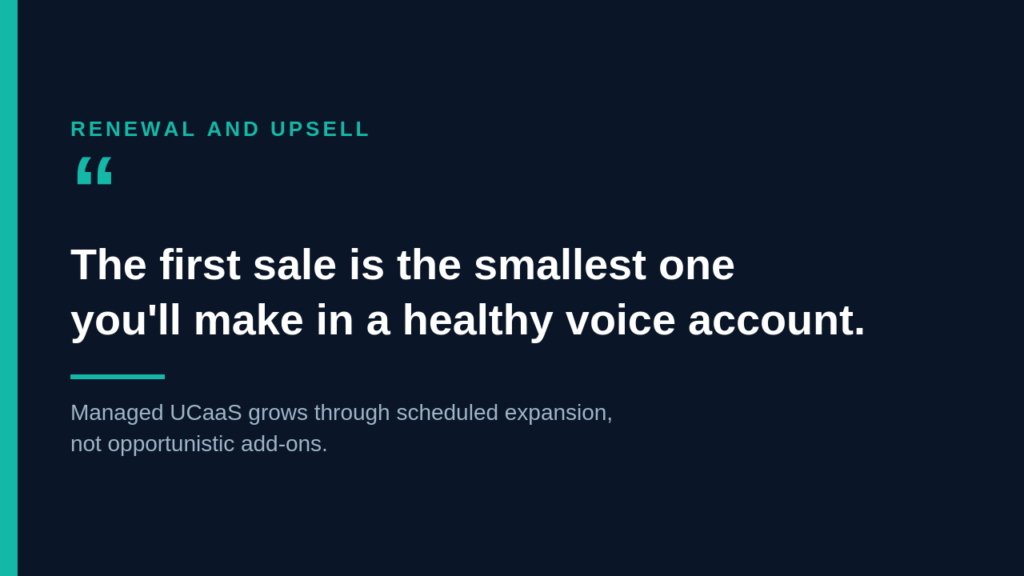
The first sale is the smallest one you’ll make in a healthy voice account. Managed UCaaS grows through expansion, and expansion works best when scheduled rather than opportunistic. Put a quarterly review on the calendar and work these items in order of how easily a customer can say yes.
- Seat growth from hiring. Track headcount quarterly and add seats proactively instead of waiting for a request.
- Business SMS and MMS. Appointment reminders and keyword responders suit anyone dealing with scheduling or no-shows.
- Contact center capability. Front offices, clinics, and support desks outgrow basic queues fast, making an omnichannel contact center solution a high-value move.
- Call recording and quality monitoring. Usually driven by compliance or one dispute nobody wants repeated.
- SD-WAN and QoS. Position it when a customer opens a second location or complains about call quality.
- CRM and application integrations. Screen pops and click-to-call get used daily, making the account harder to displace.
- Tier upgrades at renewal. Review each account against your tier definitions annually. Customers outgrow what they bought two years ago.
Where AI Capabilities Fit in the Upsell Path
AI has moved from roadmap to revenue line in voice. Post-call transcription, summarization, sentiment detection, and automated wrap-up notes attach easily to any customer already running queues. Beyond that, native conversational AI agents deploy as an extension or a number and handle after-hours coverage, appointment booking, FAQ responses, and lead qualification, with human escalation always available. Because it’s built into the stack rather than sourced from another vendor, you keep one billing relationship and set your own markup.
Frequently Asked Questions
How long does it take an MSP to add voice services? With a committed team and a white-label partner, you can be selling in about 30 days. That covers portal setup, billing configuration, and enough training to provision your first customer. Certification continues after you start selling.
Do I need telecom experience to sell UCaaS for MSPs? No. Most successful voice practices are built by IT providers with no carrier background. The skills that matter most are network troubleshooting and account management, both of which you have. Your platform partner handles carrier relationships, switching, and compliance.
How much support burden do communications services for MSPs create? Tier 1 volume peaks in the first 60 days after each cutover, then drops sharply. Site champions, standardized handsets, and a clear Tier 2 escalation path keep steady-state support within what a small help desk can absorb.
Should I sell voice separately or bundle it into managed services? Both work. A separate line item is easier to introduce and easier for a client to cut. Bundling voice into a managed user rate produces stickier accounts and simpler invoices. Many MSPs start with separate offerings and bundle at renewal.
Turning the Playbook Into a Communications Reseller Program
Voice rewards operators more than salespeople. The MSPs building durable practices around communications services for MSPs did the unglamorous work upfront: defining tiers, calculating a real cost floor, writing the support boundary into the agreement, and building a migration checklist that they run the same way every time. None of that requires telecom expertise, only the operational discipline you already apply everywhere else.
The other half is the partner behind you. A communications reseller program should hand you the platform, billing infrastructure, onboarding curriculum, and escalation path, then get out of your way. SkySwitch was built for that model, with white-label UCaaS, contact center, messaging, and AI capabilities under one wholesale agreement. Get started with SkySwitch and turn this playbook into a revenue line.

Jessica is a marketing and sales strategist with deep expertise in VoIP telecommunications. As a Marketing Director, she specializes in channel marketing, account management, and product marketing within the communications industry. Jessica is passionate about helping partners grow through compelling messaging and hands-on support.