
Evaluating UCaaS Providers for Optimized Business Communication

The right UCaaS provider can transform your reseller business into a recurring revenue powerhouse.
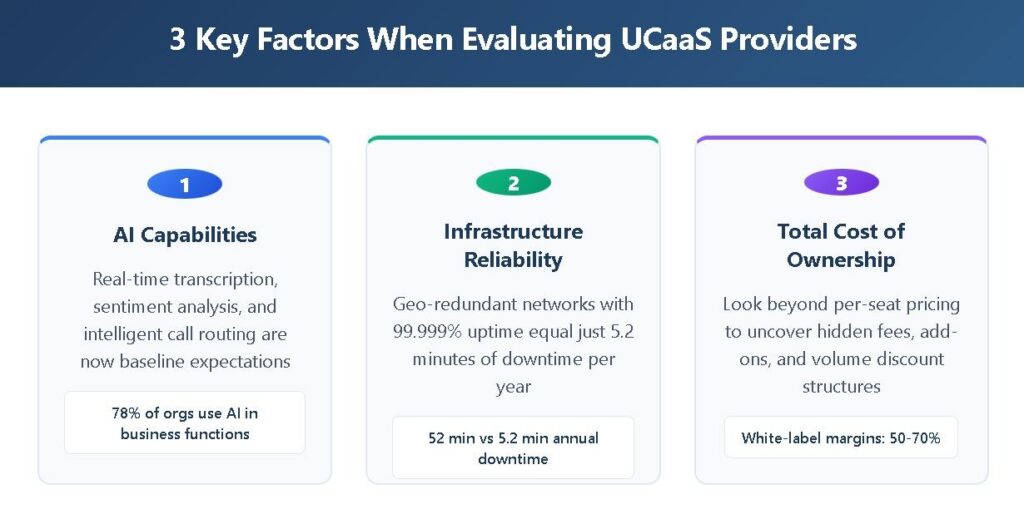
- AI-powered features like real-time transcription and sentiment analysis have become baseline expectations for 2026 provider evaluation.
- White-label partnerships offer 50–70% margins while maintaining full control over pricing and customer relationships.
- Infrastructure reliability (geo-redundant networks) and comprehensive onboarding support separate exceptional providers from the pack.
- Evaluate total cost of ownership, not just per-seat pricing, to avoid hidden fees that erode profitability.
If you’re serious about building a scalable UCaaS reselling business, this guide will walk you through exactly what to look for in a provider partnership.
Companies of all sizes need straightforward workplace communication solutions to support in-house collaboration, remote workers, and modern customer care expectations. With UCaaS, businesses can subscribe to the best combination of cost-effective cloud-hosted services without investing in expensive hardware upgrades to modernize their phone systems.
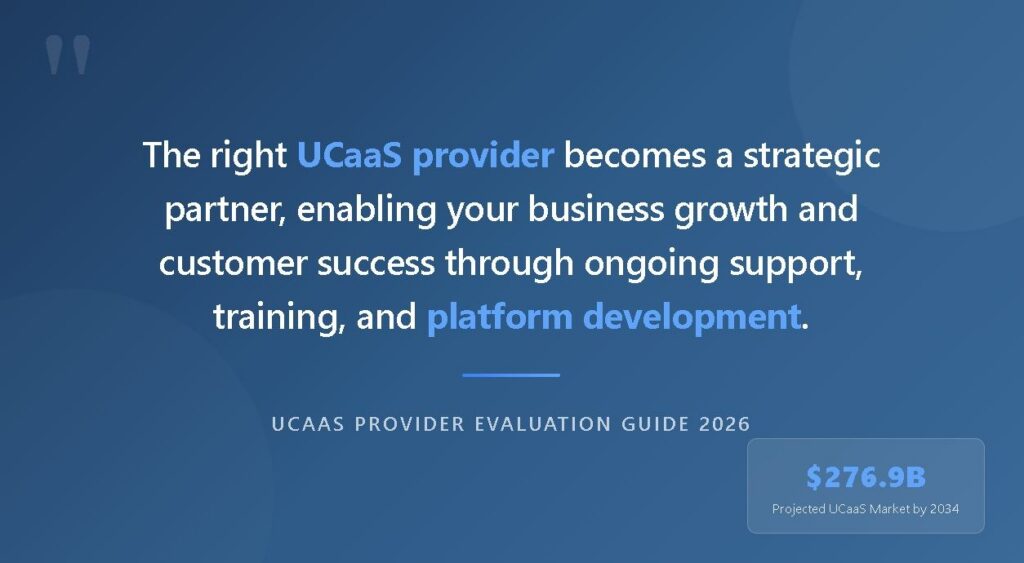
The demand is remarkable. The global UCaaS market was valued at $66.42 billion in 2025 and is projected to reach $276.9 billion by 2034, exhibiting a CAGR of 17.10%. These numbers suggest that UCaaS is the future of business communication and an attractive opportunity for companies offering telecom-adjacent products and services.
Partnering with an established UCaaS provider makes it easy to profit from an in-demand service without developing, maintaining, or monitoring a platform yourself. For MSPs, system integrators, interconnects, and VARs, evaluating UCaaS providers thoroughly before committing to a partnership is the difference between building a profitable recurring revenue stream and struggling with a solution that fails your customers.
What Should You Look for When Evaluating UCaaS Providers in 2026?
UCaaS has evolved, with AI capabilities, integration depth, and infrastructure reliability becoming critical differentiators. When choosing a UCaaS vendor, you need to assess multiple dimensions beyond basic feature checklists.
How Do AI Capabilities Impact Provider Selection?
Artificial intelligence has moved from a nice-to-have feature to a fundamental expectation for modern UCaaS platforms, as 78% of companies worldwide use AI on a daily basis. TechTarget reports that as both AI and generative AI take the world by storm, UCaaS providers are rapidly differentiating themselves by how quickly they can bring AI features to the table.
When comparing providers, look for these AI-powered capabilities:
- Real-time transcription: Live speech-to-text conversion during calls and meetings, enabling accurate documentation without manual note-taking
- Automated meeting summaries: AI-generated recaps that capture key decisions, action items, and follow-up tasks
- Sentiment analysis: Monitoring customer emotions during conversations to help supervisors step in when needed
- Intelligent call routing: Smart distribution based on caller intent, agent skills, and historical data patterns
- Voicemail transcription: Converting voicemails into readable text for faster response and improved accessibility
The providers that embed these capabilities natively into their platform, rather than offering them as expensive add-ons, deliver better value for resellers and their end customers.
What Infrastructure Reliability Standards Should You Expect?
For white-label resellers, call quality and service reliability directly impact brand image and business reputation. Most leading providers now offer a minimum of 99.99% availability, though many are guaranteeing 99.999% availability. That’s the difference between approximately 52 minutes of unscheduled downtime per year and just 5.2 minutes.
Look for providers with geo-redundant network architecture that provides automated failover. This means multiple data centers across different geographic locations, so if one experiences issues, calls automatically route through another without service interruption. Your customers’ critical business communications depend on this level of reliability.
Quality of service monitoring tools should be included in any provider you’re evaluating. These diagnostic capabilities detect latency, jitter, or network congestion within your customer’s LAN, at the connection point between the LAN and internet, or within the ISP network. Having this visibility means faster troubleshooting and happier customers.
How Do Different UCaaS Partnership Models Compare?
Not all UCaaS providers offer the same type of reseller arrangements. Understanding the finer points of an agreement before committing to a partnership protects your business goals and earning potential.
What Is the Agent Partnership Model?
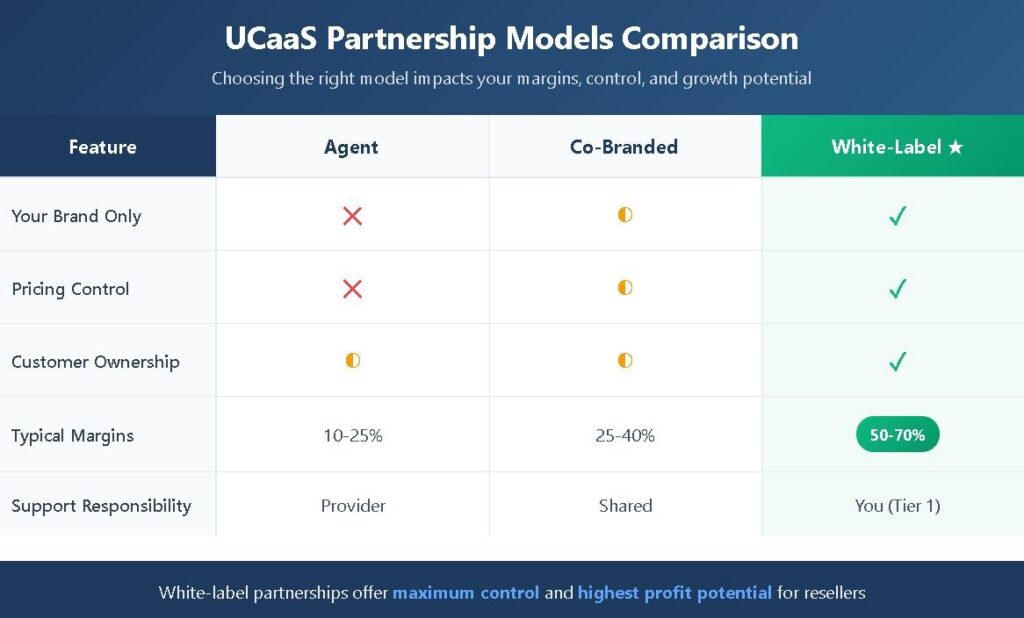
Agents sell UCaaS as a partner representative. As an agent, you receive marketing materials and training to sell your partner’s services. You’ll likely be responsible for marketing and lead generation but bound to the policies, procedures, service bundles, and pricing established by the platform provider. Payment typically comes as a monthly commission in exchange for your services.
Although you’ll stay involved with your customers, your service provider takes on the responsibility of billing and customer support once you’ve closed the sale. Some providers offer tiered, performance-driven incentives. This model works well for those who want minimal operational overhead, though it limits your control over pricing and customer relationships.
How Does Co-Branded Partnership Work?
Customers subscribing to a co-branded UCaaS platform see two logos when logging into their portal: yours and your reseller platform provider’s. The arrangement makes it clear to clients that they’re investing in a communication solution maintained by one company and sold through another. With this model, resellers leverage the potentially positive impact of name recognition and brand reputation.
You’ll likely continue providing customer support after closing the sale and may have some flexibility to set your own prices. If you do, you’ll have an easier time staying relevant in a competitive market and maintaining control over your margins.
Why Do Many Resellers Prefer White-Label Partnerships?
White-label products and services are designed, developed, and produced by one company before being offered to multiple vendors to resell for a profit. As a white-label UCaaS reseller, customers logging into your business communication platform see only your company name, contact information, and logo.
For resellers looking to build their business and brand reputation on a turnkey communication solution, white-label arrangements have multiple advantages. With the right UCaaS partner, you get all the training and guidance needed to support customers and grow your business, while subscribers have no way of knowing that you’re reselling a service.
This model offers the highest margin potential, typically ranging from 50–70%, along with complete control over pricing, packaging, and customer relationships.
What Is the Real Cost of Evaluating UCaaS Providers Incorrectly?
Many providers advertise low entry-level costs, but those prices often don’t tell the full story. Advanced business UCaaS features like analytics, compliance tools, and integrations are frequently locked behind add-ons or complex licensing. Enterprises and resellers frequently discover the real total cost of ownership only after committing.
How Should You Evaluate Pricing Transparency?
When sourcing pricing for a UCaaS provider partnership, consider these critical factors:
- Base plan inclusions: Verify what’s included, such as unlimited minutes, voicemail transcription, recordings, and real-time analytics.
- Hidden fees: Confirm taxes, regulatory fees, and any per-minute overages for international calling.
- Add-on costs: Understand what features require additional payment beyond your base subscription.
- Volume discounts: Ask whether pricing tiers automatically reduce costs as your customer base grows.
The best UCaaS reseller programs build volume discounts directly into contracts. As you grow, your costs decrease, and profitability increases without requiring renegotiation.
What About Startup and Onboarding Fees?
The higher the initial cost of getting your UCaaS platform running, the longer it takes to recoup your investment and turn a profit. Some UCaaS providers charge their reseller partners hefty fees that exceed the actual cost of onboarding and training. Others don’t inflate startup costs but charge substantial penalties for contract termination.
Look for providers that keep startup charges minimal and reasonable, reflecting actual training and setup costs rather than hidden profit centers. A comprehensive onboarding process should include instructional videos, hands-on activities, and one-on-one training with a dedicated onboarding specialist.
What Essential Features Should Your UCaaS Comparison Include?
When evaluating UCaaS providers, you need a systematic approach to comparing capabilities across multiple providers. The following feature categories deserve careful evaluation in any UCaaS comparison.

Which Core Business UCaaS Features Are Non-Negotiable?
Any UCaaS platform you consider should include these foundational capabilities:
- Cloud PBX: Enterprise-grade phone system with auto attendants, call queues, call recording, and voicemail transcription
- Video conferencing: High-quality meetings with screen sharing, recording capabilities, and participant management
- Team messaging: Real-time chat functionality with presence indicators and file sharing
- Mobile applications: iOS and Android apps that provide full platform functionality for remote and hybrid workers
- Business SMS/MMS: Text messaging capabilities for customer communication with compliance features
The best platforms integrate all these functions into a unified interface that’s accessible on any device, eliminating the frustration of managing separate applications for different communication needs.
How Important Are Integration Capabilities?
UCaaS platforms increasingly serve as hubs for existing business systems. Native integrations with CRM tools, productivity suites, and other enterprise applications streamline workflows, while APIs allow custom connections for unique business requirements.
When comparing providers, verify the use of standards-based APIs because they make it easy for UCaaS subscribers to integrate familiar third-party applications directly into their dashboards. Leading platforms offer 200+ integrations out of the box, including connections to Salesforce, HubSpot, Microsoft Teams, and popular productivity tools.
For resellers, integration capabilities determine whether you can serve clients across multiple industries with varying technology stacks. The more comprehensive the integration library, the broader your potential customer base.
What Security and Compliance Standards Should Providers Meet?
Security, regulatory compliance, and data privacy have always ranked high among customer selection criteria but have become even more important with the pervasive adoption of flexible work models. The growing risk of cyberattacks, coupled with evolving regulations, drives many organizations to choose solutions that keep their data private and secure.
Look for providers offering:
- End-to-end encryption: Protection for voice calls, video conferences, and messaging
- Multi-factor authentication (MFA): Additional security layers beyond passwords
- Compliance certifications: HIPAA compliance for healthcare clients, SOC 2 Type II certification, and other industry-specific standards
- Data residency options: Control over where customer data is stored geographically
- STIR/SHAKEN compliance: Protection against caller ID spoofing and spam calls
UCaaS providers must constantly update their security and compliance postures as regulations evolve. Ask potential partners about their security update frequency and how they communicate changes to resellers.
What Does Comprehensive Reseller Support Look Like?
Getting started with or switching to a new white-label provider involves more than clicking a button. The quality of support you receive directly impacts how quickly you can start generating revenue and how effectively you can serve your customers.
What Should Onboarding Include?
Learning the finer points of running a UCaaS platform takes time. During the first phase of training, you should have access to instructional videos, quizzes, and hands-on activities. If a platform doesn’t offer one-on-one training with an onboarding specialist, keep looking.
A comprehensive onboarding program should cover:
- Platform configuration: Setting up your white-label branding, portal customization, and service packages
- Technical training: Understanding provisioning, troubleshooting, and supporting end customers
- Billing services: Learning to generate statements, set up customer billing, create product catalogs, and navigate tax systems
- Sales enablement: Marketing materials, call scripts, and strategies for closing UCaaS deals
The goal of every dedicated onboarding specialist should be sharing knowledge, building confidence, and ensuring you’re fully trained before going live. When choosing a UCaaS vendor, you should expect 24/7 access to a comprehensive knowledge base with guidance, support, and additional coaching as needed.
How Important Is Ongoing Partner Support?
Support responsiveness is essential, yet many providers struggle in this area, especially after you’re onboarded. You want to know who to call, speak to an experienced person when you have a problem or need advice, and know the issue will get resolved.
End-to-end support includes guidance in the early stages to make it easy for you to transition from what you may have been selling before to what you’re selling now, plus ongoing support so you can effectively take care of your customers. The providers that partner for long-term success stay by your side for the life of your partnership.
Look for providers offering:
- Tier 2 and Tier 3 technical support: Help with complex issues beyond basic troubleshooting
- Dedicated partner account managers: A consistent point of contact who understands your business
- Marketing toolkit: Brandable materials including product slicks, videos, and social media content
- Partner community: Access to other resellers who can share best practices and advice
Frequently Asked Questions About Evaluating UCaaS Providers
How long does it typically take to turn a profit as a UCaaS reseller? For companies already selling UCaaS or similar products that may be moving their customer base from another platform, profitability is achievable nearly immediately. For businesses new to the UCaaS industry without an existing customer base, it typically takes about six months to turn a profit.
What technical expertise do I need to resell UCaaS successfully? While UCaaS providers handle platform management, you’ll benefit from basic networking knowledge, understanding of VoIP technologies, and familiarity with common business applications for integration purposes. Most providers offer comprehensive training programs to develop necessary expertise, so prior telecom experience isn’t required.
Can I set my own prices as a white-label reseller? In a true white-label reseller relationship, you retain full control over pricing. You can create packages and determine what to include in each tier. Providers that require resellers to charge set prices for limited service bundles make it difficult to stay competitive or ensure profitability.
What size customers are best suited for UCaaS solutions? UCaaS works well for businesses of all sizes, but the 25–250 employee segment often provides the best opportunity for resellers. These organizations seek cost-effective, scalable communication solutions that can grow with their business without requiring significant technical expertise to manage.
Ready to Partner with a UCaaS Provider Built for Reseller Success?
Evaluating UCaaS providers thoroughly before committing protects your business, your customers, and your brand reputation. The right provider becomes a strategic partner, enabling your business growth and customer success through ongoing support, training, and platform development.
For MSPs, system integrators, and telecom providers ready to capitalize on the growing UCaaS market, white-label partnerships offer a clear pathway to recurring revenue and enhanced customer relationships. SkySwitch offers a comprehensive white-label UCaaS platform designed specifically for reseller success, with all the technology, training, and support you need to build a thriving communications business under your own brand. Get started today and discover how a proven partner program can transform your business with profitable, recurring UCaaS revenue.

Jessica is a marketing and sales strategist with deep expertise in VoIP telecommunications. As a Marketing Director, she specializes in channel marketing, account management, and product marketing within the communications industry. Jessica is passionate about helping partners grow through compelling messaging and hands-on support.