
How to Evaluate UCaaS Phone System Providers: A Checklist for Resellers

The UCaaS market is exploding at 19.8% annual growth, creating multiple opportunities for resellers to capture lucrative recurring revenue streams.
- Platform reliability and comprehensive feature sets determine long-term customer satisfaction and retention rates.
- Support programs and pricing flexibility directly impact reseller profitability and competitive positioning.
- Integration capabilities and white-label customization separate industry leaders from commodity providers.
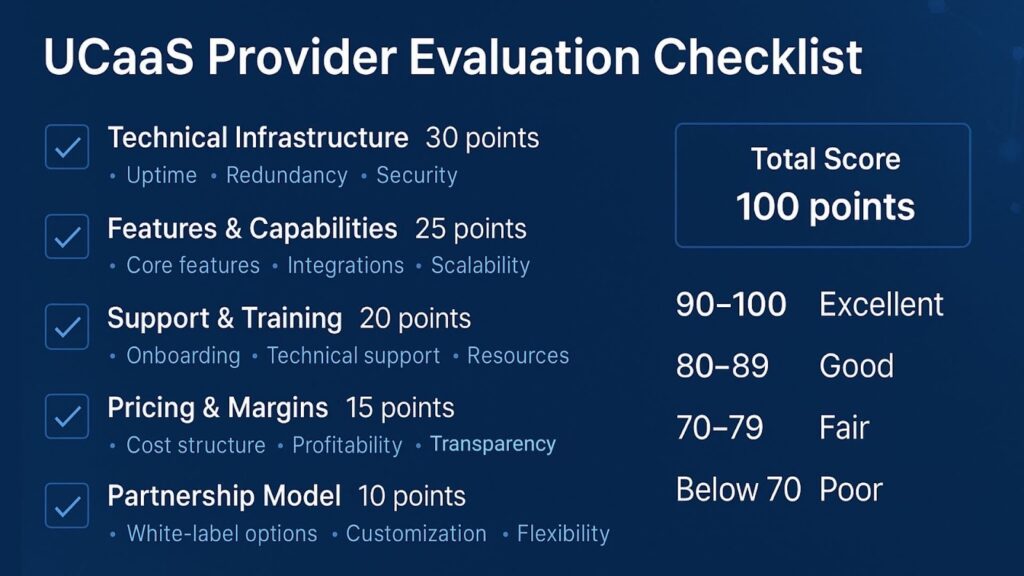
- UCaaS vendor selection requires evaluating technical infrastructure, business models, and partnership commitment with a comprehensive cloud voice checklist.
Choose your UCaaS phone system provider wisely. Your business growth and customer relationships depend on making the right decision.
The global UCaaS market will reach $262.37 billion by 2030. This explosive 19.8% compound annual growth rate signals a shift in how businesses approach communication. For resellers, system integrators, and managed service providers, this growth creates an enormous opportunity to capture market share in one of technology’s fastest growing segments.
However, success in the UCaaS reseller market isn’t guaranteed simply by entering the space. The difference between building a thriving, profitable business and struggling with margin erosion often comes down to selecting the right UCaaS phone system provider partner.
Smart resellers recognize that their partnership affects every aspect of their business, from customer satisfaction and retention to profit margins and growth potential. The right partnership provides the foundation for sustainable growth, satisfied customers, and healthy recurring revenue streams.
What Does the UCaaS Phone System Provider Landscape Look Like?
The UCaaS provider ecosystem includes several distinct categories of companies, each offering different approaches to unified communications. Understanding these differences helps resellers identify which type of provider best aligns with their business model and target market.
Platform Ownership vs. Passive Reselling
The distinction between UCaaS providers isn’t about whether they use third-party technology, but rather how they manage and enhance it. Some providers simply resell pre-packaged solutions with minimal customization or technical investment, offering limited control over features, pricing, or the customer experience.
The most capable providers take a different approach. They build robust backend infrastructure and engineering capabilities around proven core technologies, investing in custom development that enhances platform functionality and differentiates their offerings. These providers maintain dedicated development teams that continuously add features, optimize performance, and tailor solutions to specific market needs.
Look for providers demonstrating active platform management through proprietary tools, custom integrations, and ongoing feature development. Providers with strong technical teams can rapidly respond to market changes, implement customer-requested features, and maintain competitive advantages through innovation. This engineering investment translates into better support, greater customization options, and more competitive pricing for reseller partners compared to providers who simply rebrand off-the-shelf solutions.
White-Label vs. Agent Models
The partnership structure you choose impacts your business potential. Agent partnerships typically involve promoting another company’s brand, resulting in shared customer relationships and limited pricing control. White-label partnerships allow complete branding customization and full customer ownership, creating stronger relationships and higher profit potential for resellers willing to invest in their own brand development.
Specialized vs. Generalist Providers
Some UCaaS providers focus exclusively on specific market segments or feature sets, while others attempt to serve all customer types with generalized offerings. Specialized providers often deliver superior results for their target markets by optimizing features, support, and pricing for specific use cases.
Nearly 90% of organizations now use UCaaS as either their primary phone system or in conjunction with existing on-premises platforms, with more than 56% planning to increase their UCaaS spending. The rapid market growth has attracted numerous new entrants, creating a crowded landscape where distinguishing between legitimate providers and those lacking staying power becomes crucial.
What Are the Essential Technical Infrastructure Requirements?
Technical infrastructure forms the foundation of any successful UCaaS deployment, directly impacting customer satisfaction and your reputation as a provider. Evaluating infrastructure requires examining multiple components that work together to deliver reliable service.

Network Architecture and Redundancy
Look for providers utilizing geo-redundant data centers with automatic failover capabilities that ensure minimal downtime during service disruptions. Industry-leading providers maintain service level agreements guaranteeing 99.99% or higher uptime, translating to less than 52 minutes of unscheduled downtime annually. Network architecture becomes particularly vital as your customer base grows, with providers utilizing multiple geographic nodes delivering superior call quality and reduced latency compared to single-site deployments.
The best UCaaS phone system providers invest heavily in network infrastructure, including redundant internet connections, backup power systems, and geographically distributed servers. These investments ensure consistent service delivery regardless of local network issues or natural disasters that might affect individual data centers.
Security and Compliance Framework
Modern businesses require robust security measures that protect sensitive communications and ensure regulatory compliance. Evaluate providers based on their security certifications, including SOC 2 Type II, HIPAA compliance, and ISO 27001 standards. End-to-end encryption for voice and video communications should be standard, not an optional add-on.
Compliance requirements vary across industries and regions. Healthcare organizations need HIPAA compliance, financial services require specific data protection measures, and government contractors must meet FedRAMP standards. Choose providers that understand these requirements and maintain appropriate certifications for your target markets.
Quality of Service Monitoring
Advanced UCaaS providers offer real-time quality monitoring tools that identify and resolve performance issues before they impact customer experience. These tools should provide detailed analytics on call quality, network performance, and user experience metrics. Quality monitoring capabilities enable proactive support and help maintain high customer satisfaction levels.
Which Feature Sets and Platform Capabilities Should You Look For?
Your UCaaS vendor selection should consider comprehensive feature sets so that you can address diverse customer needs and command higher pricing. Modern businesses expect integrated solutions that combine voice, video, messaging, and collaboration tools in a single platform.
Core Communication Features
Essential voice features include auto attendants, call queues, voicemail transcription, call recording, and advanced routing. Video conferencing should support HD quality, screen sharing, and recording functionality that rivals standalone solutions. Messaging capabilities must encompass both internal team communication and external customer engagement through SMS and MMS.
Mobile accessibility has become non-negotiable for most organizations. Look for providers offering native mobile applications that deliver full UCaaS functionality, not simplified versions that limit user capabilities. Remote work trends have made mobile access a primary consideration rather than a nice-to-have feature.
Advanced Collaboration Tools
Beyond basic communication, modern UCaaS platforms should include file sharing, presence indicators, and integration with popular productivity suites. These features enable seamless workflows and reduce the need for multiple standalone applications. The most advanced platforms incorporate artificial intelligence for features like transcription, translation, and automated meeting summaries.
Contact Center Capabilities
Many businesses require contact center functionality as part of their solution. Evaluate whether providers offer integrated contact center features, including automatic call distribution, intelligent routing, real-time analytics, and workforce management tools. Your reseller business can offer customer service operations without requiring separate solutions.
Contact center integration creates a beneficial upsell opportunity for resellers, often doubling or tripling the per-seat revenue from customer accounts. Look for providers that make contact center functionality easy to deploy and manage without requiring specialized expertise.
What Type of Support and Training Programs Do You Need for Reseller Success?
The quality of provider support directly impacts your ability to deliver excellent customer service and grow your business. Comprehensive support programs should address both technical assistance and business development needs.

Technical Support Structure
Evaluate the provider’s technical support availability, response times, and escalation procedures. The best providers offer multiple support channels, including phone, email, chat, and ticketing systems with clearly defined response time commitments. Twenty-four-hour support becomes essential as your customer base grows and spans multiple time zones.
Consider whether the provider offers branded support options that allow your customers to receive assistance under your company name rather than the provider’s brand. White-labeling helps maintain customer relationships and reinforces your position as their primary technology partner.
Training and Onboarding Programs
Comprehensive training programs should cover technical aspects of the platform and business development strategies, offering valuable reseller tips that accelerate your path to successful UCaaS selling. Look for providers offering structured onboarding processes, ongoing education, and access to sales and marketing resources.
The most valuable training programs include hands-on experience with the platform, certification programs that validate your expertise, and regular updates on new features and capabilities. Effective onboarding programs can reduce your time to market and accelerate revenue generation.
Business Development Support
Evaluate whether providers offer business development assistance, including marketing materials, sales tools, and competitive positioning guidance. Some providers assign dedicated partner managers who actively support your growth efforts and provide strategic guidance based on market trends and customer feedback.
How Do Pricing Models Affect Profitability?
Understanding provider pricing structures and their impact on your profitability requires careful analysis of both direct costs and hidden fees that can erode margins over time.
Wholesale Pricing Structures
Most UCaaS providers offer tiered pricing based on feature sets and user volumes, but the specifics vary between providers. Some charge per-user monthly fees with additional costs for premium features, while others offer bundled pricing that includes comprehensive feature sets. Evaluate which pricing model aligns best with your target market and desired profit margins.
Consider the impact of volume discounts and growth incentives on your long-term profitability. Providers that offer automatic price reductions as you grow enable improved margins and competitive pricing for larger deals. However, ensure that volume requirements are realistic based on your growth projections and market opportunities.
Hidden Costs and Fee Structures
Examine provider fee structures carefully to identify potential hidden costs that could impact profitability. Common areas where unexpected fees arise include number porting, setup charges, technical support fees, and early termination penalties. The most transparent providers publish comprehensive fee schedules and avoid surprise charges that can damage reseller relationships.
Margin Opportunities
Reseller margins vary depending on the partnership model and value-added services offered. White-label partnerships generally provide higher margins than agent relationships because they offer greater pricing flexibility and customer ownership.
Evaluate opportunities for additional revenue streams beyond basic UCaaS services, one of the most practical reseller tips for increasing profitability and long-term growth. Providers that offer complementary solutions like SD-WAN, security services, or specialized industry applications enable portfolio expansion and increased customer lifetime value.
How to Evaluate Integration and Customization Capabilities
Modern businesses require UCaaS solutions that integrate with existing applications and workflows, making these capabilities a valuable evaluation factor.
API Accessibility and Documentation
Robust API access enables custom integrations that differentiate your offerings and address specific customer requirements. Evaluate the comprehensiveness of provider APIs, documentation quality, and support for custom development projects. The best providers offer extensive API libraries with clear documentation and development support.
Consider whether the provider offers pre-built integrations with popular business applications, including CRM systems, help desk platforms, and productivity suites. These integrations reduce implementation complexity and accelerate customer adoption.
White-Label Customization Options
For resellers building their own brand, extensive customization is essential. Evaluate the level of branding available, including logo placement, color schemes, domain customization, user interface modifications, and brandable marketing assets. Comprehensive white-label options enable complete brand ownership and stronger customer relationships.
Scalability and Flexibility
Assess the provider’s ability to accommodate growing customer requirements and changing business needs. Scalable platforms should handle rapid user growth, geographic expansion, and evolving features without requiring platform migrations or significant technical changes.
Top 10 Questions Every Reseller Must Ask
When evaluating potential UCaaS phone system providers, this cloud voice checklist helps reveal the true compatibility with your reseller business:
- What uptime guarantees do you provide, and what compensation do you offer for service disruptions? Look for providers offering 99.99% or higher uptime with clear remediation policies for outages.
- Can you provide references from current reseller partners in my market segment? Speaking with existing partners reveals real-world experiences and potential challenges you might encounter.
- What training and onboarding support do you provide for new reseller partners? Comprehensive training programs accelerate your time to market and improve customer success rates.
- How do your pricing structures work, and what margins can I expect? Understanding cost structures and profit potential helps evaluate business viability and growth opportunities.
- What level of customization and white-labeling do you support? Extensive customization options enable stronger brand development and customer relationships.
- Which integrations do you currently support, and how do you handle custom integration requests? Integration capabilities directly impact customer satisfaction and implementation success.
- What technical support do you provide for reseller partners and their customers? Quality support structures reduce your support burden and improve customer satisfaction.
- How do you handle feature updates and platform evolution? Regular updates and feature additions keep your offerings competitive and customers satisfied.
- What geographic markets do you serve, and what compliance certifications do you maintain? Geographic reach and compliance capabilities determine your addressable market size.
- What contractual terms and exit procedures do you require? Understanding partnership terms and termination procedures protects your business interests and provides flexibility for future changes.
Frequently Asked Questions
What’s the difference between white-label and agent UCaaS partnerships?
White-label partnerships allow complete branding and customer ownership, typically offering higher margins and greater pricing control. Agent partnerships involve promoting the provider’s brand with shared customer relationships and limited customization options.
How important are integration capabilities when selecting a UCaaS provider?
Integration capabilities are critical for customer adoption and satisfaction. Businesses expect UCaaS solutions to work seamlessly with existing applications like CRM systems, productivity suites, and industry-specific software. Providers offering robust APIs and pre-built integrations enable faster implementations and higher customer satisfaction rates.
What size customers are best suited for UCaaS solutions?
UCaaS works well for businesses of all sizes, but the 25–250 employee segment often provides the best opportunity for resellers. These organizations need enterprise features but lack internal IT resources for complex implementations. They also represent a good balance between deal size and sales cycle length.
How do I evaluate the financial stability of a UCaaS provider?
Look for providers with strong financial backing, consistent growth, and positive customer references. Established companies with multiple funding rounds or profitable operations provide greater partnership stability. Avoid providers with recent financial difficulties or high customer churn rates that might indicate underlying problems.
Capitalize on the UCaaS Market with the Right Provider
The explosive growth in the UCaaS market presents an extraordinary opportunity for resellers to build profitable, sustainable businesses while helping customers modernize their communication infrastructure. However, success requires partnering with the right UCaaS phone system provider that offers robust technology, comprehensive features, and exceptional support programs.
By following this comprehensive evaluation checklist and applying proven reseller tips, you can identify UCaaS vendors that align with your business goals and market requirements. The investment in thorough due diligence pays dividends through stronger customer relationships, higher profit margins, and accelerated business growth.
SkySwitch provides the comprehensive white-label platform, training, and support you need to succeed. Get started today and discover how our proven partner program can transform your business with profitable, recurring UCaaS revenue.

Jessica is a marketing and sales strategist with deep expertise in VoIP telecommunications. As a Marketing Director, she specializes in channel marketing, account management, and product marketing within the communications industry. Jessica is passionate about helping partners grow through compelling messaging and hands-on support.