
How to Resell VoIP: 2026 Startup Guide for White-Label Providers

The global VoIP market is projected to reach $415.20 billion by 2034, making now the ideal time to launch your reselling business.
- White-label VoIP allows MSPs, system integrators, and VARs to offer branded communication solutions without infrastructure investment.
- Successful resellers typically achieve 50–70% profit margins through recurring monthly revenue models.
- A structured approach covering market evaluation, provider selection, and pricing strategy can have you selling within 60-90 days of completing onboarding.
If you’ve been considering adding VoIP to your service portfolio, this guide provides the tactical roadmap you need to get started.
The VoIP market reached $161.79 billion in 2025 and continues growing at an 11% CAGR. Small and medium-sized businesses are the fastest growing segment, and they’re actively seeking local providers who can deliver personalized service alongside modern communications solutions.
For managed service providers, system integrators, interconnects, and VARs, this growth translates into a concrete business opportunity. Learning how to resell VoIP effectively means tapping into recurring revenue streams while strengthening existing customer relationships. The barrier to entry has never been lower, thanks to white-label platforms that handle the technical complexity while you focus on serving your customers.
This VoIP startup guide walks you through everything you need to know about launching a reseller business in 2026, from initial planning through your first sales and beyond.
What Does It Mean to Resell VoIP in 2026?
Before diving into the tactical steps, it’s worth understanding what VoIP reselling actually involves and who stands to benefit most from this business model. White-label solutions have become increasingly sophisticated and accessible in recent years, making it easy to learn how to resell VoIP and grow your business.
What Is the White-Label VoIP Model?
When you become a VoIP reseller through a white-label provider, you’re partnering with a company that has already built the infrastructure, developed the software, and established the carrier relationships necessary to deliver voice services. You then rebrand these services as your own and sell them to your customers.
The beauty of this arrangement is that your customers never need to know about the underlying provider. They see your logo, interact with your support team, and receive invoices bearing your company name. You maintain complete control over pricing, packaging, and the customer relationship while your white-label partner handles the technical backend.
This arrangement differs from agent or referral models, where you simply pass leads to another company in exchange for commissions. As a true white-label VoIP reseller, you own the customer relationship and build equity in your own brand.
Who Can Become a VoIP Reseller?
The short answer: almost anyone with an existing customer base that needs communication solutions. However, certain business types tend to find success in this space.
MSPs already managing IT infrastructure for clients are natural candidates. These relationships create built-in trust and provide opportunities to bundle voice services with existing offerings. System integrators working on technology deployments can add VoIP as a value-added component. ISPs looking to diversify beyond connectivity find VoIP reselling a logical extension. Even office equipment dealers have discovered that bundling communication services with copier leases creates longer customer contracts and additional revenue streams.
The common thread among successful resellers is having established customer relationships and a willingness to learn a new product category.
How to Resell VoIP: Your Step-by-Step Startup Checklist
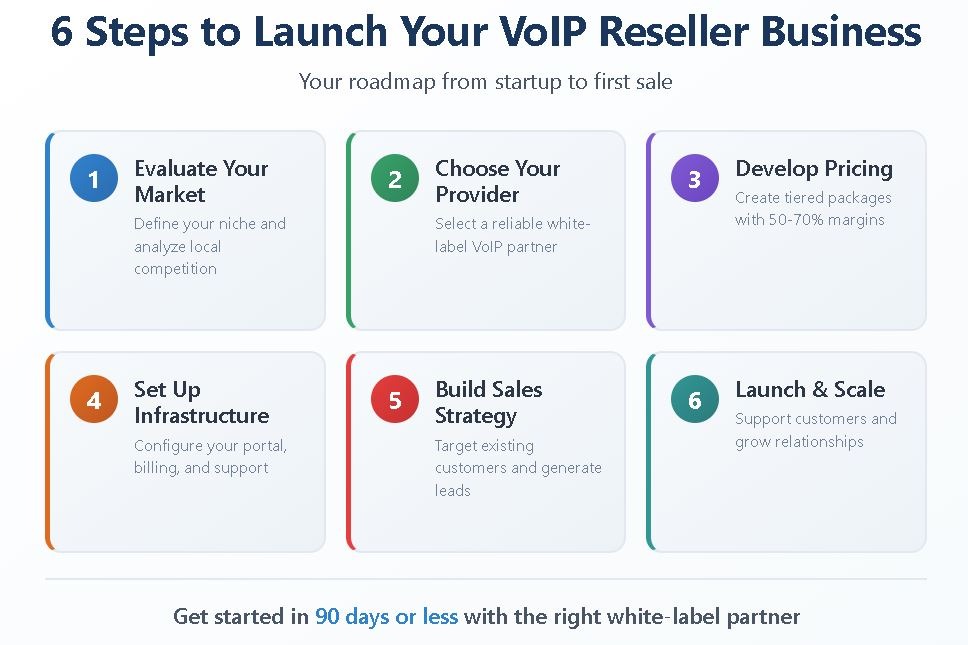
Getting your VoIP reseller business off the ground requires methodical planning and execution. The following VoIP startup guide provides a roadmap from initial concept through active selling.
Step 1: Evaluate Your Market and Define Your Niche
Resist the temptation to sell VoIP to everyone. The most successful resellers focus their efforts on specific market segments where they can develop deep expertise and strong reputations.
Start by analyzing your existing customer base. What industries do they represent? What communication challenges do they face? A reseller serving healthcare practices will encounter different requirements than one focused on law firms or construction companies. Understanding these nuances allows you to effectively position your offerings and speak your customers’ language.
Geographic focus matters too. Many thriving VoIP resellers operate regionally, building relationships within their local business communities rather than competing nationally against larger providers. This approach allows for more personalized service and faster response times.
Research your local competition as well. Understanding what others charge and which features they emphasize helps you identify gaps you can fill or areas where you can differentiate.
Step 2: Choose a Reliable White-Label VoIP Provider
Your choice of white-label partner will impact your success. This relationship extends far beyond simply purchasing wholesale services. You’re selecting a technology platform, a support structure, and a business partner.
Evaluate potential providers across several dimensions. Platform reliability should top your list since your brand reputation depends on consistent service delivery. Look for providers with geo-redundant infrastructure that ensures automatic failover during outages. Ask about their track record and request references from existing resellers.
Support capabilities matter, especially as you’re learning how to resell VoIP. The best white-label providers offer comprehensive onboarding programs, ongoing training, and responsive technical support when issues arise. Some even provide brandable marketing assets and sales coaching to help new resellers close their first deals.
Examine the feature set carefully. Modern businesses expect more than basic calling. Video conferencing, team messaging, mobile apps, and contact center capabilities have become standard expectations. Ensure your chosen provider delivers a complete UCaaS platform rather than bare-bones voice services.
Finally, understand the financial arrangements. Transparent pricing without hidden fees, reasonable minimums, and volume discounts as you grow all indicate a provider invested in your long-term success.

Step 3: Develop Service Packages and Pricing Strategy
With your provider selected, turn your attention to how you’ll package and price services for your customers. This step directly impacts your profitability and competitive positioning.
Most successful resellers create tiered service packages. A basic package might include essential calling features suitable for small offices. A standard package adds capabilities like video conferencing and mobile apps for growing businesses. A premium tier includes advanced features like contact center functionality and extensive integrations for larger organizations.
When setting prices, research what competitors charge in your market while considering your target margins. VoIP resellers typically achieve margins between 50% and 70%, depending on how they structure their packages. Your pricing needs to cover not only the wholesale costs but also your sales efforts, customer support, and business overhead.
Consider bundling strategies as well. Offering VoIP alongside existing services can create more attractive packages while making it harder for competitors to poach individual service lines.
Step 4: Establish Your Technical Infrastructure
One advantage of white-label VoIP is minimal infrastructure requirements on your end. However, you still need certain operational elements in place before launching.
Your reseller portal becomes your command center for provisioning services, managing customers, and monitoring usage. Spend time learning its capabilities thoroughly during onboarding. Understanding how to resell VoIP includes activating new customers, adding features, and troubleshooting common issues, which will save countless hours once you’re actively selling.
Billing processes require attention as well. Some white-label providers offer integrated billing platforms that handle invoicing, payment processing, and tax calculations. Others expect you to manage billing through your own systems. Either approach works, but you need clarity on the workflow before signing your first customer.
Don’t neglect your support structure. You’ll likely handle tier-one support for basic questions and troubleshooting, escalating more complex technical issues to your provider. Establishing clear processes and training your team on common scenarios ensures smooth customer experiences from day one.
Step 5: Build Your Sales and Marketing Approach
With operational foundations in place, focus shifts to generating demand and closing deals. Even the best VoIP solution won’t sell itself.
Your existing customer base offers the warmest opportunity. These businesses already trust you with other aspects of their technology. Reaching out to discuss their communication needs often uncovers pain points you can address. Perhaps they’re frustrated with unreliable phone service, struggling to support remote workers, or paying too much for outdated systems.
For new customer acquisition, develop educational content that demonstrates your expertise. Blog posts explaining VoIP benefits, comparison guides, and case studies from successful implementations all position you as a knowledgeable advisor rather than just another salesperson. Many white-label providers offer brandable marketing materials you can customize, accelerating your go-to-market efforts.
Referrals from satisfied customers often become your most valuable lead source over time. Building referral requests into your customer success processes pays dividends as your installed base grows.

Step 6: Launch, Support, and Scale
Your first customer implementation sets the tone for your reseller business. Approach it with extra care, documenting everything you learn along the way. These lessons inform your processes for subsequent customers.
Ongoing customer support builds loyalty and reduces churn. Regular check-ins to ensure satisfaction, proactive communication about new features, and rapid response to issues all contribute to long-term relationships.
As your customer base grows, look for opportunities to expand relationships. Existing customers often need additional lines, upgraded features, or services for new locations. These expansion opportunities typically close faster and more easily than new customer acquisitions.
Which Essential Features Does Every VoIP Reseller Need from Their Provider?
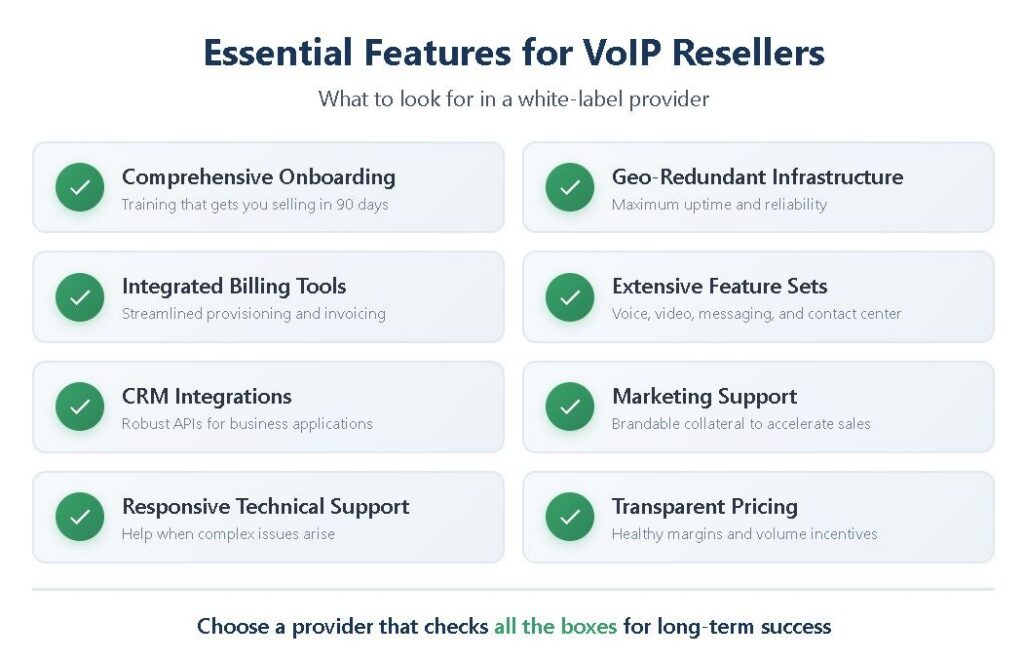
With the broader unified communications market growing at 17.4% annually through 2030, choosing a provider with comprehensive UCaaS capabilities positions you for long-term success. When evaluating potential partners, prioritize these capabilities:
- Comprehensive onboarding and training that gets you selling confidently within 90 days or less
- Geo-redundant infrastructure ensuring maximum uptime and reliability for your customers
- Integrated billing and provisioning tools that streamline your operations
- Extensive feature sets, including voice, video, messaging, mobile apps, and AI- powered contact center options
- CRM and business application integrations through robust APIs
- Marketing support and brandable collateral to accelerate your sales efforts
- Responsive technical support for when complex issues arise
- Transparent pricing with healthy margins and volume incentives
What Are Common Mistakes New VoIP Resellers Should Avoid?
Learning from others’ missteps can save you time and frustration. Watch out for these common pitfalls.
Choosing providers based solely on the lowest wholesale pricing often backfires. Rock-bottom prices frequently come with inadequate support, unreliable platforms, or hidden fees that erode your margins.
Underestimating the learning curve leads to frustration. VoIP involves terminology, concepts, and processes that take time to master. Budget adequate time for training, and expect your first few implementations to move slower than later ones.
Neglecting customer support after the sale damages relationships and increases churn. The recurring revenue model only works when customers stick around. Investing in ongoing success pays out through renewals and referrals.
Trying to compete on price alone commoditizes your offering. Competing providers can always undercut you. Instead, differentiate through superior service, specialized expertise in particular industries, or unique bundled solutions that competitors can’t easily replicate.
Frequently Asked Questions About Starting a VoIP Reseller Business
How much does it cost to become a VoIP reseller? Startup costs vary by provider. Some charge upfront onboarding fees that include comprehensive training and portal setup, while others offer free entry with higher per-seat costs. Generally, expect initial investments ranging from minimal to a few thousand dollars, far less than building your own telecommunications infrastructure would require.
Do I need technical expertise to resell VoIP? Basic networking knowledge helps, but deep technical expertise isn’t required. Quality white-label providers handle the complex infrastructure while providing training on the customer-facing elements you’ll manage. Many successful resellers come from sales or business backgrounds rather than technical ones.
How long before I start making money? Timeline varies based on your existing customer relationships and sales efforts. Resellers with established customer bases often close their first deals within weeks of completing onboarding. Those building from scratch typically see profitability within six to twelve months as they develop their sales processes and build momentum.
What if my customers need features my provider doesn’t offer? Choose providers with comprehensive feature sets and active development roadmaps. The best white-label VoIP providers continuously enhance their platforms based on market trends and partner feedback. Additionally, look for platforms with extensive API capabilities that enable custom integrations when standard features don’t quite fit.
Start Your VoIP Reselling Journey Today
The VoIP market’s continued expansion creates a genuine opportunity for service providers ready to act. Whether you’re an established MSP looking to diversify revenue streams or an entrepreneur entering the telecommunications space, white-label VoIP reselling offers a proven path to recurring revenue with manageable risk.
Success requires choosing the right partner that combines robust technology with a commitment to reseller success. SkySwitch provides exactly that combination through a comprehensive white-label UCaaS platform, extensive training and support, and a partner community dedicated to mutual growth. Get started with SkySwitch today to explore how VoIP reselling fits your business.

Jessica is a marketing and sales strategist with deep expertise in VoIP telecommunications. As a Marketing Director, she specializes in channel marketing, account management, and product marketing within the communications industry. Jessica is passionate about helping partners grow through compelling messaging and hands-on support.