
What Is a White-Label UCaaS Platform? A Reseller’s Guide

White-label UCaaS lets you sell enterprise-grade communications under your own brand without building the infrastructure yourself.
- The market is shifting from standalone VoIP to full platforms that bundle voice, messaging, video, and contact center.
- A strong white-label communications platform gives you pricing control, customer ownership, and a recurring revenue stream.
- The right provider scales with you, so you can add users and services without buying new hardware.
- Comparing providers comes down to reliability, support, feature breadth, and how easily the platform grows with you.
If you want predictable, recurring revenue and full control of your brand, a white-label UCaaS platform is one of the most practical ways to get there.
You don’t have to build a phone network to sell one. White-label UCaaS gives MSPs, system integrators, and IT providers a way to offer a complete white-label communications platform under their own brand, while a behind-the-scenes partner runs the infrastructure. That model has gone from niche to mainstream as demand for cloud communications climbs. The UCaaS market is on track to grow from roughly $70 billion in 2026 to more than $220 billion by 2031. For resellers, that’s a long runway of recurring revenue, as long as you pick the right platform and position yourself as a communications partner rather than a one-time phone vendor.
What Is a White-Label UCaaS Platform?
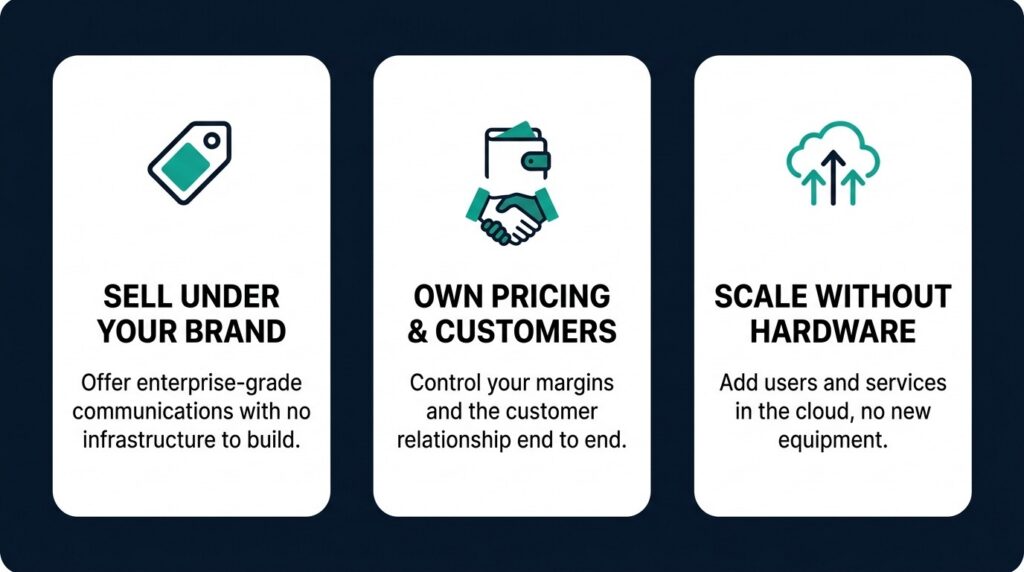
A white-label UCaaS platform is a cloud communications system that one company builds and operates, then lets other businesses rebrand and resell it as their own. You set the pricing, own the customer relationship, and put your logo on the portal, while your provider handles the network, maintenance, and platform updates behind the scenes. It’s the difference between renting a fully built storefront and pouring the foundation yourself.
How the Reseller Model Works
You sign on with a provider, get your portal and billing branded, and start selling cloud voice and collaboration to your customers. Because everything runs in the cloud, you can provision new users and turn on features remotely, with no trips to a server room. Your customers experience your brand at every touchpoint, from the app they log into to the invoice they pay, which is what makes the model so sticky.
Is White-Label the Same as Private-Label?
Yes. White-label and private-label describe the same arrangement, where you take a finished product and sell it under your own name. You’ll see both terms used across the industry, sometimes in the same sentence, so don’t let the wording trip you up. What matters is the substance: can you fully brand the solution, control pricing, and own the customer relationship?
What’s Driving Demand for White-Label Communications Platforms?
Demand isn’t slowing down, and the reasons are pretty practical. Most employers (88%) now offer some form of hybrid work, which means distributed teams need communication tools that work anywhere their people happen to be. Layer on the steady retirement of aging phone systems, and you’ve got a wave of businesses actively shopping for cloud voice.
The Move Away From On-Premise PBX
For years, businesses paid for bulky on-premise PBX hardware that needed wiring, maintenance, and a technician on call. A white-label communications platform eliminates that overhead by moving everything to the cloud, so there are no boxes to install and no hardware to age out. Hosted, cloud-based delivery now leads the UCaaS market, and the businesses you serve increasingly expect it as the default.

Why Customers Want One Platform, Not Five Tools
Juggling a separate phone line, video app, texting tool, and chat service is a headache for any business. UCaaS consolidates voice, video, business SMS, and team messaging into a single platform, so your customers manage fewer vendors and you become their one point of contact. That consolidation is good for them and even better for you because every service you add deepens the relationship and raises switching costs.
How Do You Compare White-Label Communications Providers?
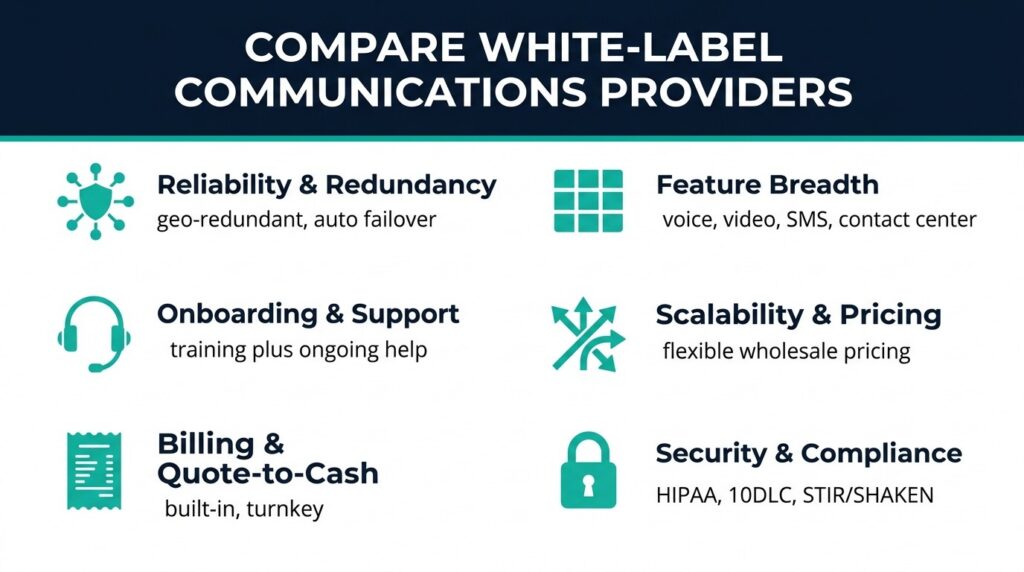
Not every platform is built the same, and the gaps usually show up after you’ve signed. Before you commit to a white-label communications provider, run them through a simple framework. These are the six factors that matter most when you’re evaluating partners.
- Network reliability and redundancy. Your brand is on the line every time a customer picks up the phone, so look for a geo-redundant network with automatic failover across multiple data centers. Ask exactly how the platform keeps calls connected if a single node goes down.
- Feature breadth. A modern platform should cover voice, video, business SMS, auto attendants, call recording, and contact center, and AI-powered features with room to add more over time. The wider the feature set, the more you can sell into each account.
- Onboarding and support. The best providers train you to sell, provision, and bill, then stay reachable when you hit a snag. Weak support is a common reason resellers outgrow a partner and switch.
- Scalability and pricing flexibility. You want a platform that grows from your first customer to your hundredth without forcing you into rigid pricing. Wholesale pricing lets you package and price the way your market expects.
- Billing and quote-to-cash tools. Built-in quoting, billing, and taxation save you from stitching together back-office systems on your own. A turnkey platform gives you hours back every week.
- Security and compliance. Look for HIPAA-ready configurations, fraud monitoring, and support for regulations like 10DLC and STIR/SHAKEN, especially if you plan to serve healthcare, finance, or legal clients.
It helps to understand the key differences between models before you sign because the partner you choose shapes how much of the business you actually own.
How Does a White-Label UCaaS Platform Scale With Your Business?
Scalability is where the cloud model really pays off. With a white-label UCaaS platform, growth doesn’t mean buying servers or hiring a deployment crew. Most of the time, it means clicking a few buttons in your portal.
Adding Users and Features Without New Hardware
Because the platform lives in the cloud, you can add seats, enable features, and provision phones through self-service tools in your portal. There’s no on-site installation and no waiting on hardware orders, so a customer who needs 10 more lines tomorrow can have them today. Speed is a selling point your customers will notice, and it keeps your own operation lean as you grow.
Expanding Into New Services as You Grow
Once you’ve landed a customer on core voice, you can layer on higher-value services over time. Common add-ons that grow your average revenue per customer include:
- Contact center for omnichannel customer support
- Business SMS for appointment reminders and marketing campaigns
- Virtual fax and Microsoft Teams integration for specialized workflows
Each add-on is another reason for a customer to stay and another line on your monthly invoice. A flexible communications platform lets you start simple and expand without re-platforming, which protects both your time and your margins.
What Recurring Revenue Can a Hosted PBX Reseller Build?
Here’s the part that changes your business. A hosted PBX reseller isn’t selling a one-time box. You’re selling a monthly service that renews on its own. That shift from project revenue to recurring revenue turns a reseller into a durable, sellable business.
Why Monthly Recurring Revenue Is a Game Changer
Recurring revenue is predictable, it compounds, and it’s far more valuable than one-off sales. Every customer you add stacks on top of the last, so your revenue base keeps growing month after month, even when you’re not closing new deals. Businesses built on predictable recurring revenue also tend to command higher valuations, which matters a lot if you ever plan to sell.
Owning the Customer Relationship and Your Margins
As a hosted PBX reseller, you set your own prices and bill your customers directly, so you control your margins and own the relationship end to end. That ownership is the difference between being an agent who earns a referral cut and being a provider who builds real equity in a customer base. A structured reseller program gives you the billing, training, and support to make that ownership practical from your very first account.
Frequently Asked Questions
What’s the difference between white-label UCaaS and reselling as an agent?
With white-label UCaaS, you own the brand, set the pricing, and control the customer relationship, while an agent simply refers business and collects a commission. The white-label model takes more involvement, but it builds a recurring revenue base that’s genuinely yours. Serious resellers choose white-label over an agent arrangement once they’re ready to grow.
How fast can you launch a white-label communications platform?
With a committed effort, you can launch a white-label communications platform business in as little as 30 days. Full onboarding and training programs typically run a few weeks longer, but you don’t have to wait for everything to be perfect before you start selling. The cloud model removes the infrastructure delays that used to make launching a phone business slow.
What’s the difference between UCaaS and VoIP?
VoIP refers to voice calling over the internet, while UCaaS bundles that voice service with video, messaging, collaboration, and contact center into one platform. Most business customers expect the full UCaaS experience rather than voice alone. Selling a complete platform also gives you more to upsell and a stickier customer over the long run.
Do you need deep technical expertise to become a hosted PBX reseller?
No. A good white-label communications provider handles the complex infrastructure and trains you on provisioning, billing, and support. You bring the customer relationships and local market knowledge, and the platform supplies the technology and the backup when you need it.
The Bottom Line for Resellers
A white-label UCaaS platform is one of the clearest paths to recurring revenue and long-term business growth in communications. The market is expanding, businesses are retiring old phone systems, and they’d rather buy from a trusted local partner than a faceless carrier. That partner can be you.
Building a branded communications business with the technology, training, and support to back it up requires the right partner. SkySwitch gives you a complete white-label UCaaS platform and a reseller program built for growth. Get started today to see how quickly you can launch.

Jessica is a marketing and sales strategist with deep expertise in VoIP telecommunications. As a Marketing Director, she specializes in channel marketing, account management, and product marketing within the communications industry. Jessica is passionate about helping partners grow through compelling messaging and hands-on support.