
How to Start a White-Label Communications Platform Business

The white-label model lets you sell branded voice, video, and messaging without building or maintaining a single piece of infrastructure.
- A white-label communications platform gives you full control over branding, pricing, and the customer relationship while a provider runs the back end.
- Recurring subscription revenue creates a predictable monthly cash flow that compounds with every customer you add.
- Cloud scalability and operational simplicity let you grow without piling on hardware, data centers, or a large technical team.
- The platform partner you pick matters most: reliability, support, billing tools, and AI-ready features separate the winners from the headaches.
If you serve businesses still running aging phone systems, now is the moment to evaluate a white-label communications platform and turn telecom services into your next recurring revenue stream.
Businesses are abandoning premises-based phone systems, and they want one partner who can modernize how their teams call, message, and collaborate. That shift is opening real territory for MSPs, IT shops, interconnects, and telecom resellers. The global UCaaS market was estimated at roughly $106 billion in 2025 and is projected to reach $404 billion by 2033, growing at a 17.7% compound annual rate. Launching a white-label communications platform lets you ride that growth with your own brand on the front of an enterprise-grade solution, while a provider handles the switches, carriers, and uptime behind the scenes.
This guide walks through what the model is, why owning the platform experience pays off, the steps to launch, how to evaluate a partner, and who’s best positioned to win.
What Is a White-Label Communications Platform?
A white-label communications platform is a cloud-based system you license from a provider, rebrand as your own, and resell to your customers. You get the voice, video, messaging, fax, and collaboration capabilities of an enterprise-grade system, but your customers see your logo, your pricing, and your support team.

The model is the engine behind both white-label UCaaS and hosted voice resale. Instead of investing years and serious capital into carrier relationships, data centers, and software development, you plug into a proven platform and focus on selling and serving. The appeal of white-label business communications is that you own the brand and the customer, and the provider owns the heavy lifting.
It’s worth distinguishing a few terms people use loosely. VoIP is the underlying calling technology. UCaaS bundles voice with video, messaging, presence, and collaboration into one cloud service. A communications platform is the broader package you actually resell, including the portals, billing, and provisioning tools that make running the business practical. When you understand how UCaaS benefits IT resellers, the platform layer is where most of your day-to-day value and margin live.
Why Does Owning the Platform Experience Matter Now?
Plenty of resellers can sell a phone line. Far fewer own the entire experience their customer touches every day. Ownership turns a one-time sale into a durable, profitable relationship. Demand for cloud communications keeps climbing as companies retire on-premise gear, and a white-label communications platform is how you capture that demand under your own name.
Recurring Revenue You Actually Control
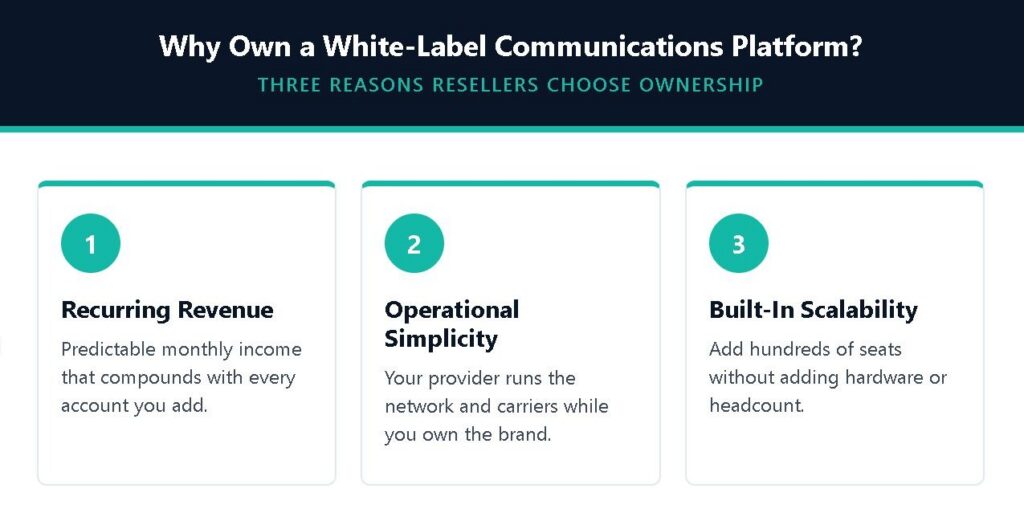
Unlike one-time hardware sales, communications services generate monthly recurring revenue that builds a predictable base. The subscription model is what buyers want, with research from Mordor Intelligence finding that around 62% of CFOs prefer operating-expense IT models for the balance-sheet flexibility they offer. Your customers depend on these tools every single day, which makes them far less likely to churn than most other services you might sell. Because you set your own pricing and bill customers directly, you control your margins and the longevity of your agreements rather than waiting on a vendor’s payout schedule. Stack enough accounts, and that recurring base becomes the most valuable asset in your books.
Operational Simplicity Without the Infrastructure
Owning the brand doesn’t mean owning the burden. Your provider runs the network, carriers, and core software, so you skip the capital expense and maintenance that come with traditional telecom. That simplicity flows straight to your customers too. Moving off aging, premises-based phone systems lets a business trade unpredictable hardware and maintenance costs for a single, predictable monthly subscription, which gives you a concrete reason for prospects to switch. You get to lead with modernization and savings instead of apologizing for a clunky legacy system.
Scalability That Grows With You
When a customer doubles in size or opens three new locations, your provider absorbs the backend scaling. You can add hundreds of seats without worrying about server capacity, redundancy, or technical maintenance. Growth doesn’t automatically translate into more headcount on your side, which is how a small reseller competes with national carriers. If you’re launching your reseller brand from scratch, elasticity keeps your operation lean while your revenue compounds.
What Are the Steps to Launch a White-Label Communications Business?
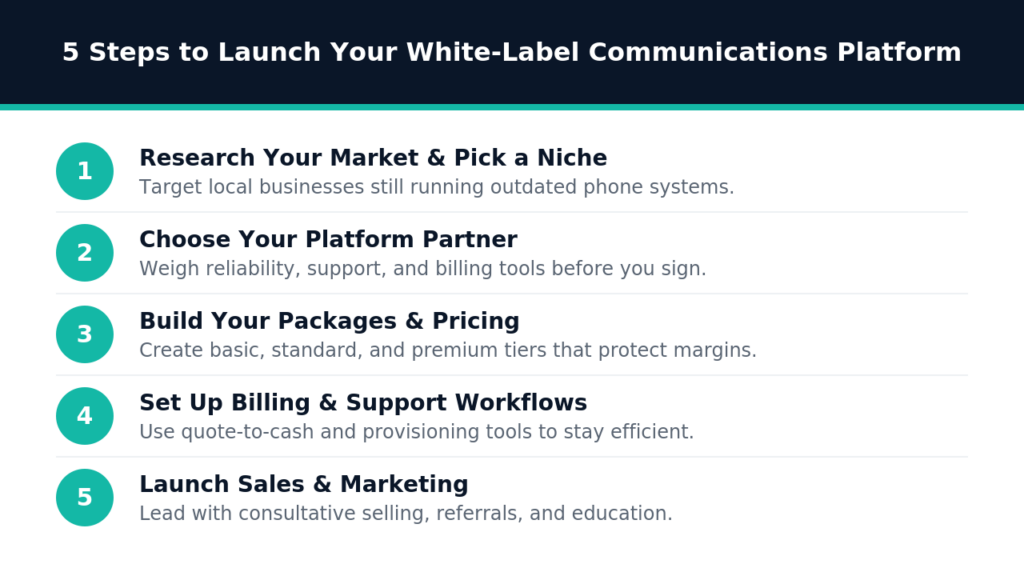
Getting started is more about strategy than technology, since the platform itself is already built. Here’s the practical path resellers follow to start a white-label communications platform business:
- Research your market and pick a niche. Map the businesses in your area still running outdated phone systems, and look for industries where you already have credibility. Specializing in a vertical, such as healthcare, professional services, or multi-location retail, lets you tailor your pitch and command better pricing.
- Choose your platform partner. This decision shapes everything else, so weigh reliability, support, and billing tools carefully before you sign. Talk to existing resellers and ask hard questions about uptime, onboarding, and roadmap. The path to becoming a service provider relies on this choice.
- Build your packages and pricing. Create tiered bundles, often a basic, standard, and premium tier, that match different customer sizes and needs. Research local competition so your pricing stays competitive while protecting healthy margins.
- Set up onboarding, billing, and support workflows. Even though the provider handles infrastructure, you still need clean processes for quoting, provisioning, billing, and issue resolution. Good platforms include quote-to-cash and provisioning tools that make this aspect far easier.
- Launch your sales and marketing engine. Communications sells best through relationships and referrals, so pair consultative selling with educational content that addresses reliability and cost concerns head-on. Show prospects exactly how the switch improves their day.
How Do You Evaluate a White-Label UCaaS Provider?
Your provider becomes an extension of your brand, so evaluation deserves more than a feature checklist. The strongest white-label UCaaS partners offer transparent pricing, a proven track record, and a genuine partnership approach rather than a transactional vendor relationship. Dig beneath the marketing and pressure-test the areas below before you commit.
Reliability and Geo-Redundant Networks
Network reliability is your reputation. Look for providers with geo-redundant networks and multiple data centers that deliver automated failover, so a single point of failure never takes your customers offline. Ask how they communicate during incidents because transparency when something goes wrong is just as important as preventing the issue in the first place.
Onboarding, Support, and Enablement
Comprehensive onboarding and ongoing support determine how fast you reach profitability. The best partners provide structured training, marketing resources, and clear escalation paths for complex technical issues. When you’re choosing the best platform, prioritize partners that invest in your success after the contract is signed, not just before it.
Billing, Taxation, and Provisioning Tools
Administrative overhead eats reseller margins. Efficient billing platforms, automated provisioning, and built-in taxation and compliance support streamline operations and reduce costly errors. Telecom tax is complicated, so a partner that handles the heavy lifting here saves you from a major operational headache. This area is worth scrutinizing closely when you’re evaluating a wholesale provider.
AI-Ready and Future-Proof Features
Modern buyers expect a complete platform, including voice, video, messaging, mobile apps, auto attendants, call routing, and CRM integrations. AI features are increasingly built into UCaaS platforms, so it’s smart to choose a partner with a forward-looking roadmap rather than a static product. A platform that keeps evolving lets you bring new capabilities to customers without rebuilding your business each time the market shifts.
Who Should Become a Hosted PBX Reseller?
The white-label model fits a wide range of businesses, especially those with existing customer relationships they can extend. If you already advise companies on technology, adding communications is a natural way to deepen those relationships and add a recurring revenue line. The strongest candidates for becoming a hosted PBX reseller usually include:
- MSPs and IT service providers who already manage networks and want to bundle voice into their stack.
- Interconnects and VARs transitioning customers off legacy or premises-based systems.
- System integrators and copier or equipment dealers looking to package communications into longer-term contracts.
What unites these groups is access to small and medium-sized businesses that value local service and personal relationships over a faceless national carrier. As a hosted PBX reseller, your edge is consultative guidance plus a modern platform, a combination that the big providers struggle to match.

Frequently Asked Questions
How fast can I launch a white-label communications platform business? With the right partner and a real commitment, you can begin selling in as little as 30 days. Full onboarding and training programs typically run several weeks beyond that, but committed resellers don’t have to wait for the entire program to finish before signing their first customer.
Do I need deep technical expertise to resell hosted voice? No. A basic understanding of networking and cloud communications helps with customer conversations, but your provider handles the infrastructure and offers training and support. Most successful resellers come from sales, IT services, or telecom backgrounds and learn the platform as they go.
What’s the difference between white-label UCaaS and white-label VoIP? White-label VoIP focuses on the calling layer, while white-label UCaaS bundles voice with video, messaging, presence, and collaboration in one cloud service. A communications platform wraps those services together with the portals, billing, and provisioning tools you need to run the business.
How do resellers make money on a white-label communications platform? You set your own prices and bill customers directly, keeping the margin between your provider’s wholesale cost and your retail price. Because the revenue is subscription-based, it recurs every month and grows as you add accounts, which is what makes the model so attractive.
Can a white-label communications platform integrate with my customers’ existing tools? Yes. Modern platforms offer extensive integrations with CRMs, productivity suites, and industry-specific software. These integrations make your service stickier and help justify premium pricing.
Ready to Build Your White-Label Communications Platform?
The opportunity in front of resellers is hard to overstate: a growing market, predictable recurring revenue, and a model that lets you own the brand and the customer without owning the infrastructure. Success comes down to choosing the right partner and staying focused on customer outcomes. As businesses keep modernizing their communications and embracing hybrid work, demand for reliable, feature-rich white-label business communications will only keep climbing.
SkySwitch provides a turnkey white-label communications platform that empowers resellers to launch and scale quickly and profitably, backed by geo-redundant networks, comprehensive training, and dedicated partner support. Explore the SkySwitch reseller program to see how the platform fits your business, and get started today to join the growing community of successful white-label communications entrepreneurs.

Jessica is a marketing and sales strategist with deep expertise in VoIP telecommunications. As a Marketing Director, she specializes in channel marketing, account management, and product marketing within the communications industry. Jessica is passionate about helping partners grow through compelling messaging and hands-on support.