
Voice API Security: What Resellers Must Know

Resellers looking to offer programmable communication solutions to their clients must prioritize voice API security.
- Failures can result in million-dollar FCC fines, customer data breaches, and business closure for telecommunications resellers.
- Essential requirements include FCC registration compliance, HIPAA adherence for healthcare clients, robust authentication frameworks, and end-to-end encryption.
- Most resellers underestimate the complexity of telecommunications compliance.
Partnering with a security-focused white-label provider dramatically reduces risk while ensuring scalable growth.
Voice API security is one of the most critical yet underestimated challenges facing telecom resellers. With API attacks increasing by 27% and voice communications becoming the backbone of business operations, security failures can devastate reseller businesses through regulatory penalties, customer losses, and reputation damage.
The stakes are high for resellers entering the programmable voice market. Recent enforcement actions demonstrate the FCC’s aggressive stance on compliance violations, including a $1 million penalty for regulatory non-compliance. Meanwhile, cybersecurity threats targeting voice infrastructure continue escalating, with toll fraud losses reaching billions annually across the telecommunications industry.
For resellers building UCaaS businesses, voice API security requires navigating federal compliance requirements, implementing enterprise-grade security controls, and maintaining continuous monitoring across customer deployments. The challenge lies in balancing comprehensive security with operational efficiency and competitive pricing.
What Are the Fundamentals of Voice API Security?
Voice API security differs from standard web application security due to the real-time nature of voice communications and the regulatory environment governing telecom services. When resellers implement voice APIs, they’re handling sensitive customer communications that flow through multiple network segments, carrier interconnections, and potentially regulated industries.
The foundation of secure telecom API implementation begins with understanding the data flow. Voice communications typically involve signaling protocols like SIP (Session Initiation Protocol) for call setup and RTP (Real-time Transport Protocol) for media transmission. Each protocol presents unique security challenges that require specialized protection mechanisms.

Authentication is the first line of defense in programmable voice security. Unlike traditional web APIs that may rely solely on API keys, voice communications require robust identity verification that can handle both programmatic access and real-time session management. Solutions must have OAuth 2.0 frameworks for application authentication while maintaining low-latency performance for voice traffic.
Network security becomes complex in voice API implementations due to the need for real-time media processing. Voice traffic requires predictable routing paths and consistent quality of service, making traditional network security approaches like dynamic firewall rules potentially disruptive to call quality. Successful implementations require a careful balance between security controls and performance.
What Are the Current Compliance Requirements for Telecom Resellers?
Telecommunications resellers face federal, state, and industry-specific compliance requirements that many underestimate when entering the voice API market. The FCC treats resellers as telecom providers subject to the same regulatory obligations as facilities-based carriers, regardless of their underlying infrastructure arrangements.
Federal Communications Commission Requirements
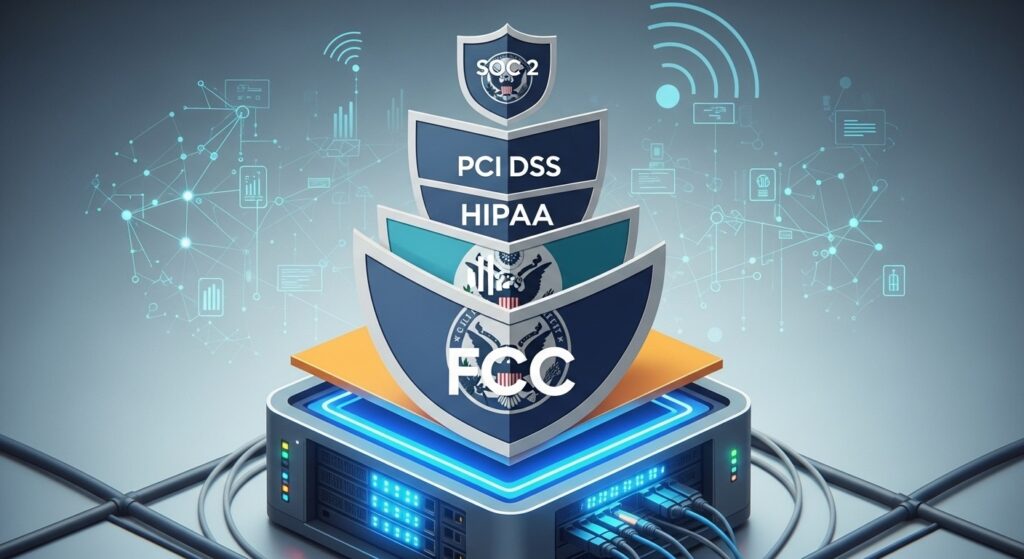
Whether you offer VoIP, SIP trunking, or UCaaS solutions, every telecom reseller must register with the FCC using Form 499-A and maintain current information about their services, coverage areas, and revenue reporting. FCC registration requirements apply to any entity reselling voice services, including those operating through white-label arrangements with wholesale providers.
Customer Proprietary Network Information (CPNI) compliance is an ongoing obligation for resellers. CPNI rules govern how resellers collect, use, and protect customer usage data, billing information, and communication patterns. Annual certifications are required, and violations can result in substantial penalties.
Universal Service Fund (USF) contributions create ongoing financial obligations for resellers based on their interstate revenue. Accurate revenue reporting requires billing systems that can properly categorize traffic as interstate, intrastate, or international. Many resellers struggle with this requirement due to inadequate billing platform capabilities or a lack of understanding about traffic classification rules.
Healthcare Industry Compliance
Healthcare clients present a lucrative opportunity for resellers, but serving this market requires HIPAA compliance across all voice communications. HIPAA regulations create specific obligations for voice service providers handling Protected Health Information (PHI).
Business Associate Agreements (BAAs) are required when voice APIs process, store, or transmit PHI. However, many programmable voice security providers qualify for the “conduit exception” if they only provide transmission services without accessing or storing content. Resellers must carefully evaluate their service model to determine when BAAs are required versus when conduit protections apply.
Technical safeguards under HIPAA include access controls, audit controls, integrity protections, person authentication, and transmission security. For compliance APIs, these requirements translate to encrypted communications, secure authentication systems, detailed logging of all access and system activity, and procedures for detecting and responding to security incidents.
Industry-Specific Security Standards
Financial services clients often require SOC 2 Type II compliance, which evaluates security, availability, processing integrity, confidentiality, and privacy controls. Voice APIs serving financial institutions must include comprehensive security frameworks that address data encryption, network security, access management, and business continuity planning.
PCI DSS compliance is relevant when voice APIs integrate with payment processing systems or handle cardholder data during voice interactions. Financial businesses must have methods of securing voice recordings that might contain credit card information and implement proper data retention and destruction procedures.
What Are the Essential Security Controls for Voice APIs?
Building comprehensive voice API security requires multiple layers of protection that address the unique challenges of real-time communications while maintaining compliance with regulations.
Authentication and Authorization Frameworks
OAuth 2.0 and OpenID Connect provide the foundation for secure API authentication, but voice APIs require additional considerations for session management and real-time access control. Implement multi-factor authentication for administrative access while ensuring authentication tokens can support the low-latency requirements of voice communications.
API key management includes key rotation schedules, usage monitoring, and automatic revocation procedures. Voice APIs typically require longer lived credentials than web APIs due to persistent connection requirements, making comprehensive monitoring essential for detecting unauthorized usage patterns.
Role-based access control (RBAC) enables granular permissions management across different user types and service levels. Design permission structures that align with your customer deployment models, allowing for flexible configurations while maintaining security boundaries between different client environments.
Encryption Standards and Implementation
Transport Layer Security (TLS) 1.3 should be mandatory for all API communications, with perfect forward secrecy enabled to protect against future cryptographic compromises. Voice APIs require consistent encryption across both signaling and media streams, often using SRTP (Secure Real-time Transport Protocol) for media encryption.
End-to-end encryption presents unique challenges in voice communications due to the need for media processing, transcoding, and quality monitoring. Evaluate whether your use cases require full end-to-end encryption or whether transport encryption with secure processing environments provides adequate protection while maintaining operational flexibility.
Certificate management becomes critical in voice API deployments due to the number of interconnection points and the real-time nature of communications. Implement automated certificate provisioning and renewal processes that can handle large-scale deployments without service interruption.
Fraud Prevention and Anomaly Detection
Rate limiting protects against denial-of-service attacks and toll fraud by controlling the volume and pattern of API requests. Implement dynamic rate limiting that can adapt to legitimate usage patterns while quickly detecting and blocking suspicious activity. Voice APIs require sophisticated rate limiting due to the variable nature of legitimate voice traffic.
Anomaly detection systems should monitor multiple dimensions of voice traffic, including call volume patterns, destination analysis, duration distributions, and geographic usage patterns. Machine learning detection systems can identify subtle patterns that indicate fraudulent activity while minimizing false positives that disrupt legitimate business operations.
Toll fraud prevention requires specialized monitoring of international calling patterns, premium rate destinations, and unusual call routing behaviors. Implement real-time blocking capabilities for high-risk destinations while providing administrative override capabilities.
Monitoring and Incident Response
Comprehensive logging must capture all API access attempts, system configuration changes, and security events while remaining compliant with data retention regulations. Voice API logs require careful handling due to the potential for capturing sensitive communication metadata that may be subject to privacy regulations.
Security Information and Event Management (SIEM) integration enables correlation of security events across multiple systems and platforms. Focus on detecting patterns that indicate coordinated attacks, credential compromise, or systematic abuse of voice services. Automated response capabilities can provide immediate protection while human analysts investigate complex incidents.
Incident response procedures should address both cybersecurity events and regulatory compliance incidents. Develop clear escalation procedures that account for different types of security events, customer notification requirements, and regulatory reporting obligations.
What Are Common Security Mistakes Resellers Make?
Many resellers enter the voice API market with an insufficient understanding of the security challenges inherent in telecom services. These common mistakes can result in compliance violations, security breaches, and business disruption.

Generic Security Considerations
The most frequent error involves treating voice APIs like standard web services without accounting for telecom-specific requirements. Voice communications involve regulatory obligations, carrier interconnections, and real-time performance requirements that demand specialized security. Resellers who apply generic API security practices often discover gaps when facing regulatory audits or security incidents.
Focusing Solely on Features and Pricing
Inadequate due diligence is another critical failure point. Many resellers focus primarily on features and pricing when evaluating voice API providers without thoroughly assessing security capabilities, compliance certifications, and incident response procedures. This oversight can expose resellers to liability when their chosen provider experiences security incidents or compliance failures.
Inadequate Security Controls
Customer onboarding processes frequently lack adequate security controls, particularly around identity verification and usage monitoring. Insufficient know-your-customer procedures can expose resellers to fraud liability, while inadequate usage monitoring fails to detect abuse patterns until significant damage occurs.
Insufficient Data Considerations
Data retention and privacy policies often receive insufficient attention during initial implementation but become critical during regulatory audits or legal proceedings. Many resellers lack clear procedures for handling customer data requests, law enforcement inquiries, and regulatory investigations. This oversight can result in compliance violations even when technical security controls are properly implemented.
Ignoring Emergency Planning
Emergency response planning typically focuses on technical outages while neglecting security incident scenarios. Voice services require rapid response to security events due to the potential for ongoing fraud losses and regulatory reporting requirements. Inadequate incident response can transform manageable security events into business-threatening crises.
How Do You Build a Security-First Approach?
Compliance APIs require embedding security into every aspect of your reseller business, from initial customer acquisition through ongoing service delivery and support. This comprehensive approach protects against both technical threats and regulatory compliance failures.
- Start with a thorough risk assessment that evaluates your target customer segments, planned service offerings, and growth projections. Different market segments present distinct security challenges and compliance requirements.
- Vendor selection should prioritize security capabilities and compliance certifications alongside features and pricing. Evaluate potential voice API providers based on their security track record, incident response capabilities, and willingness to provide transparency about their security practices.
- Customer security requirements should be clearly defined and consistently enforced across all client deployments. Develop standard security questionnaires, configuration templates, and deployment procedures that ensure consistent security baselines while allowing for customization based on specific requirements.
- Staff training and certification programs ensure your team maintains current knowledge of security best practices and regulatory requirements. Voice API security involves specialized knowledge that extends beyond general IT security, requiring ongoing education about telecom regulations, voice protocol security, and industry-specific compliance.
Regular security assessments and penetration testing help identify vulnerabilities before attackers can exploit them. Voice API environments require specialized testing approaches that account for real-time communications protocols and telecom infrastructure.
Frequently Asked Questions
What FCC compliance requirements apply to voice API resellers?
Voice API resellers must register with the FCC using Form 499-A, file annual revenue reports for Universal Service Fund contributions, maintain CPNI compliance, and adhere to all applicable telecommunications regulations. The FCC treats resellers as telecommunications providers regardless of their underlying infrastructure arrangements.
How does HIPAA compliance work for voice APIs serving healthcare clients?
HIPAA compliance APIs depend on whether the service processes, stores, or transmits Protected Health Information. Voice API providers may qualify for the “conduit exception” if they only provide transmission services without accessing communication content. However, many voice API implementations require Business Associate Agreements due to features like call recording, transcription, or integration with healthcare systems.
What security measures are essential for programmable voice security?
Essential security measures include OAuth 2.0 authentication, TLS 1.3 encryption for all communications, SRTP encryption for voice media, comprehensive rate limiting, fraud detection systems, detailed security logging, and incident response procedures. Voice APIs also require specialized protections against toll fraud, unauthorized call routing, and abuse of premium rate services.
How can resellers ensure compliance API implementations meet regulatory requirements?
Compliance API implementations require understanding the specific regulations applicable to your target markets, implementing appropriate technical safeguards, maintaining detailed documentation of security controls, conducting regular compliance assessments, and working with legal counsel experienced in telecom law. Regular training and certification programs help ensure ongoing compliance as regulations evolve.
Build a Secure Voice API Business
Voice API security is a critical business requirement that extends beyond basic cybersecurity into complex regulatory compliance and operational risk management. Resellers who underestimate these requirements face financial and legal exposure, while those who implement comprehensive security frameworks gain advantages through enhanced customer trust and regulatory confidence.
Building a successful voice API reseller business requires balancing comprehensive security with operational efficiency and competitive pricing. The companies that achieve this balance through strategic partnerships and systematic security implementation will capture the greatest opportunities in the expanding voice communications market.
SkySwitch provides enterprise-grade voice API security with FCC compliant, HIPAA-ready configurations, and proven fraud protection systems that enable resellers to focus on growth while maintaining the highest security standards. Keep in mind, it is the reseller’s responsibility to stay updated with the latest FCC requirements and consult the FCC website for new information.
Get started today to upgrade your reseller business’s security without the complexity of managing telecom compliance independently.

Jessica is a marketing and sales strategist with deep expertise in VoIP telecommunications. As a Marketing Director, she specializes in channel marketing, account management, and product marketing within the communications industry. Jessica is passionate about helping partners grow through compelling messaging and hands-on support.