
White Label Billing: The Key to Profitability for VoIP and UCaaS Resellers

White label billing is the difference between struggling with thin margins and thriving with high profitability in the UCaaS reseller market.
- Automated billing for resellers eliminates manual overhead that can consume large portions of gross margins.
- Tax compliance automation protects against costly penalties while reducing administrative burden.
- Integrated billing platforms streamline workflows and enable scaling without proportional staff increases.
- Modern UCaaS billing software provides real-time analytics that optimize pricing strategies and reduce revenue leakage.
The resellers who master billing automation dominate their markets while others struggle to stay afloat.
The UCaaS market is projected to grow from $66.42 billion in 2025 to $215.5 billion by 2032, creating opportunities for resellers. Yet many UCaaS and VoIP resellers find themselves trapped in a cycle of low margins and administrative overhead, watching profits disappear into billing complexity. The difference between struggling resellers and thriving ones often comes down to one critical factor: their approach to white label billing.
Telecom companies lose approximately 2% of annual revenue due to billing errors alone. For resellers operating on thin margins, these losses can mean the difference between profitability and failure. The solution lies in partnering with a white-label platform with automated billing for resellers that transforms administrative burden into a competitive advantage.
Why Is Billing the Foundation of Reseller Profitability?
Most resellers focus on features, pricing, and support when evaluating UCaaS platforms. However, the most successful resellers understand that billing automation forms the foundation of their entire business model. Without efficient billing, even the best UCaaS solutions become profit drains.
Traditional billing approaches force resellers into a resource-intensive cycle of manual invoice generation, payment tracking, and regulatory compliance management. This overhead typically consumes 15 to 20 hours per month. Manual billing requires dedicated staff time for invoice generation, usage calculation, tax compliance, and payment processing. These labor costs scale linearly with customer growth, creating a ceiling on profitability. Meanwhile, resellers using modern automated billing systems can reduce this time drain by 87%.
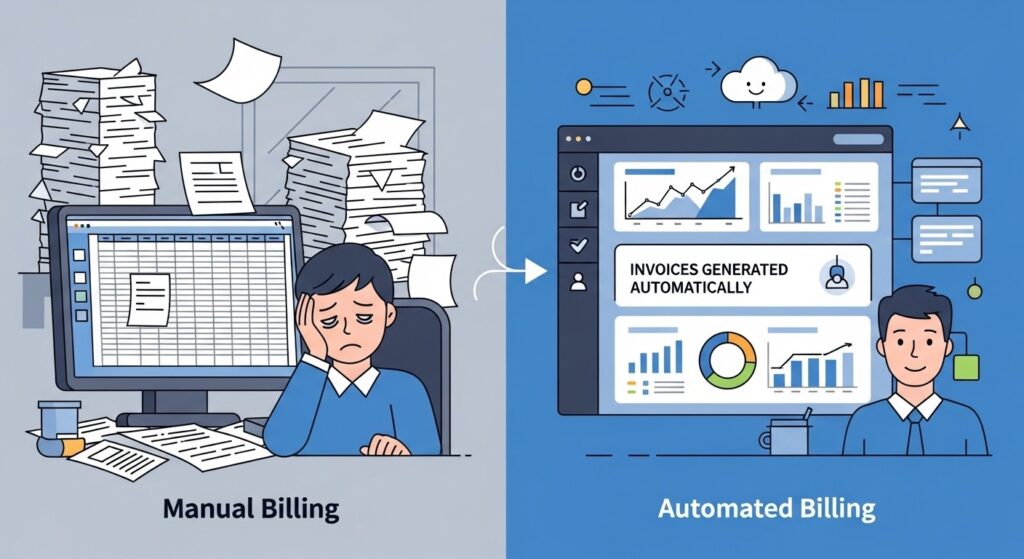
Automated billing for resellers eliminates these inefficiencies while providing scalability. Modern systems handle complex usage calculations, apply appropriate taxes, generate branded invoices, and process payments without human intervention. Automation allows resellers to grow their customer base exponentially without proportionally increasing their administrative overhead.
What Are the Hidden Costs of Manual Billing Systems?
The true cost of manual billing extends beyond obvious labor expenses. Hidden costs accumulate through delayed payments, compliance risks, customer disputes, and missed revenue opportunities.
Manual billing cycles often create delays between service delivery and invoice generation. These delays compound when customers dispute unclear charges or request clarification on complex invoicing. Extended payment cycles strain cash flow and increase collection costs.
Compliance risks pose another substantial hidden cost. Telecom taxation varies by state and changes regularly. Manual tracking of these changes requires constant attention and specialized knowledge. Errors in tax calculation can result in costly audits, penalties, and interest charges that quickly erode profits.
Customer disputes arising from billing errors create both direct and indirect costs. Direct costs include staff time spent resolving disputes and potential revenue adjustments. Indirect costs include damaged customer relationships and increased churn rates. Billing-related customer service issues could result in complete service cancellation.
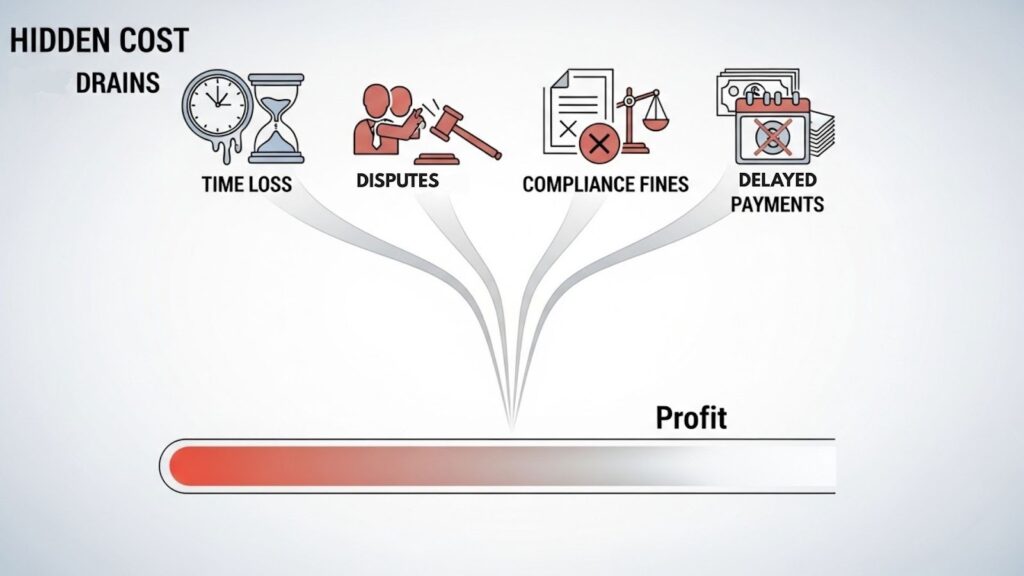
The opportunity cost of manual billing may be the highest hidden expense. While staff members manually process invoices and resolve billing issues, they can’t focus on revenue-generating activities like customer acquisition and retention. This misallocation of resources compounds over time, limiting growth potential and competitive positioning.
How Can Automated White Label Billing Transform Margins?
Modern UCaaS billing software delivers benefits that directly impact profitability. These systems address every aspect of the billing lifecycle while providing the flexibility resellers need to differentiate their offerings.
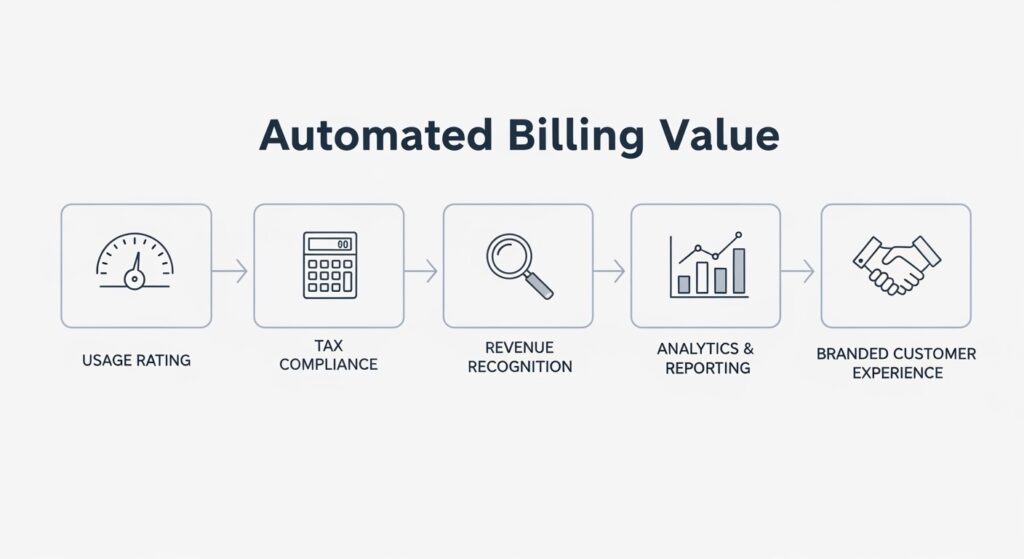
Real-Time Usage Rating and Mediation
Automatic billing processes usage data in real time, instantly applying complex rating rules. Resellers can offer sophisticated pricing models, including usage-based billing, tiered pricing, and hybrid subscription models. Real-time processing eliminates the delays associated with batch processing systems, enabling faster invoicing and improved cash flow.
Automated Tax Compliance
Modern billing systems include built-in tax engines that automatically calculate appropriate taxes based on service location and current regulations. These systems automatically update tax rates and maintain audit trails for compliance. This automation eliminates the need for specialized tax expertise while protecting against costly compliance errors.
Flexible Revenue Recognition
Automated systems handle complex revenue recognition requirements, including deferred revenue accounting and subscription revenue management. This capability is particularly important for resellers offering multi-year contracts or bundled services. Automated revenue recognition ensures accurate financial reporting while reducing accounting overhead.
Advanced Analytics and Reporting
Comprehensive reporting tools provide insights into customer behavior, usage patterns, and profitability metrics. Resellers can optimize pricing strategies, identify upselling opportunities, and detect potential issues before they impact revenue. Advanced systems include predictive analytics that forecast customer lifetime value and churn probability.
Branded Customer Experience
White label billing platforms enable complete branding customization, ensuring customers see only the reseller’s brand throughout the billing experience. This image consistency strengthens customer relationships and reinforces the reseller’s market position. Self-service portals allow customers to manage their accounts independently, reducing support costs while improving satisfaction.
Compliance: Your Shield Against Risk and Penalties
Regulatory compliance is both a significant risk and a competitive differentiator for UCaaS resellers. The telecom industry faces complex and evolving regulatory requirements that vary by jurisdiction and service type.
Federal regulations, including FCC requirements, STIR/SHAKEN compliance, and accessibility standards, create baseline obligations. State and local regulations add additional complexity, with requirements that can vary even within the same metropolitan area. Manual compliance tracking becomes exponentially more complex as resellers expand their geographic footprint.
Automated compliance systems continuously monitor regulatory changes and update billing parameters accordingly. These systems maintain detailed audit trails that demonstrate compliance during regulatory reviews. The automation extends to tax filings, where systems can generate required reports and submit them to the appropriate authorities.
Tax compliance automation is particularly critical given the complexity of telecom taxation. Different service types face different tax requirements, and rates change frequently at local levels. Automated systems track these changes and apply appropriate rates without manual intervention, protecting resellers from costly compliance errors.
Beyond regulatory compliance, automated systems help resellers maintain internal compliance with their own business rules and customer agreements. This includes enforcing credit limits, managing payment terms, and ensuring compliance with service level agreements. Automated monitoring identifies potential issues before they escalate into customer problems or revenue losses.
How to Create Seamless Workflows
The most effective automated billing for resellers integrates seamlessly with existing business systems. This integration eliminates data silos while creating efficient workflows that span the entire customer lifecycle.
CRM integration enables automated customer onboarding and service provisioning. When sales teams close new accounts, integrated systems automatically create billing profiles, provision services, and send welcome communications. This automation reduces onboarding time while eliminating manual data entry errors that can cause billing problems later.
Accounting system integration streamlines financial reporting and reconciliation processes. Automated systems generate journal entries, handle accounts receivable, and maintain detailed transaction records. This integration reduces month-end closing time while improving financial accuracy and visibility.
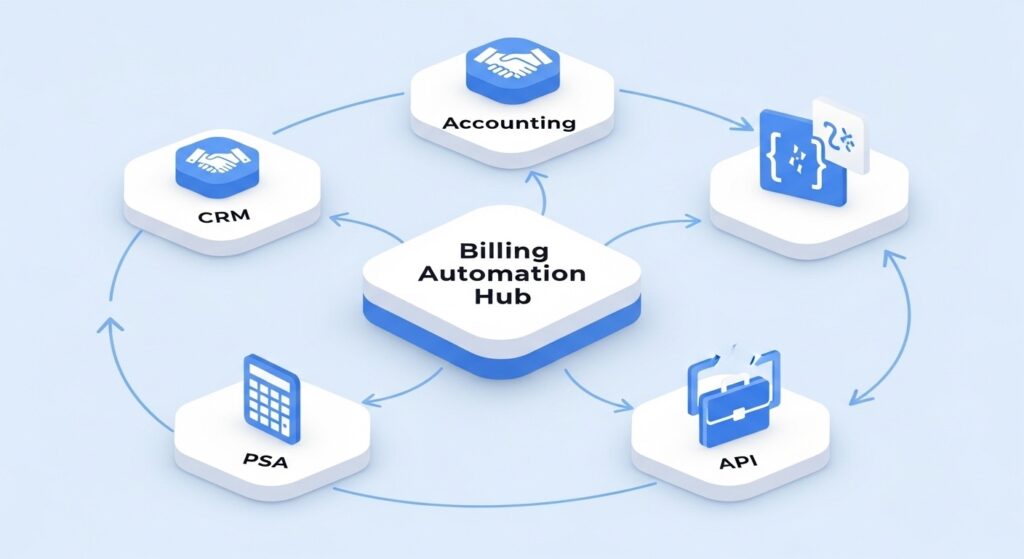
Professional Services Automation (PSA) integration connects billing with service delivery and project management. This connection enables accurate time and materials billing while providing visibility into project profitability. Integration also supports automated billing for professional services delivered alongside UCaaS solutions.
API connectivity allows resellers to integrate billing with custom applications and third-party tools. Modern billing platforms provide comprehensive APIs that support real-time data exchange and automated workflows. This flexibility enables resellers to create unique customer experiences while maintaining operational efficiency.
The integration capabilities extend to customer-facing systems as well. Self-service portals integrate with billing systems to provide real-time account information, usage data, and payment processing. Mobile applications can access billing data to provide on-the-go account management.
How Does Automation Enable Growth?
Manual billing systems create linear scaling challenges where each new customer requires additional administrative support. Automated billing for resellers breaks this cycle by enabling exponential growth with minimal operational scaling.
Automated provisioning workflows handle new customer onboarding without manual intervention. When sales teams close deals, integrated systems automatically create accounts, provision services, and generate initial invoices. Resellers can onboard customers quickly while maintaining accuracy and consistency.
Usage monitoring and billing automation scale effortlessly as customer bases grow. Modern systems process millions of usage records without degrading performance or requiring additional staff. Real-time processing ensures that billing remains current even as usage volumes increase.
Payment processing automation handles the entire payment lifecycle from invoice generation through collection activities. Automated systems process various payment methods, handle failed payments gracefully, and manage dunning processes for overdue accounts. This automation maintains cash flow efficiency regardless of customer volume.
Scalability extends to customer service and support functions. Self-service portals and automated communication systems handle routine customer inquiries without staff intervention. Automated alerts notify customers about upcoming billing events, service changes, or payment issues.
Advanced analytics scale with business growth, providing insights that become more valuable as data volumes increase. Machine learning algorithms identify patterns and trends that would be impossible to detect manually. These insights enable optimized pricing strategies and proactive customer management.
Frequently Asked Questions
How does UCaaS billing software handle complex pricing models?
Modern UCaaS billing software supports virtually unlimited pricing complexity, including usage-based billing, tiered pricing, bundled services, and hybrid models. Systems can simultaneously apply multiple pricing rules and automatically handle proration, discounts, and promotional pricing.
What level of customization is available for white label billing experiences?
Leading white label billing platforms offer complete customization, including logos, color schemes, terminology, and workflow customization. Resellers can create branded customer portals, invoices, and communications that reflect their unique identity. Advanced platforms also support custom business rules and workflow automation.
How do automated billing systems ensure data security and privacy?
Enterprise-grade billing systems implement comprehensive security measures, including data encryption, access controls, audit logging, and compliance certifications. Many platforms maintain SOC 2, PCI DSS, and other industry certifications. Regular security assessments and updates protect against evolving threats while maintaining regulatory compliance.
Simplify Your Reseller Business
White label billing serves as the foundation for profitable UCaaS reselling. The difference between struggling with thin margins and building a thriving business often comes down to billing automation. Resellers who master automated billing gain competitive advantages, including improved margins, streamlined operations, and scalable growth.
The UCaaS market’s growth creates unprecedented opportunities for prepared resellers. However, success requires a comprehensive approach to billing automation that addresses usage rating, tax compliance, customer experience, and operational efficiency.
SkySwitch provides a comprehensive white-label UCaaS platform with integrated billing automation and additional options designed for reseller success. Our Foundations Partner Program includes everything you need to build a profitable UCaaS business, from automated billing and tax compliance to dedicated partner support and training. Get started with SkySwitch today and discover how our proven platform can accelerate your path to profitability.

Jessica is a marketing and sales strategist with deep expertise in VoIP telecommunications. As a Marketing Director, she specializes in channel marketing, account management, and product marketing within the communications industry. Jessica is passionate about helping partners grow through compelling messaging and hands-on support.