
VoIP Network Assessment Tools: Why Resellers Still Need Them

Modern VoIP network assessment tools have evolved from simple connectivity checkers into AI-powered diagnostic platforms essential for hybrid work success.
- Today’s tools provide real-time quality monitoring, predictive issue detection, and compliance validation capabilities that prevent customer problems before they occur.
- Advanced platforms measure critical metrics like jitter, latency, and packet loss while offering automated diagnostics that streamline network troubleshooting.
Choose a comprehensive assessment solution that transforms reactive troubleshooting into proactive network optimization.
Hybrid work has changed how businesses evaluate their communication infrastructure. Unlike the office-centric deployments of previous years, modern VoIP implementations must perform flawlessly across home offices, mobile networks, and shared workspaces where IT teams have limited control over network conditions.
This distributed reality makes VoIP network assessment tools essential for resellers. When a sales call drops during a customer negotiation or a remote team member can’t join an important video conference, the technical root cause might be buried in network configurations that traditional speed tests can’t identify. The shift to distributed workforces has created complex troubleshooting scenarios that require sophisticated diagnostic capabilities.
For resellers, hybrid environments create both challenge and opportunity. Customers expect crystal-clear communication quality regardless of location, but diagnosing connectivity issues across multiple network environments requires tools that go far beyond basic bandwidth measurements. A comprehensive VoIP network assessment tool is the foundation for successful deployments and long-term customer satisfaction.
What Do Modern VoIP Network Assessment Tools Actually Test?
Today’s VoIP network assessment tools have evolved into comprehensive diagnostic platforms that analyze every aspect of voice communication quality. Unlike simple internet speed tests that only measure download and upload bandwidth, professional tools examine the specific network conditions that directly impact voice quality.
Modern platforms test critical performance metrics, including:
- Jitter (variations in packet delivery timing)
- Latency (communication delays that cause awkward conversational gaps)
- Packet loss (data that fails to reach its destination)
These measurements provide precise insights into how real voice calls will perform under current network conditions.

Advanced tools also evaluate Quality of Service configurations, firewall port accessibility, and Session Initiation Protocol Application Layer Gateway interference. These factors often determine the difference between professional-quality business communications and frustrating connectivity problems that damage customer relationships.
The most sophisticated VoIP readiness tests simulate actual voice calls with multiple codecs and concurrent session scenarios. This approach reveals how networks will perform during peak usage periods, providing realistic assessments that help resellers set appropriate customer expectations and identify necessary infrastructure improvements.
Why Speed Tests Alone Fail for VoIP Deployments
While internet speed tests measure raw bandwidth capacity, they completely miss the network characteristics that determine voice quality. A connection might deliver excellent download speeds while simultaneously suffering from variable latency that makes VoIP calls sound choppy and unprofessional.
VoIP communication requires consistent, predictable data delivery rather than maximum throughput. Voice packets must arrive at their destination within specific timing windows to maintain natural conversation flow. When network conditions introduce irregular delays or cause packets to arrive out of sequence, even high-bandwidth connections produce poor call quality.
Network performance for VoIP also depends on factors like router configurations, Quality of Service policies, and traffic prioritization settings that speed tests can’t evaluate. A business might have sufficient bandwidth for dozens of concurrent calls, but without proper QoS implementation, a single large file download could completely disrupt voice communication across the entire network.
Professional assessment tools identify these hidden issues before they impact customers. Comprehensive testing prevents the majority of post-installation connectivity problems, dramatically reducing support costs and improving customer satisfaction scores.
8 Essential Features Every VoIP Network Assessment Tool Must Have
Modern businesses need assessment platforms that address the complex requirements of distributed workforces and advanced technologies. The most effective tools combine traditional network testing with intelligent diagnostics that identify potential issues before they impact business operations.
- Real-Time Quality Monitoring: Continuous measurement of Mean Opinion Score (MOS), jitter levels, and packet loss percentages with automated alerting when metrics exceed acceptable thresholds. Advanced monitoring platforms provide historical trending data that helps identify developing problems before they become critical.
- AI-Powered Predictive Analytics: Machine learning algorithms that analyze network behavior patterns to predict potential connectivity issues days or weeks before they occur, enabling proactive maintenance and preventing customer-impacting outages.
- Multi-Codec Testing Capabilities: Simulation testing with various voice codecs, including G.711, G.722, and Opus, to determine optimal configuration settings for different network conditions and bandwidth availability scenarios.
- Comprehensive Port and Firewall Analysis: Automated verification that all necessary UDP and TCP ports are properly configured for VoIP traffic, with detailed reporting on SIP ALG interference and NAT traversal issues.
- Geographic Performance Mapping: Testing capabilities that measure call quality between multiple locations, essential for businesses with distributed offices or remote workforce deployments.
- Integration with Business Applications: APIs and connectors that link assessment data with CRM systems, ticketing platforms, and network management tools for streamlined workflow integration.
- Mobile Network Assessment: Specialized testing for cellular and WiFi connections that remote workers rely on, including bandwidth fluctuation analysis and mobility handoff evaluation.
- Compliance and Security Validation: Built-in checks for regulatory requirements, including E911 capabilities, HIPAA compliance where applicable, and verification of encryption implementation across all communication channels.
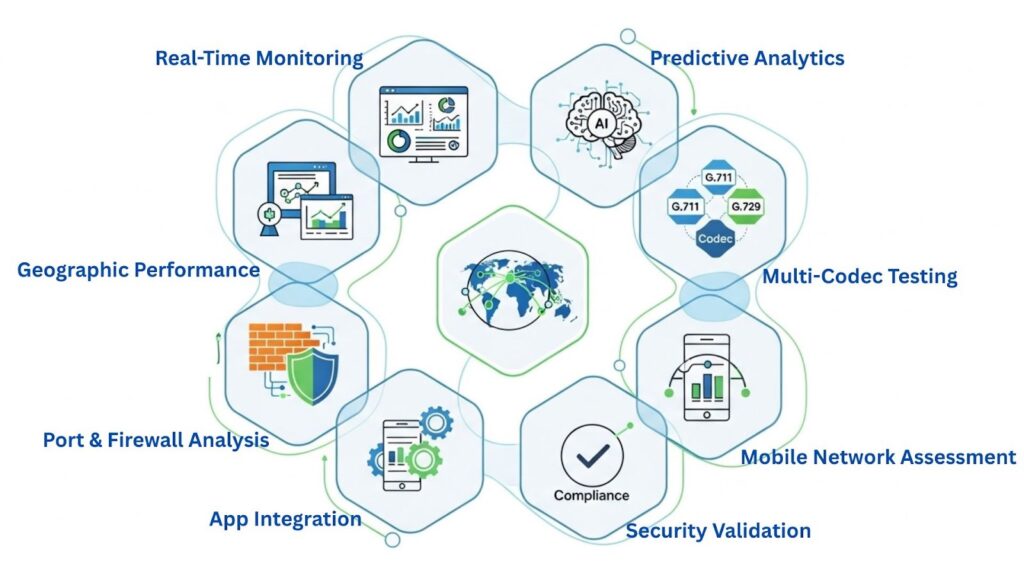
These eight features are the foundation of VoIP network assessment, but the biggest advancement comes from how artificial intelligence enhances each of these capabilities. Traditional assessment tools required manual interpretation of results and reactive responses to network issues, while AI-powered platforms can automatically correlate data across all these feature areas to provide predictive insights.
How Does AI Impact Modern Network Assessment?
Artificial intelligence has shifted VoIP network assessment from reactive problem-solving into predictive maintenance. AI-powered network monitoring identifies subtle patterns that indicate developing issues long before they impact call quality.

Modern AI systems analyze massive volumes of data, including historical call quality metrics, network performance trends, and usage patterns, to establish baseline behaviors for specific environments. When the system detects statistically significant deviations from these baselines, it generates predictive alerts that enable proactive intervention.
Machine learning algorithms excel at identifying the complex relationships between network conditions and voice quality. Traditional monitoring might miss the connection between gradually increasing latency on a specific trunk provider and declining customer satisfaction scores, but AI systems can correlate these seemingly unrelated factors to predict service degradation.
The most advanced platforms use AI to automatically optimize network configurations based on real-time conditions. When the system detects congestion patterns that typically lead to call quality issues, it can automatically adjust Quality of Service policies or recommend routing changes that maintain optimal performance.
What Are the Compliance and Security Considerations?
VoIP regulations are complex, making comprehensive assessment tools essential for maintaining compliance across multiple jurisdictions. New FCC requirements mandate specific capabilities for emergency services, robocall mitigation, and accessibility features that impact network configuration and testing procedures.
TCPA compliance requires careful attention to call routing and consent management, while HIPAA regulations demand encryption verification and access control validation for healthcare communications. Modern compliance frameworks require ongoing monitoring rather than one-time certification, making continuous assessment crucial for maintaining regulatory standing.
Security considerations include fraud detection, intrusion prevention, and network access control validation. Assessment tools must verify that voice traffic travels through properly secured channels while maintaining the performance levels that businesses expect from professional communication systems.
Best Practices for Resellers Using Assessment Tools
Successful resellers approach network assessment as a consultative process that demonstrates expertise while building customer confidence. Rather than simply running tests and providing technical reports, effective resellers use assessment results to educate customers about the relationship between network conditions and business communication quality.
Establish baseline measurements before any UCaaS deployment to document current network performance for VoIP and identify potential improvement areas. Leading resellers conduct follow-up assessments 30 and 90 days after implementation to ensure optimal performance and proactively address any developing issues.
Document all assessment findings with clear explanations of their business impact. Instead of simply noting “high jitter levels,” explain how this condition might cause choppy audio during important customer calls. Help customers understand the value of recommended network improvements.
Use NPAT tools to support ongoing customer relationships rather than just initial deployments. Regular network health checks demonstrate ongoing value while providing opportunities to recommend additional services or upgrades that improve communication quality.
Develop expertise in interpreting assessment results across different industry verticals. A law firm’s communication requirements differ from a manufacturing facility’s needs, and effective resellers understand how to translate technical findings into industry-specific recommendations.
How to Choose the Right VoIP Network Assessment Tool
The platform you select impacts your ability to deliver successful VoIP solutions and maintain long-term customer satisfaction. Evaluate potential providers based on their ability to address the specific challenges your customers face.
Look for platforms that provide white-label capabilities, allowing you to brand the assessment process as your own service rather than directing customers to third-party tools. You can maintain customer relationships while positioning your organization as the technical expert responsible for ensuring optimal communication quality.
Consider integration capabilities with your existing business systems, including CRM platforms, ticketing systems, and billing applications. Comprehensive UCaaS platforms often include built-in assessment tools that integrate with other communication services, providing a unified management experience.
Evaluate the quality and comprehensiveness of reporting capabilities. The best assessment tools generate reports that you can confidently share with customers, complete with clear explanations of findings and specific recommendations for addressing any identified issues.
Ensure that your chosen platform provides adequate training and support resources. Assessment tools are only valuable when your team understands how to interpret results and translate findings into actionable recommendations that benefit customer business operations.
Frequently Asked Questions
What’s the difference between a VoIP readiness test and ongoing network monitoring?
A VoIP readiness test evaluates network conditions at a specific point in time to determine whether the infrastructure can support quality voice communications. Ongoing monitoring continuously tracks network performance to identify developing issues and ensure consistent call quality over time. Both approaches are essential for successful VoIP deployments.
How often should resellers conduct network assessments for existing customers?
Quarterly assessments provide a good balance between proactive monitoring and resource efficiency. However, conduct additional assessments whenever customers report call quality issues, make significant network changes, or expand their communication requirements to new locations.
Can assessment tools help identify security vulnerabilities in VoIP networks?
Yes, comprehensive assessment platforms include security evaluation capabilities that identify common vulnerabilities like open SIP ports, weak authentication configurations, and inadequate encryption implementation. However, these tools complement rather than replace dedicated cybersecurity assessments.
What metrics should resellers prioritize when explaining assessment results to customers?
Focus on business-impact metrics like call completion rates, audio quality scores, and connection reliability rather than technical measurements. Customers care more about whether their calls will be clear and professional than about specific jitter measurements or codec configurations.
Find the Right White-Label Partner for VoIP Success
Distributed workforces make sophisticated network assessment capabilities more critical than ever for reseller success. Customers expect flawless communication quality across diverse network environments, and simple speed tests can’t provide the comprehensive insights necessary to ensure optimal performance.
Professional VoIP network assessment tools enable resellers to transform reactive problem-solving into proactive network optimization. By identifying potential issues before they impact customer communications, these platforms help build stronger customer relationships while reducing support costs and improving overall satisfaction scores.
SkySwitch provides comprehensive assessment capabilities integrated directly into our white-label UCaaS platform, giving resellers everything they need to deliver exceptional customer experiences from initial deployment through ongoing support. Get started with SkySwitch to discover how the right assessment tools can accelerate your business growth.

Jessica is a marketing and sales strategist with deep expertise in VoIP telecommunications. As a Marketing Director, she specializes in channel marketing, account management, and product marketing within the communications industry. Jessica is passionate about helping partners grow through compelling messaging and hands-on support.