
Best Wholesale VoIP Providers in 2026: Features, Pricing & How to Choose

Choosing a wholesale VoIP provider in 2026 is about finding a partner that lets you build a real business under your own brand rather than finding the cheapest per-minute rate.
- The VoIP market is projected to reach $195.39 billion in 2026, growing to $388.97 billion by 2034 at a 10.4% CAGR. That’s a massive runway for resellers ready to claim their slice.
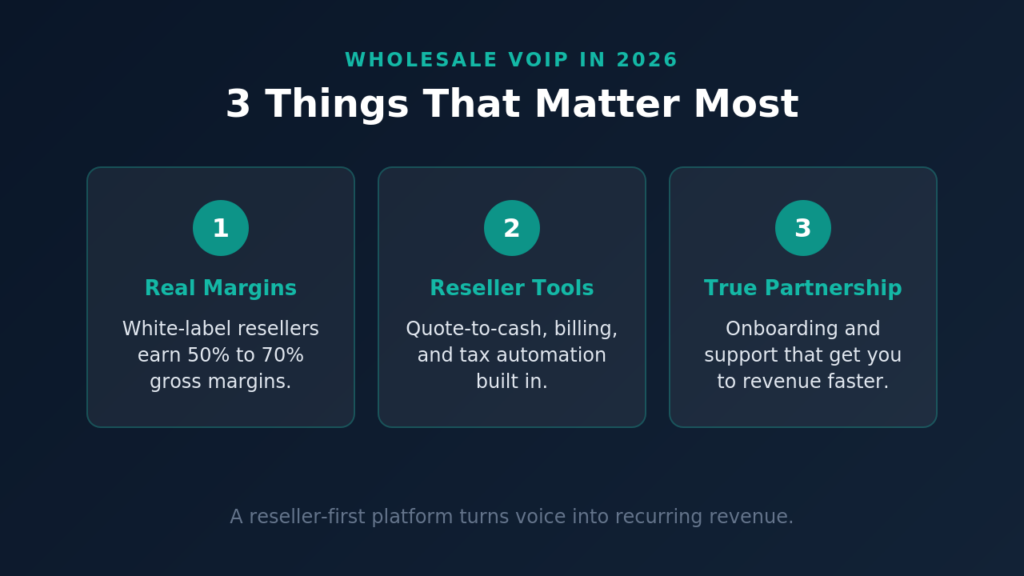
- Reseller margins typically land in the 50% to 70% range with white-label models, well above the smaller commissions that traditional agent or referral arrangements pay out.
- The best wholesale VoIP providers offer more than minutes and trunks. Look for built-in quote-to-cash tooling, telecom tax automation, geo-redundant networks, and features your customers actually want, like UCaaS, SMS, and contact center.
- The right provider sets you up for profitability in months, not years. The wrong one buries you in support tickets and surprise fees.
Pick a partner whose success depends on yours, not one that treats you like a wholesale account.
If you’ve spent any time looking at the wholesale VoIP providers market lately, you’ve probably noticed it’s gotten crowded. There are dozens of platforms claiming to offer the best margins, the cleanest portals, and the most reseller-friendly pricing. But beneath the marketing language, the providers vary wildly in what they actually deliver, how they bill, and whether they treat you like a partner or a line item.
With the global VoIP market projected to reach $195.39 billion in 2026 and continue climbing through 2034, the opportunity is real. But choosing the wrong wholesale partner can stall your growth before you ever get going. This guide walks through what wholesale telecom providers do, what features matter most, how pricing works, and how to evaluate the options so you end up with a provider that fits how you want to run your business.
What Are Wholesale VoIP Providers?
Wholesale VoIP providers are the companies that operate the underlying voice infrastructure, networks, switches, carrier interconnects, and number inventory that resellers use to deliver phone service to end customers. Instead of building millions of dollars of telephony infrastructure yourself, you tap into someone else’s, brand it as your own, and focus on selling and supporting customers. The wholesale model is the foundation of the entire reseller channel, and it’s the fastest path into a market that keeps getting bigger.
What’s changed recently is the expectation. A few years ago, wholesale VoIP meant SIP trunks, DIDs, and per-minute rates. That’s still part of it, but the bar is now higher. Modern wholesale VoIP providers are expected to deliver full-stack UCaaS platforms, including business SMS, video, contact center, and integrations with the CRMs and productivity tools your customers already use. The bigger industry context backs this up. The Unified Communications market is growing at a 17.4% CAGR through 2030, and resellers who only sell voice are leaving money on the table.
Wholesale vs. White-Label vs. Agent Models
The terminology around reselling can get muddy, and the differences matter for your bottom line. A pure wholesale VoIP arrangement gives you bulk minutes, trunking, or seats at discounted rates, but the customization and branding control vary. A white-label model goes further: you fully rebrand the platform, portal, and billing as your own, and your customers never see the underlying provider. An agent model is the opposite. You refer customers to the provider, who owns the relationship, and you collect a commission, which is typically much smaller than what you’d earn owning the customer outright.
For most MSPs, system integrators, and VARs, the white-label wholesale model is the strongest fit because it combines the margins of wholesale with the brand equity and customer ownership of being a true provider. If you want a deeper look at how these models compare in practice, this guide to white-label VoIP providers breaks it down in more detail.
What Features Should the Best VoIP Providers Offer?
Not all wholesale VoIP providers are built the same, and the feature set you choose has a direct impact on what you can sell, how you support customers, and how much margin you keep. Here’s what to look for.
Core Voice Infrastructure
Reliability is non-negotiable. Your customers don’t care whose network is behind their phone service. If calls drop, they call you. The best VoIP carriers run geo-redundant networks with multiple data centers, automatic failover, and proven uptime track records. Beyond reliability, the core voice stack should include origination and termination across the U.S. and Canada at a minimum, with international A-Z termination available for customers who need it. Number management, including local DIDs, toll-free numbers, and porting support, should be straightforward and self-service from a reseller portal.
Confirm that the provider supports modern call-quality features like HD voice codecs, jitter buffers, and built-in QoS monitoring. Latency, packet loss, and jitter are the silent killers of VoIP service, and a provider that gives you visibility into those metrics will save you hours of troubleshooting later.
Reseller-Specific Tooling
Having a reseller focus is where the best VoIP providers really separate themselves. The providers worth partnering with give you tools that help you run a business: a quote-to-cash workflow, automated provisioning, integrated billing, and telecom tax handling that doesn’t require you to become a telecom tax expert. A modern reseller portal should let you onboard new customers, provision phones, manage features, and pull billing reports without opening a ticket.
The other piece often overlooked is the equipment supply chain. The best providers offer access to a vetted online store with auto-provisioning, so phones arrive at customer sites ready to plug in. That alone shaves hours off every deployment.
Compliance and Security
Telecom compliance is more complicated than it used to be. STIR/SHAKEN call authentication, 10DLC registration for business SMS, Kari’s Law and RAY BAUM’s Act for E911, and HIPAA-aligned configurations for healthcare customers all need to be handled correctly. A wholesale VoIP provider that bakes compliance into the platform protects both you and your customers. If a provider is vague about how they handle any of these, treat it as a red flag.
How Does VoIP Wholesale Pricing Work?
VoIP wholesale pricing models vary, and understanding the structure is the only way to know whether a deal is competitive. Here’s the rundown on what to watch for and what kind of margin you should target.

Per-Minute and Per-Seat Pricing Models
Wholesale VoIP pricing typically follows one of two structures: per-minute rates for trunking and termination or per-seat pricing for hosted PBX and UCaaS bundles. Per-minute rates for U.S. termination tend to fall in the fractional-cent range, with international rates varying by destination. For voice-only wholesale SIP trunking arrangements, you’ll see structures with channel commitments, DID monthly fees, and usage rates layered together.
Per-seat pricing is the dominant model for full UCaaS resale. You pay the wholesale provider a flat monthly rate per user, then mark it up for your end customer. The advantage is predictability. You know exactly what your costs are, you set your retail price, and your margin is locked in. Some providers offer tiered seat pricing based on volume, so as your customer base grows, your unit cost drops and your margin expands.
Watch for hidden fees. The lowest sticker price isn’t always the best deal once setup fees, monthly minimums, taxation services, support tiers, and add-on charges are factored in. A provider with slightly higher headline pricing but no surprise costs often delivers better real margins than the cheapest option.
What Margins Should You Expect?
White-label resellers typically achieve gross margins between 50% and 70%, depending on how aggressively you price, what you bundle, and how efficiently you operate. Compare that to traditional agent or referral arrangements that pay out a much smaller commission percentage, and the case for white-label wholesale gets pretty compelling.
The resellers at the top of that range share a few habits. They bundle voice with value-added services like SMS, contact center, and CRM integrations rather than competing on raw price. They focus on specific verticals like healthcare, legal, or professional services, where they can charge premium rates. And they invest in customer success early because retention has a much bigger impact on lifetime margin than any per-seat price negotiation. For resellers building their first packages, this guide to becoming a VoIP reseller covers practical pricing strategy in more depth.
What Are the Different Types of Wholesale VoIP Providers?
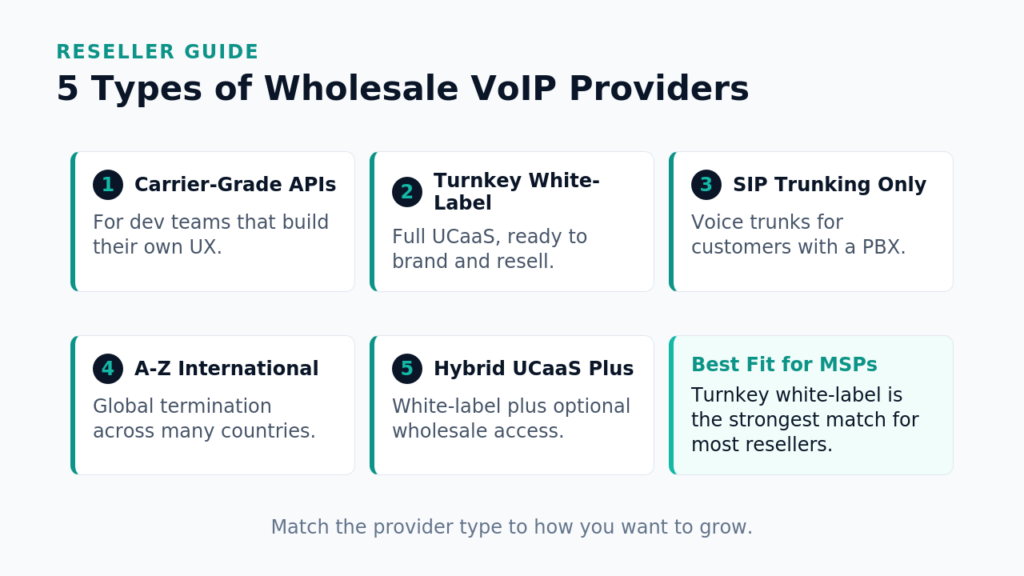
The category “wholesale VoIP providers” contains several different business models, and understanding which type fits your goals saves you a lot of wasted demo calls. Here are the five main types you’ll encounter:
- Carrier-grade API providers. These are programmable voice platforms aimed at developers and software-first companies. You get raw access to SIP trunks, numbers, and APIs, but you build the user experience yourself. Great for technical teams with engineering resources, less so for traditional MSPs.
- Turnkey white-label UCaaS platforms. These are full-stack platforms where you get a complete UCaaS product, including voice, video, SMS, and contact center, ready to brand and resell. Quote-to-cash tooling, billing, taxation, and support are typically included. This model is the strongest fit for MSPs, system integrators, and VARs who want to sell, not build.
- Voice-only SIP trunking wholesalers. These providers focus narrowly on bulk SIP trunking and termination. Margins on trunking alone are tighter than full UCaaS, but for resellers serving customers who already have a PBX, this can be a clean add-on offering.
- A-Z international termination specialists. These wholesalers focus on global call termination across hundreds of countries. They’re worth considering if your customer base does heavy international calling, but most domestic-focused resellers don’t need this as a primary partner.
- Hybrid UCaaS plus wholesale platforms. A growing category that combines turnkey white-label UCaaS with optional wholesale-only access for resellers who already have their own back-office infrastructure. The flexibility is useful if you expect your business model to evolve.
How Do You Choose the Right Wholesale VoIP Partner?
Picking the right wholesale VoIP provider comes down to honestly assessing what kind of reseller business you want to build, then matching the provider to that picture. A few practical filters can save you from a mismatch.

Start with onboarding and support. The reality of telecom is that the first few customer deployments are where most resellers stumble. A provider that walks you through the first ports, configurations, and customer setups gets you to revenue faster than one that hands you documentation and disappears. Ask any provider you’re evaluating exactly what their onboarding looks like, how long it takes, and who you’ll be working with during your first 90 days.
Next, look at the financial structure. A provider with low monthly minimums and no upfront fees is appealing on the surface, but those terms often correlate with thinner support and less investment in your success. A provider that asks for a reasonable commitment in exchange for substantial training, sales coaching, and ongoing partner management is usually worth more in the long run. Revenue growth is what matters, and a provider that helps you grow is worth more than one that just gives you the cheapest seats.
Finally, look at the platform’s roadmap and the parent company’s stability. Telecom is a long game. A provider that’s continuously investing in AI features, integrations, security, and platform improvements is going to keep you competitive. One that’s standing still will leave you explaining to customers why you don’t have features your competitors do. If you want a more detailed evaluation framework, this list of essential tips for choosing a wholesale VoIP provider covers the criteria in depth.
Frequently Asked Questions
What’s the difference between wholesale VoIP and retail VoIP? Wholesale VoIP refers to bulk voice services sold to resellers, who then resell to end customers under their own brand or another arrangement. Retail VoIP is the finished service sold directly to a business or consumer end user. As a reseller, you’re buying wholesale and selling retail, with the margin in between funding your business.
How long does it take to become profitable as a wholesale VoIP reseller? For resellers with an existing customer base who can migrate accounts to the new platform, profitability often comes within the first few months. Resellers starting from scratch typically need 6 to 12 months to build enough recurring revenue to cover costs and start generating real profit. The pace depends heavily on your sales activity and how well you leverage your provider’s onboarding and marketing resources.
Do I need technical telecom expertise to resell VoIP? Not as much as you might think. The point of partnering with a wholesale VoIP provider is that they handle the heavy infrastructure and most of the technical complexity. You’ll need a working understanding of basic networking, VoIP fundamentals, and your platform’s portal, but a quality provider’s training program will get you there. Many successful resellers come from IT, MSP, or general business backgrounds rather than telecom.
Can I bundle SMS, contact center, and other services with wholesale VoIP? Yes, and you should. Bundling value-added services like business SMS, contact center, virtual fax, and CRM integrations is one of the most effective ways to expand your margin and reduce churn. Customers who use multiple services from the same provider are less likely to leave, and bundles command better pricing than a standalone voice service.
Building Your Wholesale VoIP Business on the Right Foundation
The wholesale VoIP market in 2026 has more options than ever, and the right partner can be the difference between a recurring revenue engine and a constant headache. Focus on the providers that combine reliable infrastructure with reseller-friendly tools, transparent pricing, and a real commitment to your growth.
SkySwitch was built specifically for resellers who want to own their brand, pricing, and customer relationships, with the platform, training, and support to back it up. Get started with SkySwitch and see how a true partner approach can accelerate your business.

Jessica is a marketing and sales strategist with deep expertise in VoIP telecommunications. As a Marketing Director, she specializes in channel marketing, account management, and product marketing within the communications industry. Jessica is passionate about helping partners grow through compelling messaging and hands-on support.