
VoIP Reseller vs White-Label VoIP: Key Differences Explained

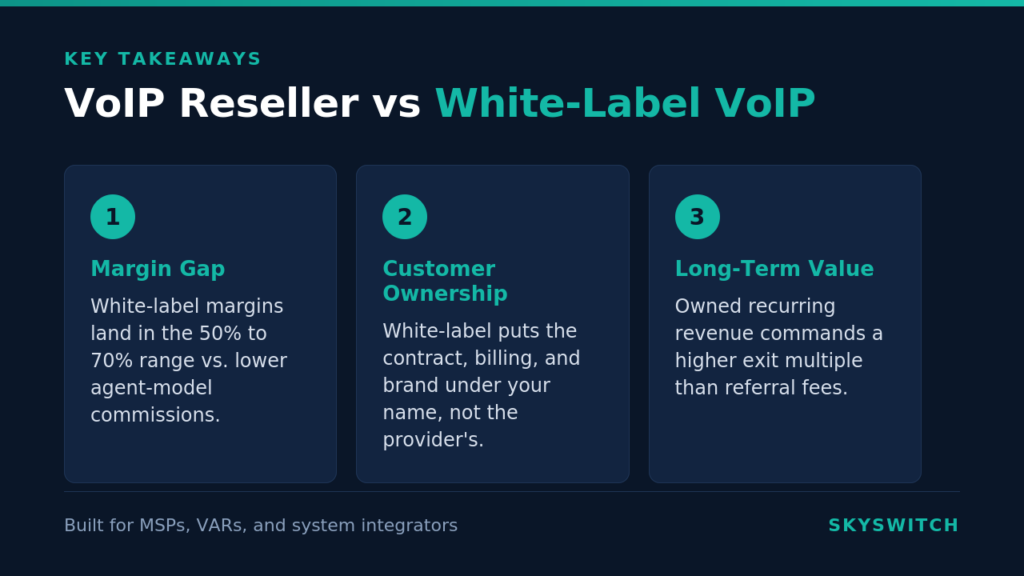
The biggest difference between a VoIP reseller and a white-label VoIP partnership comes down to ownership: who owns the brand, the customer, and the margin.
- Traditional VoIP reseller models operate as agent or referral programs, with commissions usually in a small range and the upstream provider visible to your customers.
- White-label VoIP lets you sell under your own brand, set your own pricing, and own the entire customer relationship, with margins commonly landing in the 50% to 70% range.
- The model you choose determines your long-term business value, your customer churn risk, and how much control you have over support, billing, and pricing.
- Most MSPs, VARs, and system integrators looking to build recurring revenue (rather than collect referral fees) end up choosing white-label because the economics scale with their growth.
If you want to build a real communications practice that grows in value over time, white-label is almost always the right call.
If you’ve been comparing VoIP reselling options and feeling like the terminology blurs together, you’re not alone. “Reseller,” “partner,” “agent,” “white-label,” and “wholesale” get used interchangeably across vendor marketing, but the underlying business models are very different. This guide breaks down VoIP reseller vs white-label VoIP cleanly so you can make a decision that fits the kind of business you’re trying to build.
Cloud voice has become one of the fastest-growing service categories in the entire technology channel. The global VoIP services market is projected to grow from roughly $176 billion in 2026 to nearly $389 billion by 2034, at a CAGR of 10.4%. That kind of momentum is exactly why MSPs, VARs, and system integrators are looking at how to add voice as a recurring revenue stream. The catch is that not all VoIP partnerships are structured the same way, and the choice between a traditional VoIP reseller program and a white-label model determines almost everything about how your business will operate, scale, and earn.
What Does VoIP Reseller vs White-Label VoIP Mean?
Before getting into margins and ownership, it helps to clarify what each model actually is in practice. Both involve selling cloud voice services from an underlying technology provider, but the structure of the relationship and what it looks like to your end customers is different.
How Does the Traditional VoIP Reseller Model Work?
In a traditional VoIP reseller model, you essentially refer or sell another company’s branded service to your customers. The provider’s name appears on the contract, the bill, the customer portal, and sometimes the support line. You earn a commission on each sale, often paid as a recurring percentage of the customer’s monthly spend, and the provider handles most of the operational lifting, like billing, support, and account management.
This practice is called the agent or referral model, and it’s appealing because the barrier to entry is low. You don’t have to learn billing, provision anything, or support customers technically. The trade-off is that you have very little control over pricing, packaging, or customer experience, and your earning ceiling is capped by the commission rate the provider sets.
How Is White-Label VoIP Different?
The white-label VoIP reseller model flips the relationship. You sell the underlying voice and UCaaS platform under your own brand, set your own pricing, package your own bundles, and own the customer relationship end to end. The provider runs the infrastructure quietly in the background while your customers see only your name on their portal, invoices, and emails.
White-label VoIP providers typically supply a complete platform that includes the cloud PBX, number management, administrative tools, and support tiers, along with a branding layer that lets you replace the provider’s logos and visual identity with your own. MSPs offering VoIP can generate margins ranging from 20% to 70%, depending on the partnership model and how the service is packaged. The operational responsibility in white-label is heavier than in an agent model, but the unit economics are meaningfully stronger.
Why Does the Difference Between These Models Matter for Your Business?
Deciding between VoIP reseller vs white-label VoIP models shapes your margins, your enterprise value, and how much risk you carry. Here’s where the differences show up in real numbers and outcomes for resellers.

How Big Is the Margin Gap Between the Two Models?
Margins are the most visible difference between the VoIP reseller model and white-label arrangements. Traditional agent or referral programs commonly pay residual commissions on the lower end of the range, while white-label resellers can capture margins of 50% to 70% because they’re buying at wholesale and pricing at retail.
That gap compounds over time. On a customer paying $1,000 per month for cloud voice services, a 15% commission generates $150 of recurring revenue, while a 60% white-label margin generates $600. Multiply that across a few dozen customers, and the difference is side income versus a real business.
Who Actually Owns the Customer Relationship?
Customer ownership is the second big divergence. In a traditional reseller setup, the underlying provider has the billing relationship, contract, and direct support line. If you stop selling for them, the customer typically stays with the provider, not you.
In a white-label model, the customer is yours. You bill them, you support them (or coordinate support through your provider’s tier 2 and tier 3 channels), and you own the contract. This ownership matters enormously if you ever want to sell your business because recurring-revenue companies with owned customer relationships command a higher exit multiple than referral-fee practices do.
How Much Control Do You Have Over Branding and Packaging?
Branding control is the third major distinction. Traditional VoIP resellers often have to use the provider’s branding, marketing materials, and pricing structures, which makes it difficult to differentiate from the dozens of other resellers selling the same brand. White-label VoIP, on the other hand, lets you control the entire customer-facing experience: your colors, your logo, your portal domain, your invoice template, and your service packages.
For MSPs and VARs whose entire business model depends on being a trusted local brand, this kind of control is the whole reason to be in the channel.
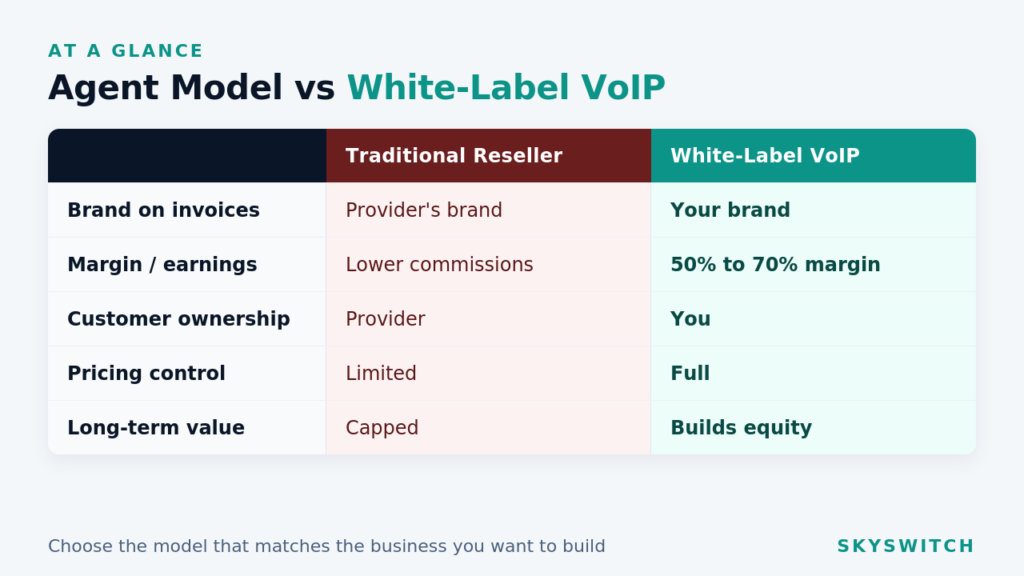
Side-by-Side: VoIP Reseller vs White-Label VoIP at a Glance
Here’s how the two models compare across the variables that actually matter when you’re choosing a path forward.
| Factor | Traditional VoIP Reseller (Agent Model) | White-Label VoIP |
| Brand visible to customer | Provider’s brand | Your brand |
| Margin / earnings | Lower commission percentages | 50% to 70% margin (wholesale to retail) |
| Customer ownership | Provider | You |
| Pricing control | Limited | Full |
| Packaging flexibility | Predefined tiers | Build your own bundles |
| Billing relationship | Provider bills customer | You bill customer |
| Support model | Provider handles | You + provider tiers |
| Time to launch | Days | Weeks (with onboarding) |
| Operational responsibility | Low | Moderate to high |
| Long-term enterprise value | Low | High |
The agent model trades long-term value for short-term ease, while the white-label model trades operational simplicity for ownership and margin.
Which VoIP Reseller Model Is Right for Your Business?
Both models have legitimate use cases. The right answer depends on the kind of business you’re trying to build, your customer base, and how much operational capacity you have. Here are the most common scenarios and which model tends to fit best.
- You’re a referral-only business. If you want to send leads, collect a commission check, and stay out of the operational details, the traditional agent model is fine. Just understand you’re capping your upside, and you don’t own the customer.
- You’re an MSP or VAR with existing customer relationships. This aspect is where white-label VoIP shines. Your customers already trust you. They want one bill from one vendor, and they expect your branding across their tools. The white-label model lets you extend your existing brand into voice without sending customers to a competitor.
- You’re a system integrator or interconnect. If you already deploy phones, networks, and infrastructure, white-label gives you full control over the voice layer and lets you integrate it cleanly with your existing service delivery and support model.
- You’re starting a new telecom business from scratch. If voice is going to be your primary revenue line, white-label is the only model that makes sense long-term. You’re building a brand, not collecting checks, so brand and customer ownership are non-negotiable.
- You sell adjacent services like copiers, IT support, or AV. Voice naturally bundles with these services, and a white-label approach lets you package them under your existing brand. This avenue is one of the fastest ways to deepen customer stickiness and add recurring revenue.
What Should You Look for in White-Label VoIP Providers?
If white-label is the right model for your business, the next decision is choosing a provider that can support the way you want to operate. There are a handful of factors that separate the strong white-label VoIP providers from the ones that fall apart at scale.
Reliability and network architecture come first. Look for providers with geo-redundant networks across multiple data centers, transparent system status reporting, and a track record of stability. An outage that takes your customers offline doesn’t just hurt the provider’s reputation; it hurts yours.
Branding depth matters more than people realize. True white-label means your customers never see the provider’s name, anywhere. Check the customer portal, mobile app, invoice templates, email notifications, and support page. If the provider’s brand bleeds through anywhere, you don’t have real white-label control.
Operational tooling determines whether you can actually scale. Quote-to-cash workflows, integrated billing, telecom tax automation, and self-service provisioning are the difference between a business that runs cleanly at 100 customers and one that drowns in spreadsheets at 30. The most useful guidance on evaluating white-label VoIP providers focuses on the operational layer rather than just the feature checklist.
Onboarding and ongoing support are the last piece. The best white-label programs walk you through the first 90 days with structured training, give you direct access to a partner account manager, and offer tier 2 and tier 3 escalation paths so you’re not stuck troubleshooting infrastructure issues alone. If you’re newer to voice, prioritize providers with a real onboarding curriculum rather than just login credentials and a wiki.
FAQs About Hosted VoIP Resale
Is hosted VoIP resale the same as white-label VoIP?
Not quite. Hosted VoIP resale is a broader category that includes both agent or referral programs (where the provider’s brand is visible) and white-label programs (where your brand is the only one customers see). White-label is a specific type of hosted VoIP resale defined by full branding control and customer ownership.
How long does it take to launch as a white-label VoIP reseller?
Most reputable white-label programs take somewhere between 30 and 90 days to fully onboard, depending on your existing telecom experience and how quickly you complete the training. You can typically start selling earlier in the process, but the full operational launch (billing, provisioning, support workflows) usually lands in that window.
Do I need deep telecom experience to be a white-label VoIP reseller?
No, but it helps. The strongest white-label programs are built to onboard partners who are coming from adjacent industries like IT services, networking, or AV integration. Basic networking knowledge and a willingness to learn the platform are usually enough, especially if your provider has a structured training program.
Can I switch from a traditional reseller model to white-label later?
Yes, and many resellers do exactly that once they realize the agent model is capping their growth. The migration involves moving customers off the legacy provider’s platform onto your white-label provider’s platform, which takes coordination but is well-trodden ground. A good provider will have a dedicated team to help with platform migration and number porting.
Building the Right VoIP Reseller Business for the Long Term
The VoIP reseller vs white-label VoIP decision really comes down to how much business you want to own. Agent and referral models are simple, fast, and capped. White-label is more involved but gives you real margin, real customer relationships, and a real asset to grow over time. For most MSPs, VARs, and system integrators serving small and medium businesses, the math points clearly in one direction.
SkySwitch offers a private-label UCaaS platform built specifically for resellers who are aiming for a branded voice practice with strong margins, full customer ownership, and the operational tooling to scale cleanly. Get started with the SkySwitch reseller program to see how a true white-label partnership can transform your business.

Jessica is a marketing and sales strategist with deep expertise in VoIP telecommunications. As a Marketing Director, she specializes in channel marketing, account management, and product marketing within the communications industry. Jessica is passionate about helping partners grow through compelling messaging and hands-on support.