
8 Strategies for Success with a White-Label Contact Center

White-label contact centers give resellers brand ownership, pricing control, and access to enterprise-grade customer service solutions without massive infrastructure investments.
- The CCaaS market is projected to grow to nearly $28 billion by 2033, creating substantial opportunities for MSPs and telecom resellers.
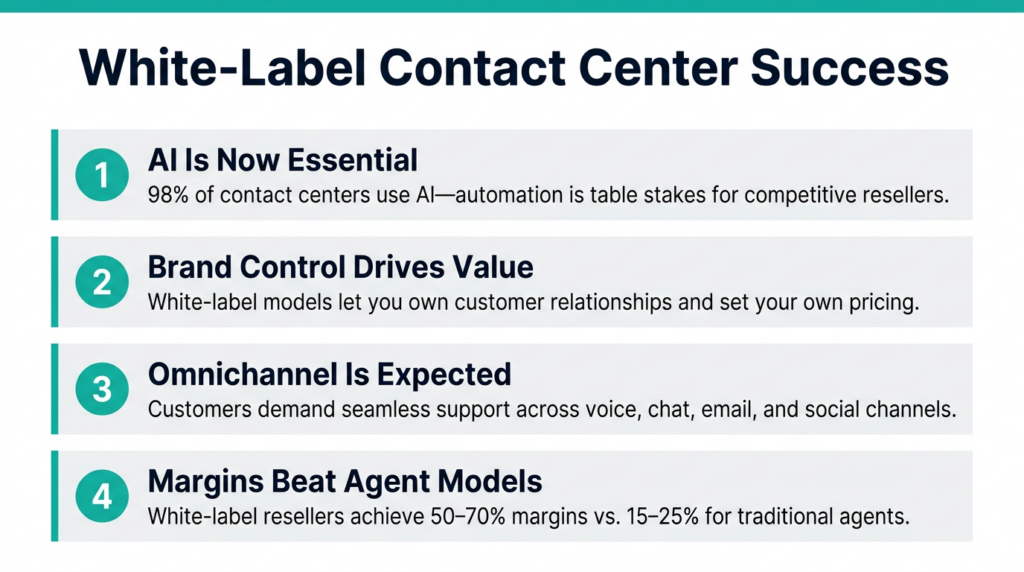
- AI integration has become essential, with 98% of contact centers now using AI capabilities in some form.
- Resellers who master omnichannel delivery and agent experience optimization will capture the lion’s share of this expanding market.
- Integrated UCaaS and CCaaS platforms consistently deliver strong ROI while boosting customer satisfaction.
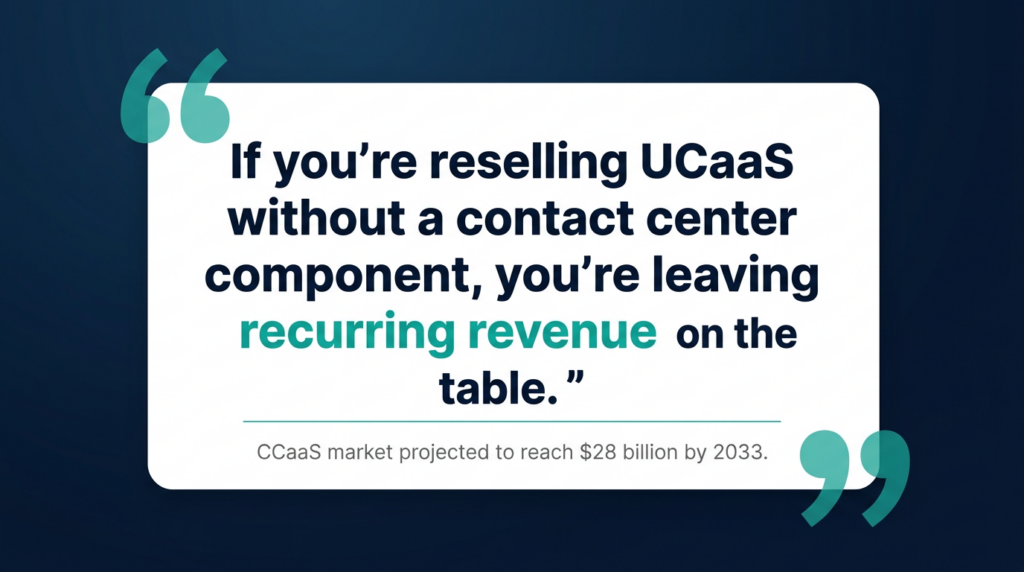
If you’re reselling UCaaS without a contact center component, you’re leaving recurring revenue on the table.
White labeling gives your brand more power and control over customer relationships. Nearly 63% of B2B marketers say brand is critical to long-term success, making ownership an imperative for resellers looking to differentiate themselves. Whether you’re already reselling UCaaS or exploring new revenue streams, consider the advantages of a white-label contact center.
Contact centers include a suite of features, and the white-label model enables resellers to rebrand and sell these solutions under their own identity. The CCaaS market was valued at $7.2 billion in 2024 and projected to reach $27.9 billion by 2033. This trajectory is driven by AI adoption, omnichannel demand, and the continued shift to cloud-based operations.
The main purpose of this business model is to enable resellers to focus on offering top-notch customer service without worrying about investing in expensive infrastructure or developing advanced technologies. White-label reselling provides financial benefits while allowing resellers to offer a wider range of services, expanding market presence and enhancing brand reputation.
What Makes a White-Label Contact Center Valuable for Resellers?
Reselling a white-label contact center platform offers tremendous value through its comprehensive solution that caters to both resellers and their clients. It provides a robust platform that resellers can customize and brand as their own, delivering top-tier customer service capabilities without significant investment in infrastructure or technology development.
With a white-label solution, resellers maintain and strengthen their brand through every customer interaction. The platform can reflect your brand aesthetics, including logo, color scheme, and overall design language. Every interaction a client has with the contact center reinforces your brand, fostering trust and loyalty.
Why Does White-Label UCaaS Reselling Create Competitive Advantages?
As part of a comprehensive UCaaS solution, contact centers are equipped with advanced features to enhance customer service delivery and communication. Capabilities include sophisticated call routing, auto attendants, real-time analytics, and omnichannel support. By offering these features under your brand, resellers provide clients with a comprehensive solution that meets diverse communication needs.
One advantage of white-label contact center services is the freedom they offer resellers. You can set your own pricing, aligning it with the value you deliver and the market you serve. Consider competitive pricing options, promotional campaigns, and flexible pricing models, such as subscription- or usage-based structures. By controlling your prices, you can better manage profit margins and ensure business sustainability.
Resellers can also extensively customize their offerings. With a white-label UCaaS partner, you aren’t restricted to predefined service packages. You can create customized offerings to cater to client needs, designing packages with a mix of features ranging from basic voice call handling to advanced omnichannel services.
How Can Resellers Succeed with Contact Center Strategies?
Having understood the value of a white-label model, the next step is to devise effective strategies that harness its full potential. These contact center strategies ensure successful implementation and usage while contributing to overall business growth and success.
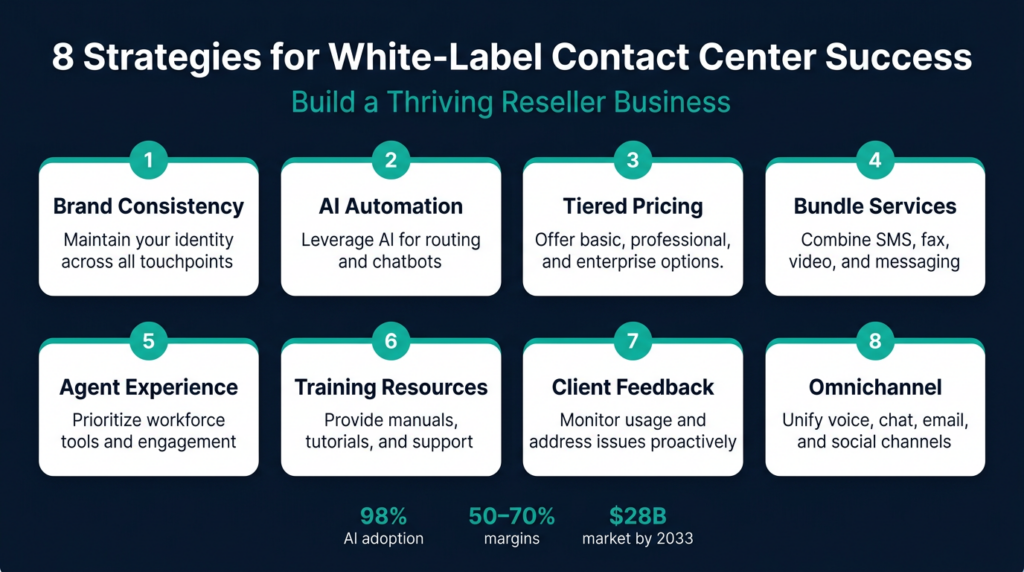
Strategy 1: Maintain Your Brand Name Across All Touchpoints
One of the main advantages of a white-label contact center, as well as any other UCaaS service, is the ability to rebrand it as your own. Every client interaction reinforces your brand, building recognition and trust over time.
Your branding should extend beyond logos and color schemes. Consider customizing agent scripts, email templates, reporting dashboards, and customer-facing portals. The goal is to create a seamless experience where your clients never question who provides the service. When done right, this white-label approach strengthens customer relationships and makes switching providers feel like a major disruption rather than a simple vendor change.
Strategy 2: Embrace AI-Powered Automation for Competitive Advantage
According to a report, 98% of contact centers now use AI in some capacity. Additionally, Gartner predicts that by 2029, 80% of customer service issues will be resolved by agentic AI, leading to lower operational costs. For white-label contact center resellers, AI capabilities have become table stakes for remaining competitive.
Modern AI features your platform should offer include automated call summarization that saves agents time, real-time sentiment analysis that alerts supervisors to challenging interactions, intelligent routing that matches customers with the best-suited agents, and conversational chatbots that handle routine inquiries. These capabilities reduce costs while improving customer experience, creating measurable value you can demonstrate to prospects.
The key is to position AI as an augmentation tool rather than an agent replacement. Your clients’ customers still want a human connection for complex issues, but AI handles the routine work that previously consumed agent time. This balance between automation and human interaction is what separates effective contact center implementations from frustrating ones.

Strategy 3: Offer Tiered Support Options to Match Client Needs
Not all clients have identical needs, and your pricing and packaging should reflect this reality. Some may require basic voice and queue services, while others need advanced features like third-party integrations, SMS capabilities, and web chat functionality. By offering different tiers of support options with pricing fully in your control, you cater to diverse client requirements and ensure each customer finds a solution that fits.
Consider structuring tiers around common business scenarios:
- A basic tier might include voice queuing, standard reporting, and email support.
- A professional tier could add omnichannel capabilities, CRM integration, and advanced analytics.
- An enterprise tier might include workforce management tools, custom integrations, and dedicated support.
Tiered options make it easy for prospects to understand what they’re getting and simplify the sales conversation.
Strategy 4: Expand Your Service Portfolio Through Platform Features
A contact center solution comes packed with features that can expand your business value. Imagine offering your customers powerful analytics tools, quality assurance features, and downloadable desktop portals to meet their contact center needs. This expansion enhances your market presence and reduces the chances of clients turning to competitors for additional services.
Look for opportunities to bundle complementary services. Business SMS, virtual fax, video conferencing, and team messaging can all be packaged with contact center capabilities. When clients rely on you for multiple communication services, switching costs increase and relationships deepen. The resellers who capture the most value from white-label contact centers position themselves as complete communication partners rather than single-service vendors.
Strategy 5: Prioritize Agent Experience and Workforce Optimization
Contact center success depends heavily on agent performance, and leading platforms now include workforce engagement management tools that boost productivity and satisfaction. Gamification features with recognition and leaderboards increase overall workforce engagement. AI-powered coaching provides individualized feedback to help agents improve performance and develop skills.
Self-scheduling capabilities allow agents to adjust work schedules autonomously, which can reduce attrition rates. Workforce management tools that let agents directly request shift swaps or time off create a sense of flexibility and transparency. Happy agents deliver better customer experiences, creating a virtuous cycle that benefits everyone.
When evaluating white-label platforms, assess the agent-facing tools as carefully as the customer-facing features. The best contact center solutions make agents’ work easier, not harder. Real-time assistance, knowledge base integration, and streamlined interfaces reduce cognitive load and help agents resolve issues faster.

Strategy 6: Invest in Training and Support Resources
To ensure clients can effectively use the contact center solution, provide them with adequate training and support resources. Consider user manuals, video tutorials, FAQs, and dedicated customer support. A smooth onboarding experience helps clients get the most out of the solution and establishes your value as a knowledgeable partner.
Your training program should address multiple learning styles and experience levels. Some users prefer self-service documentation that they can reference as needed. Others benefit from live training sessions or video walkthroughs. Building a comprehensive resource library takes time upfront but pays dividends through reduced support tickets and higher customer satisfaction.
Strategy 7: Regularly Evaluate the Client Experience
Regularly evaluating the client experience from their perspective involves conducting surveys, seeking feedback, and monitoring usage patterns. By understanding how clients use the contact center and what challenges they face, you can continually improve your offerings and ensure a positive experience.
Pay attention to leading indicators that suggest problems before they escalate. Declining login activity, increasing support tickets about the same issues, or reduced feature adoption all signal opportunities for proactive outreach.
Strategy 8: Deliver True Omnichannel Customer Experiences
Customers expect to reach businesses through whichever channel is most convenient for them at any given moment. They use a mix of email, chat, social media, and phone, depending on their needs and preferences. Your white-label contact center should unify all these channels into a single agent interface with a consistent view of customer history.
True omnichannel support means conversations can flow seamlessly between channels while maintaining context. A customer might start troubleshooting on a website, move to a chatbot for help, and finish by connecting with a live agent without losing any conversation history. This seamless experience keeps customers happy and helps businesses solve problems cost-effectively.
Emphasize this capability when positioning your contact center offerings to prospects. Many businesses still operate with disconnected communication channels that frustrate both customers and agents. Solving this pain point creates immediate, tangible value.
What Should Resellers Look for in a White-Label Contact Center Partner?
Choosing the right white-label reseller program impacts your success. The ideal solution should align with your business objectives and cater to client needs. Industry-leading partners offer a blend of advanced features, customization options, scalability, and robust support.
How Do You Identify the Right Platform?
The first step in choosing a white-label reselling partner is identifying a UCaaS platform that aligns with your business needs and objectives. Evaluate various solutions based on features, ease of use, reliability, support, and pricing.
Consider the provider’s reputation and track record in the industry. Look for a solution that offers a comprehensive set of features, including call routing, auto attendants, analytics, and omnichannel support, to ensure you can meet client voice and communication needs. AI capabilities are essential, so evaluate how the platform incorporates automation and intelligence.
Why Does Customization Matter?
Customization is a key aspect of white-label solutions. The ability to tailor the platform to your business and create customized service packages for clients can make or break your competitive positioning. Ensure the solution you choose offers extensive customization options, allowing you to differentiate your offerings in the market while supporting customer demands.
Beyond visual branding, look for customization in reporting, workflows, and integrations. The more you can tailor the solution to specific client needs, the more valuable your services become. Generic, one-size-fits-all platforms limit your ability to win deals against competitors who offer more personalized approaches.
What Role Does Scalability Play?
As clients’ businesses grow, their communication needs evolve. The contact center solution you choose should scale to accommodate this growth without painful migrations or service disruptions. Whether it’s handling increased call volumes, adding new communication channels, or integrating with additional business systems, the solution should grow over time.
Scalability also applies to your own business. As you add more clients, your platform needs to support efficient management across multiple accounts. Look for provider portals that make it easy to provision new accounts, monitor performance, and manage billing at scale.
Frequently Asked Questions
What is the typical profit margin for white-label contact center reselling? Resellers can achieve margins ranging from 50–70% on white-label UCaaS and contact center services, depending on how they package and price their offerings. This model compares favorably to traditional agents who often yield only 15–25% margins.
How long does it take to get started as a white-label contact center reseller? Most resellers can launch their contact center business within 30–90 days, depending on their existing infrastructure and experience level. Comprehensive onboarding programs help accelerate this timeline by providing training, marketing materials, and technical support.
Do I need technical expertise to resell white-label contact center solutions? While some technical knowledge helps, the best white-label providers handle infrastructure, maintenance, and platform updates. Your role focuses on sales, customer relationships, and first-level support. Providers typically offer training to help you become proficient with the platform and support your clients.
What’s the difference between white-label and co-branded contact center partnerships? White-label arrangements let you present the solution entirely under your brand, with no visible connection to the underlying provider. Co-branded partnerships display both company names, sharing credit for the service. White-label models typically offer greater brand control and higher perceived value to your clients.
Building a Thriving Contact Center Reselling Business
White-label contact center solutions offer an incredible opportunity for UCaaS resellers. They provide a comprehensive, customizable, and scalable platform that enables resellers to deliver top-tier customer service under their own brand identity. The strategies outlined above can transform how you approach this market, from embracing AI automation to prioritizing agent experience and omnichannel delivery.
SkySwitch’s white-label partner program provides the robust platform you need with all the features and customization your customers demand. Maintain your brand identity and control how you operate your business with our contact center solution. Get started today and unlock new avenues of growth and success in your UCaaS business.

Jessica is a marketing and sales strategist with deep expertise in VoIP telecommunications. As a Marketing Director, she specializes in channel marketing, account management, and product marketing within the communications industry. Jessica is passionate about helping partners grow through compelling messaging and hands-on support.