
SMS Platform Reseller Guide: How to Choose the Right Provider

Choosing the right SMS platform reseller partner is the biggest factor in determining whether your texting offering becomes a profit driver or a support headache.
- The U.S. SMS marketing market is projected to grow from $9.99 billion in 2025 to over $28 billion by 2030, creating a massive runway for resellers.
- Pricing models vary, and understanding subscription, pay-per-message, credit-based, and hybrid structures impacts your margins.
- Bundling SMS with VoIP increases customer stickiness, raises average revenue per user, and reduces churn.
- Compliance support for 10DLC, TCPA, and HIPAA is a baseline expectation.
Start your evaluation by mapping your customer base to specific use cases, then reverse-engineer the platform features and pricing model that fit best.
If you’ve been watching the business communications space, you already know texting has shifted from a nice-to-have to a non-negotiable. The U.S. SMS marketing industry is on track to nearly triple by 2030, and over 64% of businesses plan to increase their SMS budgets in the year ahead. For those exploring SMS platform reseller opportunities, this growth means real recurring revenue waiting to be captured.
However, not all platforms are built the same, and the wrong choice can eat your margins, frustrate your customers, and tie up your support team. Choosing the right partner requires understanding how pricing models work, how compliance is handled, and how the platform fits into a broader bundled offering with voice services.
What Makes the SMS Platform Reseller Opportunity So Compelling Right Now?
Consumers want fast, direct, low-friction communication with businesses, and they want it on their phones. Open rates for text messages consistently outperform every other channel by a wide margin, and response rates routinely beat email. For your customers, that translates into more bookings, faster service resolution, and stronger retention. For you, it translates into a high-margin recurring revenue stream that complements your existing offerings.
The global A2P messaging market was estimated at $74.27 billion in 2025 and is projected to reach $125.79 billion by 2033. That growth is driven by industries that were slow adopters just a few years ago. Healthcare, financial services, hospitality, and professional services are now among the heaviest users. If you serve any of these verticals, you have customers who are either already texting or will be soon.
The opportunity sits on top of this demand. Businesses don’t want to manage SMS infrastructure, navigate carrier registration, or stay current on compliance rules. They want a turnkey, branded solution from a provider they trust. By partnering with the right SMS reseller platform, you can meet that demand without building anything from scratch.
Which Core Features Should an SMS Reseller Platform Include?
Before you can compare providers, you need a clear picture of what business-grade texting requires. Consumer texting apps and basic mass-text tools fall short for the kinds of workflows your customers will need.
What Messaging Capabilities Should You Expect?
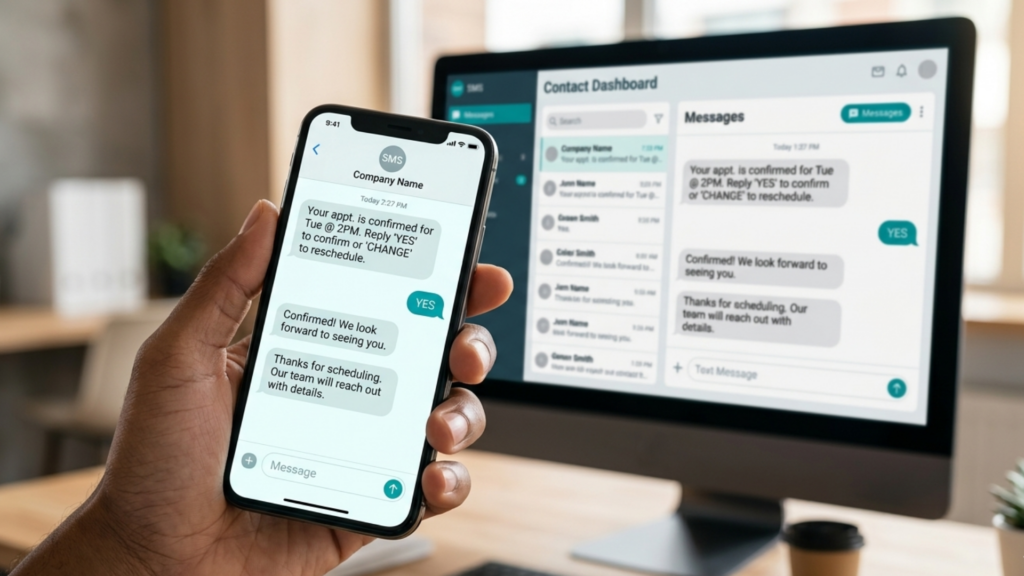
Strong business texting solutions go beyond sending and receiving messages. Look for keyword auto-responders that can trigger campaigns or actions based on inbound text content. A real estate agency, for instance, can set up “LISTING” to automatically send property details, while a healthcare practice can use “REFILL” to handle prescription requests. Multi-device synchronization is equally important. Your customers’ staff need to access the same conversation thread from a desktop, mobile app, or shared inbox without losing context.
Message blasting, drip campaigns, and scheduled sends round out the core toolkit. These features let your customers run targeted campaigns to specific contact segments, automate follow-up sequences, and time their outreach for maximum impact. Without these capabilities, your SMS offering will struggle to compete.
Why Do Contact Management and Analytics Matter?
Contact management is one of those features that sounds basic but separates serious platforms from generic tools. You want segmentation by attributes like purchase history, location, or service type so your customers can send the right message to the right list. Address book sync across devices keeps shared teams aligned without constant manual updates.
Analytics close the loop. Delivery rates, response rates, and engagement patterns help your customers prove ROI and refine their strategies. When evaluating SMS platforms for resellers, ask whether reporting can be customized, scheduled, and exported. The platforms that win on this front make it easy for you to demonstrate value to your end customers without doing the analysis manually.
What Integration Capabilities Should You Look For?
Modern businesses run on a stack of tools, and your business texting solutions need to fit cleanly into that stack. CRM integrations with HubSpot, Salesforce, Pipedrive, and others should be the baseline. Beyond that, look for collaboration tool integrations like Microsoft Teams, Slack, and Google Chat, plus webhook support and API access for custom workflows. The more integrations a platform supports, the easier it will be for your customers to deploy and the longer they’ll stay.
How Do SMS Provider Pricing Models Compare?
Pricing is where reseller deals are won and lost. Understanding the key SMS provider comparison points around pricing helps you protect your margins and build packages customers want to buy.
Subscription Pricing
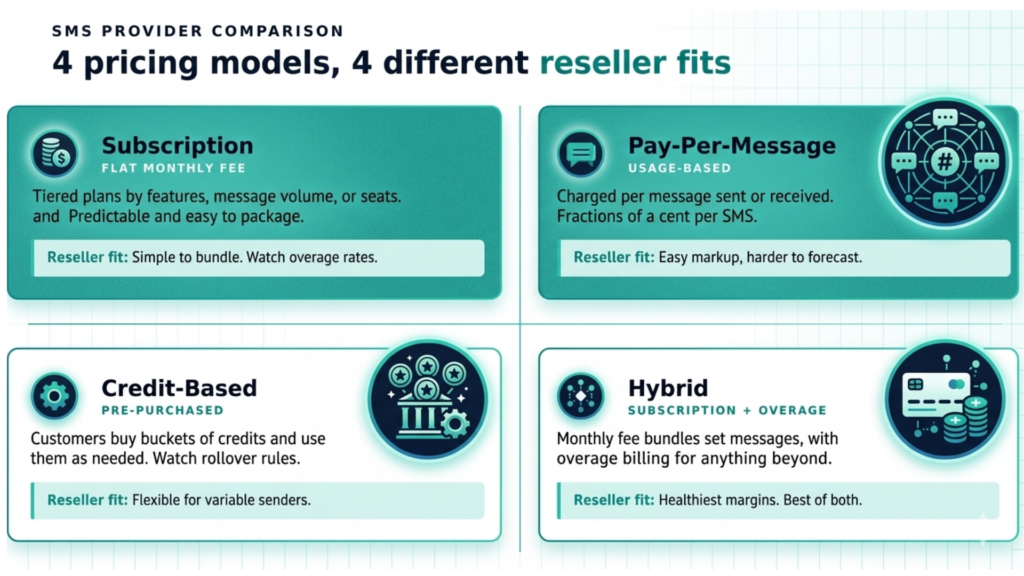
Subscription models charge a flat monthly fee, usually tiered by features, message volume, or user seats. They’re predictable, easy to budget for, and simple to package. The downside is that customers who don’t use their full allotment feel like they’re overpaying, while heavy users can blow past included credits and rack up overage fees.
Pay-Per-Message Pricing
Pay-as-you-go pricing charges per message sent or received, typically at fractions of a cent per SMS. Per-message rates in the U.S. typically fall between $0.01 and $0.05, depending on volume, message type (SMS vs. MMS), provider, and whether carrier fees are bundled in. This model appeals to low-volume users but can become expensive for high-volume senders. From a reseller perspective, pay-per-message is easy to mark up but harder to forecast.
Credit-Based Pricing
Credit-based pricing sits between the two. Customers pre-purchase a bucket of message credits and use them as needed. It rewards predictability and gives customers some buffer for variable months. Credits often have rollover limits or expiration dates, which is something you’ll want to communicate clearly.
Hybrid Pricing
Most modern platforms blend models. A common structure includes a monthly subscription that bundles a set number of messages, with overage billing for anything beyond the included volume. This hybrid approach gives you the predictability of subscription pricing with the flexibility of usage-based billing. For resellers, hybrid pricing tends to deliver the healthiest margins because you can build profit into both the recurring base fee and the per-message overage.
When evaluating an SMS reseller platform, ask about wholesale rates, volume discounts, and any monthly minimums. Resellers in the white-label UCaaS space commonly see healthy margins on bundled services, and SMS is often one of the more profitable line items in the mix. For a deeper look at structuring profitable packages, this post on maximizing profits as an SMS reseller walks through pricing strategies in more detail.
Why Should You Bundle VoIP and SMS Together?
Selling SMS as a standalone service is fine. Selling it bundled with voice is better. Here’s why bundling delivers stronger results for both you and your customers.
How Does Bundling Boost Margins and Reduce Churn?
When customers buy voice and SMS from the same provider, you become harder to replace. Switching one service is annoying. Switching two services that are integrated through a single phone number, single portal, and single bill is a project most customers won’t take on. That stickiness translates directly into lower churn and longer customer lifetimes.
Bundled offerings also let you charge a premium for convenience. Customers consistently pay more for an integrated package than they would for the same services purchased separately, and the convenience justifies the uplift on their side. Voice and texting on the same business number creates a seamless experience for end users, who can take a call, send a follow-up text, and see the conversation history all in one client.
What Use Cases Benefit Most From Bundled VoIP and SMS?
Some industries see immediate, obvious value from a bundled communications package. If your customer base includes any of these, leading with a bundled offer is usually the right move:
- Healthcare practices use voice for patient calls and SMS for appointment reminders, prescription pickups, and intake forms. HIPAA compliance is a must, and a unified platform simplifies audit trails.
- Real estate agencies rely on voice for buyer and seller conversations and SMS for listing updates, showing confirmations, and lead nurture sequences. Shared numbers let teams cover for each other without losing context.
- Auto dealerships and service shops use voice for sales calls and SMS for service reminders, status updates, and trade-in announcements. Drip campaigns drive repeat business.
- Professional services firms like accounting practices, law offices, and consultancies use voice for consultations and SMS for appointment confirmations, document requests, and billing reminders.
- Hospitality and restaurants use voice for reservations and SMS for booking confirmations, wait list updates, and last-minute promotions.
- Field services like HVAC, plumbing, and home repair rely on voice for dispatch and SMS for ETA updates, technician arrival notifications, and post-service follow-ups.

For deeper guidance on positioning bundled offerings, this post on reselling business SMS strategies for seamless integration is worth a read.
How Do Compliance and Security Requirements Differ Across Providers?
Compliance is non-negotiable, and the wrong platform partner can leave you exposed.
The most important U.S. requirement is 10DLC registration through The Campaign Registry. Every brand sending application-to-person SMS over 10-digit numbers must register, and each campaign must be approved before messages can be delivered reliably. A good SMS reseller platform guides partners through it with clear workflows. Platforms that leave you to figure it out on your own create a steady stream of support tickets.
Beyond 10DLC, your platform should support TCPA-compliant opt-in and opt-out handling, automatic STOP/HELP keyword responses, and detailed audit trails. For customers in regulated industries, HIPAA-compliant messaging is essential. Platforms with geo-redundant networks add another layer of reliability, ensuring messages get through even if one node has an issue. Encryption in transit and at rest, role-based access controls, and complete audit logs round out the security checklist.
If a provider is vague about how they handle any of these areas, treat that as a red flag. The cost of a compliance failure is far higher than the cost of switching platforms early.
What Should You Compare When Evaluating SMS Provider Options?
When you’re ready to do a proper SMS provider comparison, work through these criteria rather than getting distracted by flashy demos.
- Reliability and network architecture. Look for geo-redundant data centers and transparent reporting on outages. Your reputation depends on consistent service.
- Total cost of ownership. Look beyond the headline price. Factor in 10DLC registration fees, MMS surcharges, integration costs, and support tier pricing.
- Onboarding and time to first sale. Some platforms have you operational in two weeks, others take three months. Ask for a realistic timeline.
- Reseller margin structure. Understand wholesale pricing, volume discounts, and whether you control end-customer pricing or have to follow a published price list.
- Support quality. Test response times during your evaluation. Send a tough question and see how fast and how thoroughly you get a real answer.
- Branding control. Confirm you can fully white-label the customer-facing portal, mobile apps, billing statements, and support documentation.
- Roadmap and innovation. Ask what’s been added in the last 12 months and what’s coming next. Stagnant platforms become liabilities fast.
Building a weighted scoring model around these criteria, with weights that reflect your specific business priorities, takes the emotion out of the decision and makes it easier to compare options apples to apples.
SMS Platform Reseller FAQs
How much can I expect to earn as an SMS platform reseller? Margins vary by platform and pricing model. White-label UCaaS resellers typically see healthy margins on bundled services that include SMS, with the exact figure depending on your wholesale rates, customer pricing, and how aggressively you bundle voice and SMS together.
Do I need to handle 10DLC registration myself? Not always. Strong SMS reseller platforms either handle 10DLC registration on behalf of your customers or guide them through it with built-in workflows. If a platform expects you to manage registration manually for every customer, factor that workload into your support cost.
How long does it take to launch an SMS reseller business? With a turnkey platform, most resellers can be operational within 30 to 90 days. The timeline depends on how much onboarding the provider offers and how quickly you can train your sales and support teams.
Can I sell SMS without also selling voice? Yes, SMS can stand alone, but bundling SMS with voice typically delivers stronger margins, lower churn, and easier upsells. If you already sell voice, adding SMS is usually a faster path to revenue than leading with SMS alone.
What features matter most for a small business customer? For most small businesses, the must-haves are keyword auto-responders, appointment reminders, two-way conversations, MMS support, and a mobile app. Industry-specific features like HIPAA compliance or CRM integration become important depending on the vertical.
Build Your SMS Reseller Business with Confidence
The texting opportunity is real, the demand is growing, and the customers are ready. The hard part is choosing a platform partner that gives you the features, pricing, compliance support, and bundling flexibility you need to compete and win. Take the time to evaluate providers against the criteria above, ask hard questions about pricing and support, and prioritize partners who treat your success as their success.
SkySwitch is a partner that delivers carrier-grade SMS and voice, along with a complete white-label ecosystem under your brand, making it easy to launch and scale a profitable business texting practice. Get started today and see how a complete UCaaS reseller platform can power your next chapter of growth.

Jessica is a marketing and sales strategist with deep expertise in VoIP telecommunications. As a Marketing Director, she specializes in channel marketing, account management, and product marketing within the communications industry. Jessica is passionate about helping partners grow through compelling messaging and hands-on support.