
8 MSP Growth Strategies to Drive Revenue and Stand Out in 2026

The MSPs winning in 2026 are treating growth like a business model, not a side effect of doing good technical work.
- The market rewards growth-minded operators: 55% of MSPs project double-digit revenue growth in 2026, with cybersecurity and communications leading expansion categories.
- Voice and UCaaS are the most overlooked recurring revenue streams, with reseller margins commonly landing in the 50–70% range under white-label models.
- Vertical specialization, AI-enabled service delivery, and ecosystem partnerships are the clearest paths to differentiation as commoditization pressure intensifies.
Pick two of the eight strategies below, commit to them for 12 months, and tie them directly to a measurable revenue or retention goal.
Managed Service Providers sit in a weird spot in 2026. The opportunity is huge, but so is the pressure. Clients want strategic guidance, not break-fix tickets. Vendors keep launching new offerings you’re expected to support. And the gap keeps widening between MSPs that grow predictably and the ones stuck on the same revenue plateau.
The good news is that the playbook for breaking through is more visible than ever. Industry data shows that55% of MSPs are projecting double-digit revenue growth in 2026, and 87% remain optimistic about the channel even with economic uncertainty in the mix. The MSPs hitting those numbers are executing a deliberate set of MSP growth strategies that prioritize recurring revenue, vertical expertise, and service expansion into adjacent categories like cloud communications.
This guide walks through eight of those strategies. Whether you’re trying to grow your MSP business through new client acquisition or deeper wallet share with existing customers, these moves are the ones top performers are making right now.
What Are the Most Effective MSP Growth Strategies for 2026?
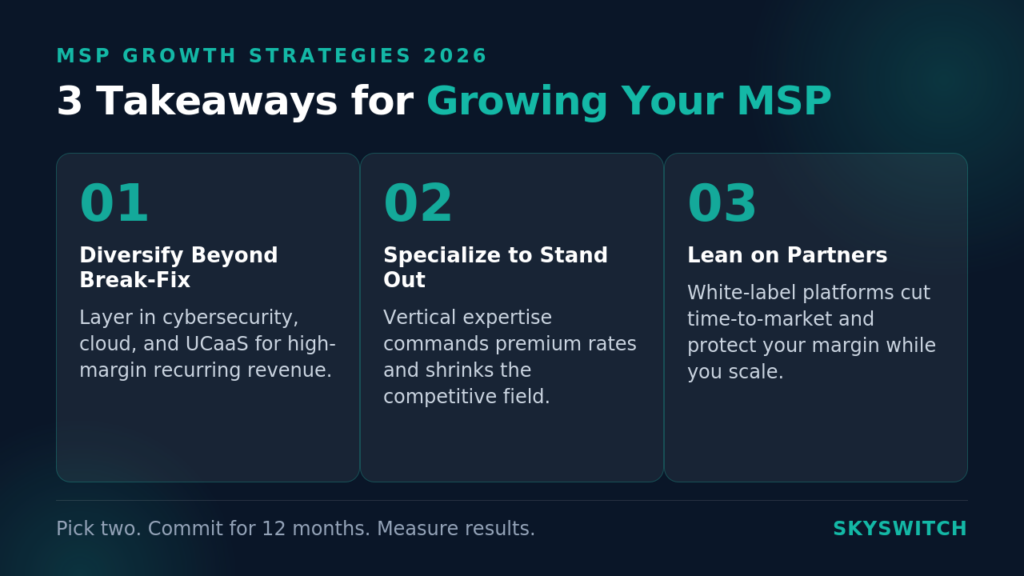
The most effective MSP growth strategies are interconnected plays that reinforce each other. Diversifying services creates upsell opportunities. Specialization makes marketing easier. Strong customer success programs feed referrals. AI tooling frees up time you can reinvest in sales. Pick the ones that fit your business stage and run them with intent.
1. Diversify Your Service Portfolio Beyond Traditional IT Support
Relying on standard help desk and infrastructure management is a holding pattern, not a growth path. The MSPs scaling fastest are layering in adjacent, high-margin services. Some of the strongest categories include:
- Advanced cybersecurity and managed detection and response. The global managed security market is projected to grow from roughly $43 billion in 2026 to nearly $77 billion by 2031, making it a fast-expanding category in the channel.
- Cloud migration and FinOps. Clients juggling hybrid environments need partners who can rein in cloud spend and optimize multi-cloud architecture beyond basic lift-and-shift work.
- Unified Communications as a Service (UCaaS). Voice and collaboration services are one of the most underused MSP revenue growth levers, especially when delivered under your own brand through a white-label partner.
Adding these services gives customers more reasons to consolidate spend with you and prospects more reasons to pick you over a generalist.
2. How Can Voice and UCaaS Become a Reliable Revenue Stream for MSPs?
Voice services align almost perfectly with the MSP business model because they’re recurring, sticky, and grow with the customer. A 50-employee client today might be 100 employees in two years. Their headcount-based UCaaS bill grows automatically, with no new sales cycle required.
The market timing also helps. The global UCaaS market grew 6.1% in 2025 to $23 billion and is projected to expand another 6.6% in 2026, led by North America. Meanwhile, on-premises PBX revenue continues to decline, which means more buyers are actively shopping for cloud voice every month.
White-label UCaaS lets you capture this demand without building infrastructure. You set the pricing, own the customer relationship, and bill directly. Reseller margins on white-label UCaaS commonly land in the 50–70% range, depending on how you package and price. Here’s a helpful breakdown of how MSPs build voice into their business model, with more detail on the bundling math.

3. Embrace White-Label Solutions Instead of Building From Scratch
Building new services in-house is expensive, slow, and risky. White-label solutions simplify the process. You brand a proven platform as your own and start selling within weeks instead of investing in infrastructure, engineering, and certifications.
Client expectations around feature parity have climbed. Buyers expect AI-powered transcription, mobile apps, integrated SMS, and contact center options as table stakes. Trying to develop all of that yourself isn’t realistic for most MSPs. White-label gives you four practical advantages:
- Speed to market. Launch a new service line in 30-90 days instead of waiting a year.
- Lower risk. Upfront investment is minimal, so you can test demand without committing major capital.
- Brand equity. Customers see your brand on the portal, bills, and support, deepening loyalty.
- Continuous innovation. Your platform partner handles the roadmap, so new features appear automatically.
The right partner gives you onboarding, training, brandable marketing assets, and ongoing support so you can focus on selling. Here’s a helpful guide to evaluating white-label cloud solutions if you’re trying to figure out what good looks like.
4. Invest in Managed Service Provider Marketing That Actually Converts
Managed service provider marketing in 2026 looks nothing like it did three years ago. Generic “we do IT” messaging gets ignored. Buyers want clarity, proof, and specificity before they’ll even take a discovery call.
A few shifts driving real pipeline for MSPs right now:
- Tighter positioning. “We help mid-sized law firms in Texas eliminate downtime and pass compliance audits” lands harder than “we provide managed IT services.”
- Content that answers buyer questions. Long-tail blog content, video walkthroughs, and FAQ pages are getting picked up by AI search tools and traditional SEO alike.
- Proof over promises. Client dashboards, named case studies, and uptime data carry more weight than testimonials full of adjectives.
The point isn’t to do more marketing. It’s marketing that makes prospects feel like you already understand their world before the first conversation. That’s how you grow your MSP business in a market where prospects have unlimited options and limited patience.
5. Build a Customer Success Program That Drives Retention and Expansion
Acquiring a new customer costs more than expanding an existing one. Yet many MSPs still treat onboarding as the finish line and renewals as a quiet email. The MSPs growing the fastest are treating customer success as a structured program, not a vibe.
Roughly 60% of MSPs now run a formal customer success program, and another 34% want to build one. The reason is simple: it works. Structured programs surface upsell opportunities earlier, reduce churn, and turn satisfied clients into a referral engine. Components that consistently move the needle include quarterly business reviews with key clients, health-score dashboards that flag accounts trending toward churn, and dedicated onboarding specialists so every new client gets a consistent first 90 days.
The ROI shows up in lower churn and bigger contracts. Both compound over time, which is exactly the kind of MSP revenue growth you can plan around.
6. Use AI and Automation to Free Up Margin and Capacity
AI in the MSP world is a practical lever for productivity. Leading MSPs report 15–25% technician productivity gains and 40–70% reductions in ticket resolution times through AI adoption.
The point is giving your team back hours they can reinvest in higher-value work. A few practical use cases include automated patch management and remediation, AI-powered ticket triage that routes issues based on skill and history, and predictive monitoring that flags potential failures before clients notice.
AI benefits apply to your communications stack too. Modern UCaaS platforms include AI features like call transcription, summarization, sentiment analysis, and intelligent routing.
7. Develop Vertical-Specific Expertise to Command Premium Rates
Generalist MSPs are getting squeezed. Specialists are getting hired. Specialized MSPs report higher profit margins than generalists and often command pricing premiums because they understand industry-specific compliance, workflows, and software. Healthcare, finance, legal, and manufacturing are particularly strong verticals because their regulatory environments make commodity providers a poor fit.
Three high-leverage moves to build vertical expertise:
- Pick a sector you already serve well and double down. You probably have more domain knowledge than you realize.
- Build packaged solutions that address that vertical’s specific compliance, software integrations, and workflow needs.
- Show up where your buyers gather. Industry associations, trade publications, and vertical-specific conferences are where credibility gets built.
The risk of specialization isn’t that your market shrinks. It’s that you become known for something specific and stop being a commodity option in everyone else’s RFP.
8. Leverage Vendor Ecosystems and Partner Programs
The most strategic MSPs aren’t going it alone. They’re leaning into vendor ecosystems to bundle solutions, co-market with partners, and access enablement they couldn’t build internally. Clients increasingly want consolidated solutions from fewer vendors. If you can deliver IT, security, and communications under one roof through smart partner relationships, you become harder to displace.

A good partner brings sales coaching, brandable marketing assets, technical training, and access to a peer community where other MSPs share what’s working. For MSPs adding cloud communications, the right white-label UCaaS partner can completely change the economics. Instead of you carrying the cost of platform development, support infrastructure, and feature roadmap, a strong partner absorbs those costs while you keep your margin and customer ownership.
Top 3 High-Margin Service Categories for MSPs in 2026
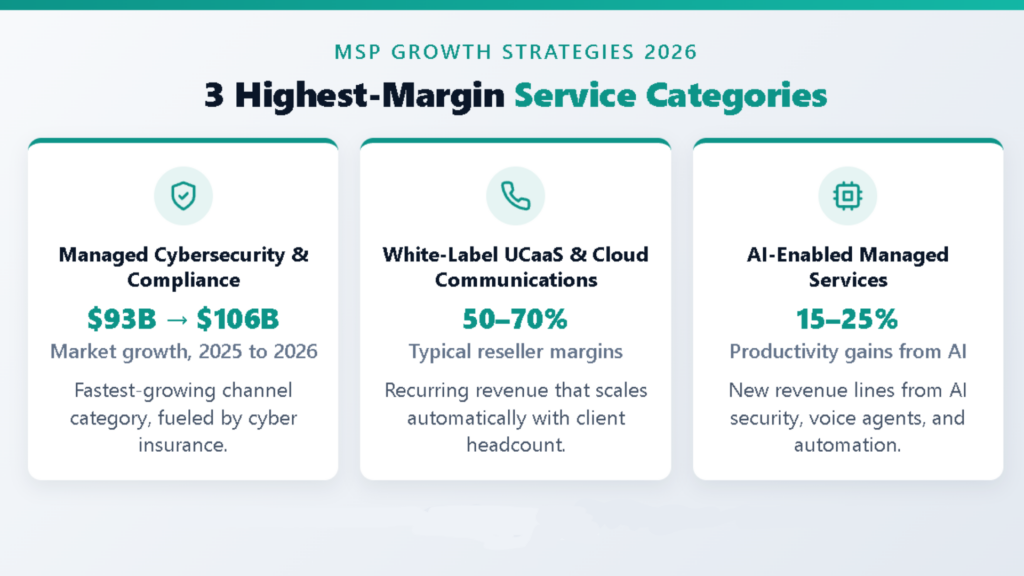
If you’re deciding where to expand next, the data points consistently to three high-margin categories worth prioritizing:
- Managed cybersecurity and compliance. Fastest-growing category in the channel, with cyber insurance requirements pushing more SMBs toward MSP-delivered security services. Compliance-focused MSPs are more likely to project revenue growth above 50% in 2026.
- White-label UCaaS and cloud communications. Recurring revenue with margins commonly in the 50–70% range, plus natural cross-sell into contact center, SMS, and integrations.
- AI-enabled managed services. From AI security to AI-powered voice agents and automation, this category is creating entirely new revenue lines that didn’t exist 18 months ago.
FAQ: MSP Growth Strategies in 2026
How fast can an MSP realistically grow in 2026?
Top-performing MSPs are projecting double-digit growth, with compliance-focused operators leading the pack. A reasonable benchmark for an established MSP investing in growth is 15–25% annual revenue increase, depending on your starting point and how aggressively you’re expanding services.
Is now a good time for an MSP to start selling UCaaS?
Yes. The UCaaS market is still growing, on-premises PBX is shrinking, and white-label platforms have matured to the point where launching takes 30-90 days or less with the right partner. The benefits of white-label UCaaS for MSPs make it one of the lowest-friction service expansions available right now.
What’s the biggest mistake MSPs make when trying to grow?
Trying to do too much at once. The MSPs that grow predictably pick two or three strategies, commit for 12 months, and measure results.
Where Do You Go From Here?
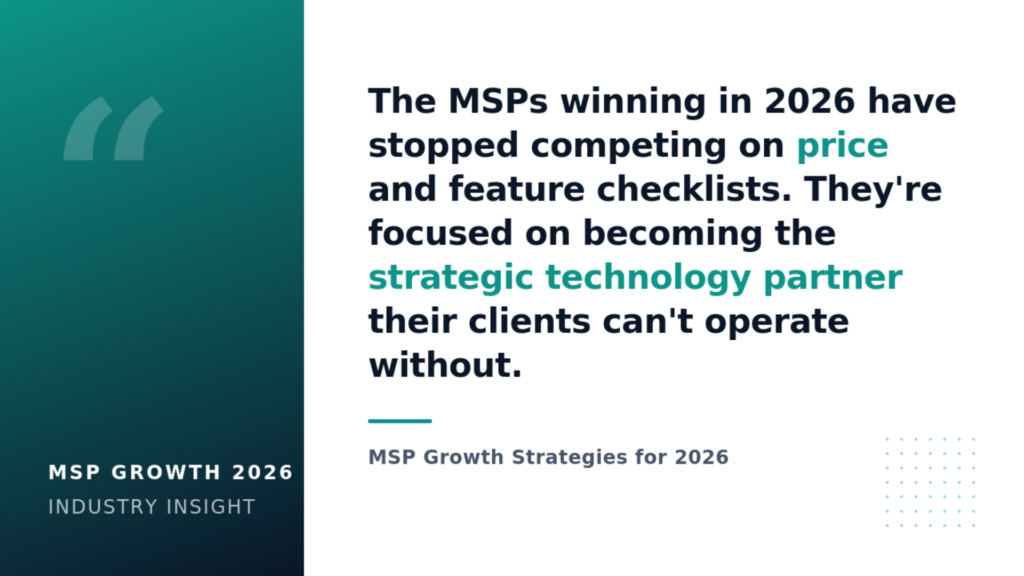
The MSPs growing fastest in 2026 share a common pattern. They’ve stopped competing on price and feature checklists. They’re focused on becoming the strategic technology partner their clients can’t operate without. That shift requires deliberate moves: better service mix, stronger marketing, smarter use of AI, and partnerships that let you scale without rebuilding everything from scratch.
If voice and UCaaS are part of your expansion plan, the right white-label partner can shorten your time to revenue. SkySwitch gives MSPs a complete white-label UCaaS platform, hands-on onboarding, and the marketing and sales support to make the launch stick. Get started with SkySwitch to map out what adding cloud communications could look like for your business.

Jessica is a marketing and sales strategist with deep expertise in VoIP telecommunications. As a Marketing Director, she specializes in channel marketing, account management, and product marketing within the communications industry. Jessica is passionate about helping partners grow through compelling messaging and hands-on support.