
How to Become a UCaaS Reseller: The Ultimate Guide

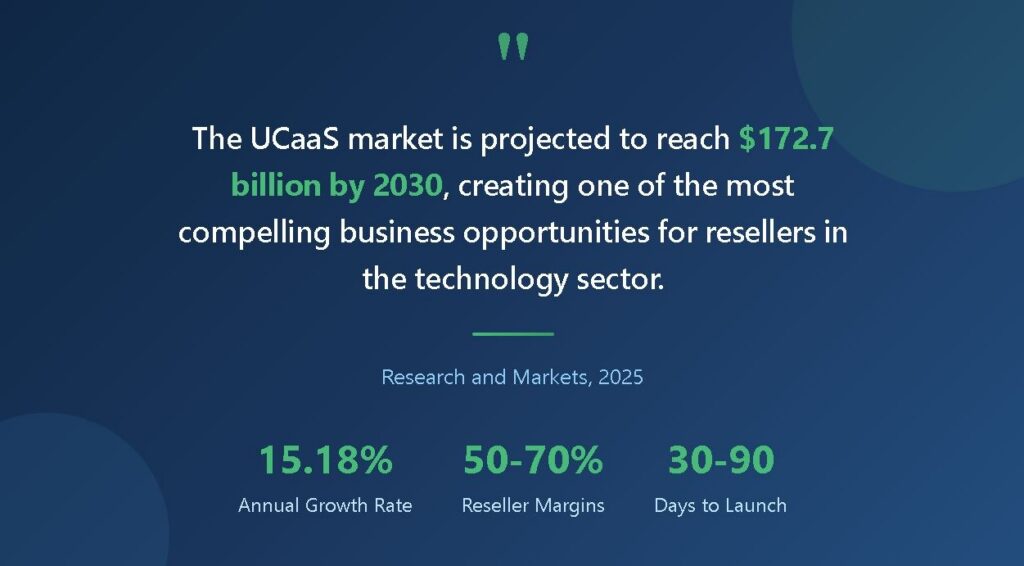
The UCaaS market is projected to reach $172.7 billion by 2030, creating a massive opportunity for resellers to build recurring revenue streams through white-label VoIP and private-label UCaaS solutions.
- MSPs, VARs, system integrators, and IT service providers can launch UCaaS offerings in as little as 30–90 days with the right white-label partner.
- Resellers typically achieve profit margins of 50–70% while maintaining full control over pricing, branding, and customer relationships.
- The shift to hybrid work has accelerated UCaaS adoption, with businesses actively seeking integrated communication solutions they can scale on demand.
Start by evaluating white-label providers that offer comprehensive onboarding, geo-redundant infrastructure, and flexible pricing models—so you can build your business your way.
Businesses are abandoning legacy phone systems. The global Unified Communications as a Service (UCaaS) market will expand from $85.19 billion in 2025 to $172.7 billion by 2030. For MSPs, system integrators, and IT service providers wondering how to become a UCaaS reseller, this growth creates a compelling business opportunity in the technology sector.
The demand for cloud-based communication solutions remains high. Remote and hybrid work models have become permanent fixtures, and organizations need unified platforms that combine voice, video, messaging, and collaboration tools into seamless experiences. Traditional PBX systems can’t meet these requirements, pushing businesses toward modern UCaaS solutions at accelerating rates.
This guide covers everything you need to know about entering the UCaaS reselling market. Learn which partnership models offer the greatest control and profitability, how to evaluate potential white-label providers, and what steps to take when you want to start a VoIP business that generates sustainable recurring revenue.
What Is UCaaS, and Why Learn How to Become a UCaaS Reseller?
Unified Communications as a Service (UCaaS) is a cloud-based delivery model that consolidates multiple communication and collaboration tools into a single, integrated platform. Rather than managing separate solutions for voice calls, video conferencing, instant messaging, and file sharing, businesses access all these capabilities through one unified interface that works across any device.
The “as-a-service” component means organizations pay subscription fees rather than investing heavily in on-premises infrastructure. This model eliminates capital expenditures for hardware, reduces IT management burdens, and provides automatic software updates and feature enhancements delivered through the cloud.
What Are the Core Components of UCaaS?
A comprehensive UCaaS platform typically includes several integrated services that work together. Voice services deliver enterprise-grade VoIP calling with features like auto attendants, call queues, voicemail transcription, and call recording. Video conferencing enables high-definition virtual meetings with screen sharing, recording capabilities, and support for large participant counts.
Messaging services encompass instant messaging for internal team communication and business SMS/MMS for customer engagement. Presence information provides real-time status updates showing whether colleagues are available, busy, or offline, enabling more efficient communication planning. Mobility features ensure all these capabilities remain accessible from smartphones, tablets, and laptops, regardless of location.
For resellers, understanding these components matters because your customers will have varying needs. Some may prioritize voice capabilities while others need robust video conferencing or advanced contact center functionality. The ability to customize solutions based on specific business requirements differentiates successful resellers from commodity providers.
What Types of Businesses Can Become UCaaS Resellers?
The beauty of the UCaaS reselling model is its accessibility across multiple business types. You don’t need decades of telecom experience or massive infrastructure investments to succeed. What matters most is having established customer relationships and the commitment to learn a new service category.
Managed Service Providers represent the largest segment of UCaaS resellers. MSPs already manage their clients’ IT infrastructure, making communication solutions a natural extension of existing services. Adding UCaaS allows MSPs to become true one-stop shops, reducing customer churn by consolidating more services under their umbrella.
System integrators bring technical expertise that translates well to UCaaS implementations, particularly for customers requiring complex integrations with existing business applications. Value-Added Resellers (VARs) can bundle communication services with hardware and software packages, creating comprehensive technology solutions. Internet Service Providers often find UCaaS complements their connectivity offerings, allowing them to capture more revenue from existing customer relationships.
Less obvious candidates include office equipment dealers who can bundle communication services with copier and technology leases, creating multi-year contracts that generate substantial recurring revenue. IT consultants can position UCaaS as part of broader digital transformation initiatives, and interconnect companies can migrate existing customers from legacy systems to modern cloud platforms.
What Are the Business Benefits of Reselling UCaaS?
Understanding how to become a UCaaS reseller starts with recognizing why this opportunity makes business sense. The advantages extend far beyond simply adding another product to your catalog.
Why Do Resellers Achieve Strong Profit Margins?
Private-label UCaaS models enable resellers to purchase services at wholesale rates while setting their own retail prices. This flexibility can translate to profit margins ranging from 50–70%, higher than many technology service categories. You control packaging, bundling, and pricing strategies rather than being locked into rigid vendor requirements.
The subscription-based model generates predictable monthly recurring revenue (MRR) that compounds over time. Unlike one-time product sales, UCaaS customers pay ongoing fees that continue generating income month after month, year after year. As your customer base grows, revenue accumulates without proportional increases in customer acquisition costs.
What Makes UCaaS Attractive to Your Customers?
Your end customers gain benefits that make UCaaS an easier sell than many technology solutions. Cost savings are a primary driver, with businesses typically reducing communication expenses compared to maintaining legacy phone systems. The elimination of expensive hardware investments, reduced maintenance costs, and flexible per-user pricing models appeal to cost-conscious decision-makers.
Scalability matters more as businesses grow and contract with market conditions. UCaaS allows organizations to instantly add or remove users without infrastructure changes, perfect for seasonal businesses or rapidly expanding companies. The flexibility to support remote and hybrid workers from any location has become essential.
The shift toward flexible work arrangements shows no signs of slowing. According to Robert Half’s analysis of workforce trends, 88% of employers now provide some hybrid work options, with 24% of new job postings in Q3 2025 being hybrid and 12% fully remote. This permanent transformation in how businesses operate creates sustained demand for communication platforms that work seamlessly regardless of employee location.
What Additional Revenue Opportunities Does UCaaS Create?
Beyond core voice and messaging services, UCaaS opens doors to complementary revenue streams:
- Contact center solutions for customers needing advanced customer service capabilities
- Business SMS platforms enabling appointment reminders, marketing campaigns, and customer engagement
- SD-WAN services optimizing network performance for voice quality
- Professional services for implementation, training, and ongoing support
- Hardware sales, including desk phones, headsets, and conference room equipment
- Integration services connecting UCaaS with CRM systems and business applications
Each additional service strengthens customer relationships while increasing per-account revenue and reducing churn likelihood.
How Do You Choose Between White-Label VoIP Partnership Models?
Understanding the distinctions between partnership models helps you select arrangements that align with your business goals and growth ambitions.
What Is the Agent Model?
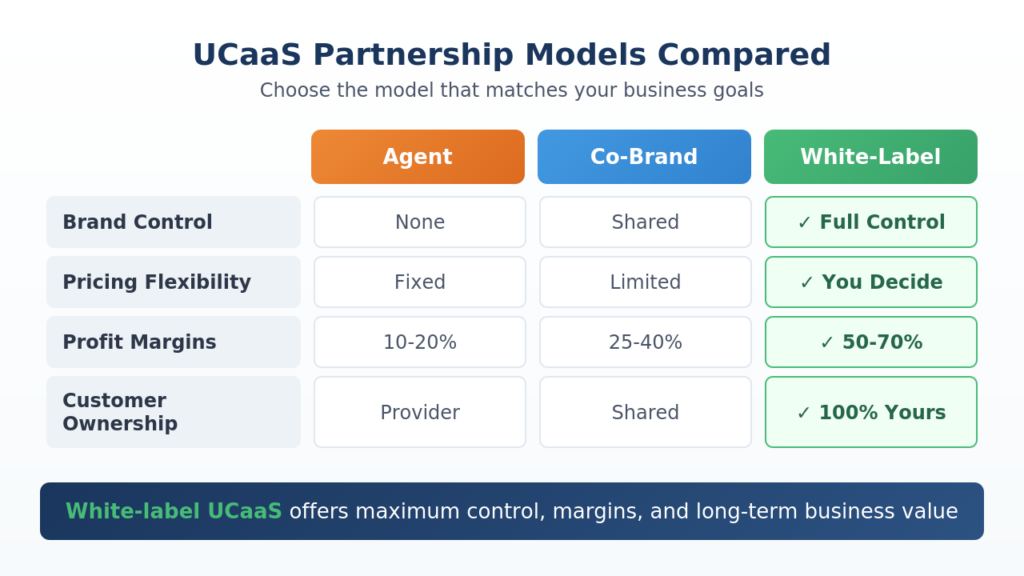
Agent or referral partnerships offer the simplest entry point but provide limited control and margins. In this model, you refer customers to the UCaaS provider, who then handles sales, billing, and support. You receive commissions on closed deals but maintain minimal ongoing customer relationships.
While agent programs require less commitment and expertise, they also limit your ability to build brand equity and customer loyalty. Customers recognize the primary provider’s brand, potentially bypassing you for future needs or expansions. Commission structures often favor the provider, leaving agents with smaller revenue shares than other models provide.
How Does Co-Branding Differ?
Co-branding arrangements position both your brand and the UCaaS provider’s brand in customer-facing materials. You share responsibility for marketing, sales, and sometimes support, with both companies visible to end customers.
This model offers more flexibility than pure agent relationships while providing some marketing support from the provider. However, co-branding can create confusion about service ownership and may dilute your brand identity over time. Customers might choose to work directly with the primary UCaaS provider for future needs, undermining your customer relationship control.
Why Do Successful Resellers Prefer Private-Label UCaaS?
White-label or private-label UCaaS partnerships offer the greatest control and profit potential. Under this model, you completely rebrand the UCaaS platform as your own, with your logo, colors, and contact information throughout customer-facing interfaces. End customers interact exclusively with your brand, unaware that the underlying infrastructure comes from a partner provider.
Private-label UCaaS gives you full ownership of customer relationships, pricing decisions, and service packaging. You bill customers directly, own the contract relationships, and control the complete customer experience. This ownership enables premium pricing strategies, customized service packages for specific verticals, and deep customer loyalty that reduces churn.
The tradeoff involves greater responsibility for sales, support, and customer success. However, reputable white-label providers offer extensive training, marketing support, and tiered technical support that enable resellers to deliver excellent service without building massive internal teams.
What Should You Look for When Starting a VoIP Business?
Learning how to become a UCaaS reseller involves more than signing a partnership agreement. Success requires preparation across multiple business dimensions.
How Do You Evaluate Your Market Opportunity?
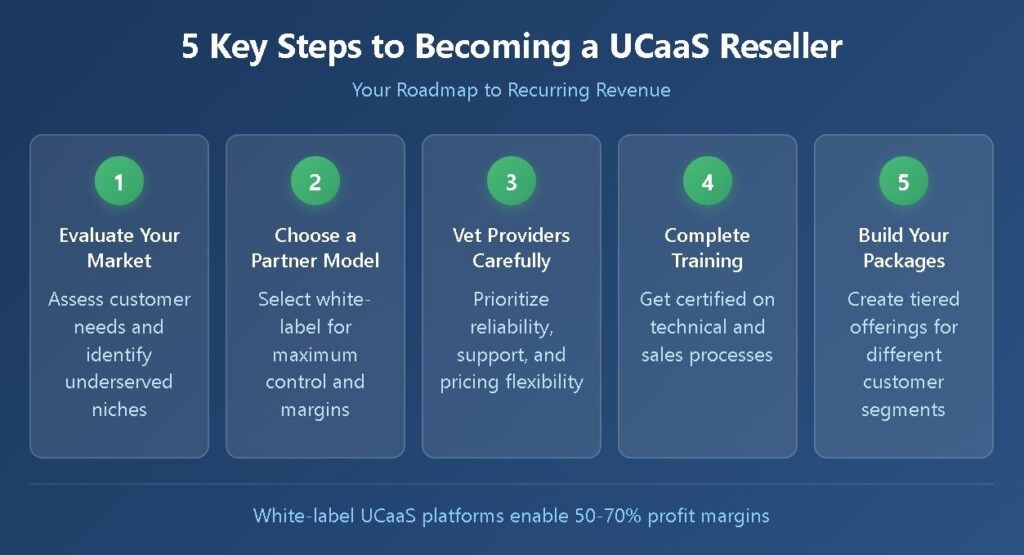
Begin by assessing your existing customer base and local market dynamics. Which of your current customers still rely on legacy phone systems or disconnected communication tools? What industries dominate your service area, and what are their specific communication requirements?
Understanding your market helps identify differentiation opportunities. Perhaps local healthcare providers need HIPAA-compliant solutions, or manufacturing companies require integration with specific ERP systems. Identifying underserved niches allows you to develop specialized expertise that commands premium pricing.
Research your competition carefully. Which providers already serve your target market? What do they offer, and where do gaps exist? Competitive analysis reveals opportunities to differentiate through better service, specialized expertise, or more flexible solutions.
What Infrastructure Do You Need?
One of the most attractive aspects of white-label VoIP reselling is the minimal infrastructure requirements. Your provider handles the technical platform, network operations, and ongoing maintenance. Your focus shifts to sales, customer relationships, and front-line support.
You will need customer relationship management tools to track prospects and manage ongoing accounts. Billing systems or integration with your provider’s billing platform streamline invoicing and payment collection. Basic demo capabilities help you showcase solutions to prospects, though many providers offer demo environments you can leverage.
How Do You Develop Service Packages and Pricing?
Successful resellers create tiered service packages that address different customer segments rather than offering one-size-fits-all solutions. Entry-level packages might include basic voice features for price-sensitive small businesses. Mid-tier offerings add video conferencing, team messaging, and mobile apps for growing companies. Premium packages incorporate contact center capabilities, advanced integrations, and enhanced support for demanding enterprises.
Research competitive pricing in your market while protecting healthy margins. Competing solely on price rarely builds sustainable businesses. Focus on value differentiation through superior service, specialized expertise, or unique solutions that justify premium positioning.
What Training and Certification Should You Complete?
Quality white-label providers offer comprehensive onboarding programs covering technical implementation, sales strategies, and ongoing support processes. Take full advantage of these resources rather than rushing to market unprepared.
Technical training ensures you understand platform capabilities, configuration options, and troubleshooting procedures. Sales training helps you articulate value propositions, handle objections, and effectively close deals. Support training prepares your team to handle common customer issues without escalating every inquiry to your provider.
Certification programs demonstrate competence to customers and often unlock additional benefits like priority support or enhanced marketing resources. Investing time in thorough preparation pays off through faster sales cycles, better customer outcomes, and reduced support escalations.
How Do You Evaluate White-Label UCaaS Providers?
Choosing the right partner ranks among the most consequential decisions you will make when learning how to become a UCaaS reseller. The wrong choice can undermine your business, damage customer relationships, and limit growth potential. Asking the right questions before committing protects your interests and positions you for success.

What Technical Capabilities Matter Most?
Platform reliability forms the foundation of any successful UCaaS partnership. Look for providers offering geo-redundant infrastructure with multiple data centers across different geographic regions. This architecture ensures automatic failover capabilities that maintain service continuity even during localized outages.
Ask about service level agreements and historical uptime performance. Top providers maintain uptime levels that translate to minimal unscheduled downtime annually. Request references from existing resellers who can share their real-world experiences with platform reliability.
Network architecture becomes increasingly important as your customer base grows. Providers utilizing intelligent routing and multiple geographic nodes deliver superior call quality and reduced latency compared to single-site deployments. Quality of service monitoring tools help identify and resolve network issues before they impact customer experience.
How Important Is Onboarding and Training Support?
The difference between struggling resellers and thriving ones often comes down to onboarding quality. Comprehensive training programs should cover technical implementation, sales strategies, billing processes, and ongoing support procedures. Look for providers offering dedicated onboarding specialists who guide you through initial setup and first customer deployments.
Technology evolves continuously, and your provider should offer regular training updates covering new features, market trends, and best practices. Knowledge bases with detailed documentation, video tutorials, and searchable articles enable self-service learning for you and your team.
Evaluate the provider’s commitment to reseller success beyond initial onboarding. Do they offer sales coaching for your first customer engagements? Are marketing resources available to help you generate leads and build brand awareness? How accessible is technical support when you need assistance with complex implementations?
What Pricing Flexibility Do You Require?
Pricing structures vary across providers. Some mandate specific retail pricing that limits your ability to compete or maximize margins. Others offer true wholesale models where you purchase services at base rates and set whatever retail prices you choose.
Wholesale pricing with complete flexibility typically produces the best outcomes for ambitious resellers. You can create competitive pricing for price-sensitive accounts while maintaining premium positioning for customers valuing specialized expertise. Volume discounts that automatically lower your costs as you grow further enhance profitability over time.
Understand all costs thoroughly before committing. Some providers charge upfront onboarding fees, monthly minimums, or per-transaction costs that affect your economics. Transparent pricing without hidden fees enables accurate business planning and prevents unpleasant surprises.
What Technology Trends Are Shaping UCaaS Reselling?
Staying ahead of technology trends positions resellers to capture emerging opportunities and provide forward-thinking guidance to customers. Several developments deserve particular attention.

How Is AI Transforming Business Communications?
Artificial intelligence integration is one of the most impactful developments in UCaaS. AI-powered features like automatic call transcription, sentiment analysis, and meeting summaries enhance productivity without requiring additional user effort. Intelligent assistants can handle routine inquiries, schedule appointments, and route calls based on caller intent.
For resellers, AI capabilities create differentiation opportunities. Customers increasingly expect intelligent features that simplify workflows and surface actionable insights from communication data. Providers investing heavily in AI development position their reseller partners to meet these evolving expectations.
Why Does Security and Compliance Matter?
Security concerns have escalated as businesses adopt cloud-based communication platforms. End-to-end encryption, multi-factor authentication, and advanced threat protection have become table stakes rather than premium features. Customers in regulated industries require compliance certifications, including HIPAA for healthcare, SOC 2 for service organizations, and various financial services regulations.
Resellers serving compliance-sensitive industries should thoroughly verify their provider’s certification status and security practices. The ability to meet regulatory requirements opens access to lucrative market segments that competitors lacking proper credentials can’t serve.
What Role Does Integration Play?
Modern businesses rely on numerous software applications that must work together. UCaaS solutions offering extensive integration with CRM systems, helpdesk platforms, and productivity suites deliver greater value than standalone communication tools.
Enhancing your UCaaS offering with robust integrations creates stickier customer relationships. When communication systems connect deeply with other business applications, switching costs increase substantially. API availability enables custom integrations for clients with unique requirements, creating service opportunities that generate additional revenue.
Frequently Asked Questions
How long does it take to start a VoIP business as a UCaaS reseller?
The timeline varies based on your existing expertise and your provider’s onboarding process. With comprehensive white-label platforms offering structured training programs, new resellers typically complete onboarding within 30–90 days. This includes technical certification, billing setup, branding configuration, and initial sales preparation. Resellers with prior telecommunications experience often accelerate this timeline, while those completely new to the industry may benefit from extended training periods.
What profit margins can UCaaS resellers realistically expect?
Most successful resellers achieve profit margins ranging from 50–70% on UCaaS services. Actual margins depend on your pricing strategy, service packaging, and operational efficiency. Wholesale pricing models that give you complete control over retail rates enable optimization based on market conditions and customer segments. Volume discounts that reduce your costs as you grow further improve margins over time.
Do I need technical expertise to become a UCaaS reseller?
While technical knowledge helps, it is not absolutely required. Quality white-label providers offer tiered support structures where you handle front-line customer inquiries while escalating complex technical issues to provider specialists. Comprehensive training programs bring new resellers up to speed on platform capabilities and common troubleshooting procedures. Many successful resellers focus primarily on sales and relationship management while leveraging provider resources for technical implementation and support.
What happens to my customers if I need to switch providers?
This concern highlights the importance of provider selection. With true white-label arrangements, you own customer relationships and contracts, providing some flexibility if transitions become necessary. However, switching providers involves significant effort, including number porting, system reconfiguration, and customer communication. Choosing a reliable, financially stable provider from the start minimizes this risk.
Build Your UCaaS Reselling Business
The opportunity to build a thriving UCaaS reselling business has never been stronger. Market growth continues to accelerate as businesses abandon legacy systems for modern, cloud-based platforms. Hybrid work models have made unified communications essential, driving demand across virtually every industry and company size.
SkySwitch offers a complete white-label UCaaS platform designed for resellers who want to build their own branded communication businesses. With geo-redundant infrastructure, comprehensive training programs, and flexible pricing models, we provide everything you need to succeed in the growing UCaaS market. Get started with SkySwitch to learn how our reseller platform can power your UCaaS offering.

Jessica is a marketing and sales strategist with deep expertise in VoIP telecommunications. As a Marketing Director, she specializes in channel marketing, account management, and product marketing within the communications industry. Jessica is passionate about helping partners grow through compelling messaging and hands-on support.