
Private-Label UCaaS: A Profitable Model for MSPs
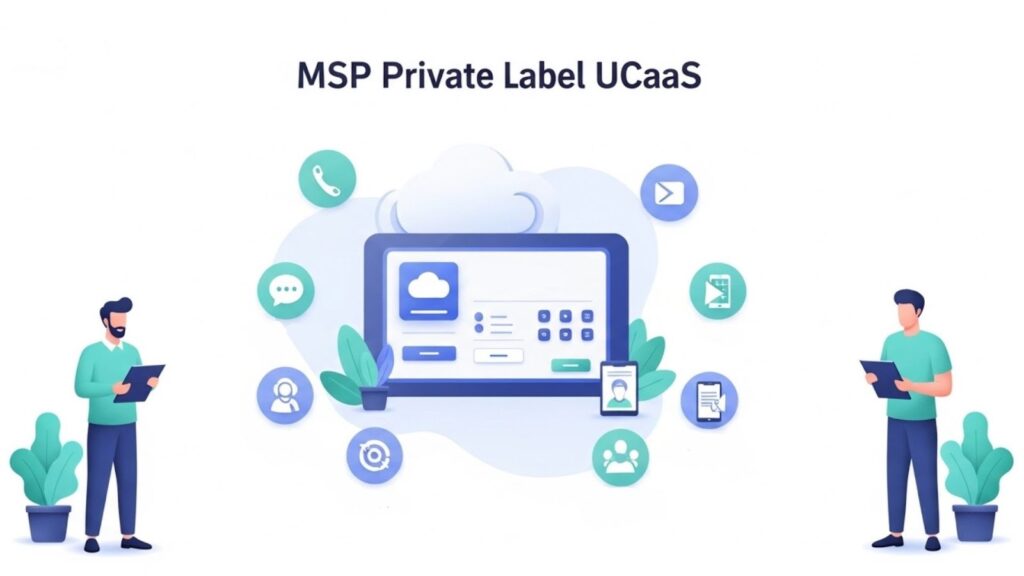
Private-label UCaaS is a transformative opportunity for MSPs to build sustainable recurring revenue while maintaining complete control over customer relationships and brand positioning.
- MSPs achieve rapid market entry within weeks rather than years by leveraging established infrastructure without massive capital investment.
- Complete customer relationship ownership enables higher profit margins compared to agent models that offer only commission-based revenue.
- Cross-selling opportunities with existing IT services create multiple touchpoints for deepening customer relationships and increasing lifetime value.
- Predictable monthly recurring revenue from subscription-based UCaaS provides financial stability that supports strategic planning and business growth.
The most successful MSPs approach private-label UCaaS as a complete business transformation rather than simply adding another product line to their portfolio.
While MSPs once thrived on hardware sales and break-fix models, today’s market demands recurring revenue streams and comprehensive service portfolios. The global UCaaS market is projected to reach $262.37 billion by 2030, growing at nearly 20% annually, creating massive opportunities for service providers who can adopt the right strategy.
For MSPs struggling to differentiate, private-label UCaaS is a pathway to building deeper customer relationships, achieving predictable monthly recurring revenue, and establishing your brand as a comprehensive technology partner.
What Makes Private-Label UCaaS Different from Traditional Reselling?
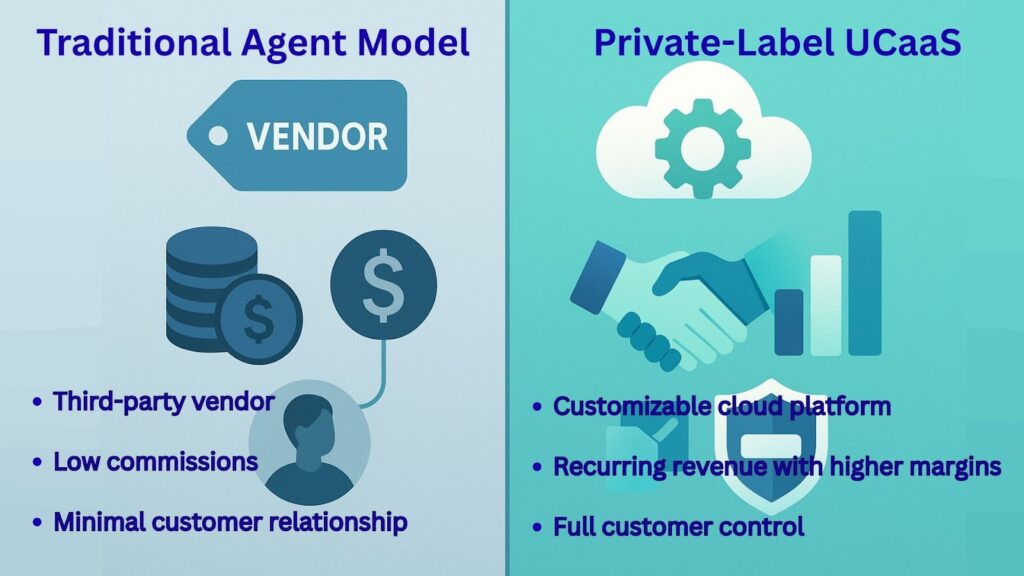
Private-label UCaaS goes far beyond simply reselling another company’s products. Unlike traditional agent models, where you earn commissions while the vendor maintains the customer relationship, white-label UCaaS puts you in complete control of your brand, pricing, and customer experience.
With traditional reselling arrangements, your customers know they’re receiving services from a third party. Marketing materials display the vendor’s branding, customer support flows through their channels, and you’re essentially a sales intermediary. This model limits your ability to build lasting relationships and often results in lower profit margins, especially when you’re trying to resell UCaaS without full control of the customer experience.
With private-label UCaaS, you brand the entire solution as your own service, from initial marketing through ongoing support. Your customers view you as their complete communication provider, never knowing that the backend infrastructure is managed by a white-label partner. This ownership enables you to control pricing strategies, customize service packages, and build the kind of customer loyalty that drives long-term business growth.
MSPs can achieve margins of 50–60% through white-label partnerships, compared to 10–20% commission structures common in traditional relationships. This increased profitability stems from your ability to set pricing while leveraging wholesale rates from your white-label provider.
Why MSPs Are Choosing Private-Label UCaaS Over Other Models?
The shift toward private-label UCaaS reflects broader changes in how customers evaluate and purchase technology services. As 68% of CIOs are planning to consolidate, it’s clear that businesses increasingly prefer working with fewer vendors who can provide comprehensive solutions rather than managing multiple relationships for different services.
Complete Customer Relationship Control
White-label UCaaS enables MSPs to own every aspect of the customer lifecycle. From initial sales presentations through ongoing support interactions, your brand remains front and center. This continuous brand presence strengthens MSP communication across the entire lifecycle and reduces the risk of customers being poached by competitors or upstream vendors.
Your team handles all customer communications, billing processes, and service modifications. This direct relationship control allows you to respond quickly to customer needs, customize solutions for specific requirements, and position additional services as client needs evolve.
Predictable Recurring Revenue Streams
The subscription-based nature of UCaaS gives MSPs a reliable monthly revenue foundation. Instead of relying on inconsistent break-fix or hardware sales, each new seat adds stable, forecastable income that compounds as your customer base grows.
What makes this model especially powerful is its long service lifespan. Businesses rarely switch communication platforms once deployed, meaning a single win can generate recurring revenue for years. This consistency allows MSPs to plan ahead with confidence, invest in staff and marketing, and smooth out the cash-flow volatility that often challenges service providers. Over time, the predictability of UCaaS revenue becomes a strategic advantage, enabling MSPs to scale with far less financial risk.
Rapid Market Entry Without Infrastructure Investment
Building UCaaS infrastructure from scratch requires massive capital investment, technical expertise, and regulatory compliance across multiple jurisdictions. The timeline from initial planning to market launch typically spans months or years, during which competitors capture available market share.
Private-label partnerships enable market entry within weeks. Your white-label provider handles complex infrastructure management, compliance requirements, and ongoing technical maintenance while you focus on customer acquisition and relationship building. This speed-to-market gives you a real edge, letting you meet customer needs as they shift instead of falling behind.
Cross-Selling and Portfolio Integration Opportunities
Private-label UCaaS integrates seamlessly with existing MSP service portfolios. Customers who trust you for network management, cybersecurity, or cloud services naturally extend that trust to communication solutions when positioned properly.
The integrated approach also enhances MSP communication across services, creating multiple touchpoints for deepening customer relationships. Network optimization services support UCaaS performance, security services protect communication channels, and backup solutions ensure business continuity. This comprehensive approach increases customer lifetime value while making your services more essential to daily business operations.
How to Set Up Your White-Label UCaaS Business
Rolling out a private-label UCaaS offering isn’t a plug-and-play step. It takes alignment across your team and your processes, and the MSPs who grow the fastest are those who approach it as a strategic move for their business.

Market Assessment and Customer Identification
Begin by analyzing your existing customer base to identify the strongest candidates for UCaaS adoption. Companies with remote workers, multiple locations, or aging phone systems represent immediate opportunities. Healthcare organizations, professional services firms, and growing businesses typically show high demand for advanced communication features.
Conduct brief assessments with key customers to understand their current challenges. Are they struggling with remote collaboration? Do they lack mobility features? Are maintenance costs for existing systems becoming problematic? These conversations reveal specific value propositions for your UCaaS offering while demonstrating proactive customer service.
Document your findings to create customer personas that guide your sales approach and service packaging. Understanding common pain points across your customer base helps you develop standardized solutions while maintaining customization capabilities for unique situations.
Technology Partner Selection
Choosing the right white-label UCaaS provider determines your success in this market. Evaluate potential partners across multiple criteria, including infrastructure reliability, feature comprehensiveness, support quality, and business model alignment.
- Infrastructure reliability should be your top priority. Look for providers with geo-redundant data centers, proven uptime track records, and comprehensive disaster recovery capabilities. Your brand reputation depends on consistent service delivery.
- Feature sets must align with your target market’s needs. Basic voice services may suffice for price-sensitive customers, but businesses expecting comprehensive collaboration require advanced video conferencing, instant messaging, and integration. Consider platforms that offer extensive voice API support for custom integrations and future scalability.
- Support quality is vital during the transition period and ongoing operations. Evaluate onboarding programs, training resources, technical support responsiveness, and partner account management. The best providers offer comprehensive resources that accelerate your learning curve while providing ongoing support as your practice grows.

When you resell UCaaS, consider a comprehensive platform that combines enterprise-grade infrastructure with extensive partner support designed specifically for MSPs building profitable UCaaS practices.
Service Packaging and Pricing Strategy
Develop service packages that address different customer segments while maintaining healthy profit margins. Many MSPs create three-tier offerings that range from basic voice services to comprehensive collaboration suites.
Entry-level packages typically focus on essential voice features with basic collaboration tools. These offerings attract price-sensitive customers while providing a foundation for future upgrades. Mid-tier packages add advanced features like video conferencing, instant messaging, and mobile applications that appeal to growing businesses. Premium packages include comprehensive collaboration features, advanced security, and priority support for customers requiring enterprise-grade capabilities.
Pricing strategies should balance competitive positioning with profit requirements. Research local market rates while considering the total value your comprehensive service provides. Customers often pay premiums for simplified vendor relationships and superior local support.
Build upgrade paths into your pricing structure that encourage natural growth as customer needs expand. Volume discounts for larger deployments and multi-year commitments can improve customer retention while providing pricing flexibility for competitive situations.
Sales Process and Team Training
Develop systematic sales processes that position UCaaS as a strategic business solution rather than a commodity service. Successful UCaaS sales focus on business outcomes like improved productivity, reduced costs, and enhanced customer service rather than technical specifications.
Create discovery processes that uncover communication challenges and quantify the business impact of current limitations. How much time do employees waste managing multiple communication tools? What revenue opportunities are lost due to poor customer communication? These questions position UCaaS as a business investment rather than an expense.
Train your team on consultative selling techniques that position you as a trusted advisor. UCaaS buyers want partners who understand their business challenges and can recommend appropriate solutions. Technical features matter less than demonstrating how those features solve specific problems.
Develop reference materials that simplify complex technical concepts for decision-makers. Case studies, ROI calculators, and comparison charts help prospects understand the value proposition while building confidence in your expertise.
What Revenue Potential Can MSPs Expect?
The financial opportunity in private-label UCaaS extends beyond simple per-seat pricing models. Successful MSPs develop comprehensive revenue strategies that maximize both initial sales and long-term account growth.

Most MSPs achieve higher gross margins on UCaaS services compared to traditional hardware or basic IT services. These improved margins enable substantial reinvestment in business growth while maintaining competitive pricing for customers.
Because customer-lifetime value (CLV) captures revenue over the full span of a business relationship, including renewals, cross-sales, and usage expansion, it becomes a vital metric for long-term profitability. Companies that track CLV holistically (factoring in what the customer spends, how engaged they are, and how deeply they adopt the offering) are better positioned to prioritize high-potential accounts, reduce churn, and invest wisely in expansion.
Additional revenue opportunities emerge through complementary services. Network optimization, security enhancements, and integration services create additional billable work while improving overall solution value.
Frequently Asked Questions
How long does it take to launch a private-label UCaaS practice?
With proper planning and the right partner support, most MSPs can begin to resell UCaaS relatively quickly, often moving from onboarding to first customer deployment in just a few weeks. This timeline includes partner selection, training completion, service packaging development, and initial customer onboarding. Providers with comprehensive onboarding programs can accelerate time to market.
What technical expertise does my team need for white-label UCaaS?
While deep telecommunications expertise isn’t required, your team needs a basic understanding of network concepts, VoIP fundamentals, and customer support processes. Most white-label providers offer comprehensive training programs that bring your team up to speed quickly. Focus on customer relationship skills and business consultation capabilities rather than technical depth.
How do I price private-label UCaaS services competitively while maintaining healthy margins?
Research local market pricing while emphasizing the total value of your comprehensive service approach. Many MSPs find they can command premium pricing by bundling UCaaS with network optimization, security services, and superior local support. Consider value-based pricing that reflects business outcomes rather than competing solely on per-seat costs.
What happens if customers have technical issues with the UCaaS platform?
White-label providers typically offer multi-tier support structures that handle complex technical issues while enabling you to maintain customer relationships. Many providers offer co-branded support options where customers receive assistance under your brand. Comprehensive training helps your team handle common issues, while escalation procedures ensure complex problems receive expert attention.
Building Your Profitable UCaaS Future
Private-label UCaaS is a smart opportunity for MSPs ready to evolve beyond traditional service models. The combination of recurring revenue potential, customer relationship control, and market growth creates conditions for substantial business expansion.
Success requires strategic planning, thoughtful partner selection, and consistent MSP communication across sales, service delivery, and customer support. MSPs who approach white-label UCaaS as a complete business transformation rather than a simple product addition achieve the best results.
SkySwitch provides the comprehensive platform, training, and support you need to build a thriving UCaaS practice under your own brand. Get started today and discover how our proven partner program can accelerate your growth in this high-opportunity market.

Jessica is a marketing and sales strategist with deep expertise in VoIP telecommunications. As a Marketing Director, she specializes in channel marketing, account management, and product marketing within the communications industry. Jessica is passionate about helping partners grow through compelling messaging and hands-on support.