
How MSPs Can Offer HIPAA-Compliant VoIP Services

Healthcare is one of the stickiest, most profitable verticals a communications reseller can sell into, and HIPAA-compliant VoIP services are the key that unlocks it.
- The healthcare cloud communications market is growing, with small and midsize practices leading the demand and rarely having in-house telecom staff.
- Compliance is the entry ticket, so understanding the BAA and core safeguards separates you from generic phone providers.
- Medical practices don’t switch easily, which turns every healthcare account into durable, recurring revenue.
- The white-label model does the heavy lifting, letting you package, price, and launch healthcare communications on your own terms.
Treat healthcare as a focused growth play, build a compliant offering, and turn medical practices into a long-term recurring revenue engine.
Healthcare is one of the few markets where demand for better communication never really slows down. Every clinic, dental office, and specialty practice runs on phone calls, voicemails, faxes, and appointment reminders, and each of those touchpoints has to protect patient information. That combination of constant communication and strict privacy rules is why HIPAA-compliant VoIP services have become a valuable thing to sell.
The market for healthcare-specific cloud communications is projected to grow from $5.83 billion in 2026 to more than $10 billion by 2031, and most of that spend flows through smaller practices that rely on outside partners to set up and support their phone systems. If you resell communications through a white-label UCaaS platform, medical practices are a high-value, low-churn segment you can win and keep for years.
Why Are HIPAA-Compliant VoIP Services Such a Big Opportunity for Resellers?
Healthcare keeps showing up near the top of UCaaS adoption for good reasons. Practices are moving off aging on-premise systems, telehealth has normalized cloud communication, and patients now expect to text, call, and message their providers the same way they interact with every other business. For resellers, that demand turns into steady, recurring revenue once you can meet a few specific requirements. Let’s look at why this vertical deserves your attention.

A Market That Keeps Growing
Healthcare is consistently one of the largest verticals in cloud communications. Recent analysis points to healthcare as a leading industry segment for UCaaS adoption, driven by telehealth, multi-location care groups, and the push to consolidate voice, video, and messaging onto a single platform. Smaller practices are the fastest-growing slice of that market, and they rarely have dedicated telecom staff to lean on. That gap is where a reseller becomes indispensable because the practice needs a trusted partner to design, deploy, and support the whole thing.
Recurring Revenue That Sticks
Medical practices don’t switch phone systems casually. Once a clinic’s appointment reminders, call routing, and secure messaging are running smoothly, the cost and disruption of ripping it all out keep them loyal for years. That stickiness is a reseller’s best friend because the monthly recurring revenue you build in healthcare tends to stay on the books. One satisfied practice also tends to refer others in the same network, so a handful of healthcare accounts can anchor a very healthy book of business. You can see this pattern playing out across emerging industries driving adoption, and healthcare sits right at the front of the line.
What Makes VoIP HIPAA-Compliant?
Before you can sell into healthcare, you need to understand what your clients are actually buying. A medical practice needs assurance that every call, voicemail, and fax that touches patient data stays protected. Here’s what separates HIPAA-compliant VoIP services from standard business phone service, and what you’ll need to be able to explain in a sales conversation.
The Business Associate Agreement
The most important piece is the Business Associate Agreement (BAA). When you provide communications to a healthcare client and your platform stores or transmits their patients’ protected health information, you legally become a business associate. That means you share responsibility for safeguarding that data, and any provider that won’t sign a BAA simply can’t be sold into healthcare. Of the 14 largest healthcare data breaches in 2024, eight involved business associates of covered entities, which is why practices scrutinize the vendors behind their phone systems so carefully.
Core Safeguards Your Clients Will Ask About
Beyond the paperwork, the platform itself has to enforce real protections. The essentials your healthcare clients will expect include:
- Encryption in transit and at rest, so patient data is protected as it moves and while it’s stored.
- Access controls and unique user logins, so only authorized staff can reach sensitive records.
- Audit logging and secure storage for call recordings, voicemail, and fax.
These safeguards apply across every channel that can carry patient information, from voice calls and voicemail to SMS and fax. Since the rules can feel unfamiliar to anyone coming from a pure IT or voice background, it helps to lean on a partner that has already mapped out how resellers navigate HIPAA compliance in the healthcare market.

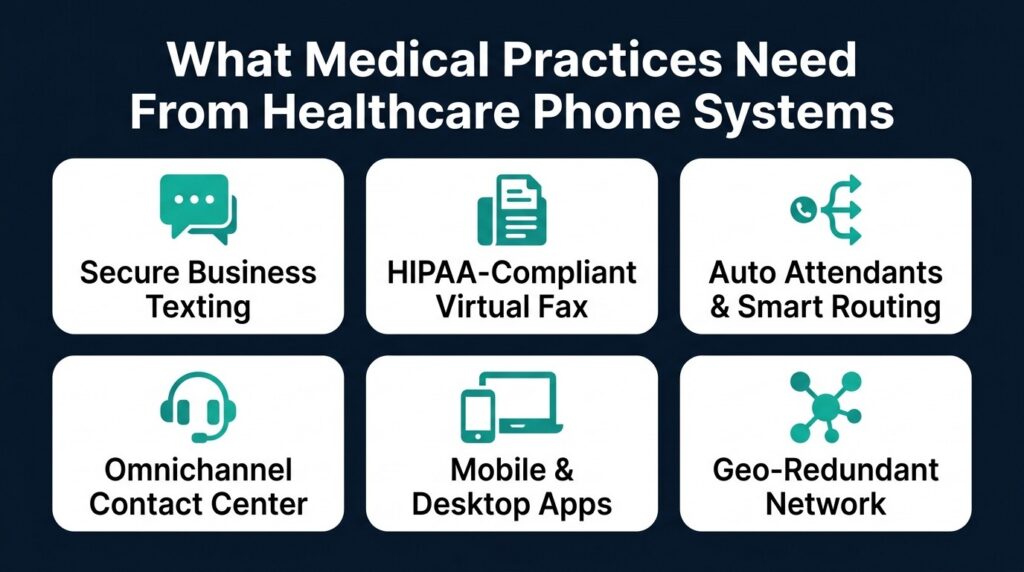
What Do Medical Practices Need From Healthcare Phone Systems?
Compliance gets you in the door. Features keep you there. Modern healthcare phone systems have to do far more than connect calls, and knowing what a practice uses day to day helps you package the right solution instead of overselling. Here are the capabilities medical clients ask for most:
- Secure business texting. Practices want to send appointment reminders, prescription pickup notices, and two-way messages without exposing patient data. Look for 10DLC-compliant business texting that runs through the practice’s existing numbers.
- HIPAA-compliant virtual fax. Faxing is still everywhere in healthcare, from referrals to lab results. A secure virtual fax solution lets a practice ditch the old machine while keeping documents protected and stored safely.
- Auto attendants, AI agents, and smart call routing. Practices need calls sent to the right department, after-hours handling, and overflow routing so patients never sit on hold during a rush.
- A contact center for patient experience. Larger groups benefit from a true omnichannel contact center that ties voice, SMS, chat, and email together with full patient interaction history.
- Mobile and desktop apps. Multi-location groups and hybrid staff need to take their extension anywhere, which means softphone apps that work on a laptop or smartphone.
- A reliable, geo-redundant network. When the front desk phone goes down, scheduled patients suffer, so geo-redundant networks with automatic failover are a genuine selling point.
When you bundle these features thoughtfully, you’re selling healthcare communications that make a practice run better, and that’s a much easier conversation to have with a busy office manager.
How Do You Turn UCaaS for Healthcare Into Recurring Revenue?
Profitably selling UCaaS for healthcare comes down to how you package, price, and deliver it. The white-label model is built for exactly this kind of vertical play, where each client wants a slightly different mix of features.
Package by Tier and Price on Your Terms
Most successful resellers build simple tiers, something like Basic, Standard, and Pro, and slot the healthcare features into the higher tiers where compliance and security matter most. Because you set your own prices, you control your margins, with the opportunity to keep up to 70%, depending on how you package your offering. You also own the customer relationship directly, invoicing the practice yourself rather than handing the account to a carrier. That ownership makes UCaaS for healthcare a long-term asset rather than a one-time sale.

Launch Fast and Provision Yourself
The other advantage of the cloud model is speed. There’s no on-premise PBX to install, no truck rolls for every change, and provisioning happens through self-service tools you control. With a turnkey reseller program handling billing, onboarding, and back-end support, committed partners can start selling in as little as 30 days. Platform automation and integrated billing then keep your operating costs low as you scale, so more of that recurring revenue lands as profit. If you want a wider view of where the category is heading, the latest UCaaS trends for resellers are worth a read.
How Do You Win VoIP for Medical Practices Against the Big Carriers?
The national carriers and big-box brands all chase healthcare too, so how does a regional reseller compete for VoIP for medical practices? You compete on the things the giants are notoriously bad at. Practices remember who picked up the phone when their front desk went quiet, and that kind of responsiveness is hard for a faceless national brand to replicate.
Your edge comes down to a few advantages you can build into every deal. Local, responsive support means you can be reachable and accountable in a way a national call center never will. White-label branding lets you put your own name on the solution, building trust and loyalty with the practice instead of pointing them toward someone else’s logo. And a consultative approach, where you map a clinic’s actual workflows before recommending features, positions you as a healthcare communications advisor rather than a vendor reading from a price sheet. Add the ability to extend the platform with tools like voice API integrations for appointment automation, and you can tailor a solution that the big players won’t bother to build for a single practice.

Frequently Asked Questions About HIPAA-Compliant VoIP Services
A few questions come up when resellers start exploring the healthcare market. Here are quick answers to the most common ones.
Does a VoIP provider really have to be HIPAA-compliant?
Yes, if the practice’s patient data touches the platform. The moment your service stores or transmits protected health information, you become a business associate and share responsibility for protecting it. A signed BAA and proper safeguards are non-negotiable when you sell into healthcare.
What’s the difference between healthcare phone systems and regular business VoIP?
The underlying technology is similar, but healthcare phone systems add a layer of compliance, security, and documentation that standard business VoIP doesn’t require. Think encryption across every channel, access controls, audit trails, secure storage, and a provider willing to sign a BAA. Practices pay for that assurance, which is part of what makes the vertical so attractive.
How quickly can I start selling UCaaS for healthcare?
With a turnkey white-label platform behind you, committed partners can be up and selling in as little as 30 days because there’s no infrastructure to build, and provisioning is self-service. Building deep healthcare expertise takes a bit longer, but you don’t have to wait for that to start landing accounts.
Do I need to be a healthcare IT specialist to sell to medical practices?
No. You need a compliant platform, a basic grasp of HIPAA and the BAA, and a partner that supports you on the technical and compliance details. Many successful healthcare resellers started as general MSPs or VARs and grew their expertise one practice at a time.
Build Your Healthcare Communications Practice
Healthcare rewards resellers who show up prepared. Get the compliance piece right, package the features practices actually use, and you’ll be building a recurring revenue stream that’s tough for competitors to pry away. The demand is already there, the market is growing, and small practices need a partner who understands both their technology and their obligations.
That’s exactly what SkySwitch was built to support, giving you a white-label platform, healthcare-ready features, and the onboarding and compliance resources to win in this vertical. Get started with SkySwitch and start turning medical practices into long-term, profitable accounts.

Jessica is a marketing and sales strategist with deep expertise in VoIP telecommunications. As a Marketing Director, she specializes in channel marketing, account management, and product marketing within the communications industry. Jessica is passionate about helping partners grow through compelling messaging and hands-on support.