
The Future of Unified Communications in 2026

Unified communications has evolved into the central nervous system of modern enterprises, and 2026 marks the year AI becomes an active participant in business conversations rather than a passive observer.
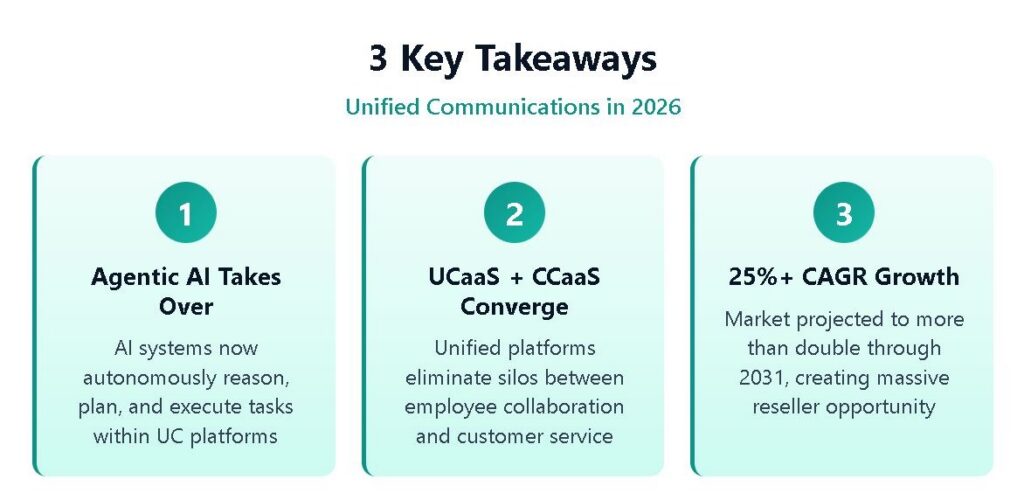
- Agentic AI is transforming UC platforms into autonomous systems that can reason, plan, and take action on behalf of users.
- The UCaaS market is growing at a 25%+ CAGR through 2031.
- UCaaS and CCaaS convergence is accelerating, with organizations demanding unified platforms that eliminate silos between employee collaboration and customer engagement.
- Security requirements are shifting toward zero-trust architectures and regional data sovereignty as compliance becomes a competitive differentiator.
Resellers who position themselves as strategic advisors on unified communications transformation will capture disproportionate market share as businesses accelerate their migration from legacy systems.
Unified communications has matured since its early days as a simple integration layer between voice and messaging. Today, UC represents a comprehensive cloud-based ecosystem that consolidates voice, video, messaging, presence, collaboration tools, and AI capabilities into a single platform accessible from any device.
The definition itself has expanded. Where unified communications once meant connecting phone systems to email, modern UC platforms are intelligent hubs that facilitate communication and actively participate in business processes. The global UCaaS market reached $70.56 billion in 2026 and continues its ascent toward unprecedented valuations.
For resellers serving small and medium businesses, this evolution creates both opportunity and responsibility. Your clients are now asking how quickly they can modernize their communication infrastructure to compete with organizations already leveraging these capabilities.
What Are the Biggest Unified Communications Trends Shaping 2026?
Unified communications in 2026 are defined by several trends that are reshaping how businesses communicate, collaborate, and serve their customers. Understanding these UCaaS future trends positions resellers to guide clients through technology decisions rather than simply selling features.
The Rise of Agentic AI
AI has been in production for a few years now, but 2026 is the year of agentic AI. These systems can autonomously reason, plan, and adapt to changing environments. Unlike previous generations of AI that simply responded to prompts or automated predefined workflows, agentic systems operate with a high degree of independence and continuously refine their actions based on context.
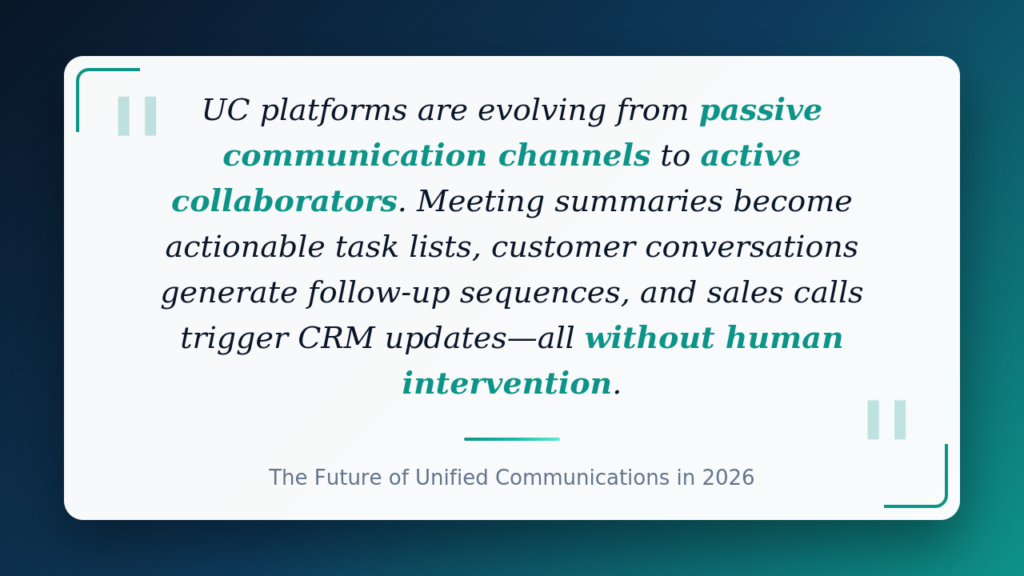
UC platforms are evolving from passive communication channels to active collaborators. Meeting summaries are actionable task lists that automatically populate project management systems. Customer conversations generate follow-up sequences without human intervention. Sales calls trigger CRM updates, schedule appointments, and draft proposal outlines based on discussed requirements.
The implications for business communication trends extend beyond efficiency gains. Organizations implementing agentic AI within their unified communications platforms report measurable improvements in response times, customer satisfaction, and employee productivity. Resellers can position themselves as advisors helping clients navigate which AI capabilities deliver genuine value versus which represent marketing hype.

UCaaS and CCaaS Convergence
One of the most impactful business communication trends is the convergence of unified communications as a service with contact center as a service platforms. While these technologies historically operated in separate worlds, organizations increasingly demand integrated UCaaS and CCaaS solutions that eliminate the friction between internal collaboration and customer-facing interactions.
When a support agent needs expertise from a billing specialist or product engineer, they should be able to pull in that expert through unified collaboration tools without switching applications or losing customer context. True integration means the tools internal teams use for voice, video, and chat are directly connected to the systems support and sales teams rely on daily.
For resellers, this convergence creates upsell opportunities. Clients who initially engage for basic hosted voice solutions represent expansion opportunities as their businesses grow and their customer service requirements become more sophisticated. The key is partnering with providers that offer genuine platform integration rather than loosely coupled point solutions marketed as unified.
The Hybrid Workplace Is Here to Stay
Flexible models have become commonplace, with 88% of U.S. employers offering some level of hybrid work and approximately 25% offering hybrid arrangements to all employees. This trend makes unified communications essential.
The UCaaS evolution to support hybrid work is more than remote access to phone systems. Modern platforms must deliver consistent experiences whether employees are at headquarters, working from home, visiting client sites, or traveling. Quality of service monitoring, intelligent routing, and seamless device switching have moved from differentiating features to baseline requirements.
Employee engagement platforms are becoming central to UC offerings as well. Leading providers are creating mobile-first, social-media-like employee experience dashboards designed to boost recognition, interaction, and retention. Employees can customize daily news feeds, follow colleagues, participate in polls, view live streams, and review assigned training modules, all within their UC environment.
Voice Renaissance Powered by AI
Contrary to predictions that text-based communication would render voice obsolete, AI is actually making voice more valuable than ever. With real-time voice translation, sentiment analysis, and intent detection, AI transforms spoken conversations into structured data that feeds CRM systems, knowledge bases, analytics platforms, and compliance systems.
Voice is evolving from a support channel to a strategic signal source. Organizations can now trigger automation workflows based on spoken keywords or emotional cues detected during conversations. Sales managers can receive real-time alerts when deals appear to be at risk based on customer sentiment analysis. Customer service leaders can identify training opportunities by analyzing patterns across thousands of recorded interactions.
For resellers serving businesses that rely heavily on phone-based communication, this trend creates opportunities to demonstrate ROI. The conversation has shifted from cost-per-minute comparisons to value generated through actionable intelligence extracted from every customer interaction.
What Does the 2026 UCaaS Market Look Like?
The UCaaS future trends we’re witnessing translate into impressive market growth that creates substantial opportunities for resellers. Understanding the current market helps you position your services and choose partners that will remain competitive through the evolution ahead.
Market Size and Growth Projections
The UCaaS market is growing at 25.67% CAGR, with some segments growing even faster. It’s projected to more than double over the next five years, creating billions of dollars in new revenue opportunities.
Several factors drive this sustained growth. The shift to hybrid work models means unified communications has graduated from convenience to a business continuity requirement. Organizations that might have delayed cloud migration are now accelerating their timelines as legacy systems reach end-of-life.

Competitive Landscape Shifts
The UCaaS market has matured, with clear market leaders emerging while smaller providers consolidate or find specialized niches. Microsoft, Cisco, Zoom, and RingCentral collectively command significant market share, creating a competitive environment where differentiation matters more than ever.
Competing directly against global technology giants on feature sets or brand recognition isn’t realistic for most regional service providers. However, white-label UCaaS platforms enable resellers to offer enterprise-grade capabilities under their own brand while providing the local expertise, responsive support, and consultative relationships that large vendors struggle to deliver at scale.
The providers that succeed in 2026 understand that unified communications has become a commodity in core capabilities. Differentiation now comes through integration depth, vertical expertise, AI-powered features, and partnership support that helps resellers win and retain clients.
How Is AI Transforming Business Communication Trends?
Understanding how AI enhances communication platforms helps resellers articulate value propositions that resonate with business decision-makers focused on outcomes rather than technology specifications.
Intelligent Meeting Management
Modern unified communications platforms automatically generate meeting summaries that identify key decisions, action items, and follow-up requirements. These summaries can be automatically distributed to participants and stakeholders who couldn’t attend, ensuring alignment without requiring additional administrative effort.
More sophisticated implementations connect meeting intelligence directly to business systems. Discussed budget figures can automatically populate financial planning tools. Mentioned customer names can trigger CRM record updates with conversation context. Assigned tasks can flow directly into project management platforms with relevant deadlines and dependencies already populated.
Real-Time Communication Enhancement
AI now operates during conversations rather than just analyzing them afterward. Real-time translation enables multilingual meetings without the need for an interpreter. Sentiment analysis provides speakers with feedback on audience engagement levels during presentations. Noise cancellation and background blur have become so sophisticated that professional-quality calls happen from virtually any environment.
For contact centers, AI enhancement has become table stakes rather than a competitive advantage. Approximately 98% of contact centers now use AI in some capacity, making advanced features requirements rather than differentiators. The question is no longer whether to implement AI but how to implement it effectively and govern it appropriately.
Predictive Analytics and Automation
The integration of AI with unified communications and CRM systems creates predictive capabilities that transform business operations. Communication patterns can indicate customer churn risk before explicit complaints surface. Scheduling optimization can recommend meeting times that maximize attendance probability based on historical patterns. Resource allocation models can predict communication volume spikes and adjust staffing recommendations accordingly.
These capabilities create measurable business value. Resellers who can articulate these outcomes and help clients measure improvement position themselves as strategic partners rather than commodity service providers.
What Security Challenges Must Unified Communications Address?
As unified communications becomes central to business operations, security requirements have evolved from checkbox compliance to a strategic priority. The UCaaS evolution in 2026 includes advances in how platforms protect sensitive communications and data.
Zero-Trust Architecture Adoption
The zero-trust security model is one of the most impactful business communication trends affecting platform architecture. Rather than trusting users or devices based on network location, zero-trust assumes potential compromise and requires continuous verification throughout every interaction.
Modern unified communications platforms implement zero-trust principles through multiple mechanisms. Multi-factor authentication protects account access. End-to-end encryption secures communications in transit. Role-based access controls limit functionality based on user permissions. Continuous monitoring detects anomalous behavior patterns that might indicate compromised credentials.
Data Sovereignty Requirements
Global privacy regulations continue expanding, creating data residency requirements that affect how UC platforms operate across jurisdictions. Organizations increasingly demand that their communication data remain within specific geographic boundaries, forcing providers to invest in regional data center infrastructure.
For resellers serving clients with international operations or regulated industry requirements, data sovereignty capabilities have become essential evaluation criteria. Providers that can guarantee data residency within specific regions while maintaining seamless global connectivity command premium positioning.
Compliance Integration
Unified communications platforms must support industry-specific compliance requirements. Healthcare organizations need HIPAA-compliant communication channels. Financial services firms require recording and archiving capabilities that satisfy regulatory examination requirements. Government contractors must meet stringent cybersecurity frameworks.
The most effective resellers deeply understand their target industries’ compliance requirements and can configure UCaaS solutions that comprehensively address these needs rather than treating compliance as an afterthought.
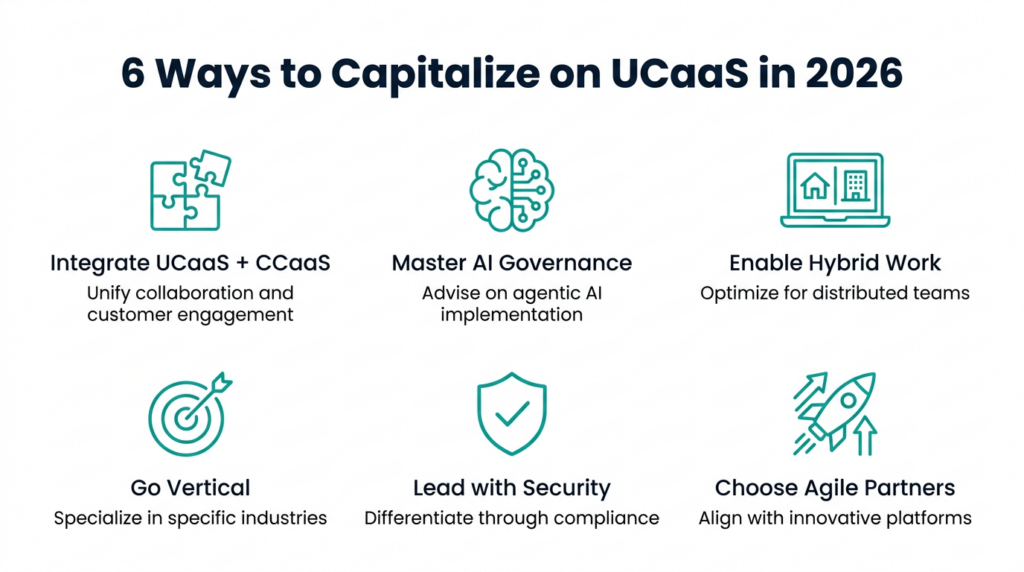
6 Ways Resellers Can Capitalize on UCaaS Evolution in 2026
The UCaaS future trends reshaping the market create opportunities for resellers who position themselves strategically. Here are the most important actions to prioritize this year:
- Lead with integrated UCaaS-CCaaS solutions. Organizations are consolidating vendors and seeking unified platforms that address both employee collaboration and customer engagement. Resellers offering truly integrated solutions rather than loosely coupled point products win more comprehensive deals.
- Develop AI governance expertise. As agentic AI capabilities expand, organizations need guidance on implementation, monitoring, and compliance. Resellers who can advise on appropriate AI deployment earn trusted advisor status.
- Specialize in hybrid work enablement. The staying power of distributed work creates ongoing opportunities to optimize communication infrastructure for employees working across multiple locations and devices.
- Build vertical market depth. Generic unified communications capabilities have become commoditized. Resellers who develop deep expertise in specific industries can articulate unique value propositions and command premium pricing.
- Prioritize security and compliance. Organizations evaluate communication platform security as rigorously as other critical infrastructure. Resellers who can conduct security assessments and recommend appropriate controls differentiate themselves from competitors focused solely on features.
- Partner with white-label providers offering platform agility. The pace of innovation in unified communications requires partners who continuously invest in platform development. Resellers dependent on stagnant technology lose competitive position.
How Can Resellers Choose the Right UCaaS Partner?
Selecting the right UCaaS provider has become more consequential as the market matures and differentiation gets harder. The partner you choose affects the features you can offer, your operational efficiency, margin potential, and long-term competitive positioning.
Evaluate Platform Innovation Investment
Partners who rely on third-party platforms have limited ability to differentiate or respond to market changes. Those who actively develop their technology can deliver innovations that help resellers win competitive deals.
Look for evidence of recent feature releases, roadmap transparency, and responsiveness to market trends. Providers actively adding agentic AI capabilities, expanding integration ecosystems, and enhancing security features demonstrate commitment to keeping resellers competitive.
Assess Support Infrastructure
Reliability directly impacts your brand reputation. Evaluate potential partners on their support responsiveness, technical expertise depth, and escalation procedures. The best technology means nothing if support failures leave your clients frustrated and your reputation damaged.
Geo-redundant infrastructure with automatic failover capabilities provides the reliability your clients require. Look for providers maintaining service level agreements guaranteeing exceptional uptime backed by meaningful consequences for failures.
Verify Economic Model Sustainability
Partnership economics determine your ability to build a sustainable business. Evaluate margin structures, minimum commitments, and pricing flexibility to ensure the partnership supports your growth objectives. The most successful resellers maintain margins up to 70% on unified communications services, providing room for competitive pricing while sustaining profitable operations.
White-label arrangements that allow complete brand control maximize your ability to build lasting client relationships and company value. Partners who position themselves between you and your clients undermine the relationship equity that makes reseller businesses valuable long-term assets.
Frequently Asked Questions
What is agentic AI in unified communications?
Agentic AI refers to artificial intelligence systems that can autonomously reason, plan, and take action within communication platforms. Unlike traditional AI assistants that respond to explicit commands, agentic AI operates independently to complete multi-step tasks like scheduling follow-up meetings, updating CRM records after calls, or routing customer inquiries based on real-time context analysis.
Why are UCaaS and CCaaS converging?
Organizations demand unified platforms that eliminate silos between internal collaboration and customer-facing communication. Converged platforms enable seamless escalation from customer service agents to internal experts, provide consistent communication experiences across employee and customer touchpoints, and reduce vendor management complexity while improving data integration.
What security features should unified communications platforms have in 2026?
Modern unified communications platforms should implement zero-trust architecture principles, including multi-factor authentication, end-to-end encryption, role-based access controls, and continuous behavioral monitoring. Data sovereignty capabilities that guarantee regional data residency are important for organizations subject to privacy regulations. Industry-specific compliance features, such as HIPAA compliance for healthcare or financial services recording requirements, should be available without complex customization.
Position Your Business for the Unified Communications Opportunity Ahead
Unified communications present an unprecedented opportunity for resellers prepared to guide clients through technology transformation. As businesses accelerate their migration from legacy systems, demand integrated platforms supporting both employee collaboration and customer engagement, and seek partners who understand emerging AI capabilities, resellers positioned as strategic advisors capture disproportionate market share.
SkySwitch delivers the comprehensive white-label platform, robust partner support, and margin-friendly economics that enable resellers to build thriving practices in this expanding market. Get started with SkySwitch today to position your business at the forefront of unified communications transformation.

Jessica is a marketing and sales strategist with deep expertise in VoIP telecommunications. As a Marketing Director, she specializes in channel marketing, account management, and product marketing within the communications industry. Jessica is passionate about helping partners grow through compelling messaging and hands-on support.