
VoIP Reselling Opportunities in 2026: A Growth Guide for New MSPs

The VoIP services market is projected to reach $413 billion by 2032, and MSPs who add voice services now are positioned to capture significant recurring revenue.
- The average MSP on Channel Partners’ 2025 MSP 501 list generates $16 million in recurring revenue annually, with 14% year-over-year growth.
- White-label VoIP business models offer profit margins between 50 and 70% with minimal infrastructure investment.
- New MSPs can launch a complete UCaaS practice in as little as 90 days with the right platform partner.
If you’re an MSP looking to diversify revenue, VoIP reseller opportunities represent one of the fastest paths to predictable monthly income.
Businesses no longer tolerate clunky on-premise phone systems that require expensive maintenance and offer zero flexibility for remote teams. This trend creates massive VoIP reseller opportunities for MSPs and ISPs ready to meet demand with modern cloud communication solutions.
The global VoIP services market reached $178.89 billion in 2025 and is expected to grow at a 12.7% compound annual growth rate through 2032. North America captures roughly 36% of global revenue, translating into a substantial addressable market for new MSPs.
For newcomers entering the space, this guide breaks down where the biggest opportunities exist and how first-time VoIP resellers can quickly gain traction in a fast-expanding market.
What Makes VoIP Reseller Opportunities So Attractive in 2026?
Several factors make 2026 ideal for pursuing VoIP reseller opportunities. Hybrid and remote work arrangements have become permanent, and companies need communication systems that work seamlessly regardless of employee location. Traditional phone systems can’t deliver this flexibility.
Additionally, small and medium-sized businesses actively seek providers who can consolidate their technology stack. When you offer VoIP alongside existing managed services, you become a one-stop solution rather than another point product. This stickiness dramatically improves customer retention and lifetime value.
Why Should New MSPs Consider the VoIP Business Model?
Starting any new service line requires careful consideration of investment versus returns. The VoIP business model offers an unusually favorable risk-reward profile for new MSPs entering the market.
The Recurring Revenue Advantage
Unlike project-based IT work, where revenue fluctuates monthly, VoIP services generate predictable monthly recurring revenue. The 2025 Channel Partners MSP 501 data reveals that top-performing MSPs averaged 14% growth in recurring revenue, with the average MSP 501 company generating $16 million annually in recurring revenue.

For a new MSP, even a modest customer base generates meaningful income. Sign 10 small business customers averaging 20 seats each at $25 per seat monthly, and you produce $5,000 in monthly recurring revenue. Scale to 50 customers and you’re generating $300,000 annually in predictable income.
Profit Margins and Low Barriers to Entry
White-label VoIP platforms typically enable reseller margins between 50 and 70 points. This margin profile exists because you leverage existing infrastructure rather than building your own. Your platform partner handles the technical heavy lifting while you focus on customer relationships.
Many MSPs assume that entering the VoIP market requires substantial capital or specialized expertise. White-label platforms have eliminated most barriers. You don’t need network infrastructure, telecom engineers, or carrier licenses. The right partner provides everything from the technology stack to training, billing systems, and ongoing support. Most white-label UCaaS programs get new resellers productive within 30 to 90 days.
How to Evaluate White-Label VoIP Platforms
Choosing the right platform partner ranks among the most consequential decisions you’ll make when pursuing VoIP reseller opportunities. The wrong choice can saddle you with unreliable technology or unfavorable economics.
Essential Platform Capabilities
Any platform you consider should include these core features:
- Full UCaaS feature set including voice, video conferencing, team messaging, mobile applications, and AI-powered capabilities.
- Geo-redundant infrastructure ensuring high availability without single points of failure
- Comprehensive self-service provisioning allowing you to add customers without calling support
- Automated billing and taxation simplifying subscription management
- Quality of service monitoring tools for proactive issue identification
- Extensive API access for CRM and business application integrations

For new MSPs entering the VoIP and UCaaS market, these features are the foundation for delivering a reliable, scalable, and low-maintenance service your customers can trust. Starting with a platform built on these essentials ensures you can grow confidently without being weighed down by operational complexity.
Support and Economic Terms
Technical platforms mean nothing without knowledge to deploy them effectively. Evaluate potential partners based on training depth and accessibility. Look for structured onboarding covering technical implementation, sales strategies, and operational best practices.
Ongoing support matters equally. The best platform partners offer comprehensive reseller programs with dedicated account managers, technical support teams, and peer communities. Dig deep into financial arrangements before committing. Understand wholesale pricing, calculate realistic margins, and ensure you have the flexibility to create custom packages and set your own prices.
How Do You Build Your MSP Reseller Growth Strategy?
Entering the VoIP market requires more than signing up with a platform. You need a deliberate strategy for identifying target customers, positioning services, and building a sustainable sales pipeline.
For Established MSPs: Leveraging Your Existing Customer Base
If you already serve IT customers, they represent your most accessible market for VoIP services and MSP reseller growth. You’ve established trust and demonstrated technical competence. Start by auditing your customer base for immediate opportunities: businesses with legacy phone systems nearing end-of-life, companies with multiple locations struggling with communication consistency, or organizations where employees work remotely without reliable business phone access.
The bundling approach strengthens your competitive position. When customers source IT services and communications from separate providers, they face coordination challenges. By offering both, you eliminate headaches while deepening relationships and increasing switching costs.
Identifying Your Ideal Customer Profile
Focus efforts on segments where you deliver clear value. Small and medium businesses with 10–100 employees typically represent a sweet spot. These organizations need sophisticated communication tools but lack internal IT resources. Professional services firms, healthcare practices, and real estate agencies rely heavily on phone communication and value features like call recording, auto attendants, and CRM integration.
Developing Your Sales Motion
Lead with business outcomes rather than technical features. Business owners care about improving customer service, enabling remote workers, and reducing costs. Position VoIP services as solutions to problems rather than impressive technology. Discovery conversations should explore current communication pain points, growth plans, and budget expectations. Demonstrations prove powerful since prospects experiencing the mobile app and admin portal find abstract benefits become tangible.
What Are the Steps to Launch Your VoIP Startup with a White-Label Provider?
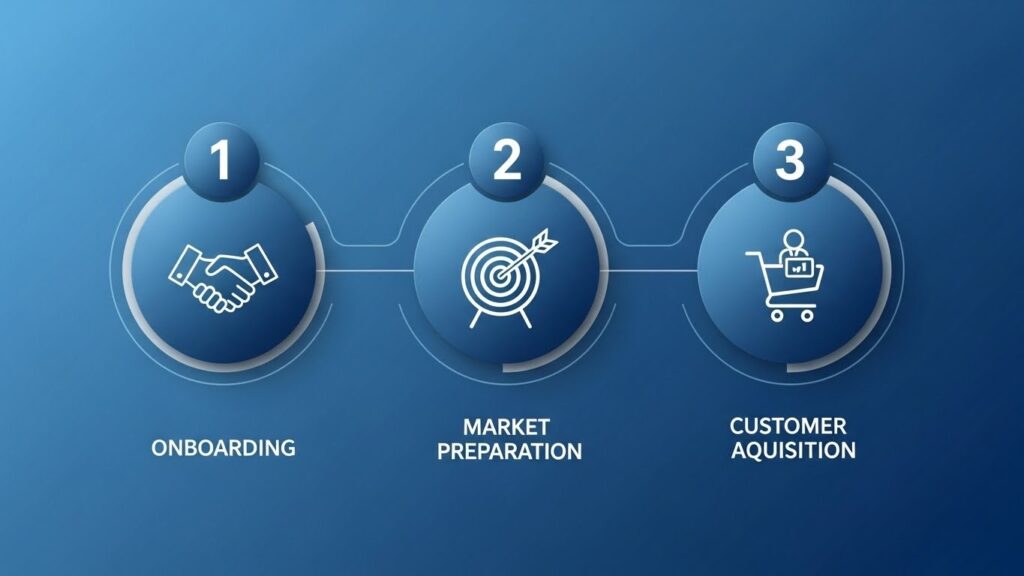
Converting VoIP reseller opportunities into actual revenue requires systematic execution. Follow this roadmap from initial decision through first customer acquisition.
Phase One: Platform Selection and Onboarding
Research potential white-label providers thoroughly. Request demos, speak with existing resellers, and carefully evaluate the economics. Once you’ve selected a provider, engage fully in their onboarding program. Configure your branded portal, establish a pricing structure, and set up billing processes. Work through technical training until you can confidently provision services and troubleshoot common issues. Most quality programs include structured onboarding processes designed to get you productive within 30 to 90 days.
Phase Two: Market Preparation and Customer Acquisition
Before actively selling, update your website to reflect VoIP capabilities, create sales collateral, and develop a target customer list. Research competitive offerings in your market to understand pricing and positioning opportunities.
Launch sales efforts systematically. Begin with warm outreach to existing customers who fit your ideal profile. Parallel to warm outreach, establish lead generation activities appropriate for your market. For each opportunity, follow a consistent sales process from discovery through demonstration to proposal.
Phase Three: Delivery Excellence
Customer acquisition matters, but retention determines long-term success. Implement professionally and communicate proactively throughout deployment. Set appropriate expectations about timelines and potential disruptions during number porting. After implementation, establish regular check-ins to ensure customers realize value. Happy customers become references and referral sources, fueling growth with minimal marketing investment.
Frequently Asked Questions About VoIP Reselling
How much technical expertise do I need to start reselling VoIP?
You need foundational IT knowledge but not deep telecom engineering experience. If you can configure routers, understand basic networking concepts, and troubleshoot connectivity issues, you have a sufficient technical background to succeed. Quality white-label platforms include comprehensive training that covers voice-specific topics like SIP, QoS configuration, and common troubleshooting scenarios.
What kind of profit margins can I realistically expect?
Most white-label VoIP platforms enable gross margins between 50% and 70% depending on your pricing strategy and customer mix. Your actual margins depend on how you package services, your competitive positioning, and the efficiency of your operations. Higher-touch customers requiring more support typically command premium pricing, while self-service-oriented customers may accept lower prices in exchange for reduced support or feature expectations.
How do I handle number porting and complex migrations?
Reputable white-label platforms provide support for number porting as part of their standard processes. Your platform partner typically manages the technical aspects of working with carriers to transfer numbers while you coordinate customer communication and cutover timing. For complex migrations involving multiple locations or integration with existing systems, most platforms offer professional services or can recommend qualified implementation partners.
What if a customer experiences call quality issues?
Call quality problems typically stem from network issues at the customer site rather than platform problems. Quality of service monitoring tools help you identify whether issues relate to bandwidth, latency, jitter, or packet loss. Most resolutions involve network configuration adjustments, router upgrades, or occasionally recommending customers upgrade their internet service. Your platform partner should provide troubleshooting guidance and escalation paths for complex issues.
Start Building Your VoIP Reseller Business Today
The VoIP reseller opportunities available in 2026 represent a compelling growth path for new MSPs. Market demand continues to expand as businesses modernize their communication infrastructure. White-label platforms have removed traditional barriers to entry, enabling MSPs to launch profitable voice practices without massive capital investment or specialized expertise.
Success requires choosing the right platform partner, committing to proper training, and executing a deliberate go-to-market strategy. The MSPs who move decisively position themselves to capture recurring revenue that compounds over time while deepening customer relationships that resist competitive displacement.
SkySwitch provides a turnkey white-label UCaaS platform designed specifically for resellers ready to pursue these opportunities. With comprehensive onboarding, robust support infrastructure, and the tools you need to build a profitable voice business, SkySwitch partners with you for success from day one. Get started to learn how our reseller program can accelerate your growth in the VoIP market.

Jessica is a marketing and sales strategist with deep expertise in VoIP telecommunications. As a Marketing Director, she specializes in channel marketing, account management, and product marketing within the communications industry. Jessica is passionate about helping partners grow through compelling messaging and hands-on support.