
VoIP Industry Growth: Why Now Is the Time to Resell

The global VoIP market is projected to grow at a 10.8% CAGR, creating unprecedented opportunities for MSPs and telecom resellers.
- Remote and hybrid work models are accelerating adoption as businesses demand flexible, cloud-based communication solutions.
- North America dominates the market with over 46% share, and SMBs are driving a 15%+ growth surge.
- AI integration and UCaaS bundling are transforming VoIP from a cost-saving tool into a comprehensive business productivity platform.
Now is the time to act: Resellers who position themselves as trusted VoIP providers can capture high-margin recurring revenue before market saturation.
The telecom industry has reached an inflection point. The global VoIP market was valued at $144.77 billion in 2024 and is projected to surge to $326.27 billion by 2032. This 10.8% CAGR is one of the strongest sustained growth trajectories in the technology sector.
For MSPs, system integrators, and VARs looking to expand their service offerings, this VoIP industry growth translates directly into opportunity. The shift away from traditional phone systems is an accelerating wave driven by fundamental changes in how businesses operate. Companies are moving away from outdated premises-based PBX systems and embracing cloud-based communication solutions that scale with their needs.
What Does VoIP Industry Growth Mean for Resellers?
The math is straightforward. Businesses switching to VoIP phone services can reduce their telecommunications costs by up to 60%. When you combine cost savings with enhanced features like video conferencing, team messaging, and mobile accessibility, the value proposition becomes compelling for nearly every organization. As a reseller, you’re positioned to deliver these benefits while building a predictable revenue stream that grows with your customer base.
Hybrid work is here to stay, legacy infrastructure is reaching end-of-life, and SMBs are actively seeking partners who can guide them through the transition. The window to establish yourself as a trusted telecom reseller is wide open, but it won’t stay that way indefinitely.
What Are the Key VoIP Trends of 2025 Driving Market Expansion?
The VoIP trends of 2025 reveal a market that’s maturing rapidly while simultaneously expanding into new use cases. Understanding these trends is essential for resellers who want to position themselves ahead of customer demand rather than simply reacting to it.
How Is Remote and Hybrid Work Accelerating VoIP Adoption?
The permanent shift toward flexible work arrangements has changed what businesses expect from their communication infrastructure. Companies can no longer rely on desk phones tethered to office locations when employees work from home offices, coffee shops, and client sites. VoIP enables voice, video, and messaging from any internet-connected device.
Research indicates that 69% of managers believe their hybrid and remote teams are more productive compared to those working exclusively in the office. This productivity advantage relies heavily on robust communication tools that keep distributed teams connected. The cloud voice market has responded with increasingly sophisticated solutions that rival enterprise-grade systems at a fraction of the cost.

For resellers, this trend creates natural conversation starters with existing clients. When you’re already managing a customer’s IT infrastructure, asking about their communication challenges opens doors to additional service opportunities. The businesses you serve are likely struggling with fragmented communication tools, and unified communications is a logical extension of your relationship.
What Role Is AI Playing in Modern VoIP Platforms?
Artificial intelligence has become a practical reality in VoIP platforms. Most UCaaS service providers are now integrating AI capabilities into their products. These features include real-time call transcription, automated meeting summaries, intelligent call routing, and sentiment analysis that helps businesses understand customer interactions at scale.
AI-powered voicemail transcription saves time for busy professionals. Smart routing ensures calls reach the right person on the first attempt. Automated insights help managers identify training opportunities and improve customer service outcomes. For resellers, AI capabilities provide compelling differentiation when pitching against commodity VoIP offerings.
The integration of AI also addresses one of the persistent challenges in VoIP deployment: support complexity. Machine learning algorithms can proactively identify network quality issues, predict potential problems before they affect call quality, and suggest configuration optimizations. This intelligence reduces the support burden on resellers while improving customer satisfaction.
Why Is the Cloud Voice Market Overtaking Traditional Systems?
The cloud voice market has fully validated the forecasts made earlier in the decade. The industry expectation that most organizations would shift to cloud-first architectures has now become reality, with businesses retiring on-premises PBX systems in favor of platforms that deliver far greater flexibility and scalability. Companies want communications tools that adapt quickly, integrate across workflows, and support distributed teams without the limitations of aging hardware.
Cost structure plays a major role in this migration. On-premises systems require substantial capital expenditure, ongoing maintenance contracts, and dedicated technical staff. Cloud solutions convert these costs to predictable monthly subscriptions that scale with actual usage. For businesses operating on tight margins, this shift from CapEx to OpEx often determines their communication technology decisions.
The reliability argument has also shifted in favor of cloud solutions. Leading platforms now operate across geo-redundant data centers with redundancy protocols that exceed what most businesses could achieve with on-premises equipment. When paired with SD-WAN technology, cloud voice can deliver enterprise-grade quality of service without the complexity of managing network infrastructure internally.
7 Statistics That Demonstrate VoIP Industry Growth
The numbers behind VoIP industry growth tell a compelling story for anyone considering the reseller opportunity. Here’s what the data reveals about market trajectory and potential:
- Global VoIP market reaches $326 billion by 2032 with a 10.8% CAGR, according to Fortune Business Insights, representing one of the fastest-growing segments in telecommunications
- The UCaaS market is projected to grow from $85.19 billion in 2025 to $172.69 billion by 2030, showing 15.18% annual growth as reported by Research and Markets.
- North America commands 46% of the VoIP market, creating a concentrated opportunity for MSP telecom providers operating in the region.
- Mobile VoIP is surging toward $73.4 billion by 2032, according to Global Market Insights, driven by smartphone penetration and BYOD policies.
- SMBs are driving 15%+ growth in VoIP adoption, making this segment particularly attractive for regional resellers who specialize in serving smaller businesses.
- 75% of companies are expected to use UCaaS for their business needs by 2030, signaling that cloud communication will become the default rather than the exception.
- Businesses save up to 60% on telecommunications costs by switching to VoIP, creating an easy ROI story for sales conversations.
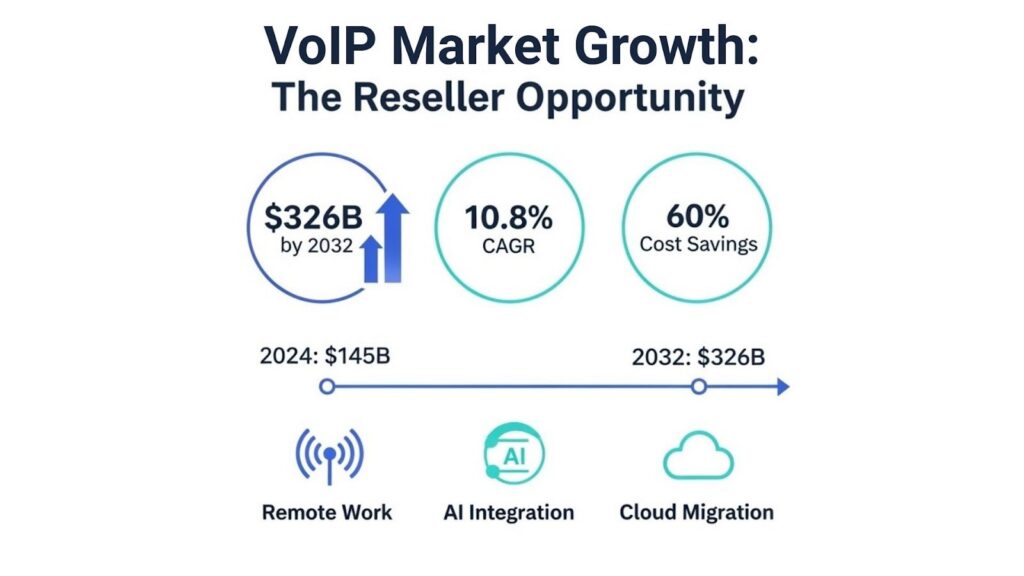
These statistics demonstrate that VoIP industry growth is both substantial and sustainable. The market is undergoing a structural shift that will continue for years to come.
Why Are MSP Telecom Services Perfectly Positioned?
MSP telecom expansion is one of the most logical service additions for managed service providers. If you’re already managing a client’s network, security, and IT infrastructure, you understand their business intimately. Adding voice and communication services creates deeper customer relationships while generating additional recurring revenue.
The synergies are compelling. Network monitoring skills translate directly to voice quality management. Security expertise applies to protecting VoIP systems from fraud and intrusion. Help desk capabilities extend naturally to supporting end-user communication needs. The technical overlap means you’re not starting from scratch. You’re building on existing competencies.
From a business model perspective, white-label VoIP reselling offers attractive margins that often exceed traditional IT services. Partners working with established platforms routinely achieve 50–70% gross margins on voice services. This profitability stems from the recurring nature of telecommunications and the relatively low support burden once systems are properly deployed.
The competitive dynamics also favor MSPs who move decisively. Many SMBs prefer working with a single trusted technology partner rather than juggling multiple vendor relationships. When you can offer IT services and telecommunications under one roof, you become harder to displace. Every additional service you provide increases switching costs and customer lifetime value.

Consider the alternative perspective: if you don’t offer communication services, someone else will. That competitor gains access to your customers, builds relationships through regular interactions, and potentially positions themselves to take other business. Controlling the communication layer protects your existing revenue while creating growth opportunities.
How Can You Capitalize on VoIP Industry Growth?
Recognizing the opportunity is only the first step. Successfully entering the VoIP reseller market requires strategic thinking about target markets, selecting the right partner, and executing go-to-market strategies. The good news is that proven frameworks exist for building a profitable VoIP practice.
Which Market Segments Should Resellers Target?
Small to medium businesses with 10–500 employees are prime targets for most resellers. These organizations need sophisticated communication capabilities but lack the internal IT resources to build and manage complex systems. They’re willing to pay for quality service and value the relationship-based support that local providers offer.
Certain industries present particularly strong opportunities. Healthcare organizations need HIPAA-compliant solutions. Professional services firms depend on reliable voice systems for client interactions. Retail and hospitality businesses require multi-location communication management. Manufacturing companies often have distributed facilities that benefit from unified communications. Each vertical brings specific requirements that knowledgeable resellers can address.
Geographic focus matters as well. Building density in a specific region creates operational efficiency through reduced travel time and concentrated marketing efforts. Local reputation carries significant weight in SMB purchasing decisions. Businesses prefer working with providers who understand their community and can respond quickly when issues arise.
The key is matching your existing customer base and expertise with market segments where you can deliver exceptional value. Spreading too thin across multiple verticals and geographies makes it difficult to develop the specialization that commands premium pricing.
How Do You Build Sustainable Recurring Revenue?
The recurring revenue model that drives VoIP profitability requires consistency across sales, implementation, and ongoing support. Start by understanding that you’re selling monthly relationships, not one-time projects. This mindset affects everything from how you price services to how you invest in customer success.
Packaging strategies impact your revenue potential. Rather than selling individual features à la carte, create tiered bundles that address common customer needs. Entry-level packages attract price-sensitive customers, mid-tier options serve most businesses, and premium bundles capture maximum value from customers who prioritize features and support. This approach simplifies purchasing decisions while enabling organic revenue growth as customers upgrade.
White-label platforms provide the infrastructure to execute this model. When you partner with the right provider, you gain access to billing systems, provisioning tools, and support resources that would take years to build internally. The platform handles the technical complexity while you focus on customer relationships and business development.
Customer retention deserves as much attention as new customer acquisition. In recurring revenue businesses, churn directly impacts profitability. Proactive account management, regular business reviews, and continuous value delivery keep customers engaged and reduce the temptation to shop elsewhere. The best resellers view each customer as a long-term partnership rather than a completed transaction.
Frequently Asked Questions
What initial investment is required to start reselling VoIP?
Entry costs for VoIP reselling are substantially lower than many technology businesses. White-label platforms eliminate the need for infrastructure investment, and training programs get partners operational quickly. Most resellers can begin generating revenue within 30 to 90 days of signing with a platform partner. Ongoing costs primarily consist of platform fees, which are typically offset by early customer revenue.
Do I need technical expertise to resell VoIP services?
Basic networking knowledge helps, but you don’t need to be a telecom engineer. Quality platform partners provide comprehensive training that covers both technical fundamentals and sales processes. Many successful resellers come from IT backgrounds where they’ve developed customer-facing skills and general technical literacy. The platform handles complex back-end operations while you focus on customer needs.
How do I compete with established telecom providers?
Local resellers often win against larger providers through superior service, relationship depth, and responsiveness. SMBs frequently report frustration with big telecom companies. Hold times, impersonal support, and complex escalation processes create opportunity for providers who answer the phone and solve problems quickly. Your competitive advantage comes from knowing your customers personally and delivering the attention they deserve.
What compliance considerations apply to VoIP reselling?
VoIP services involve regulatory requirements, including E911 support, CPNI protection, accessibility compliance, and FCC registration, depending on your specific offerings. Reputable white-label UCaaS platforms handle much of this complexity on your behalf through built-in compliance features and tax automation. Before launching services, confirm that your platform partner addresses applicable regulations for your target markets.
Start Building Your VoIP Reseller Business
The VoIP industry growth trajectory creates a compelling opportunity for MSPs, system integrators, and VARs ready to expand their service portfolios. Market projections point toward continued expansion through the end of the decade, driven by remote work adoption, cloud migration, and AI-powered feature innovation.
SkySwitch offers a turnkey white-label reseller program designed specifically for partners who want to capitalize on VoIP trends in 2025 and beyond. With comprehensive onboarding, ongoing support, and a platform built for reseller profitability, you can launch your VoIP practice with confidence. Get started today to learn how SkySwitch can power your growth in the expanding VoIP market.

Jessica is a marketing and sales strategist with deep expertise in VoIP telecommunications. As a Marketing Director, she specializes in channel marketing, account management, and product marketing within the communications industry. Jessica is passionate about helping partners grow through compelling messaging and hands-on support.