
What’s Next for AI in UCaaS? Emerging Trends MSPs Should Watch

Large language models and agentic AI are transforming UCaaS platforms from simple communication tools into intelligent business ecosystems that proactively manage workflows, optimize customer interactions, and predict operational needs.
- AI in UCaaS has evolved beyond basic automation to include real-time decision-making, predictive analytics, and autonomous task management.
- Organizations implementing generative AI achieve average returns of $3.70 per dollar invested, with top performers reaching $10.30 returns per dollar.
- MSPs who understand emerging AI trends like voice APIs and intelligent routing can differentiate their offerings.
- Despite promising capabilities, 95% of generative AI pilot programs fail to achieve rapid revenue acceleration, highlighting the importance of strategic implementation.
The MSPs who recognize and adapt to these AI-driven changes will capture the most valuable client relationships.
The communications industry stands at an inflection point where artificial intelligence is no longer an experimental add-on but the driving force behind next-generation UCaaS platforms. While many MSPs have witnessed the initial wave of AI features, like basic chatbots and simple automation, emerging capabilities will reshape how businesses communicate, collaborate, and serve customers.
Recent industry data reveals that 88% of organizations now regularly use AI in at least one business function, with over 30% of enterprises already scaling their artificial intelligence programs. MSPs can no longer treat AI as a future consideration but must understand how these technologies will impact their UCaaS offerings and client expectations.
Modern AI in UCaaS platforms creates intelligent ecosystems that learn from communication patterns, predict business needs, and proactively optimize workflows. For MSPs, this evolution presents unprecedented opportunities to deliver value and new challenges in selecting the right technology partners.
How is AI in UCaaS Transforming Business Communications?
The integration of AI in UCaaS creates predictive, intelligent systems that anticipate and respond to business needs before they become apparent to human operators. Unlike previous technology waves that simply digitized existing processes, AI is creating entirely new ways for businesses to communicate internally and with customers.
The Current State of AI Adoption in Communication Platforms
Current AI adoption in unified communications has moved well beyond experimental deployments into production-ready implementations that deliver measurable business results. Organizations using generative AI achieve average returns of $3.70 per dollar invested, with top performers reaching $10.30 per dollar.
The most successful companies focus on specific, high-impact use cases rather than broad AI deployment across all functions. Forecasts indicate that 25% of customer service departments will see a 10% increase in self-service by the end of 2026 as executives’ trust in AI grows. Real-time sentiment analysis during customer calls enables agents to adjust their approach, while automated call routing based on natural language understanding eliminates traditional menu trees that frustrate customers.
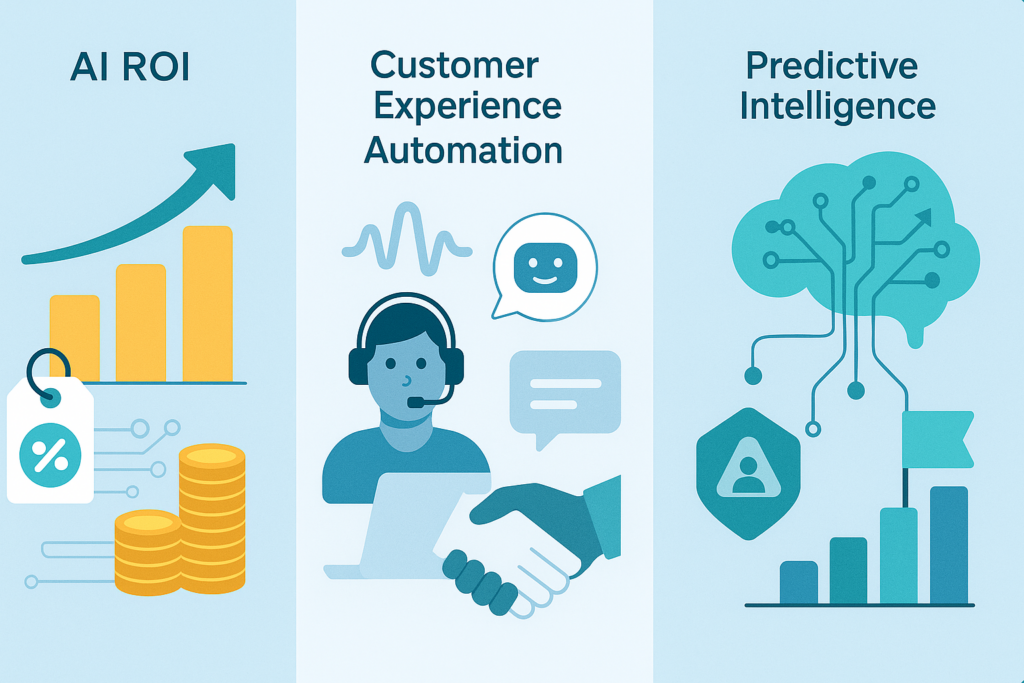
UCaaS automation has evolved to handle complex decision-making that previously required human judgment. Modern platforms can analyze historical communication data to predict staffing needs, identify potential customer churn through conversation analysis, and automatically escalate high-priority issues based on contextual understanding rather than simple keyword matching.
Beyond Basic Automation: What’s Different Now
The current generation of AI-powered UCaaS platforms operates on different principles than earlier automation tools. Where traditional systems followed rigid rules and workflows, modern AI adapts its behavior based on context, learning from each interaction to improve responses.
Large language models integrated into UCaaS platforms can understand nuanced communication patterns and generate contextually appropriate responses that feel natural rather than scripted. This capability transforms customer service interactions from frustrating experiences with limited chatbots to conversational exchanges that often resolve issues without human intervention.
The shift toward proactive communication is a major turning point. AI systems now monitor communication patterns to identify potential issues before they escalate, suggest optimal times for important conversations based on recipient availability patterns, and automatically prepare relevant information for upcoming meetings or calls.
What AI Innovations Are Reshaping Contact Centers?
Contact centers serve as the testing ground for many AI innovations that eventually spread throughout the broader UCaaS ecosystem. The combination of high interaction volumes, measurable outcomes, and clear ROI metrics makes contact centers ideal environments for AI development and refinement.

Intelligent Call Routing and Real-Time Analytics
Modern AI contact center systems have replaced traditional interactive voice response menus with conversational interfaces that understand natural language queries and route calls based on intent rather than menu selections. This technology has resulted in improvements to operational efficiency, though specific performance gains vary by implementation and industry.
Real-time analytics powered by machine learning algorithms provide unprecedented insight into customer sentiment, agent performance, and efficiency. Supervisors can identify coaching opportunities as they occur, rather than discovering issues during post-call reviews. Predictive analytics help forecast call volumes and optimize staffing levels, reducing both customer wait times and operational costs.
AI-powered quality assurance tools automatically review 100% of customer interactions, identifying compliance issues, coaching opportunities, and best practices that can be shared across the entire team. This comprehensive analysis would be impossible with traditional manual review processes that typically examine less than 5% of customer interactions.
AI Contact Center Agents vs Human Agents
The relationship between AI contact center agents and human agents continues to move toward collaboration. AI agents excel at handling routine inquiries, gathering initial information, and providing instant responses to common questions. However, they seamlessly transfer complex issues to human agents along with complete context and suggested solutions.
AI call handling systems now manage substantial portions of initial customer contacts while maintaining customer satisfaction scores that equal or exceed human-only interactions for routine issues. The key lies in intelligent escalation protocols that recognize when human intervention would provide better outcomes and transfer calls smoothly without requiring customers to repeat information.
Human agents supported by AI tools demonstrate improved performance compared to either AI-only or human-only approaches. Real-time coaching, automated research assistance, and suggested responses enable human agents to effectively handle more complex issues while reducing stress and improving job satisfaction.
Which Emerging AI Technologies Should MSPs Prioritize?
Understanding which AI technologies will have the greatest impact on UCaaS platforms helps MSPs make informed decisions about partnerships, training investments, and client recommendations. The following technologies are promising opportunities for MSPs to differentiate their offerings and deliver measurable value to clients.
Large Language Models in UCaaS Platforms
Large language models integrated directly into UCaaS platforms enable sophisticated natural language processing that transforms how users interact with communication systems. Rather than learning specific commands or navigating complex menus, users can simply describe what they want using everyday language.
These models power advanced features like automated meeting transcription with speaker identification, real-time language translation during international calls, and intelligent document search that understands context rather than relying on exact keyword matches. The technology also enables sophisticated chatbots that can handle complex customer service scenarios while maintaining conversational flow and context throughout extended interactions.
UCaaS automation driven by large language models extends to internal productivity improvements. Automated email composition, meeting preparation based on calendar context, and intelligent contact suggestions based on communication patterns help users work more efficiently while reducing routine administrative tasks.
Agentic AI for Proactive Communication Management
Agentic AI is a leap forward from reactive automation to systems that actively identify opportunities and take autonomous action within defined parameters. These systems monitor communication patterns, business metrics, and external factors to proactively suggest or implement improvements without human intervention.
Examples include automatically scheduling follow-up communications based on customer engagement patterns, identifying potential communication breakdowns before they impact business relationships, and optimizing message timing based on recipient availability and response patterns. The technology also enables predictive maintenance for communication systems, identifying potential issues before they affect user experience.
The key advantage of agentic AI lies in its ability to operate continuously across multiple communication channels, identifying patterns and opportunities that would be impossible for human operators to detect manually. This capability becomes increasingly valuable as business communications become more complex and distributed across multiple platforms and time zones.
Voice APIs with AI-Powered Capabilities
Modern voice APIs incorporate sophisticated AI capabilities that enable developers to build intelligent communication applications without extensive AI expertise. These APIs provide access to advanced features like real-time speech recognition, natural language understanding, and dynamic call routing based on conversational context.
AI-enhanced voice APIs enable applications that adapt their behavior based on user intent, emotional state, and communication history. Customer service applications can automatically adjust their approach based on detected frustration levels, while sales tools can identify buying signals and provide real-time coaching to representatives.
The integration of voice APIs with other AI technologies creates powerful automation opportunities for businesses. Automated appointment scheduling, intelligent voicemail transcription and routing, and dynamic auto attendant systems that adapt based on caller history are just a few applications that MSPs can offer to differentiate their services.
How Can MSPs Prepare for AI-Driven UCaaS Evolution?
Successfully navigating AI in UCaaS requires a balance of technical capabilities and practical considerations. MSPs who begin building AI competencies now will be better positioned to capitalize on emerging opportunities and provide valuable guidance to clients uncertain about AI adoption.
The transition to AI-enhanced UCaaS platforms affects every aspect of MSP operations, from technical infrastructure requirements to sales processes and ongoing support procedures. MSPs can develop comprehensive strategies that maximize the benefits while minimizing risks.

Building AI-Ready Infrastructure and Partnerships
MSPs need partnerships with UCaaS providers that offer robust AI capabilities while maintaining the reliability and support standards that business clients require. The ideal platform combines cutting-edge AI features with practical implementation support, comprehensive documentation, and proven scalability for growing businesses.
Infrastructure considerations include data handling, security protocols, and integration capabilities. AI-powered UCaaS platforms generate significantly more data than traditional systems, requiring partnerships with providers that offer comprehensive analytics tools and secure data management practices.
Quality partnership programs provide MSPs with access to AI training resources, technical support, and sales tools that help communicate AI benefits to clients. Look for providers that offer white-label AI capabilities, enabling MSPs to brand and customize AI features according to their specific market positioning and client needs.
Training Teams for AI-Enhanced Service Delivery
MSP teams require new skills to effectively sell, implement, and support AI-enhanced UCaaS solutions. Technical staff need to understand AI capabilities and limitations, while sales teams must learn to communicate AI benefits in business terms rather than technical jargon.
Ongoing training should cover AI ethics, data privacy considerations, and best practices for implementation in business environments. As AI technologies evolve, establishing continuous learning programs ensures teams stay current with new developments and can provide accurate guidance to clients.
Support procedures must adapt to AI-powered systems that operate differently than traditional communication platforms. Troubleshooting AI-related issues often requires an understanding of data flows, model training, and integration points that differ from conventional technical problems.
What Challenges Should MSPs Expect with AI Implementation?
While AI technologies offer opportunities for MSPs and their clients, success requires understanding and preparing for common challenges that can derail projects or create unrealistic client expectations.
Managing Client Expectations Around AI Capabilities
One of the biggest challenges MSPs face involves managing client expectations about what AI can and cannot accomplish in UCaaS environments. Popular media coverage of AI often creates unrealistic expectations about immediate capabilities and implementation timelines.
Clients frequently expect AI systems to work perfectly from day one without understanding that most AI applications require training periods and ongoing optimization. Setting realistic expectations about timelines, initial capabilities, and ongoing improvement helps prevent disappointment and builds stronger client relationships.
MSPs who invest time in helping clients understand AI capabilities, limitations, and best practices often achieve better outcomes than those who focus solely on technical implementation without addressing the human factors involved in AI adoption.
Balancing Automation with Human Touch
Finding the right balance between AI automation and human interaction is a critical consideration. While automation can improve efficiency and reduce costs, over-automation can create impersonal experiences that damage customer relationships.
The most successful implementations maintain clear escalation paths from AI systems to human agents when situations require empathy, creativity, or complex problem-solving that exceeds AI capabilities. This hybrid approach maximizes the benefits of both AI efficiency and human expertise while providing customers with appropriate support for their needs.
MSPs should help clients develop policies and procedures that define when AI automation is appropriate and when human intervention should take priority. These guidelines should consider factors like customer value, issue complexity, and emotional sensitivity to ensure that automation enhances rather than replaces meaningful human connections.
Frequently Asked Questions
What’s the difference between traditional UCaaS automation and AI-powered features?
Traditional automation follows pre-programmed rules and workflows, while AI-powered features adapt based on context and learn from interactions. AI can understand natural language, make decisions based on complex factors, and improve performance over time without manual programming changes.
What security concerns should MSPs address when recommending AI-enhanced UCaaS platforms?
Key security considerations include data encryption for AI training and processing, compliance with industry regulations like HIPAA or GDPR, and clear policies about data usage and storage. MSPs should verify that AI providers maintain appropriate certifications and offer transparency about how client data is used to train and improve AI models.
How can smaller MSPs compete with larger providers in offering AI-enhanced UCaaS solutions?
Smaller MSPs can leverage white-label AI platforms to offer enterprise-grade capabilities while focusing on personalized service and industry specialization. Success often comes from understanding specific client needs and providing tailored AI implementations rather than trying to compete on breadth of features.
How AI-Enhanced UCaaS Can Transform Your Business
AI in UCaaS transforms how businesses communicate and collaborate. MSPs who understand these emerging trends and prepare for AI-driven changes will find themselves well-positioned to capture valuable opportunities.
The key to success lies in developing partnerships with platforms that balance innovation with practical support. By focusing on client outcomes rather than technical complexity, MSPs can guide businesses through this transformation while building stronger, more valuable relationships.
The future of UCaaS is intelligent, automated, and essential for business success. Get started with SkySwitch and discover how our intelligent communication platform can accelerate your growth in the AI-driven marketplace.

Jessica is a marketing and sales strategist with deep expertise in VoIP telecommunications. As a Marketing Director, she specializes in channel marketing, account management, and product marketing within the communications industry. Jessica is passionate about helping partners grow through compelling messaging and hands-on support.