
White-Label Cloud PBX vs. White-Label UCaaS: What MSPs Should Know

While both offer white-label branding opportunities, white-label cloud PBX focuses on hosted voice services under your brand, whereas white-label UCaaS provides comprehensive unified communications including voice, video, messaging, and collaboration tools.
White-label UCaaS delivers higher customer value and revenue potential for MSPs, while white-label cloud PBX offers simpler voice-focused implementations. Most successful MSPs choose white-label UCaaS for its broader feature set and competitive differentiation opportunities.
- White-label cloud PBX specializes in hosted voice communication with basic features under your brand
- White-label UCaaS integrates voice, video, messaging, and advanced collaboration tools in a unified platform
- White-label UCaaS typically generates 40-60% higher margins due to expanded service offerings
- Both solutions let you own the customer relationship, but white-label UCaaS provides superior growth potential
The white-label communications landscape presents MSPs with a critical strategic decision. With 90% of organizations now using UCaaS as either their primary phone system or alongside existing platforms, MSPs must choose between offering white-label cloud PBX services or comprehensive white-label UCaaS solutions. This choice between white-label approaches determines how you position your business for sustainable growth in an increasingly competitive market.
Modern businesses demand more than basic hosted phone service under your brand. They need integrated communication solutions that support hybrid workforces, streamline collaboration, and reduce operational complexity—all while maintaining your brand identity and customer relationships. This evolution creates both opportunities and challenges for MSPs evaluating white-label communication platforms.
What is White-Label Cloud PBX?
White-label cloud PBX represents a focused approach to hosted business communications, delivering essential voice services through a cloud-based platform that you can completely brand and sell as your own. This white-label solution provides traditional PBX functionality—call routing, auto attendants, voicemail, call forwarding, and conference calling—without requiring on-premises hardware while maintaining your brand identity throughout the customer experience.
The white-label aspect means you maintain complete control over customer relationships and branding. Your clients see your company name, logo, and support contacts throughout their experience. You set pricing, manage billing, and handle all customer interactions while leveraging the underlying hosted PBX technology provided by your wholesale partner.
Key capabilities of white-label cloud PBX typically include advanced call handling features, mobile applications for remote access, basic video conferencing, and integration capabilities with existing business systems. The solution focuses primarily on voice communication while offering supplementary features that support basic collaboration needs—all under your brand.
For MSPs, white-label hosted PBX represents a streamlined entry point into cloud communications. The technology is mature, customer expectations are well-established, and the learning curve for both providers and end-users is relatively modest while maintaining complete brand control.
What is White-Label UCaaS?
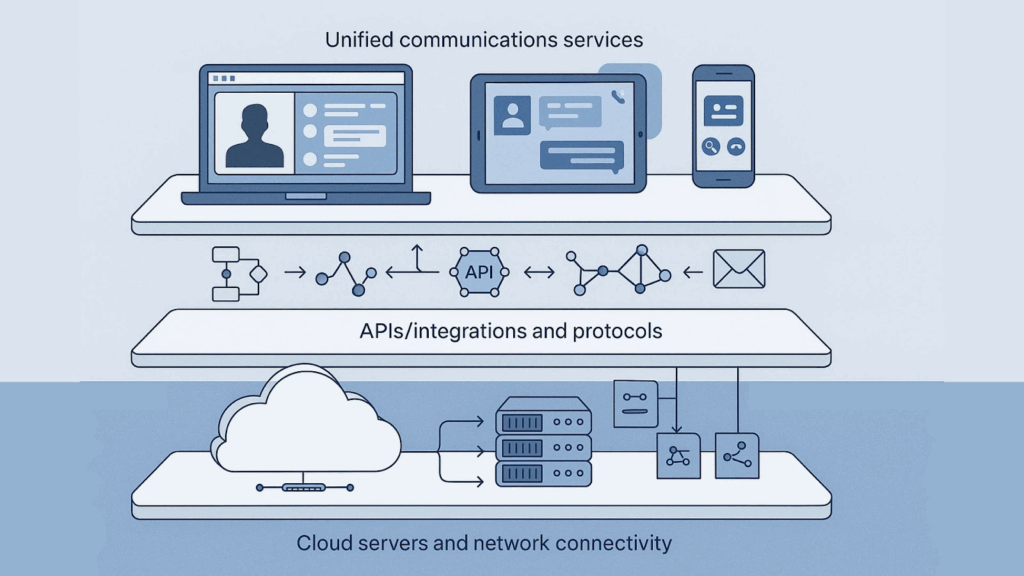
White-label UCaaS takes a comprehensive approach to business communications by integrating multiple communication channels into a single, cloud-based platform that you can brand and sell as your own solution. White-label UCaaS platforms combine voice calling, video conferencing, instant messaging, file sharing, presence information, and collaboration tools into one unified interface that users access through your branded solution.
White-label UCaaS represents a holistic approach to communication and collaboration under your brand. Rather than treating voice as the primary service with other features as add-ons, white-label UCaaS positions all communication methods as equally important components of a unified workflow. This means seamless transitions between voice calls, video meetings, team messaging, and document collaboration within the same application—all branded with your company identity.
Modern white-label UCaaS solutions incorporate advanced features like AI-powered meeting transcription, intelligent call routing, real-time analytics, and sophisticated integration capabilities with CRM systems, productivity suites, and business applications. The global UCaaS market reached $87.39 billion in 2024 and is expected to expand at a 19.8% CAGR through 2030, reflecting strong enterprise demand for comprehensive communication solutions.
For MSPs, white-label UCaaS represents an opportunity to become a strategic technology partner rather than just a voice service provider. The expanded feature set enables consultative selling, higher contract values, and stronger customer relationships—all while maintaining your brand identity.
Key Differences Between White-Label Solutions
Understanding the core distinctions between white-label cloud PBX and white-label UCaaS helps MSPs make informed decisions about their service portfolio strategy. While both leverage cloud delivery models and offer complete white-label opportunities, their approach to business communications differs significantly.
Scope of Communication Services
White-label cloud PBX concentrates on voice communication excellence under your brand. The platform delivers enterprise-grade calling features, mobility support, and essential collaboration tools, but voice remains the central focus. Additional capabilities like video conferencing and team messaging typically function as supplementary features rather than core components of your branded offering.
White-label UCaaS platforms treat all communication methods as integrated elements of a comprehensive collaboration environment under your brand. Voice, video, messaging, file sharing, and presence information work together seamlessly, allowing users to choose the most appropriate communication method for each interaction without switching applications—all within your branded interface.
Customer Experience and Brand Control
With white-label cloud PBX, customers primarily interact with your branded system for voice-related activities, potentially using separate applications for other communication needs. While this maintains simplicity, it can create workflow fragmentation for teams that require diverse communication methods.
White-label UCaaS platforms emphasize workflow continuity within your branded environment by enabling users to initiate voice calls from video meetings, share files during messaging conversations, and maintain context across different communication channels. This unified approach reduces application switching and improves productivity for knowledge workers—all while reinforcing your brand throughout their experience.
Revenue and Differentiation Potential
White-label cloud PBX offers steady recurring revenue through voice services under your brand, but the focused feature set can limit opportunities for premium pricing and service differentiation in competitive markets.
White-label UCaaS provides multiple revenue streams through comprehensive communication and collaboration services under your brand. The expanded feature set justifies higher pricing, creates numerous upselling opportunities, and enables stronger competitive differentiation through advanced capabilities that customers can’t easily find elsewhere.

Feature Comparison: White-Label Cloud PBX vs. White-Label UCaaS
| Feature Category | White-Label Cloud PBX | White-Label UCaaS |
| Voice Communication | Advanced call routing, auto attendants, voicemail-to-email, call recording, mobile apps | Full PBX functionality plus intelligent routing, presence-aware calling, HD voice quality |
| Video Conferencing | Basic video calling, screen sharing | Enterprise video meetings, webinars, room systems integration, virtual backgrounds |
| Messaging & Collaboration | Basic SMS/MMS capabilities | Team messaging, file sharing, persistent chat rooms, real-time co-authoring |
| Mobility | Mobile softphone apps, call forwarding | Native mobile experience, unified notifications, cross-device synchronization |
| Integrations | CRM click-to-dial, basic API access | Extensive third-party integrations, workflow automation, custom app development |
| Analytics & Reporting | Call reports, basic usage analytics | Comprehensive communications analytics, AI-powered insights, performance dashboards |
| White-Label Customization | Basic branding and portal customization | Complete platform branding, custom domains, branded mobile apps |
| Scalability | User-based scaling, feature limitations | Elastic scaling, unlimited concurrent users, global deployment |
Pros and Cons for MSPs
White-Label Cloud PBX Advantages:
- Simpler implementation and support requirements reduce initial investment
- Focused feature set makes training and customer education more straightforward
- Lower complexity appeals to businesses seeking basic hosted voice solutions
- Established market understanding of PBX functionality facilitates sales conversations
- Complete brand control over voice services
White-Label Cloud PBX Disadvantages:
- Limited feature differentiation in competitive markets
- Smaller contract values due to narrower service scope
- Difficulty competing against comprehensive white-label UCaaS offerings
- Fewer opportunities for premium pricing and service expansion
White-Label UCaaS Advantages:
- Comprehensive solution enables higher contract values and profit margins
- Competitive differentiation through advanced collaboration features under your brand
- Stronger customer retention due to integrated workflows and feature dependency
- Consultative selling opportunities position MSPs as strategic partners
- Future-proof technology approach aligns with evolving business needs
- Complete platform branding and customization opportunities
White-Label UCaaS Disadvantages:
- Higher complexity requires more extensive training and support capabilities
- Initial implementation may take longer due to feature richness
- Customer education needs increase with expanded functionality
- Greater technical requirements for successful deployment and optimization
When to Choose Which White-Label Solution
The decision between white-label cloud PBX and white-label UCaaS depends on several key factors that MSPs should carefully evaluate based on their business strategy, technical capabilities, and target market characteristics.
Choose White-Label Cloud PBX When:
Your customer base consists primarily of small businesses with basic communication needs and limited budgets for technology upgrades. Organizations in traditional industries like manufacturing, construction, or retail operations may prefer straightforward voice solutions without collaboration complexity.
Consider white-label cloud PBX if your MSP lacks extensive technical resources for implementing and supporting advanced collaboration features. The focused feature set requires less specialized knowledge and reduces support complexity while maintaining brand control.
This approach also makes sense when competing primarily on price rather than value-added services. If your market positioning emphasizes cost-effectiveness over feature richness, white-label cloud PBX provides a competitive foundation.
Choose White-Label UCaaS When:
Your target customers include knowledge workers, professional services firms, or organizations with distributed teams requiring comprehensive collaboration capabilities. Businesses embracing hybrid work models particularly benefit from white-label UCaaS integration.
Select white-label UCaaS if your MSP strategy focuses on becoming a strategic technology partner rather than a commodity service provider. The comprehensive feature set enables consultative selling and positions your organization as a valuable business advisor while maintaining complete brand control.
Consider white-label UCaaS when seeking maximum revenue potential from communication services. The expanded feature set justifies higher pricing and creates opportunities for upselling additional capabilities over time—all under your brand.

MSP Revenue and Business Impact Analysis
The financial implications of choosing between white-label cloud PBX and white-label UCaaS extend beyond simple per-seat pricing differences. Understanding the total revenue impact helps MSPs make strategic decisions aligned with their growth objectives.
Revenue Per Customer Analysis
White-label cloud PBX offers steady recurring revenue through voice services under your brand, typically generating $15-25 per user monthly. However, the focused feature set can limit opportunities for premium pricing and service expansion within your branded offering.
White-label UCaaS solutions command $25-45 per user monthly pricing due to comprehensive feature sets and higher business value delivered through your brand. MSPs partnering with established white-label UCaaS providers can unlock greater long-term value through advanced features, seamless integrations, and multi-tenant scalability. Average white-label UCaaS margins for MSPs range from 40-70%, significantly exceeding traditional voice service margins.
Customer Retention and Brand Loyalty
White-label UCaaS platforms create stronger customer relationships through integrated workflows and feature dependency within your branded environment. When teams rely on unified communications for daily productivity through your solution, switching costs increase substantially. This translates to lower churn rates and higher customer lifetime values for MSPs.
White-label cloud PBX, while providing essential voice services under your brand, creates fewer switching barriers. Customers can more easily migrate to competitive offerings since voice features are relatively standardized across providers.
Market Positioning and Competitive Advantage
White-label UCaaS enables MSPs to differentiate through value-added services, consultation, and strategic technology guidance—all while maintaining complete brand control. This positioning justifies premium pricing and creates barriers to commodity competition.
MSPs offering comprehensive white-label communication solutions experience faster revenue growth compared to those focused solely on traditional voice services.
Implementation Considerations for MSPs
Successfully deploying either white-label solution requires careful planning around technical capabilities, customer onboarding processes, and ongoing support requirements.
Technical Infrastructure Requirements
Both white-label solutions demand reliable internet connectivity at customer sites, but white-label UCaaS platforms typically require higher bandwidth for optimal performance across all communication channels. MSPs should develop network assessment capabilities to ensure successful deployments.
Quality of Service monitoring becomes crucial for white-label UCaaS implementations due to the diverse communication types and user expectations for seamless experiences. Advanced network assessment tools help MSPs proactively identify and resolve potential issues.
Training and Certification Programs
White-label UCaaS platforms require more comprehensive technical training for MSP staff due to feature breadth and integration complexity. However, this investment pays dividends through improved customer satisfaction and reduced support costs.
Consider vendor-provided training programs, certification opportunities, and ongoing education resources when evaluating potential white-label platform partners.
Customer Education and Change Management
White-label UCaaS deployments benefit from structured change management processes that help users understand and adopt new communication workflows within your branded environment. MSPs should develop customer education programs that maximize feature utilization and user satisfaction.
White-label cloud PBX implementations typically require less extensive user training due to familiar voice-centric interfaces and established communication patterns.
Frequently Asked Questions
What’s the main difference between white-label cloud PBX and white-label UCaaS for MSPs? White-label UCaaS provides comprehensive unified communications including voice, video, messaging, and collaboration tools in one branded platform, while white-label cloud PBX focuses primarily on hosted voice services with basic additional features. White-label UCaaS typically offers higher margins and better customer retention for MSPs.
Which white-label solution generates more revenue for MSPs? White-label UCaaS solutions typically generate higher per-user revenue due to expanded feature sets and higher customer value delivered through your brand. The comprehensive nature of white-label UCaaS also creates more upselling opportunities and stronger customer relationships.
Is white-label cloud PBX easier to implement than white-label UCaaS? Yes, white-label cloud PBX generally requires less technical complexity and training for both MSPs and end-users. However, white-label UCaaS platforms provide better long-term growth potential and competitive differentiation opportunities.
How do I decide which white-label solution fits my MSP business model? Consider your target market, technical capabilities, and growth strategy. Choose white-label cloud PBX for price-sensitive customers with basic needs, or white-label UCaaS for organizations requiring comprehensive collaboration and higher-value partnerships.
Choosing the Right White-Label Communications Platform
The choice between white-label cloud PBX and white-label UCaaS reflects broader strategic decisions about your MSP’s market positioning, growth objectives, and competitive differentiation strategy. While both solutions offer viable paths to recurring revenue growth under your brand, white-label UCaaS provides superior opportunities for building strategic customer relationships and achieving premium pricing.
Modern businesses increasingly demand integrated communication solutions that support hybrid work models, enhance collaboration, and streamline operations—all delivered through trusted MSP partners they know and trust. MSPs that embrace comprehensive white-label UCaaS platforms position themselves as strategic technology partners rather than commodity service providers while maintaining complete brand control.
Ready to explore how white-label UCaaS can transform your MSP business? SkySwitch offers a comprehensive white-label UCaaS platform with enterprise-grade features, extensive customization options, and dedicated partner support designed specifically for MSPs seeking profitable growth in the communications market. Get started with SkySwitch and discover how the right white-label UCaaS platform can drive your business forward while strengthening your brand.

Jessica is a marketing and sales strategist with deep expertise in VoIP telecommunications. As a Marketing Director, she specializes in channel marketing, account management, and product marketing within the communications industry. Jessica is passionate about helping partners grow through compelling messaging and hands-on support.