
White-Label VoIP Reseller Guide: How to Start and Scale

The white-label VoIP reseller model gives MSPs, VARs, and system integrators a fast, low-risk path to recurring revenue without building any telecom infrastructure.
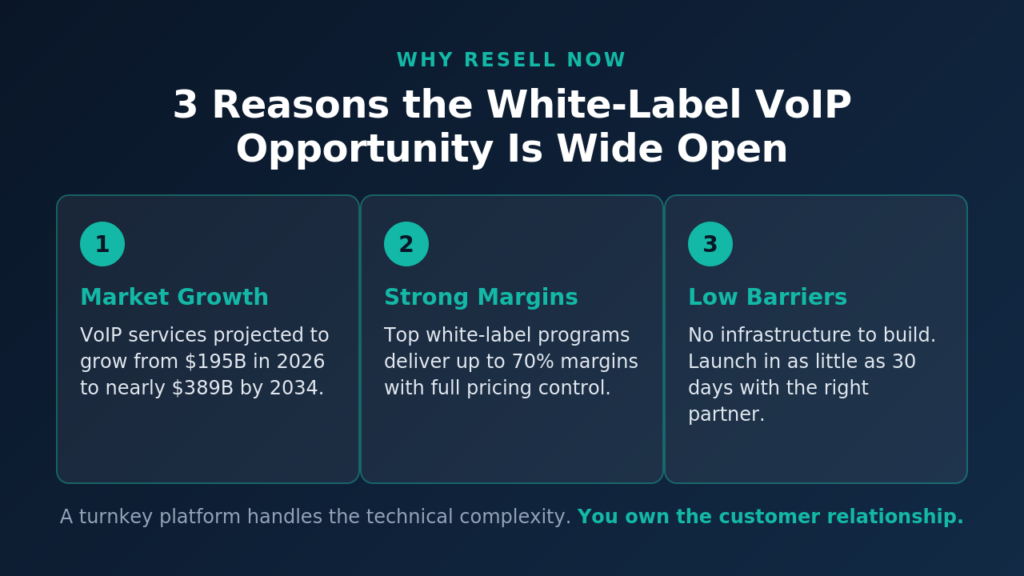
- Massive market growth: VoIP services are projected to grow to nearly $389 billion by 2034.
- Strong margin potential: Top white-label reseller programs can deliver up to 70% margins with full pricing control.
- Sustained demand: Hybrid work and SMB cloud migration are driving multi-year UCaaS adoption.
- Low barriers to entry: Modern white-label platforms eliminate hardware, infrastructure, and carrier-level expertise requirements.
The smartest move is partnering with a white-label provider that handles the technical complexity so you can focus on customer relationships, brand equity, and recurring revenue.
The communications industry is in the middle of a major shift, and the Voice over Internet Protocol services market is projected to grow from $195.39 billion in 2026 to nearly $389 billion by 2034. That growth, paired with the permanent shift to hybrid work, has created one of the most accessible business opportunities in telecom. If you’ve been thinking about entering the white-label VoIP reseller market, this guide walks you through what the model looks like in 2026, how it works, and how to position yourself for sustainable growth.
What Is a White-Label VoIP Reseller?
A white-label VoIP reseller is a business that sells cloud-based voice and unified communications services under its own brand, using a platform built and maintained by an underlying provider. You handle customer acquisition, billing, and front-line support. The provider handles the heavy infrastructure work, including switches, carrier relationships, network redundancy, compliance, and platform development.
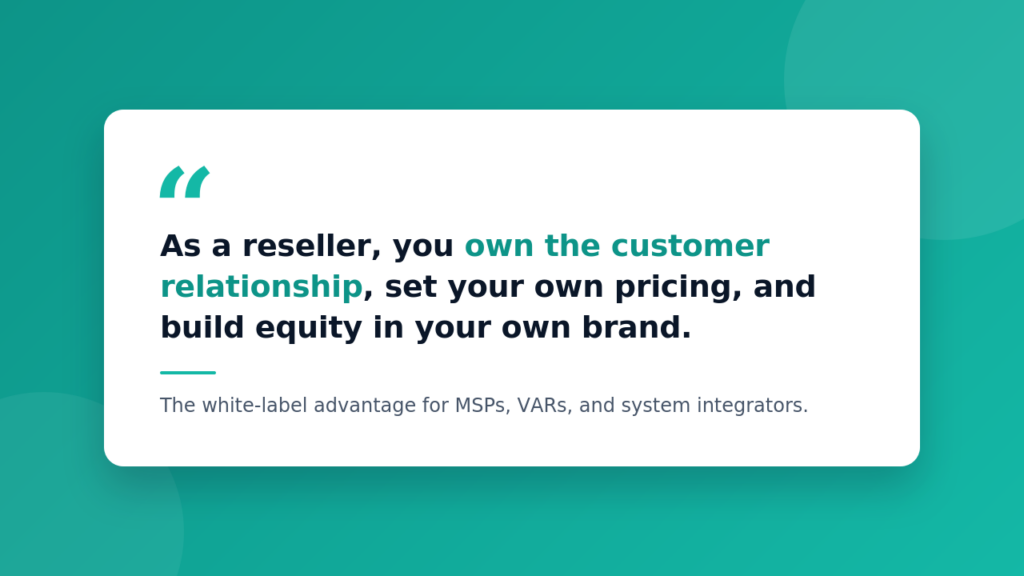
Resellers are fundamentally different from traditional sales agents or referral models. As a reseller, you own the customer relationship, set your own pricing, and build equity in your own brand. As an agent, you collect a commission, and the upstream provider owns everything else. The difference matters a lot when you think about long-term business value.
The terms white-label and private-label are used interchangeably in this space. Both describe the same arrangement: a fully brandable communications platform that your customers experience as your service, not your provider’s. Modern white-label UCaaS solutions deliver complete suites that include voice, video conferencing, business SMS, team messaging, contact center capabilities, AI-powered solutions, and integrations with the tools your customers already use.
Why Should You Become a Reseller Now?
The conditions to become a reseller in the communications space have never been better. Several trends are converging, and resellers who position now will benefit for years to come.
The Market Keeps Outpacing Expectations
According to Research and Markets, the broader VoIP services market is expected to expand from $185 billion in 2026 to over $280 billion by 2030, driven by hybrid work adoption, AI-powered call management, and continued migration away from legacy PBX systems. SMBs are the fastest-growing segment, and they’re the exact audience local MSPs and IT providers already serve.

Hybrid Work Is Permanent
According to Robert Half’s remote work research, 47% of professionals who aren’t actively job searching cite not wanting to lose their current flexibility as a key reason for staying put. Hybrid work has settled into a long-term arrangement, not a passing trend. Businesses need communications systems that connect distributed teams, support mobile employees, and deliver consistent quality regardless of where someone is working. Legacy phone systems can’t do that. Cloud-based UCaaS can, which is why demand keeps climbing.
Technology Barriers Have Disappeared
You don’t need to be a carrier. You don’t need to understand SIP routing protocols or build a network from scratch. Modern white-label platforms hand you a complete, ready-to-brand solution accessed through web portals. Even resellers with no prior voice experience can get up and running quickly with the right partner.
Margins Are Still Strong
Unlike commodity tech categories where profits have compressed, voice and UCaaS reseller programs still offer healthy economics. White-label arrangements can deliver up to 70% margins, with top performers exceeding that through value-added services and well-packaged bundles.
How Does a VoIP Reseller Program Work?
A VoIP reseller program is a structured partnership between you and your white-label provider. It defines pricing, support, training, and the tools you’ll use to run your business. The mechanics are simple in concept: you buy services at wholesale rates, package and price them however you want, and bill your customers directly. The provider invoices you on the backend, and you keep the margin.
The best VoIP reseller programs go well beyond just providing access to a platform. They include a full ecosystem, complete with quote-to-cash billing tools, taxation engines, an equipment store with auto-provisioning, training resources, marketing assets, and dedicated account management. The difference between a basic reseller program and a complete one shows up in how fast you can launch and how profitable you become. For a deeper comparison, this guide on choosing the best VoIP reseller provider walks through evaluation criteria in more detail.
Strong programs also help with the parts of the business most resellers underestimate. Telecom compliance (10DLC, STIR/SHAKEN, Kari’s Law, Ray Baum’s Act), taxation across multiple jurisdictions, fraud monitoring, and porting numbers from existing providers are all areas where a good partner saves you valuable time and reduces risk.
What Steps Do You Take to Become a White-Label VoIP Reseller?
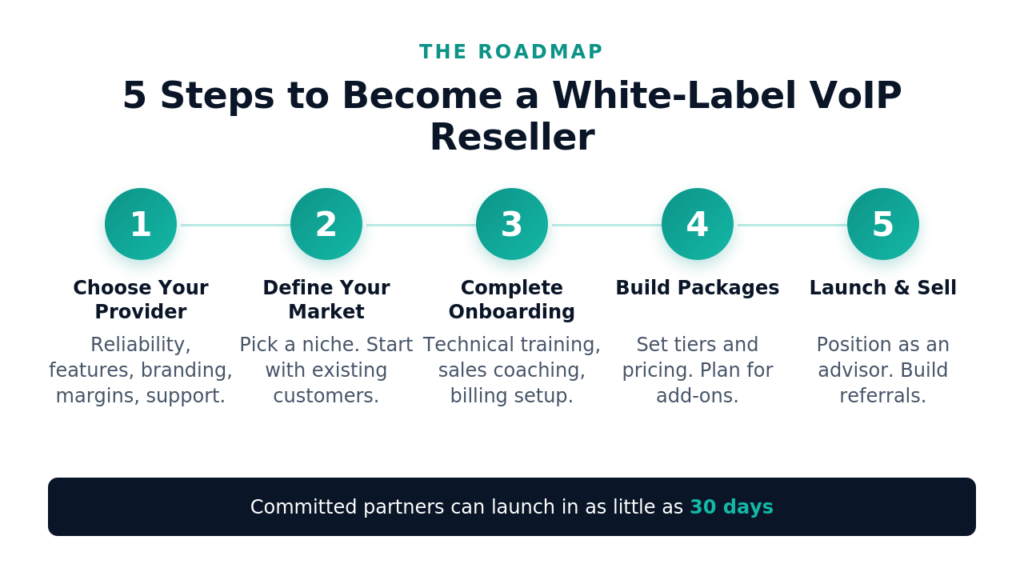
Here’s the practical roadmap to become a reseller in 2026. Each step builds on the previous one, and the order matters.
1. Choose the Right White-Label Provider
Partnering with the right platform is the most important decision you’ll make. The wrong partner caps your growth and damages customer trust. Evaluate providers on platform reliability (look for geo-redundant networks across multiple data centers), depth of features (mobile apps, video, business SMS, contact center, integrations), branding control (your name and colors on portals, billing, and clients), pricing flexibility (wholesale rates that let you set your own retail prices), and support quality (training, onboarding, ongoing technical assistance).
Don’t just take marketing claims at face value. Talk to existing partners, ask for case studies, and look at the provider’s parent company history. A platform backed by an established telecom organization will be more resilient than one with shallow financial backing.
2. Define Your Target Market
Resellers who try to sell to everyone struggle. Resellers who pick a niche grow faster. You might focus on a specific industry, such as healthcare, legal, or real estate. You might focus on a business size, such as 10-to-50-employee SMBs. You might focus on a use case like hybrid teams or multi-location franchises. Your existing customer base usually gives you a head start. The companies that already trust you for IT services are often your fastest path to your first voice deals. Learning how white-label cloud solutions fit into existing services can help you spot the easiest opportunities to start.
3. Complete a Comprehensive Onboarding Program
With a committed partner, you can launch your UCaaS business in as little as 30 days. Quality onboarding programs combine technical training (platform administration, customer provisioning, troubleshooting), sales coaching (positioning, objection handling, demos), and operational setup (billing integration, support workflows, account management). Take advantage of every learning resource your provider offers. The early effort pays back many times over once you’re selling.
4. Build Your Service Packages and Pricing
You set your own prices. Most successful resellers package services into tiers (Basic, Standard, and Pro, for example) to simplify customer decisions. Others sell à la carte for flexibility. Research your local competition, understand your wholesale costs, and target margins that support both reinvestment and profitability. Build in room for add-ons like business SMS, AI-powered features, contact center, virtual fax, and SD-WAN to grow account value over time.
5. Launch Marketing and Sales Operations
Position yourself as a trusted communications advisor, not a commodity vendor. Educational content, such as blog posts, webinars, and LinkedIn thought leadership, builds credibility with prospects researching UCaaS. Referral programs turn happy customers into a steady lead source. Clear service-level expectations on your end drive retention, which is where the real recurring-revenue value compounds.
What Advanced Features Should Your Platform Include?
Modern customers expect more than basic phone service. The best white-label platforms let you offer a complete communications suite, which makes your offering stickier and your accounts larger.
Here’s what to look for:
- Business SMS and MMS with keyword responders, blast campaigns, and CRM integrations for customer engagement that voice alone can’t match
- Omnichannel contact center capabilities covering voice, SMS, chat, and email, with skills-based routing and post-call analytics
- Microsoft Teams integration through a connector that brings full PBX features into the Teams interface
- Virtual fax, including HIPAA-compliant options for healthcare clients
- Voice APIs for custom integrations into CRMs, helpdesks, or internal business apps
- SD-WAN for managing call quality, security, and failover for your customers’ networks
- Quality of Service (QoS) monitoring that detects latency and jitter before customers notice
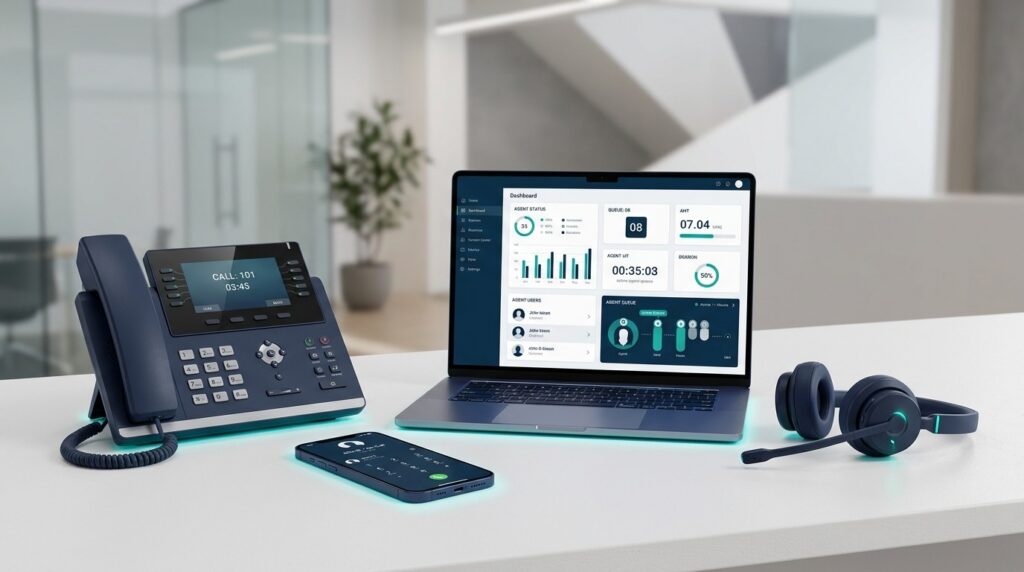
Platforms built on a strong core switch with significant in-house engineering investment offer the broadest feature set and the most reliable performance. That’s a meaningful differentiator when you’re evaluating providers.
What Challenges Do New Resellers Face?
Most common challenges are solvable with the right preparation.
Customer concerns about reliability. Many prospects worry that cloud voice won’t be as dependable as their old PBX. Counter this concern with platform uptime data, geo-redundant network architecture, and pilot programs that let them test before committing.
Competition from national providers. Large national brands compete on name recognition and price. You win on local expertise, personal service, faster implementation, and the kind of relationship-driven support a national 1-800 number can’t deliver.
Technical support complexity. You don’t need to know everything, but you do need to handle basic customer questions confidently. Strong provider training and clear escalation paths to Tier 2 and Tier 3 support are essential.
Migration management. Moving customers off legacy systems requires careful planning. Having standardized migration procedures and setting realistic timeline expectations prevents most of the issues that show up here.
Frequently Asked Questions About Becoming a Reseller
How much technical experience do I need? You don’t need a deep telecom background. Basic networking knowledge and comfort with web-based admin tools are enough to get started. Comprehensive provider training covers the rest. Many successful resellers come from IT services, sales, or even office equipment businesses.
How long until I’m profitable? Resellers with existing customer bases often see profitability quickly, sometimes almost immediately, when migrating existing accounts. Resellers starting from scratch typically need around six months to build consistent recurring revenue. Margins typically range from 50 to 70 points, depending on how you package your offering.
Do I need to register with the FCC to resell VoIP? Yes. Most VoIP resellers offering interconnected services must register directly with the FCC, typically by filing Form 499-A with USAC, and contribute to the Universal Service Fund. Your upstream provider’s compliance does not automatically cover your business. Additional obligations may include CPNI certifications, E911 compliance, Robocall Mitigation Database registration, and various state-level requirements that vary by jurisdiction. Compliance is one area where the right platform partner makes a significant difference.
What happens if my provider has problems? Choose an established platform with strong financial backing, multiple data centers, and a track record of stability. Ask about business continuity plans and customer data portability before signing.
Can I really control my own brand? With a true white-label partnership, yes. Customer portals, billing systems, and marketing materials should all reflect your brand, not your provider’s. This is the foundation of building real long-term equity in your business.
Ready to Launch Your White-Label VoIP Reseller Business?
The window is wide open. Market growth, customer demand, and platform maturity have created the right conditions for resellers who move now. The businesses that win combine enterprise-grade technology with the local expertise and personal service that national providers can’t match.
What separates a successful reseller from a stalled one is the partner behind the platform. The best partners deliver training, real-time support, marketing resources, billing automation, and an engineering team that keeps the platform competitive year after year. SkySwitch has built its reputation on exactly that kind of partnership, helping resellers launch in as little as 30 days while building toward long-term recurring revenue. Get started with SkySwitch to see how a complete white-label UCaaS platform can power your next chapter.

Jessica is a marketing and sales strategist with deep expertise in VoIP telecommunications. As a Marketing Director, she specializes in channel marketing, account management, and product marketing within the communications industry. Jessica is passionate about helping partners grow through compelling messaging and hands-on support.