
White-Label IT Support Services vs UCaaS: The Margin Gap

Choosing between white-label IT support services and UCaaS comes down to margin math, retention, and delivery overhead, and UCaaS wins on all three for most resellers.
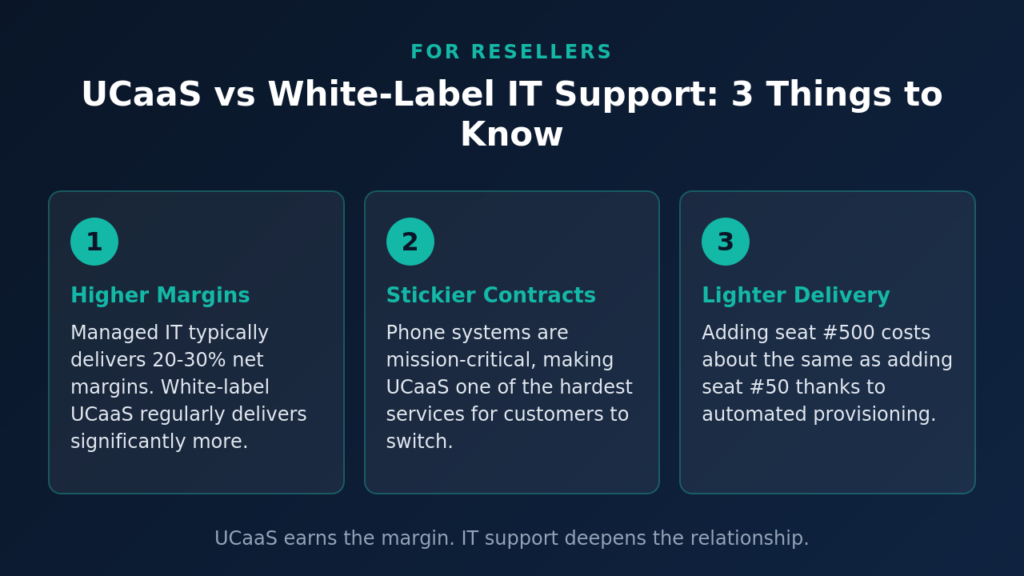
- White-label IT support services typically deliver 20–30% net margins after labor and tooling costs absorb most of the spread.
- White-label UCaaS resellers can hit up to 70% margins because the platform handles delivery instead of your technicians.
- UCaaS contracts tend to stick longer because phone systems are mission-critical and switching costs are high.
- Combining both is the strongest play, but UCaaS belongs at the center of your recurring revenue stack.
If you’re already selling managed IT, layer UCaaS on top. When choosing where to invest next, UCaaS is the higher-margin, lower-overhead bet.
Roughly 86,000 MSPs operate with at least 30% recurring revenue, but about 30% of them still struggle to make money consistently, according to Service Leadership data cited by MSP Success. The reason isn’t a lack of demand. It’s that traditional managed IT support has thinning margins, heavy labor costs, and intense competition.
Resellers looking to escape the margin squeeze are comparing white-label IT support services against UCaaS as their primary recurring-revenue play. Both are legitimate paths, but they’re not equivalent businesses. This breakdown walks through how the two stack up on margin, retention, delivery cost, and long-term scalability so you can pick the model, or the mix, that actually grows your bottom line. For a deeper look at how the white-label model works end-to-end, the foundation matters as much as the math.
What Are White-Label IT Support Services?
White-label IT support services let you offer help desk, remote monitoring and management (RMM), patch management, endpoint security, backup, and on-site support under your own brand while a backend partner handles the delivery. You set pricing, own the customer relationship, and the technical execution happens behind a layer your customer never sees.
Building an IT services practice from scratch is expensive. You’d need 24/7 staffing, ticketing infrastructure, security tooling, vendor relationships, and certifications. White-labeling shortcuts the build. You inherit a delivery engine and bolt your brand onto the front.
Common white-label IT support services include:
- Tier 1 and Tier 2 help desk coverage, often 24/7
- RMM platform access for proactive monitoring
- Cybersecurity bundles including endpoint detection, email security, and SIEM
- Backup and disaster recovery management
- Patch management and software updates
Even with the white-label model, you still carry high operational burdens. Your customers expect responsiveness, and white-label support partners pass labor costs through to you. That’s where the margin compression starts.
How Does UCaaS Differ as a White-Label Offering?
Unified Communications as a Service bundles voice, video, messaging, contact center, and collaboration tools into a single cloud-delivered platform. As a white-label UCaaS reseller, you’re selling a software platform that the provider hosts, maintains, and scales. Your job is sales, customer onboarding, and relationship management. The platform does the heavy lifting on delivery.
UCaaS offers a fundamentally different cost structure than white-label IT support services. With managed IT, every new client typically means more technician hours. With UCaaS, every new seat costs you a wholesale platform fee that you mark up. The work to add seat #500 looks almost identical to adding seat #50 because provisioning is automated through the reseller portal.
The market backdrop is also different. The global UCaaS market reached $66.42 billion in 2025 and is projected to hit $276.9 billion by 2034 at a 17.1% CAGR, according to Fortune Business Insights. Demand is accelerating, not flattening. SMBs are abandoning premise-based PBXs at scale and looking for cloud-based replacements they can buy from a trusted local partner. That’s an opening worth taking.

Which Delivers Better Margins: Managed Services vs UCaaS?
The managed services vs UCaaS margin conversation is where the two models really separate. Both can be profitable, but the spread looks very different.
White-label IT support services typically operate in the 20–30% net margin range once you account for labor pass-through costs, RMM licensing, security tool subscriptions, and the time your team spends managing escalations. Top-quartile providers push higher through operational discipline, ticket automation, and aggressive client segmentation. It’s hard work, and the ceiling is real.
White-label UCaaS regularly delivers higher margins because the cost structure is software-based rather than labor-based. Wholesale platform pricing leaves resellers with a meaningful spread on every seat, and as your seat count grows, your delivery costs barely move. That’s the structural advantage.
Here’s how the margin math typically compares:
- White-label IT support services: 20–30% net margin; labor-intensive delivery; revenue tied to technician capacity
- White-label UCaaS: Substantially higher margins on recurring seat revenue; minimal incremental delivery cost per new seat; automation handles provisioning
- Combined offering: Best of both, with UCaaS providing the high-margin anchor and IT support deepening the relationship
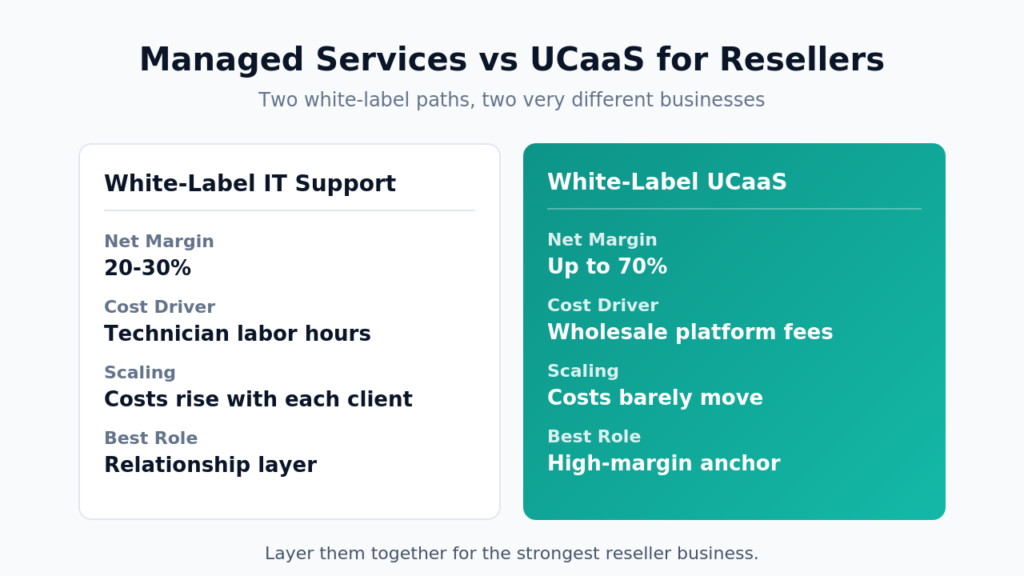
When a managed IT reseller adds a new client, costs rise almost linearly. When a UCaaS reseller adds a new client, costs rise marginally. MSPs looking to seize UCaaS reseller opportunities often find the unit economics dramatically better than what they’re used to in pure IT services.
How Do Customer Retention and Stickiness Compare?
Profit margins matter, but so does how long a customer stays. Churn destroys recurring revenue businesses.
White-label IT support services have inherent retention strength because once you’re embedded in a customer’s environment, ripping you out is painful. They’d have to retrain users, transition tooling, and audit security posture. That’s real friction.
UCaaS retention is arguably even stickier. Phone numbers are deeply tied to a business’s identity. Porting numbers is bureaucratic. Retraining staff on a new phone system disrupts daily operations. And once contact center, SMS, and CRM integrations are wired in, the switching cost climbs further. White-label UCaaS deals tend to stay for years, not months.
The other retention advantage with UCaaS is the natural expansion path. You start with a customer at 10 seats, and as they grow, you automatically add seats. You upsell SMS, contact center, virtual fax, SD-WAN, and Microsoft Teams integration over time. That account expansion is built into the model.
What Are the Operational Demands of Each Model?
Comparing managed services vs UCaaS looks similar on paper, but they consume very different amounts of your team’s time.
White-label IT support demands active engagement. You’re escalating tickets, coordinating with the backend support team, managing customer expectations during incidents, and constantly handling exceptions. Even with a white-label partner doing most of the work, you carry a meaningful operational load.
White-label UCaaS delivery is far lighter. Most of the work is during onboarding and provisioning, both of which happen through self-service portals. Post-launch support tickets exist but trend toward configuration questions rather than crisis response. Geo-redundant networks handle the heavy reliability lift behind the scenes.
For resellers without a deep IT staff, this difference is noteworthy. You can build a UCaaS practice with a small team. Building a comparable managed IT practice often requires hiring technicians, certifications, and 24/7 coverage commitments.
Can You Combine White-Label IT Support Services with UCaaS?
Yes, and for most resellers, this combination is the smartest move. The two offerings complement each other naturally because both target the same buyer: a small or mid-sized business looking to outsource technology management to a trusted local partner.
When you bundle managed IT with UCaaS, you become the customer’s single point of contact for technology. That positions you as a strategic partner rather than a vendor, which protects against churn and unlocks pricing power. You also get cross-sell efficiency. An IT customer who already trusts you is a warm lead for UCaaS, and vice versa.

The key is recognizing which offering carries the margin and which carries the relationship. UCaaS should be your high-margin recurring revenue anchor. White-label IT support services deepen the relationship and create the trust that makes UCaaS sales easier. That’s how a comprehensive white-label cloud strategy gets built.
A few practical considerations when combining the two:
- Lead with whichever offering matches the customer’s most urgent pain point, then expand from there.
- Bundle pricing strategically; don’t undercut the UCaaS margin to win an IT deal.
- Use UCaaS as the upsell during IT renewals; cloud voice is an easy yes for IT customers already in your trust circle.
Frequently Asked Questions
Are white-label IT support services worth pursuing if margins are tighter than UCaaS?
Yes, especially if you already have IT customers or in-house technicians. The margins are lower, but the relationships you build through managed IT make UCaaS upselling much easier. Think of white-label IT support services as the relationship layer and UCaaS as the profit layer.
How long does it take to start earning revenue from white-label UCaaS?
With the right white-label partner, you can launch in as little as 30 days with commitment. Full onboarding programs typically run 9–12 weeks for resellers who want comprehensive training across technical, sales, billing, and compliance topics. The faster timeline applies to motivated resellers ready to move quickly.
Do I need telecom experience to resell UCaaS?
No. Many successful UCaaS resellers come from IT, ISP, copier, or VAR backgrounds with no prior telecom expertise. White-label platforms provide training, support, and pre-built workflows for billing, provisioning, and customer onboarding so you can ramp up without telecom credentials.
Will adding UCaaS to my managed IT business cannibalize anything?
It rarely does. UCaaS targets a different budget category (communications) than managed IT (infrastructure and support), so the spending tends to be incremental rather than substitutive. Most resellers find that adding UCaaS grows account revenue rather than redistributing it.
What happens if a customer outgrows my white-label UCaaS offering?
The right platform scales with your customers. Look for a partner whose UCaaS solution supports advanced features like contact center, SMS at scale, CRM integrations, AI-powered features, and Microsoft Teams connectors so you can keep customers as they grow rather than losing them to enterprise providers.
The Bottom Line for Resellers
Both white-label IT support services and UCaaS can build a real business, but they’re not equivalent in terms of margin, retention, or operational lift. UCaaS delivers structurally better unit economics, stickier contracts, and a lighter delivery footprint, which makes it the stronger recurring-revenue anchor. White-label IT support plays a complementary role by deepening customer relationships and creating natural cross-sell paths.
For resellers wanting a partner that handles the heavy lifting on platform, training, billing, and ongoing support so you can focus on growing your customer base, SkySwitch offers a white-label UCaaS platform built specifically for MSPs, system integrators, ISPs, and VARs ready to layer cloud communications onto their existing services. Get started with SkySwitch to see how the right white-label foundation can shift your margin profile and unlock recurring revenue you control.

Jessica is a marketing and sales strategist with deep expertise in VoIP telecommunications. As a Marketing Director, she specializes in channel marketing, account management, and product marketing within the communications industry. Jessica is passionate about helping partners grow through compelling messaging and hands-on support.