
VoIP Industry Trends Resellers Need to Know in 2026

The VoIP industry is no longer about replacing landlines. It’s about owning the platform that runs every business conversation.
- The global VoIP market is projected to grow from $195.39 billion in 2026 to $388.97 billion by 2034, with North America holding the largest regional share.
- Standalone calling is fading; integrated platforms combining voice, video, messaging, and contact center are now the buying default.
- Hybrid work has stabilized at roughly half of all remote-capable U.S. employees, locking in long-term demand for cloud voice.
- Resellers who position around unified platforms and future-ready features will outpace those still selling dial tone.
For MSPs, system integrators, and VARs, the smartest move in 2026 is to evolve your VoIP offering into a strategic communications platform, not a phone replacement.
Voice over Internet Protocol sits at the center of one of the biggest shifts in business technology this decade. The VoIP industry is on track to grow from $195.39 billion in 2026 to $388.97 billion by 2034, climbing at a compound annual growth rate of 10.4%. That growth is no longer driven by businesses looking to ditch landlines. It’s driven by companies looking for a unified platform that connects voice, video, messaging, contact center, and the apps their teams already use.
For resellers, you’re no longer selling a cheaper phone bill. You’re selling the communications backbone your clients will run their business on for the next decade. The resellers who recognize this shift early and pick a platform partner built for it will define the next wave of the channel.
What Is Driving the VoIP Industry Forward in 2026?
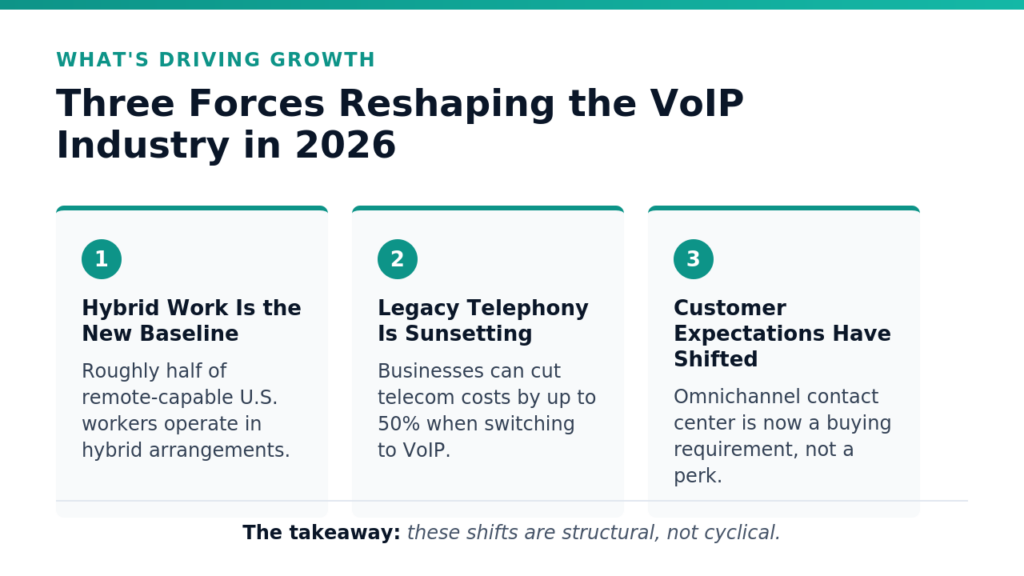
The forces behind today’s VoIP growth are structural, not cyclical. Businesses are permanently rebuilding how they communicate, and they want one integrated system to do it. Three shifts stand out.
Hybrid Work Has Stopped Being a Trend and Become the Baseline
Among remote-capable U.S. employees, roughly half now work hybrid, according to Gallup’s tracking, with another quarter working fully remote. Stanford research estimates that as of 2025, work-from-home days accounted for about a quarter of all paid workdays in the U.S. Hybrid is the new baseline, and it’s the single biggest reason your clients can’t run their business on a premises-based PBX anymore.
Legacy Telephony Is Sunsetting
Traditional copper-line and on-premises PBX systems are aging out of the market. Carriers are winding down legacy services, and the cost of maintaining old hardware keeps climbing. At the same time, businesses switching to VoIP can reduce their telecommunications costs by up to 50%. For your clients, the math is straightforward. For you, this upgrade demand doesn’t require a sales pitch.
Customer Expectations Have Changed
Modern customers expect to reach a business by phone, text, chat, and email, and they expect those conversations to feel connected. That expectation has made omnichannel contact center capability a buying requirement, not a nice-to-have. Companies are no longer evaluating VoIP in isolation. They’re evaluating whether the system can grow into a full communications platform without ripping anything out.
How Is the VoIP Industry Shifting from Standalone Calling to Unified Platforms?
This trend matters most for resellers, and it’s reshaping how you should position your offering. Standalone VoIP, the kind that just replaces dial tone, is becoming a commodity. What clients actually want is a platform that handles voice, video meetings, business SMS, virtual fax, contact center, and integrations with their CRM, all in one place.
That’s exactly why VoIP is increasingly bundled inside Unified Communications as a Service offerings. The broader UC market is growing faster than VoIP alone, and the buyers driving that growth are the small and mid-sized businesses you already serve.
If your offering is just calling, you’re competing on price against everyone else selling dial tone. If your offering is a unified platform, you’re competing on value, stickiness, and the depth of the relationship you build with each client. The margin math changes too. Bundled UCaaS packages typically command higher per-seat prices and lower churn than voice-only services.

Unification is also where a future-proof platform matters. The white-label provider you choose should already deliver this integrated experience, not promise it as a future roadmap item. If you’re evaluating partners now, look for ones that hand you a single ecosystem covering voice, messaging, contact center, and integrations on day one. That’s how you avoid being stuck reselling tomorrow’s commodity.
Which Telecom Trends Should Resellers Watch in 2026?
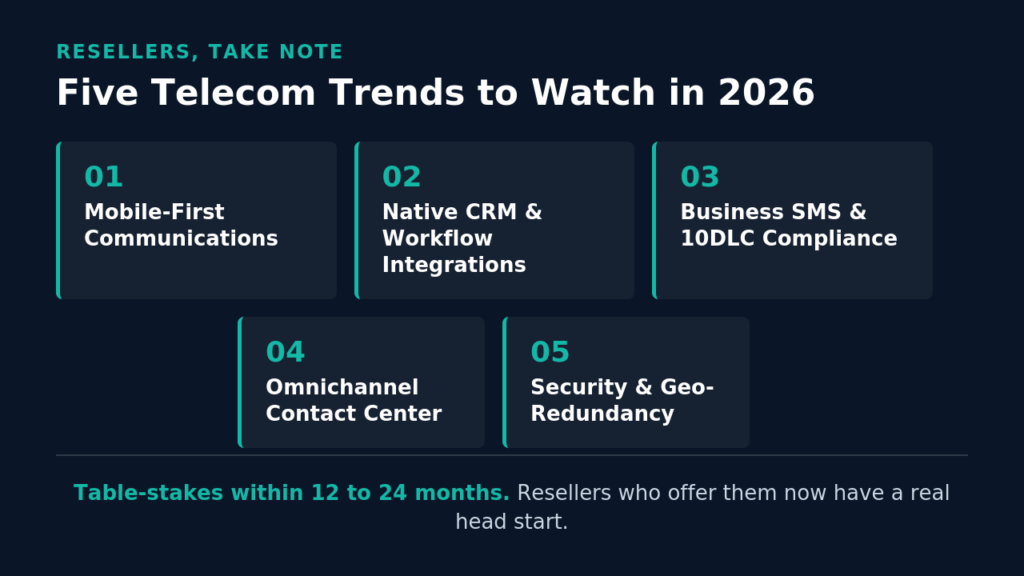
The platform shift is the headline, but several supporting trends are reshaping what clients buy and how they buy it. Tracking these telecom trends helps you stay ahead of your customers’ next questions instead of reacting to them.
- Mobile-First Communications. Frontline staff, field technicians, and hybrid workers expect their business number, presence, and messaging to follow them onto their phones. Softphone apps and mobile-native experiences are now expected.
- Native CRM and Workflow Integrations. Clients want their phone system to talk to HubSpot, Salesforce, Zoho, and Microsoft Teams without custom development. Integration depth is becoming a primary differentiator in deal evaluations.
- Business SMS and 10DLC Compliance. Texting is now a core business communication channel. Resellers who offer 10DLC-compliant SMS with keyword responders and blast campaigns can attach this to nearly every UCaaS deal.
- Omnichannel Contact Center. Even small organizations want call queues, skills-based routing, and visibility across voice, chat, SMS, and email. Adding contact center capability turns a standard UCaaS sale into a higher-value engagement.
- Security, Compliance, and Geo-Redundancy. Buyers are asking pointed questions about uptime, encryption, HIPAA, STIR/SHAKEN, and disaster recovery. Resellers backed by geo-redundant infrastructure and built-in compliance can confidently answer those questions.
None of these trends are speculative. They’re the baseline features your competitors will be selling within the next 12 to 24 months, which means the resellers who can offer them now have a real head start.
How Can Resellers Capitalize on VoIP Growth?
Knowing where the market is going matters less than knowing what to do about it. You don’t need to rebuild your business to capture this opportunity. You need to refine your positioning and pick the right platform partner.
Position Your Brand as a Strategic Communications Partner
Your clients want a guide. When you frame VoIP and UCaaS as a strategic decision about how their business will operate, instead of a line-item cost reduction, the conversation shifts. You stop being a phone provider and start being the person they call before they make any communications decision. That positioning is sticky, and stickiness builds recurring revenue.
Bundle Around Outcomes, Not Features
Most clients don’t care about the difference between an auto attendant and a queue. They care about whether their customers get answers quickly and whether their team can collaborate without friction. Build packages around outcomes: a “remote-ready” tier, a “customer experience” tier, a “compliance-focused” tier. Then attach the features that deliver those outcomes. This framing makes pricing conversations easier and helps clients self-select into higher-value packages.

Pick a Platform Partner That Will Still Be Relevant in Five Years
The biggest risk in white-label reselling is hitching your brand to a platform that falls behind. Evaluate partners on the depth of their current platform, their pace of feature development, and the strength of their reseller support model. The cheapest option often becomes the most expensive when you have to migrate clients off a stagnant platform two years in.
For a deeper look at how to choose well, this guide on picking the right VoIP reseller program walks through the evaluation criteria most resellers wish they’d known earlier.
What Does Future-Proof Reseller Positioning Look Like?
Future-proofing is about building your business on top of a platform and a relationship that can evolve without forcing you to start over.
Three things matter most.
- First, your platform partner should be investing in the roadmap, not just maintaining the existing product. Look at the cadence of new feature releases over the last 18 months. Are they shipping integrations, adding contact center depth, expanding mobile capability, and improving the admin experience? Or has the product line gone quiet?
- Second, you should own the customer relationship. White-label means your brand on the bill, your team on the support line, and your account managers in the room. If a provider tries to insert themselves into your customer conversations, that’s a sign their model is built to eventually displace you.
- Third, economics need to scale with you. Look for transparent wholesale pricing, healthy margins on bundled packages, and a path to lower per-seat costs as your installed base grows. The VoIP industry is growing, but the reseller margin opportunity is best when your platform partner is structured to grow with you instead of against you.
The resellers who dominate over the next five years won’t be the ones with the cheapest pricing. They’ll be the ones whose platform partner kept making them more valuable to their clients year after year.
Frequently Asked Questions
How fast is the VoIP industry growing in 2026?
The global VoIP market is projected to reach $195.39 billion in 2026 and grow to $388.97 billion by 2034 at a CAGR of 10.4%, according to Fortune Business Insights. North America holds the largest regional share, driven by hybrid work adoption and the sunset of legacy telephony.
What is the biggest telecom trend reshaping reseller opportunities?
The shift from standalone VoIP to fully unified communications platforms. Clients increasingly want voice, video, messaging, contact center, AI, and business app integrations from a single provider, and resellers offering complete platforms command higher margins and lower churn than those selling voice-only services.
Is VoIP still a good business to enter as a new reseller?
Yes. With VoIP growth projected to roughly double the market by 2034, demand is structural rather than cyclical. New resellers entering through a white-label platform partner can launch quickly without infrastructure investment, then expand into adjacent services like SMS, contact center, and SD-WAN as they grow.
What should resellers prioritize when choosing a VoIP platform partner?
Three things: the breadth of the current platform, the pace of ongoing feature development, and the strength of reseller support. Cheap onboarding pricing means little if the platform stagnates and forces you to migrate clients later. Geo-redundancy, integrated billing, and a clear roadmap should be non-negotiable.
How does hybrid work continue to affect VoIP demand?
Hybrid work has stabilized as the default for knowledge workers, with Gallup tracking roughly half of remote-capable U.S. employees in hybrid arrangements and another quarter working fully remote. That permanence is the structural reason cloud-based voice and unified communications keep growing, even as broader IT budgets tighten.
Build Your Business on the VoIP Industry’s Next Decade
The VoIP industry is becoming the operating layer for how businesses communicate, and the resellers who recognize that shift will own the next wave of opportunity. The right platform partner gives you the technology, support, and white-label flexibility to build a brand your clients trust for years.
SkySwitch’s white-label UCaaS platform combines geo-redundant infrastructure, deep integrations, contact center, business SMS, AI-powered solutions, and a reseller ecosystem designed to help you launch in as little as 30 days. Get started today to move beyond reselling dial tone and start building a future-proof communications practice.

Jessica is a marketing and sales strategist with deep expertise in VoIP telecommunications. As a Marketing Director, she specializes in channel marketing, account management, and product marketing within the communications industry. Jessica is passionate about helping partners grow through compelling messaging and hands-on support.