
Why MSPs Choose Private-Label UCaaS Over Legacy Systems

Private-label UCaaS gives MSPs full customer ownership, high profit margins, and cloud-based scalability that legacy PBX systems can’t match.
- Legacy on-premises phone systems drain resources through maintenance, hardware upgrades, and inflexible scaling.
- Private-label UCaaS lets MSPs brand communication solutions as their own while providers handle infrastructure.
- Customer ownership builds long-term business value and creates opportunities for lucrative exits.
- Cloud economics eliminates capital expenditures while supporting the hybrid workforces your clients demand.
If you’re still referring customers to national UCaaS providers or managing aging PBX infrastructure, you’re leaving revenue and customer equity on the table.
The unified communications market is growing, with projections showing the global UCaaS market reaching $215 billion by 2032. For managed service providers watching this expansion unfold, the question is how to capture that opportunity without sacrificing customer relationships or profit margins. Legacy phone systems that once adequately served SMB clients are now a liability, both for the businesses using them and the MSPs tasked with supporting them.
The shift toward private-label UCaaS is more than a technology upgrade. MSPs choosing this path gain complete control over their communication offerings, pricing strategies, and customer relationships. Unlike agent or referral models that hand customers to national providers, private-label arrangements let you build real business equity while delivering enterprise-grade solutions under your own brand.
What Is Private-Label UCaaS, and Why Does It Matter for MSPs?
Private-label UCaaS, sometimes called white-label UCaaS, is a business arrangement where MSPs offer comprehensive cloud communication services branded entirely as their own. The underlying platform, infrastructure, and technical maintenance remain the provider’s responsibility, while you handle sales, customer relationships, pricing, and front-line support.
This model solves the tension between expanding service offerings and maintaining customer ownership. When you become an agent for a national UCaaS provider, you earn commissions on initial sales but gradually lose influence over those customer relationships. The provider’s brand appears on invoices, support tickets, and user interfaces. Over time, those customers identify with the provider rather than your MSP.
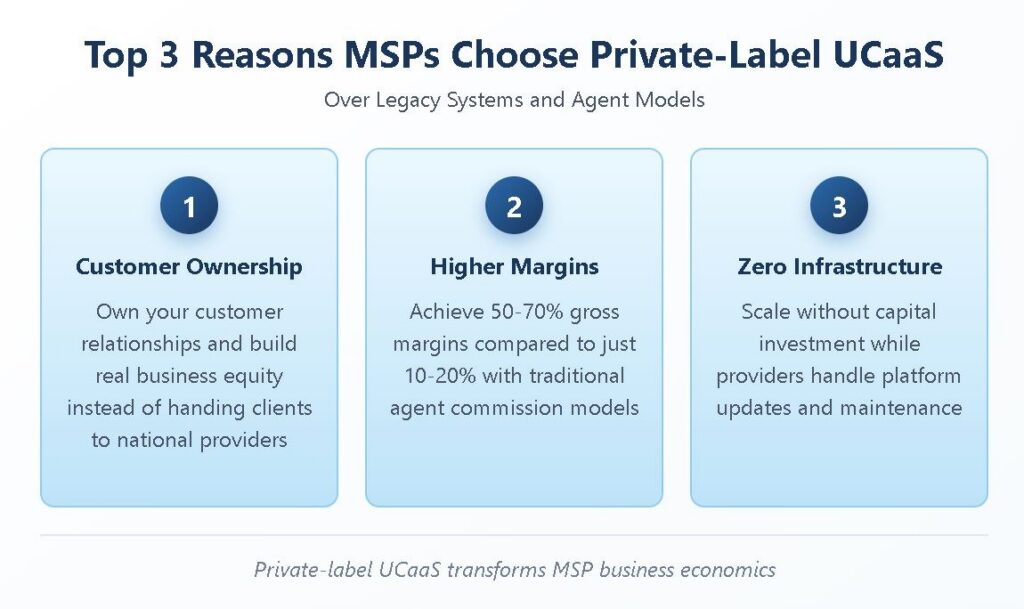
With private-label solutions, every touchpoint reinforces your brand. Customers log into portals displaying your logo, receive invoices with your company name, and call your support team when issues arise. You determine pricing structures, create service bundles that match your market, and build customer equity that has real value if you ever decide to sell your practice.
How Private-Label UCaaS Differs from Agent Models
Understanding the distinction between private-label and agent arrangements helps clarify why MSPs favor full ownership models. Agent partnerships typically offer lower barriers to entry. You receive training on someone else’s product, earn commissions on sales, and pass customers to the provider for ongoing service delivery. The math seems attractive until you realize you’re building someone else’s customer base.
Private-label models require more initial investment in learning the platform and establishing support processes. However, the payoff compounds over time. You control pricing and can achieve margins between 50% and 70% rather than the 10–20% commissions typical in agent models. More importantly, you’re creating an asset. MSPs with substantial UCaaS customer bases have sold those practices for significant multiples precisely because they owned the relationships outright.
Where Do Legacy Systems Fall Short for Modern MSPs?
MSPs who still manage on-premises PBX systems for clients face mounting challenges that make the business model unsustainable. Legacy systems weren’t designed for distributed workforces, mobile-first communication, or the integration demands of modern business applications. But the business challenges run deeper.
Supporting legacy infrastructure consumes technical resources that could drive growth. Every hour spent troubleshooting aging hardware or coordinating on-site service calls is time not spent winning new clients or expanding relationships with existing customers. The maintenance burden scales poorly, creating a ceiling on how many legacy deployments any MSP can profitably support.

The Hidden Costs of Maintaining On-Premises PBX
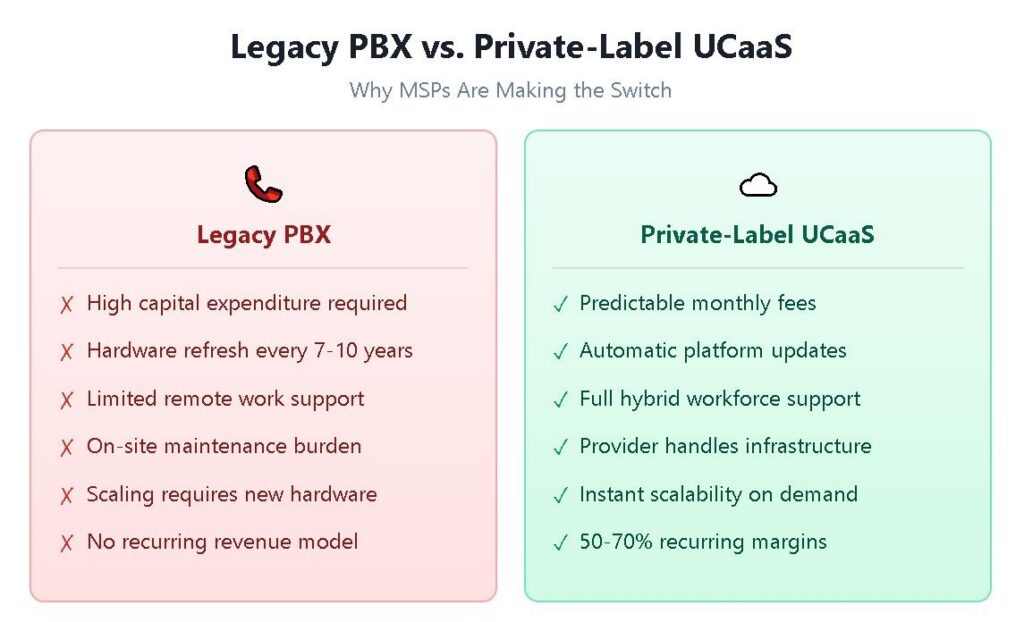
The financial case against legacy systems extends well beyond the obvious hardware expenses. Your clients face capital outlays for equipment that depreciates immediately, requires specialized maintenance contracts, and typically needs replacement every seven to ten years. But as the MSP supporting these systems, you bear hidden costs that rarely appear in project budgets.
Training technicians on proprietary PBX platforms is a recurring expense that compounds with staff turnover. Maintaining spare hardware inventory ties up working capital. Emergency service calls disrupt scheduled work and create unpredictable resource demands. Even successful legacy support practices struggle to achieve the consistent margins that subscription-based cloud services deliver.
Hosted UCaaS solutions enable SMBs to replace capital-intensive PBX systems with predictable monthly fees, resulting in up to 55% cost savings compared to premises-based telephony. When you can present clients with dramatic savings while simultaneously improving your own margins, the migration conversation becomes much easier.
Why Legacy Infrastructure Can’t Support Hybrid Workforces
The permanent shift toward hybrid and remote work arrangements has changed what businesses need from their communication systems. Nearly 90% of organizations now use UCaaS as either their primary phone system or alongside existing platforms. Your clients aren’t wondering whether to adopt cloud communications and hosted PBX solutions but rather who will provide them.
Legacy PBX systems trap voice communication within physical office locations. Employees working from home need VPN connections to access basic phone features, creating latency issues and support complexity. Mobile workers lack access to business calling features entirely, forcing them to use personal devices and creating compliance and professionalism concerns.
Private-label UCaaS eliminates these constraints. Users access full voice, video, and messaging from any device with internet connectivity. The same features work identically whether someone sits in the corporate office, works from a home office, or connects from a client site. For MSPs, this capability opens conversations with virtually every SMB client still operating legacy systems.
What Benefits Do MSPs Gain from White-Label UCaaS?
Understanding these benefits helps frame conversations with both potential clients and internal stakeholders evaluating service expansion.
The recurring revenue model deserves particular attention because it transforms MSP business economics. Legacy hardware and installation projects generate revenue spikes followed by low-margin maintenance work. UCaaS creates predictable monthly income that scales with client growth and compounds as you add customers over time.
Complete Customer Ownership and Brand Control
When you operate a white-label UCaaS practice, customers interact exclusively with your brand throughout their entire lifecycle. From initial proposals through daily usage and support interactions, your company name and identity remain front and center. This consistency builds trust and loyalty that translates directly to retention rates.
Customer ownership also provides flexibility. You set pricing without approval from upstream providers. You create bundles tailored to specific industries or client sizes. You can adjust terms, offer promotions, and negotiate deals based on relationship value rather than rigid provider guidelines. This autonomy proves valuable when competing against national providers who can’t match local MSP responsiveness and customization.
Higher Profit Margins and Recurring Revenue
The economic difference between agent commissions and private-label margins compounds over time. Agent models might deliver 10–20% of monthly service fees back to you. Private-label UCaaS and hosted PBX services can enable 50–70% gross margins on the same services. For an MSP building a customer base of several hundred seats, this difference represents hundreds of thousands in annual revenue.
The recurring nature of these payments also improves business stability and valuation. Investors and acquirers assign premium multiples to predictable subscription revenue. An MSP UCaaS practice with strong retention metrics and consistent growth becomes a valuable asset independent of any individual customer relationship.
Scalability Without Infrastructure Investment
Traditional communication services required MSPs to invest in infrastructure as they grew. More customers meant more equipment, rack space, and technical staff. White-label UCaaS decouples growth from capital requirements. Your provider handles infrastructure scaling, platform updates, and capacity management. You focus entirely on winning customers and delivering excellent service.
This model proves powerful for MSPs targeting growth in the SMB communication market. You can pursue larger opportunities without worrying whether your technical infrastructure can support expanded deployments. Geographic expansion becomes feasible because you’re not constrained by physical service areas or regional data center footprints.
5 Signs Your Customers Are Ready to Move Beyond Legacy Systems
Recognizing buying signals helps MSPs time migration conversations for maximum success. Watch for these indicators among your existing clients:
- Remote work complaints: Employees struggle to access phone features from home, use personal devices for business calls, or experience quality issues with VPN-based voice traffic.
- Expansion friction: Opening new locations requires expensive hardware purchases and lengthy installation timelines.
- Integration requests: Clients want their phone system to connect with CRM platforms, help desk software, or other business applications.
- Cost concerns: Maintenance contracts, hardware refresh cycles, and support fees generate budget discussions.
- Compliance anxiety: Industries with recording, retention, or security requirements outgrow legacy system capabilities.
When clients exhibit multiple signals, they’re essentially self-qualifying for UCaaS migration conversations. Approaching these discussions proactively (before clients start researching national providers independently) positions your MSP as the natural solution provider.
How Does Private-Label UCaaS Position MSPs for Long-Term Growth?
Building a UCaaS practice creates compound advantages that strengthen over time. Each customer relationship provides recurring revenue, potential expansion opportunity, and reference value for winning similar clients. Reseller programs let you develop genuine expertise and market positioning rather than simply processing transactions for upstream providers.

Long-term positioning also involves technology evolution. Private-label providers continuously enhance platforms with new features, AI capabilities, and integration options. Your customers automatically receive these improvements, keeping your offerings competitive without requiring you to manage development roadmaps or engineering resources.
Private-label UCaaS creates business equity that didn’t exist when you operated as an agent or simply supported legacy systems. MSPs with substantial, well-retained UCaaS customer bases have options. They can continue growing independently, partner with complementary providers, or eventually sell their practices to larger organizations seeking established customer relationships.
Frequently Asked Questions
How long does it take to launch a private-label UCaaS offering? Most MSPs can begin selling private-label UCaaS within 30–90 days of partnering with a provider, depending on the onboarding program structure and your team’s existing technical knowledge. The provider handles platform infrastructure, so your preparation focuses on sales training, support processes, and initial customer migration planning.
What technical capabilities do MSPs need to support private-label UCaaS? You’ll need staff comfortable with basic cloud service administration, troubleshooting network connectivity issues, and guiding customers through feature configuration. Most providers offer tier-2 and tier-3 support escalation, so your team handles front-line customer interactions while complex technical issues route to specialists.
Can MSPs migrate existing legacy customers to private-label UCaaS? Absolutely. In fact, existing customers often offer the best initial opportunities because you already have trusted relationships and understand their communication needs. Most providers offer migration assistance and porting support to make the transition smooth for both you and your customers.
Build Your White-Label UCaaS Practice
The communication services market continues to expand as businesses of all sizes recognize that legacy systems can’t meet modern requirements. MSPs positioned with private-label UCaaS offerings capture this growth while building genuine business equity through customer ownership and strong margins.
Making this transition requires selecting the right platform partner that combines reliable infrastructure, comprehensive features, and a genuine commitment to reseller success. SkySwitch provides the complete ecosystem MSPs need to build profitable UCaaS practices, from geo-redundant infrastructure and enterprise features to dedicated onboarding support and white-label branding tools. Get started today and discover how private-label UCaaS can transform your MSP business.

Jessica is a marketing and sales strategist with deep expertise in VoIP telecommunications. As a Marketing Director, she specializes in channel marketing, account management, and product marketing within the communications industry. Jessica is passionate about helping partners grow through compelling messaging and hands-on support.