
Why Contact Center Resellers Need Integrated UCaaS & CCaaS Solutions

The contact center market is undergoing a transformation driven by AI integration and platform convergence.
- Integrated UCaaS CCaaS platforms deliver 211% ROI within six months and boost customer satisfaction by 22%.
- Voice APIs enable custom integrations and AI-powered automation that modern businesses demand.
- 98% of contact centers now use AI, making advanced features table stakes for competitive resellers.
- MSPs capturing the $162.5 billion cloud contact center opportunity need partners offering unified platforms.
Contact center resellers who offer fragmented solutions will lose to those providing integrated UCaaS CCaaS platforms with flexible voice APIs.
The ongoing financial success of any business requires meeting and exceeding consumer expectations. Customers want personalized service with rapid, responsive communication across multiple channels. Companies that fail to respond to their customers’ collective embrace of digital resources risk missing significant opportunities to attract business, nurture leads, and build lasting relationships. For contact center resellers and MSPs, this environment creates both challenges and opportunities.
The cloud-based contact center market is projected to reach $162.5 billion by 2033, up from $32.8 billion in 2024. Even more striking, 98% of contact centers already use AI in some capacity. This rapid adoption signals a shift in what businesses expect from contact center solutions.
With the right white-label reseller partner, you’ll have everything you need to establish your brand as a trusted provider of the most cost-effective, in-demand business communication services available.
How Do the Best Contact Center Solutions Compare to Call Center Services?
Call centers typically handle incoming and outgoing voice communication on behalf of the companies they represent. Although you’ll find many reseller opportunities offering the option of branding call center services as your own, many of your prospective clients will be far better served by cloud-sourced business communications solutions that include contact center support.
Basic Call Center Functionality
Virtual phone answering services are a cost-effective customer care solution. With the right platform provider, your clients have all the advantages of hiring a team of on-site receptionists without investing in a dedicated phone system or paying additional wages. The best call center representatives are highly trained, have the customer service skills essential for ensuring a favorable outcome, and are available to take calls outside of standard business hours.
Call center representatives can be tasked with booking appointments, taking messages, forwarding calls, and providing remote workers with dial-in numbers, links, and codes to important meetings. With the right reseller platform provider, your clients pay only for the features they need, can scale those services as their business evolves, and can have their business calls rerouted to any digital device.
AI-Enhanced Business SMS
Short message service (SMS) remains one of the most widely used communication channels. Companies have been taking advantage of SMS for years to send alerts and appointment reminders, promote special offers, and increase customer engagement. Research shows that 83% of millennials open SMS messages within 90 seconds of receiving them, and over 70% prefer communicating over digital channels, making SMS integration essential for modern contact centers.
As a contact center reseller, you can provide cost-effective services designed to modernize your clients’ phone systems to transmit voice, text, and data over the internet. Your clients can take advantage of SMS services paired with AI technology. Customers sending text messages receive efficient, conversational communication with relevant information obtained from business directories and call logs.
Text-to-Speech Services
Originally developed as a technology to assist the visually impaired, text-to-speech (TTS) converts written communication to audio signals. This technology now helps companies reach audiences unencumbered by language barriers. While early text-to-speech sounded robotic, today’s TTS is far more conversational. Modern solutions even incorporate AI voice cloning capabilities for brand consistency.
Cloud-sourced text-to-speech uses an application programming interface (API), technology that allows two or more disparate applications to communicate across multiple platforms, to help strengthen brand identity.
Conversational AI and Intelligent Chatbots
Chatbots are computer programs that utilize artificial intelligence and natural language processing to generate automated responses that simulate human conversation through text or audio input. Large language models enable more natural, context-aware conversations that go beyond simple scripted responses. Most customers reaching out for support are willing to engage with AI-powered assistants, provided they also have seamless access to a live agent when needed.
Real-Time Call Data and Analytics
Historical data reporting provides a detailed overview of each contact center attendant for a specific period, information that allows business owners to evaluate call volume, duration, hold times, outcome, or the number of calls abandoned. While crucial for long-term planning, historical data only shows what has already happened.
Contact center resellers offering real-time call data give customers the ability to respond proactively. After launching multi-channel support services, real-time call analytics reveal which multimedia channels their customers rely on most often and which services they view most positively. Modern AI-powered analytics can even provide sentiment analysis and predictive insights to optimize staffing and improve customer experiences.
Why Does UCaaS CCaaS Integration Matter for Contact Center Resellers?
The lines between unified communications and contact center platforms have blurred. UCaaS CCaaS integration is an important trend reshaping the contact center reseller market. Understanding why this integration matters can give your reseller business a competitive advantage.
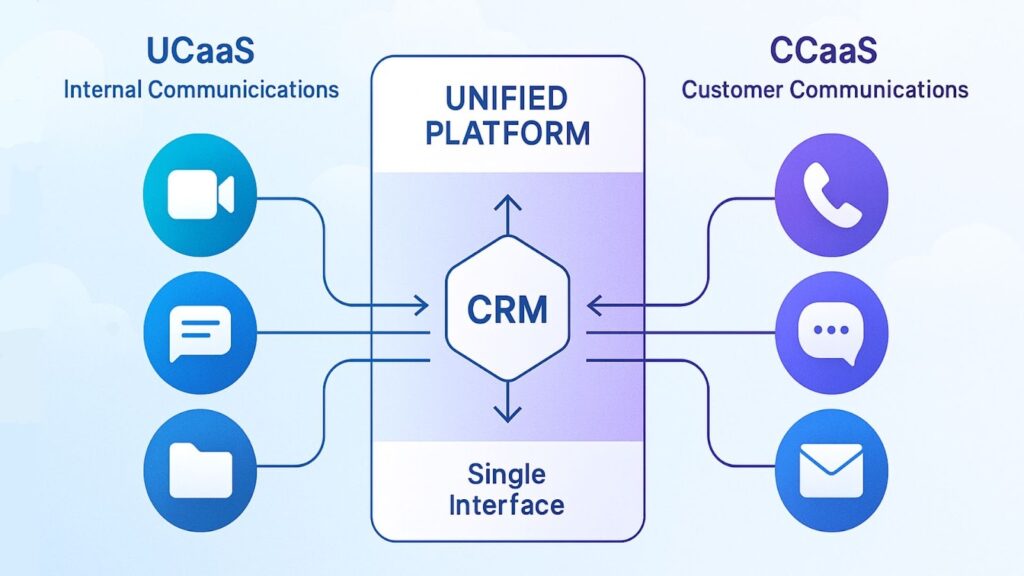
Historically, UCaaS and CCaaS systems operated in separate worlds. UCaaS platforms like Microsoft Teams provided the tools teams need to effectively collaborate, including video conferencing, messaging, VoIP, and file sharing. CCaaS platforms handled the customer-facing side with support tickets, phone queues, live chat, and automated guidance. This separation created inefficiencies that frustrated both customers and support teams.
The Business Case for Integration
The financial benefits of UCaaS CCaaS integration are substantial. Organizations implementing combined UCaaS and CCaaS solutions achieved a 211% return on investment within just six months. Companies integrating these platforms saw a 22% increase in customer satisfaction ratings.
For contact center resellers, offering integrated platforms creates multiple advantages. Your clients benefit from fewer vendors to manage, reduced licensing costs, and improved data flow between internal teams and customer-facing agents. When a support agent needs expertise from a billing specialist or product engineer, they can pull in that expert through unified collaboration tools without switching applications or losing customer context.
What True Integration Means
True UCaaS CCaaS integration means the tools your internal teams use for voice, video, and chat are directly connected to the systems your support and sales teams rely on daily. When a customer reaches out, employees have immediate access to conversation history, customer data, and internal expertise within a single interface.
Businesses agree that UCaaS CCaaS integration is essential to their future success. This recognition creates substantial opportunities for contact center resellers who can deliver truly integrated solutions rather than forcing clients to cobble together multiple platforms.
Opportunities for MSPs
For MSPs specifically, integrated UCaaS CCaaS platforms present the chance to become the single provider for all communication needs. Rather than competing solely on voice services or contact center features, MSPs can bundle comprehensive solutions that address both internal collaboration and customer engagement. This consolidation reduces vendor sprawl for clients while creating stickier relationships for the MSP.
The shift to integrated platforms also simplifies technical management. IT teams deal with one vendor relationship, one support contact, and one unified platform to configure and maintain. This reduced complexity translates directly to lower operational costs and faster problem resolution.
Voice API CCaaS: Technical Integration Opportunities
Voice APIs are a powerful differentiator for contact center resellers targeting technically sophisticated clients. Understanding how voice APIs enhance contact center solutions can help you serve developer-focused organizations and businesses requiring custom integrations.
What Do Voice APIs Enable?
A voice API connects internet-based applications to the Public Switched Telephone Network, allowing developers to programmatically control calling experiences. Contact centers gain the ability to customize call flows, integrate with proprietary systems, and build unique customer experiences without being constrained by pre-built features.
Voice API CCaaS solutions enable several critical capabilities. Developers can create custom auto attendant systems that dynamically route callers based on real-time data from CRMs. They can implement click-to-call functionality directly within business applications, eliminating the need for agents to manually dial numbers. Voice APIs also enable advanced features like real-time call transcription, sentiment analysis, and AI-powered call summarization.
Integration Use Cases
The most common use case for voice APIs in contact centers involves CRM integration. When a customer calls, the API can automatically query the CRM system, pull up the customer’s complete history, and present it to the agent before they even pick up. This screen pop functionality reduces handle time and improves first-call resolution rates.
Another powerful application involves AI voice agents. Using voice APIs, contact centers can deploy conversational AI that handles routine inquiries while seamlessly transferring complex issues to human agents. The API maintains context throughout the conversation, ensuring smooth handoffs without forcing customers to repeat information.
Voice APIs also enable outbound calling campaigns with sophisticated logic. Contact centers can programmatically initiate calls, play personalized messages using text-to-speech, detect answering machines, and route answered calls to available agents based on skill sets and availability.
Developer-Friendly Platforms
Leading voice API providers offer REST APIs that work with any programming language, comprehensive documentation, and code samples that speed implementation. For contact center resellers, partnering with a platform that includes robust voice APIs means you can serve clients who need customization without requiring your own development team.
The key is finding a provider whose voice APIs integrate seamlessly with their core contact center platform. Clients get the best of both worlds: reliable, enterprise-grade contact center features with the flexibility to customize and extend functionality through APIs.
Contact Center Solutions for MSPs: The 2025 Opportunity
Managed service providers occupy a unique position in the contact center reseller ecosystem. MSPs already serve as trusted technology advisors to their clients, making them ideal partners for delivering integrated communication solutions. The contact center market presents a substantial revenue opportunity for MSPs willing to add these capabilities to their portfolios.

Why Should MSPs Care About Contact Centers?
The global UCaaS market is forecasted to grow from $136 billion in 2023 to $417 billion by 2030. Meanwhile, the cloud contact center market is expanding even more rapidly. For MSPs, this growth translates to new recurring revenue streams and deeper client relationships.
MSPs are particularly well-positioned to succeed in the contact center market because they already handle complex technology deployments for their clients. Adding contact center solutions for MSPs feels like a natural extension of existing managed services rather than a completely new business line.
Bundling UCaaS with CCaaS
The most successful MSPs approach contact center services as part of a broader unified communications strategy. Rather than selling contact center capabilities in isolation, they bundle UCaaS and CCaaS together with network security, SD-WAN, and cloud storage into comprehensive managed offerings.
This bundled approach creates value for both MSPs and their clients. Clients get simplified vendor management, better integration between communication systems, and predictable monthly costs. MSPs benefit from higher average contract values, reduced churn due to deeper integration, and the ability to deliver end-to-end solutions rather than point products.
Recurring Revenue Opportunities
Contact center solutions deliver the predictable monthly recurring revenue that MSPs prize. Unlike project-based work or hardware sales, contact center subscriptions create steady income streams that compound as you add more clients. The seat-based pricing model also allows MSPs to start small with clients and expand revenue as their contact center grows.
Many MSPs report that contact center services create opportunities to cross-sell other offerings. A client who adopts your contact center solution may need help with CRM integration, network upgrades to support voice quality, or security enhancements to protect customer data.
Competitive Differentiation
As more MSPs recognize the contact center opportunity, having the right white-label partner becomes imperative. MSPs that can offer truly integrated UCaaS CCaaS platforms with advanced features will differentiate themselves from competitors still offering basic call center capabilities.
The key is finding a platform provider that supports your growth without forcing you to build expertise in telecommunications infrastructure. The best white-label partners handle the complex backend systems while allowing you to focus on understanding client needs and delivering exceptional service.
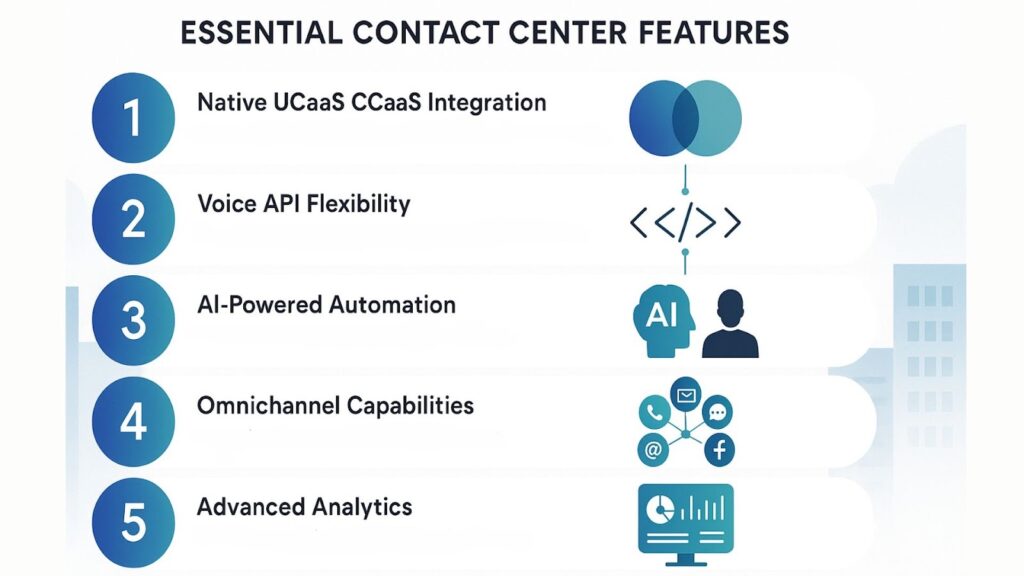
5 Essential Features Modern Contact Center Resellers Must Offer
Success as a contact center reseller requires offering solutions that meet the elevated expectations businesses now have for their communication platforms. Based on current market trends and buyer requirements, these five features have become non-negotiable.
1. Native UCaaS CCaaS Integration
Offering separate UCaaS and CCaaS platforms that claim to work together no longer cuts it. Businesses want native integration where collaboration tools and contact center features exist within a unified interface. Agents can access internal expertise without leaving their contact center application, and internal teams can monitor customer interactions in real time.
Look for platforms that share a common user database, unified reporting, and seamless authentication across both UCaaS and CCaaS components. The best solutions make it impossible to tell where UCaaS ends and CCaaS begins because they’re truly one platform.
2. Voice API Flexibility
Not every client will need voice APIs on day one, but having them available future-proofs your offering. Businesses increasingly expect the ability to customize their contact center experiences and integrate with proprietary systems. Voice APIs provide that flexibility without requiring clients to switch platforms as their needs grow.
Ensure your platform partner offers well-documented REST APIs with code samples and developer support. The easier it is for clients to work with the APIs, the more likely they’ll choose your solution over competitors with closed systems.
3. AI-Powered Automation with Human Oversight
The 2025 reality is that AI adoption in contact centers has reached critical mass. However, businesses are learning that effective AI implementation requires a careful balance between automation and human interaction.
Your platform should offer AI features like automated call summarization, sentiment analysis, intelligent routing, and conversational AI chatbots. Equally important is maintaining easy pathways for customers to reach human agents when AI can’t resolve their needs. The goal is to augment human agents rather than replace them.
4. Omnichannel Capabilities
Voice-only contact centers are relics of the past. Modern businesses need to support customers across phone, email, SMS, web chat, social media, and emerging channels like messaging apps. True omnichannel support means conversations can flow seamlessly between channels while maintaining context.
Your platform should unify all channels into a single agent interface with a consistent view of customer history, regardless of how they’ve contacted the company. This consolidation reduces customer frustration and improves resolution times by eliminating the need to repeat information when switching channels.
5. Advanced Analytics and Reporting
Data-driven decision-making separates successful contact centers from struggling ones. Your platform must provide comprehensive analytics covering both real-time metrics and historical trends. Contact center managers need visibility into agent performance, queue status, channel effectiveness, and customer satisfaction metrics.
Modern analytics platforms offer predictive insights. AI-powered analytics can forecast call volume, identify training opportunities, and recommend staffing adjustments before problems occur. These advanced capabilities help clients optimize operations and improve outcomes.
How Do White-Label Reseller Arrangements Typically Work?
White-label products and services are made by one company, then sold to other businesses for branding and reselling. It’s a mutually beneficial arrangement that has become particularly popular in the contact center space. With so many companies looking for cost-effective communications solutions that support remote and hybrid workforces, managed service providers, IT consultants, and other technology resellers are recognizing the value of offering cloud-sourced communication services.
Partnering with a white-label service provider gives you the ability to offer digital communication solutions without investing in building an entire system from the ground up. You own the customer experience and relationship. Your reseller partner benefits from your brand reputation and ability to reach more customers.
Choosing the Right Partner
To ensure your customers have the services they need when they need them, including the option of contact center support, you’ll want to partner with a white-label platform provider offering unified communications as a service.
With the right UCaaS white-label platform provider, you’ll have everything you need to establish your brand as the one-stop solution your clients can count on for business communication and collaboration essentials.
When evaluating potential partners, prioritize those offering geo-redundant networks for maximum reliability, comprehensive onboarding programs, ongoing technical support, and flexible pricing that allows you to maintain healthy margins. The platform should also provide white-label marketing materials, billing system integrations, and a partner community where you can learn from other successful resellers.
Frequently Asked Questions
What is UCaaS CCaaS integration?
UCaaS CCaaS integration combines unified communications platforms with contact center capabilities into a single, seamlessly connected system. It eliminates the friction of managing separate systems, improves collaboration between internal teams and customer-facing agents, and delivers measurable improvements in both efficiency and customer satisfaction.
How do voice APIs enhance contact center solutions?
Voice APIs give developers programmatic control over calling experiences, enabling custom integrations with CRM systems, proprietary applications, and third-party services. They allow businesses to build unique customer experiences like dynamic call routing based on real-time data, AI-powered voice agents, and click-to-call functionality within business applications. Voice APIs essentially future-proof contact center investments by ensuring businesses can customize and extend their platforms as needs evolve.
What should MSPs look for in a contact center reseller platform?
MSPs should prioritize platforms offering true UCaaS CCaaS integration rather than separate systems that claim to work together. Look for geo-redundant networks with proven reliability, comprehensive voice API support for technical clients, white-label branding capabilities, flexible pricing that supports healthy margins, and strong partner support, including onboarding, ongoing training, and technical assistance. The ideal platform allows MSPs to focus on client relationships while the provider handles complex telecommunications infrastructure.
How is AI changing contact center requirements in 2025?
AI has moved from optional to essential in contact centers, with 98% now using AI in some capacity. However, the focus has shifted from wholesale replacement of agents to intelligent augmentation. Businesses expect AI features like automated call summarization, real-time sentiment analysis, conversational chatbots, and predictive analytics as standard offerings.
Offer Your Customers the Best Contact Center Solutions with the Right Partner
Branding and reselling white-label UCaaS is more profitable and easier than you expect. With so many business owners feeling the strain of trying to keep their hybrid workforce connected while delivering exceptional customer experiences, integrated UCaaS CCaaS solutions are in high demand.
The contact center reseller market is evolving. AI integration, voice API capabilities, and UCaaS CCaaS convergence have raised the bar for what businesses expect from their communication platforms. Resellers who recognize these trends and partner with providers offering truly integrated solutions will capture the substantial growth opportunities ahead.
At SkySwitch, we understand what our reseller partners need to ensure long-term success. We offer a comprehensive UCaaS platform with integrated contact center capabilities, voice APIs for custom integrations, platform training, billing services training, real-time support, and hundreds of apps and system integrations. Our start-up fees are minimal, and you can deploy and learn our platform in as little as 30 days. Get started today, and we’ll help you expand your business without expanding your workload.

Jessica is a marketing and sales strategist with deep expertise in VoIP telecommunications. As a Marketing Director, she specializes in channel marketing, account management, and product marketing within the communications industry. Jessica is passionate about helping partners grow through compelling messaging and hands-on support.