
What Is a White-Label Communications Platform?

TL;DR: A white-label communications platform is the complete technology and business stack that lets you sell voice, video, messaging, contact center, and AI-powered communications under your own brand, without building or operating any of it yourself.
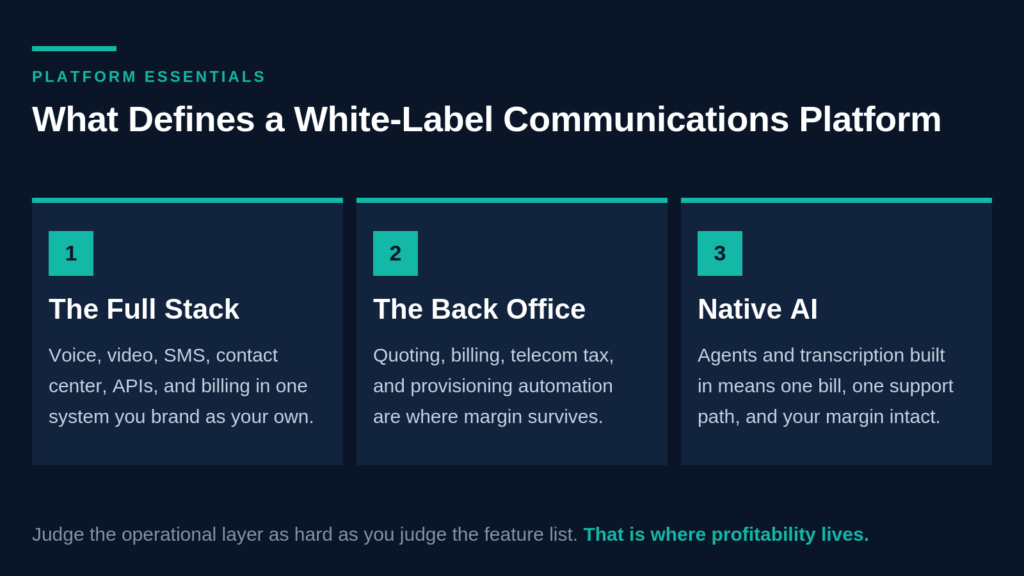
- It covers far more than dial tone. A real platform bundles voice, video, business SMS and MMS, contact center, virtual fax, APIs, and device provisioning into one system you resell as your own product.
- The back office is half the value. Quoting, billing, telecom taxation, compliance, and provisioning automation separate a platform from a rebranded phone service.
- A platform and a reseller program are two different things. The platform is the technology. The program is the training, margin structure, and support that make the technology sellable.
- AI is now part of the stack, not an add-on you source elsewhere. Conversational agents, transcription, and post-call analysis are increasingly built into the platform itself.
When evaluating white-label communications, judge the operational layer as hard as you judge the feature list. That’s where profitability actually lives.
If you sell IT or telecom services, you’ve probably been pitched on white-label VoIP more than once. The term undersells what’s on the table. A white-label communications platform is the entire technology and business stack behind a branded communications service, and it reaches well past making and receiving calls. Voice, video, messaging, contact center, billing, taxation, APIs, compliance, and partner enablement all sit inside it. You put your name on the whole thing while someone else builds, operates, and keeps it current.
The demand behind this model isn’t speculative. IMARC Group values the global UCaaS market at $90.3 billion in 2025, with a projected climb to $390.1 billion by 2034 at a 17.12% CAGR. Your customers are somewhere in that migration right now, and most would rather buy communications from a provider they already trust than shop for a new vendor. That’s the opening, and a white-label reseller platform is how you take it.
What Is a White-Label Communications Platform, Exactly?
A white-label communications platform is a fully operated cloud communications system that a provider licenses to you for resale under your own brand, pricing, and customer relationship. The provider runs the switching, carrier interconnects, number management, and infrastructure. You handle the branding, packaging, pricing, and customer. To your end users, the service is yours.
Pay attention to the language because “reselling communications” describes several very different business models, and they produce very different economics.
How Is It Different From Being an Agent or a Referral Partner?
As an agent, you introduce a customer to a provider and collect a commission on what that customer spends. The provider owns the contract, sets the price, sends the invoice, and controls the experience. Your leverage ends the moment the deal closes, and your revenue is a percentage of someone else’s relationship.
With white-label communications, you set the pricing, you invoice the customer directly, and you own the account. When your customer needs to add 10 seats or turn on business texting, they call you. That ownership turns a one-time commission into a recurring revenue line you can build a valuation around. It also means the quality of the underlying platform becomes your reputation, which is why evaluation matters so much.
What Does “White-Label” Actually Cover?
At a minimum, a white-label UCaaS platform should cover every surface your customer touches: the desktop and mobile apps, web portal, login page, invoice, notification emails, and support knowledge base. Some providers stop at a logo swap on the softphone and call it branded. That leaves your customer one password reset email away from learning who really runs their phone system.
Brandability should extend to your side of the house too, including your quoting tool, billing platform, and customer-facing documentation. The terms private-label UCaaS and white-label communications get used interchangeably, and they describe the same arrangement: the technology is theirs, the brand and the customer are yours.
What’s Inside a Modern White-Label Communications Platform?
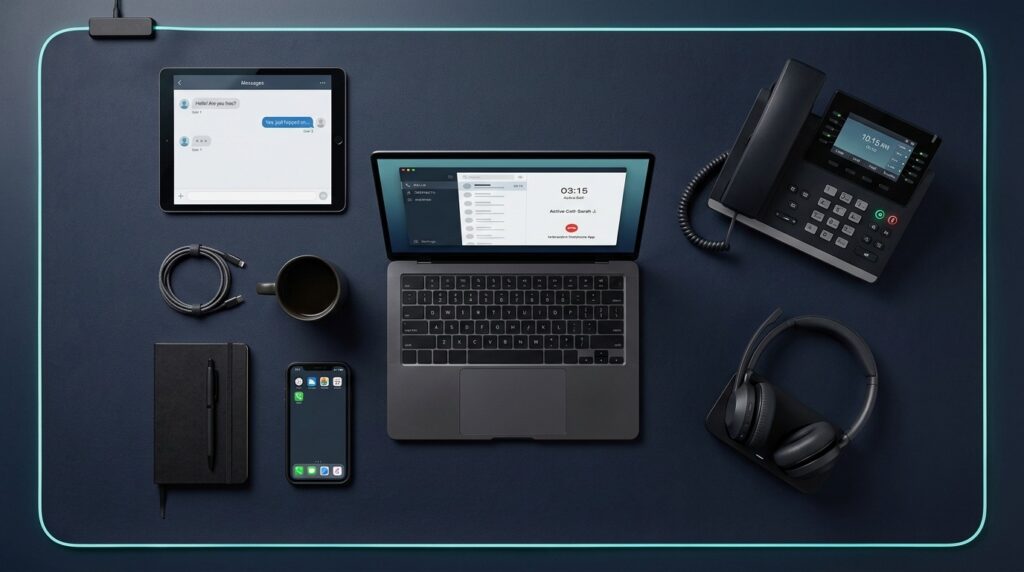
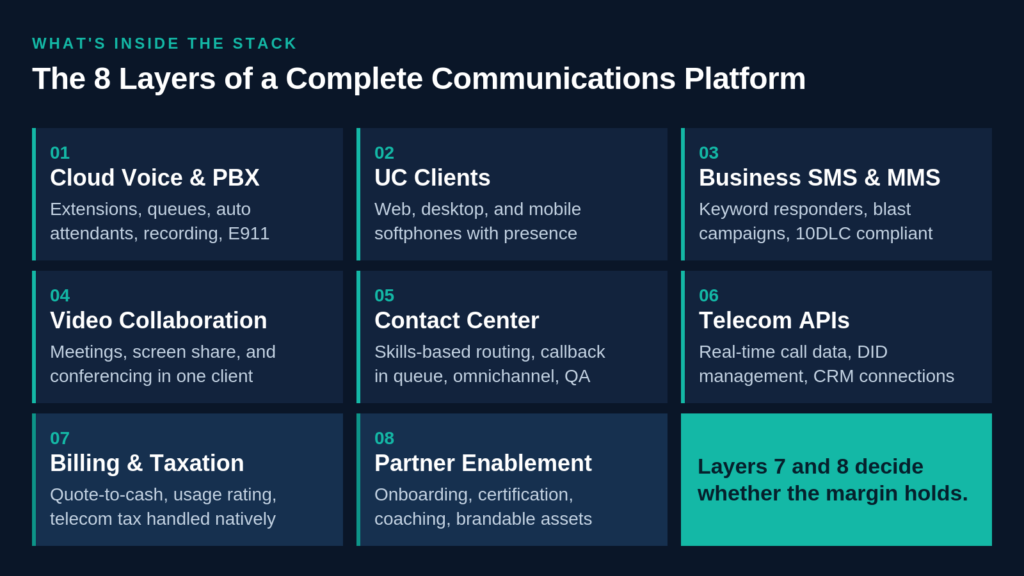
Feature lists look nearly identical across providers, so it helps to think in layers instead. A complete white-label UCaaS platform assembles eight of them, and a gap in any one becomes a vendor you source separately, a second bill to reconcile, and a second support number your customer eventually finds.
Here’s what a full stack includes:
- Cloud voice and PBX. Extensions, call queues, auto attendants, call recording, voicemail, time frames, and E911. Everything else attaches to this foundation.
- UC clients across web, desktop, and mobile. Softphones with presence, chat, visual voicemail, call transfer, and parking so your customers can retire desk phones without losing capability.
- Business SMS and MMS. Keyword responders, appointment reminders, blast campaigns, shared numbers, and 10DLC-compliant messaging from existing business numbers.
- Video and web collaboration. Meetings, screen sharing, and conferencing delivered inside the same client rather than as a separate subscription.
- Contact center. Skills-based routing, callback in queue, call recording, coaching, omnichannel handling across voice, SMS, chat, and email, plus real-time dashboards.
- Telecom APIs. REST endpoints that let your developers pull real-time call data, automate provisioning, manage DID inventory, and connect the phone system to CRMs and internal tools.
- Quoting, billing, and taxation. Quote-to-cash workflow, automated account creation, usage rating, and telecom tax handling so you bill accurately without building a billing department.
- Partner enablement. Onboarding, technical training, sales coaching, brandable marketing assets, and an escalation path for the issues your team can’t resolve alone.
Why the Operational Layers Decide Your Margin
Layers one through six sell the deal. Layers seven and eight decide whether the deal is still profitable 18 months later. Telecom billing is difficult, and telecom taxation is worse, with jurisdiction-specific surcharges that change without much warning. A platform natively handling rating, invoicing, and tax calculation removes an entire operational function from your business.
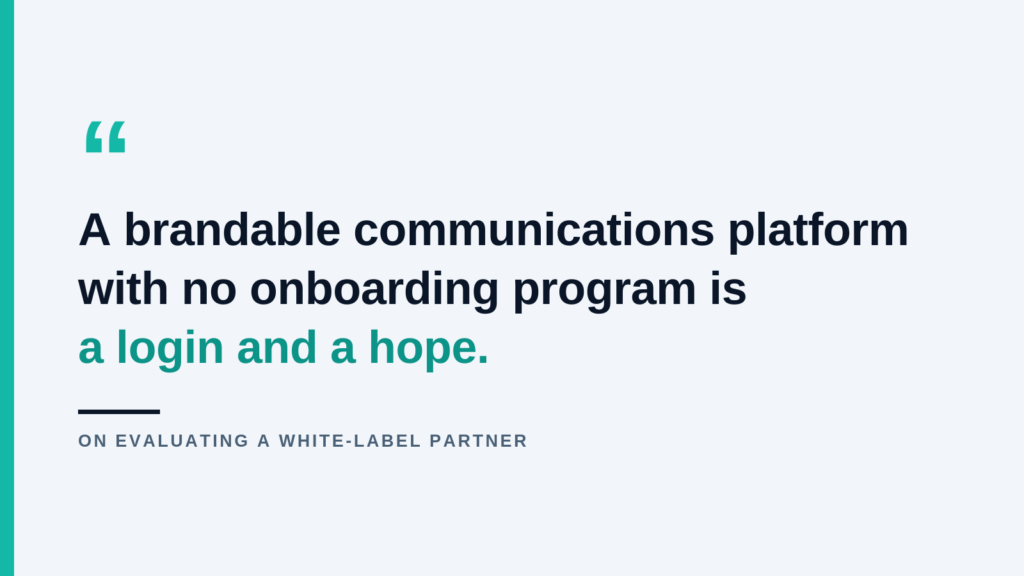
Partner enablement works the same way. A brandable communications platform with no onboarding program is a login and a hope. The providers worth working with treat your ramp as their responsibility because a partner who never launches never generates revenue for either party. The gap shows up quickly when you compare a full white-label feature set against a provider selling seats alone.
Platform vs. Reseller Program vs. Traditional VoIP: What’s the Difference?
These three terms get used as synonyms in sales conversations, and they shouldn’t be. The table below breaks down what each one actually gives you.
| Traditional VoIP Resale | Reseller Program | White-Label Communications Platform | |
| Whose brand | Provider’s | Provider’s or co-branded | Yours, end to end |
| Who owns the customer | Provider | Usually the provider | You |
| Who sets pricing | Provider | Provider, within limits | You |
| Revenue model | Commission or referral fee | Discount off list price | Wholesale cost, your margin |
| Scope of services | Voice, sometimes messaging | Voice plus select add-ons | Full communications stack |
| Back office included | No | Partial | Quoting, billing, taxation, provisioning |
| Support structure | Provider supports end user | Shared or escalation-only | You front it, provider backs you |
| Typical time to launch | Immediate | Weeks | As little as 30 days with commitment |
A reseller program and a platform aren’t competing options, and the strongest arrangements pair them. The platform is the technology you sell. The program is the training, margin structure, and support wrapped around it. A strong platform with a weak program leaves you sorting out provisioning and pricing alone, while a strong program on a thin platform gives you excellent coaching on a product that can’t compete. If you’re weighing your first move, this path to becoming a UCaaS reseller walks through how the two fit together.
How Do AI Features Fit Into a White-Label Platform?
AI has moved from roadmap item to shipping feature across cloud communications, and it’s reshaping what buyers expect a platform to include. CompTIA’s IT Industry Outlook 2026 found that 84% of business and technology professionals anticipate a significant or moderate increase in AI investment, with 45% naming new customer segments as a driver of optimism for the year. Your customers are budgeting for this. The question is whether you’re the one selling it to them.
AI reaches a communications platform in two ways, and the difference lands on your margin. The first is a bolt-on: your provider partners with a third-party AI vendor, that vendor takes a cut, and you resell whatever is left after two companies have gone first. You inherit middleware, a separate contract, and a second support path. The second is native, where the capabilities are engineered into the same platform you already sell.
What Native AI Actually Looks Like in Practice
A conversational agent that deploys as a number or extension on the customer’s PBX can identify caller intent and route accordingly, book appointments, answer questions about hours and pricing, qualify inbound leads, and cover after-hours calls without added headcount. A no-code builder means you deploy it without hiring AI engineers. Human escalation stays available throughout, so the customer conversation is about offloading repetitive work, never replacing staff.
Around that sit the supporting features: call transcription and summarization, sentiment and topic detection across customer conversations, live agent assist, smart wrap-up with automated notes, and voicemail transcription. When those AI capabilities sit inside the platform rather than beside it, you keep one billing relationship, one support channel, and partner margins that can reach up to 70%.
What Should You Look for in a VoIP Reseller Platform?
Once you understand the layers, evaluation gets more concrete. A few areas deserve pointed questions.
Network architecture. Ask about geo-redundant networks and automated failover across multiple data centers. Your brand absorbs every outage, so the underlying infrastructure is your risk.
Compliance coverage. Any VoIP reseller platform you consider should carry the regulatory load with you, including the caller ID authentication requirements the FCC has expanded across the industry through its STIR/SHAKEN framework, plus 10DLC registration for messaging, HIPAA-compliant configurations, Kari’s Law, and Ray Baum’s Act. Compliance handled at the platform level is compliance you don’t staff for.
Brand depth. Request a walkthrough of every customer-facing surface a brandable communications platform claims to cover, then look for the ones that were missed. Portals, apps, invoices, and automated emails all count.
Economics you control. Wholesale pricing with volume tiers lets you build packages and set your own markup. Healthy recurring margins are standard here, but structure matters more than the headline number, so ask how pricing improves as you scale.
Enablement depth. Onboarding, technical certification, sales coaching on early calls, and a usable knowledge base. The degree of customization a platform supports is a good proxy for how seriously a provider takes the partner relationship.
Frequently Asked Questions
Is a white-label communications platform the same as private-label UCaaS? Yes. The two terms describe the same arrangement, where a provider builds and operates the technology while you sell it under your own brand, pricing, and customer relationship. Some providers favor one term over the other, but the model is identical.
Do I need telecom experience to resell a white-label communications platform? No. Plenty of successful partners come from managed IT, system integration, or office equipment backgrounds with no prior voice experience. What matters more is an existing customer base that trusts you and a provider whose onboarding program covers provisioning, billing, and support workflows in depth.
How long does it take to launch a branded communications offering? With a committed team and a provider that runs a structured onboarding program, you can be selling in as little as 30 days. Full certification across technical, billing, and sales tracks typically continues past that point, but launch and mastery are two different milestones.
Can I sell only part of the platform instead of the whole stack? In most cases, yes. Strong platforms are modular, so you can lead with core voice and add contact center, business SMS, video, or AI features as demand develops. That flexibility also lets you build tiered packages at different price points.

Ready to Build Your Own Branded Communications Offering?
A white-label communications platform gives you something a commission check never will: a branded product line, a recurring revenue stream, and a customer relationship that belongs to you. The providers worth partnering with deliver the full stack, from cloud voice and contact center through billing, taxation, compliance, and native AI, along with a partner program built to get you selling rather than just signed.
SkySwitch has spent more than a decade building exactly that for MSPs, system integrators, VARs, and interconnects who want to own their communications business instead of renting a slice of someone else’s. Get started with SkySwitch to see what a complete white-label communications platform looks like from the partner side.

Jessica is a marketing and sales strategist with deep expertise in VoIP telecommunications. As a Marketing Director, she specializes in channel marketing, account management, and product marketing within the communications industry. Jessica is passionate about helping partners grow through compelling messaging and hands-on support.