
AI Voice Assistant vs Auto Attendant: Which Is Right for SMBs?

Most SMBs are still routing calls through a phone menu built a decade ago, and that gap is one of the easiest upsell conversations a reseller can start this year.
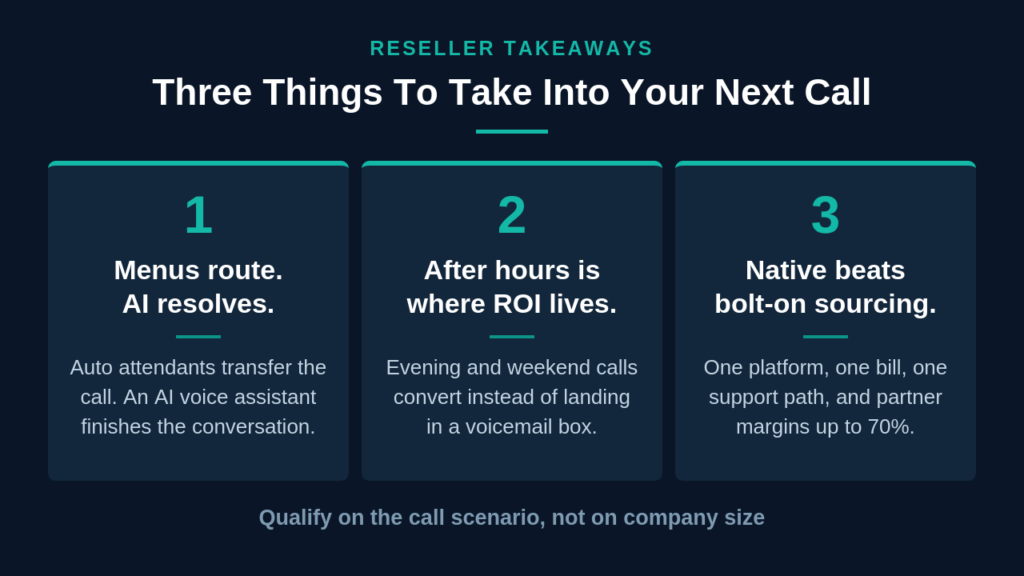
- A traditional auto attendant routes calls. An AI voice assistant handles them. One transfers the caller to a person or a voicemail box. The other answers questions, books appointments, and captures lead details before anyone picks up.
- After-hours coverage is the fastest ROI story. Menu-based routing sends evening callers to voicemail. AI call answering keeps working at 9 p.m. on a Saturday without adding a single payroll line.
- It’s not an either-or decision for most customers. The strongest deployments keep a simple menu in front and put the AI voice assistant behind it, or assign the assistant to a single high-volume department.
- The margin favors native platform features. When the AI lives inside the same platform you already resell, you keep one billing relationship, one support path, and the full markup.
Stop pitching AI voice as a technology upgrade and start pitching it as recovered revenue on calls your customer is already missing.
Your SMB clients have been living with the same phone menu since they bought their first system, and most have never been shown an alternative. That’s your opening. Discussing AI voice assistant vs auto attendant is one of the easiest doors into a larger deal you’ll find right now because it starts with a problem every owner already feels: calls that nobody answers. Census Bureau data shows that fewer than 20% of the smallest firms report using AI in any business function, while roughly one in five businesses overall expect to adopt it within six months. The demand is forming, and almost none of it has been sold yet. For resellers working from a white-label communications platform, that timing gap is the entire opportunity.
What’s the Real Difference in AI Voice Assistant vs Auto Attendant?
Both technologies answer the phone so that a human doesn’t have to, but that’s where the similarity ends. The distinction comes down to what happens in the three seconds after the greeting finishes and whether the caller has to translate what they want into a number on a keypad.
What a Traditional Auto Attendant Actually Does
A traditional auto attendant is a recorded greeting attached to a decision tree. The caller hears a menu, presses a digit, and gets transferred to an extension, a ring group, or a voicemail box. It’s deterministic, cheap, and completely predictable, which is why it has survived for 30 years.
The limitation is that the system only knows which number was pressed. It has no idea why the person called. If the caller’s reason doesn’t map cleanly to one of the options offered, they guess, press zero, or hang up. After hours, the options collapse to one: leave a message and wait.
Where Does the IVR vs Auto Attendant Question Fit In?
Plenty of buyers search “IVR vs auto attendant” instead, so know the distinction before a prospect raises it. An auto attendant is the simpler of the two. It greets callers and routes them to a destination. Interactive voice response collects input and interacts with backend data, which is how account balance lookups happen without an agent.
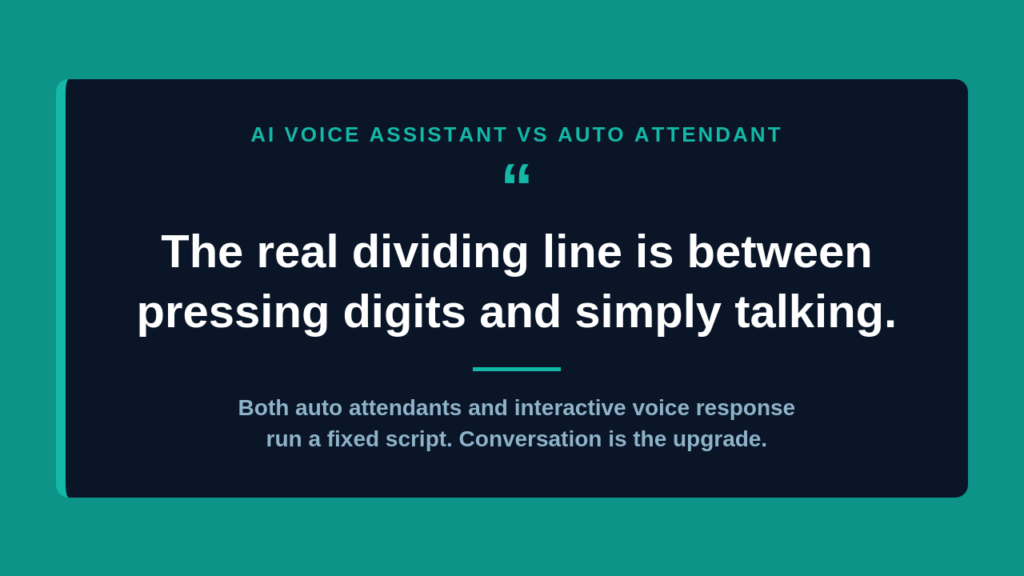
In practice, the two labels get used interchangeably, and most SMB deployments only ever needed the routing half. What matters for your pitch is that both sit on the same side of the line: keypad-driven systems running a fixed script. Comparing IVR vs auto attendant is a detail. The real dividing line is between pressing digits and simply talking.
What an AI Voice Assistant Adds
An AI voice assistant answers with an open question instead of a menu. It uses natural language understanding to identify intent, pull out details like names and dates, then either resolve the request or route it with context attached. Most implementations also handle appointment booking, FAQ responses, and lead qualification.
For the caller, the difference is that they simply say what they need. For your customer, a meaningful share of calls never reach a human at all, and the ones that do arrive pre-qualified. Some vendors market this technology as a virtual receptionist, which is a useful frame because it maps to a role your prospect already understands and pays for.
How Do the Call Flows Compare?
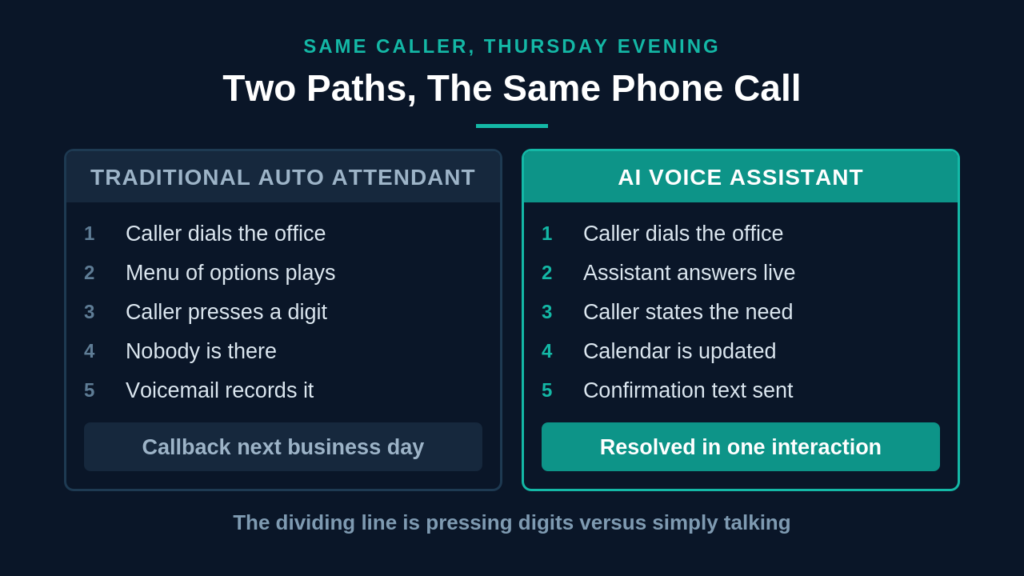
Abstract feature comparisons don’t close deals. Walking a prospect through what a specific caller experiences does. Here are the two paths for the same inbound call, a customer trying to move an appointment on a Thursday evening.
The Traditional Auto Attendant Path
Caller dials → Greeting plays → “Press 1 for sales, 2 for service,
3 for hours and location” → Caller presses 2 → Rings service queue
→ Office closed, no answer → Voicemail → Callback next business day
Four steps before the caller learns nothing will happen tonight. The appointment stays on the books, the schedule is now wrong, and somebody spends 15 minutes tomorrow playing phone tag. Nothing here is broken. It’s a system doing exactly what it was designed to do in 1995.
The AI Call Answering Path
Caller dials → Assistant answers → “How can I help you today?”
→ “I need to move my Thursday appointment to next week”
→ Intent identified, date extracted → Calendar checked and updated
→ SMS confirmation sent → Call summary logged for staff
Same call, resolved in one interaction at 8 p.m. with nobody on the clock. This scenario illustrates where AI call answering stops being a novelty and becomes a line item your customer can justify. The schedule is accurate before the office opens, and the front desk starts the day without a backlog.
Which One Should You Recommend?
Most resellers lose this deal by overselling. Not every customer needs conversational AI, and recommending it where a menu would do fine costs you credibility next time. Use the scenario as the qualifier, not company size.
| Customer scenario | Traditional auto attendant | AI voice assistant | Best fit |
| Under 30 calls a day, simple two-department routing | Handles it well | Overbuilt for the need | Auto attendant |
| Regular after-hours or weekend inbound calls | Voicemail only | Answers and resolves | AI voice assistant |
| Repetitive questions on hours, pricing, and services | Cannot answer or limited scripted answers | Answers directly | AI voice assistant |
| Appointment-driven business with no-show problems | No scheduling capability | Books and confirms | AI voice assistant |
| Seasonal or unpredictable call spikes | Callers queue or abandon | Unlimited concurrent calls | AI voice assistant |
| Highly regulated or emotionally sensitive calls | Routes to a human fast | Should escalate to a human | Auto attendant, or both |
| Complex multi-site, multi-department org chart | Strong at structured routing | Strong at intent detection | Both layered together |
That last row deserves attention in a discovery call. The layered approach keeps a short menu at the front and puts the AI voice assistant behind the busiest option. Your customer gets the upgrade without abandoning a flow their regulars have memorized, and you get a cleaner implementation with fewer edge cases.

5 Questions to Ask Before You Recommend Either Option
Running these five questions in a discovery call will tell you within minutes which side of the AI voice assistant vs auto attendant debate your prospect belongs on and roughly what the deal is worth.
- How many calls come in after hours, and what happens to them? If the honest answer is voicemail, ask what share gets returned within a day. That number is usually uncomfortable, and it’s your entire business case.
- What are the three questions the front desk answers most often? Hours, location, pricing, and availability dominate this list, and an AI voice assistant can close every one of them without a human.
- What does a missed call actually cost this business? A dental practice, a law firm, and a plumbing contractor all have wildly different answers. Get the number from them rather than supplying it yourself.
- Is anyone hired specifically to answer phones? If yes, you’re redeploying a person to more valuable work. If not, you’re selling coverage that doesn’t exist today, which is easier because nothing gets displaced.
- How often does the call flow need to change? Seasonal hours, rotating on-call staff, and frequent promotions all favor a system you can update conversationally instead of re-recording prompts.
Why the AI Voice Assistant vs Auto Attendant Question Is a Reseller Opportunity
As a reseller, how you source this capability matters more than the feature list.
The Margin Difference Between Native and Bolt-On
If you source AI call answering from a third-party vendor and staple it onto a phone system you resell separately, you’re stacking somebody else’s margin on top of yours, plus a second support relationship. When the caller experience breaks, your customer calls you, and you call someone else. That’s a bad Tuesday and a worse renewal conversation.
When native AI call handling is engineered into the platform you already sell, the math changes. Partner margins reach up to 70%, there’s one billing relationship, and no middleware sits between the PBX and the assistant. You also control packaging. Bundle it into a premium tier, sell it à la carte, or use it as the differentiator that wins a deal against a competitor still quoting seats and minutes.
Deployment Speed Decides Whether You Actually Sell It
A capability you can’t deploy quickly is one you’ll stop pitching after the second painful implementation. No-code, drag-and-drop agent builders matter for a practical reason: your existing technicians can set up a customer without hiring an AI engineer. Assigning the assistant a number or registering it as a PBX extension keeps deployment inside a workflow your team already runs.
Speed makes this opportunity a viable recurring revenue partner program addition rather than a one-off project. Committed partners can launch a full white-label voice practice in as little as 30 days, and AI slots in as an attached product rather than a separate business line. If you’re still evaluating platforms, start with how a white-label UCaaS platform works before worrying about AI features at all. The market backdrop supports the motion. Conversational AI is projected to grow from roughly $19 billion globally to more than $155 billion by 2035. Your customers are going to buy this technology from someone.
Which Verticals Should You Target First?
Not every SMB feels this pain equally. The three verticals below combine high inbound call volume with a measurable cost attached to every missed call, which keeps the ROI conversation short.
Healthcare practices live with chronic phone volume and no-show rates that hit the P&L directly. An assistant handling scheduling, reminders, and questions about insurance and prep instructions frees clinical staff for patient care. These practices also need HIPAA-compliant voice services, which narrows the field of competitors who can serve them.

Real estate brokerages lose leads to whoever calls back first, and agents are in showings all day. Instant response to listing inquiries at any hour, plus automated showing scheduling, is a speed-to-lead argument this audience understands without any education from you.
Retail and multi-location businesses face seasonal spikes that no staffing plan absorbs cleanly. An assistant scaling to unlimited concurrent calls during a holiday rush is a seasonal hire that never quits. When needs run deeper than call handling, how contact center features differ from UCaaS will help you scope correctly the first time.
The staffing pressure underneath all three is real. U.S. Chamber of Commerce data shows that 35% of small businesses plan to increase staff over the next year, down from 42% a year earlier, with inflation named the top challenge by 57%. Coverage without headcount is a message that lands right now.
Frequently Asked Questions
Does an AI voice assistant replace a receptionist? No, and you shouldn’t sell it that way. It absorbs repetitive, high-volume interactions, so staff handle the conversations that need judgment. Human escalation should always be available, and any deployment that removes that path generates complaints fast.
Can you run both a traditional auto attendant and an AI voice assistant on the same system? Yes, and it’s often the best configuration. A short menu handles the top-level split for callers who know where they’re going, and the AI voice assistant sits behind the busiest option. It’s also a lower-risk phase-one deployment.
What does an AI voice assistant cost compared to a traditional auto attendant? Auto attendants are typically included in a standard voice package. AI call answering is usually priced per minute, so the cost tracks with usage rather than seat count. That model works in your favor when packaging because you set the markup, and your cost of goods stays predictable.
What’s the difference between IVR vs auto attendants? An auto attendant greets callers and routes them to the right destination. Interactive voice response adds the ability to collect input and pull from backend data, such as an account balance or order status. The terms get used interchangeably in practice, and both are keypad-driven systems running a fixed script, which is what separates them from a conversational AI voice assistant.
Is a virtual receptionist the same thing as an AI voice assistant? The terms overlap. Virtual receptionist sometimes means a human answering service and sometimes an AI-powered one, so clarify which your prospect means before quoting. When it refers to software, it’s the same category of intent-driven call handling covered here.
Start the Conversation Before Someone Else Does
Comparing an AI voice assistant vs auto attendant isn’t a technology debate for your customers. It’s a question about how many opportunities walk away each week because nobody picked up. Lead with that, qualify honestly, and recommend the traditional auto attendant when it’s genuinely the right call. What you can’t afford is being absent from the conversation because your customers will have it with somebody.
SkySwitch gives partners native AI call handling engineered directly into the white-label platform, with the margins, no-code deployment, and single support relationship that make it a product you’ll actually want to sell. Get started with SkySwitch and add AI-powered communications to your lineup under your own brand.

Jessica is a marketing and sales strategist with deep expertise in VoIP telecommunications. As a Marketing Director, she specializes in channel marketing, account management, and product marketing within the communications industry. Jessica is passionate about helping partners grow through compelling messaging and hands-on support.