
VoIP Reseller Program Comparison: Pricing, Margins, Support

The VoIP reseller program you choose sets your margins, workload, and customers’ experience for years, so compare the whole program instead of the per-seat rate.
- Pricing goes deeper than the rate card. Onboarding fees, monthly minimums, porting charges, and telecom tax handling decide what you actually keep.
- Program structure changes your workload. Some programs leave billing, taxation, and regulatory filings to you, while others take that back office off your plate.
- Onboarding, support, and partner resources determine speed to revenue. Structured training, sales coaching, and clear escalation routes shorten the path to your first customer.
- Reliability and contract terms protect your brand. Geo-redundant networks, data portability, and fair exit terms matter most when something goes wrong.
Score two or three providers side by side with the checklist below, and pick the partner whose economics still work once you pass 500 seats.
Demand for cloud voice keeps climbing. The global VoIP services market is projected to more than double to roughly $340 billion over the next several years, and a big share of that growth flows through MSPs, VARs, interconnects, and IT providers who sell voice under their own brand. Those VoIP reseller opportunities only pay off, though, if you pick the right VoIP reseller program from the start.
Most providers pitch similar feature lists, so the real differences hide in pricing, back-office tools, support, and contract fine print. This guide skips the basics of how white-label reselling works (the White-Label VoIP Reseller Guide: How to Start and Scale covers that in depth) and focuses on how to evaluate VoIP reseller providers side by side. You’ll also get a practical checklist to bring to your next demo call.
What Should You Compare in a VoIP Reseller Program?
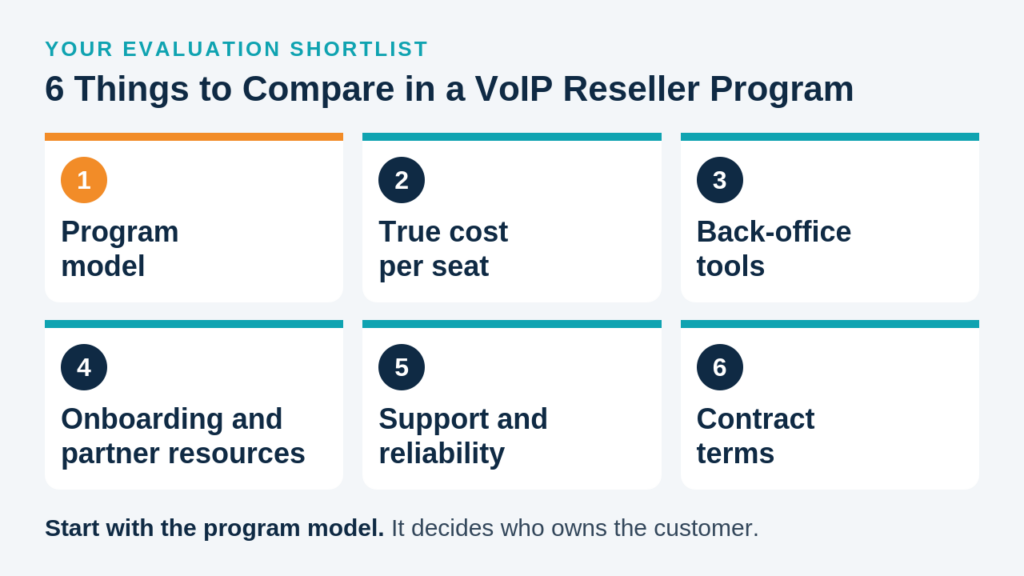
Compare six things: the program model, total cost, back-office tools, onboarding and partner resources, support and reliability, and contract terms. Start with the program model because it decides who owns the customer, who handles billing and compliance, and how much margin you keep.
Most VoIP reseller opportunities fall into one of three structures:
| Program model | Who owns the customer | Who bills and handles telecom tax | Your back-office workload | Margin potential |
| Agent or referral | The provider | The provider | Low | Lowest (commission only) |
| White-label wholesale | You | You, using the provider’s tools | Moderate to high | Highest |
| White-label with managed back office | You | The provider, under your brand | Low | High, with less admin |
Agent programs pay a commission and hand the relationship to the provider, which caps the long-term value of your book. Wholesale white-label programs give you pricing control and customer ownership, but invoicing, tax collection, and filings fall on you unless the provider’s tools carry the load. Some providers offer both options, so you can pick between a managed back office or a wholesale model. A two-tier partner program structure is a good example of how those responsibilities can be split.
Your business model should steer the choice. An MSP adding voice for existing IT clients usually benefits from a managed back office, while an interconnect migrating hundreds of seats off legacy systems may want the control of wholesale. A copier dealer bundling voice into a five-year equipment lease needs packaging and billing that match that contract term.
How Do Pricing and Margins Differ Between Providers?
Providers differ most in how wholesale rates are structured, which fees sit outside the rate card, and who handles telecom tax. Two programs with similar per-seat pricing can produce very different margins once you add those up.
Wholesale Rate Structures
Look for per-seat pricing with volume tiers that apply automatically as you grow. Per-seat pricing is the easiest structure to forecast, and most programs pair it with metered usage or bundled tiers. Ask whether volume discounts are built into the contract or require a renegotiation, since tiers that drop as you add endpoints reward growth without a sales conversation every quarter.
The Fees Behind the Rate Card
The fees that most affect your margin are onboarding fees, monthly minimums, number porting charges, device costs, and add-on licensing for contact center, business SMS, or fax. An upfront onboarding fee isn’t automatically a red flag. Providers that charge for onboarding often invest more in training and hands-on setup, and some rebate those fees once you reach volume milestones. One reseller who switched platforms said having non-recurring charges reimbursed after reaching 200 seats let them move right away instead of saving up first. The bigger warning sign is a “free” program that leaves you on your own after the contract is signed. For monthly minimums, ask when they kick in and whether there’s a ramp period while you build your base.

Taxes and Regulatory Pass-Throughs
Find out who calculates, collects, and remits telecom taxes. That answer can swing your margin more than the wholesale rate. The Tax Foundation’s annual wireless tax report shows taxes, fees, and government surcharges now make up 27.6% of the average wireless voice bill, ranging from under 17% in Idaho to over 38% in Illinois. VoIP carries its own mix of federal USF contributions, state telecom taxes, 911 fees, and local charges that shift from one jurisdiction to the next. If a program leaves tax calculation to you, budget for a third-party tax engine and the staff time to run it. Programs with an integrated taxation engine protect your margin and cut audit risk.
Which Platform and Operations Capabilities Matter Most?
Quote-to-cash automation, self-service provisioning, and integrated billing and compliance matter most because they decide whether you can add 200 seats without adding headcount. Confirm the customer-facing features after that.
Provisioning and Quote-to-Cash
A strong quote-to-cash workflow lets you build a quote from the product catalog, send it for acceptance, automatically create the customer account, and push everything to billing without rekeying data. Self-service provisioning for users, numbers, and devices matters too, especially when phones arrive auto-provisioned and ready to plug in.
An integrated equipment store with negotiated distributor pricing helps as well, letting you order, provision, and drop-ship phones in one workflow. Ask each provider to demo a new customer setup from quote to first invoice, since every manual handoff becomes labor you pay for. One reseller on a highly automated platform reported passing a thousand endpoints without hiring a single employee.
White-Label Branding Depth
Your brand should appear on every screen your customer sees, including admin portals, invoices, and support emails. Ask to see the customer portal and other applications with a sample logo applied. Any place the provider’s name shows through weakens the brand equity you’re building.
Billing and Compliance Support
Pick a program that calculates telecom tax for you and puts in writing which FCC filings it covers and which stay with you. Enforcement is tightening. Under recent FCC rules, submitting false or inaccurate Robocall Mitigation Database information carries a $10,000 base forfeiture per violation, missing the 10-business-day update window carries $1,000, and every filer must recertify by March 1 each year. Ask each reseller VoIP provider which filings they handle, which ones stay with you, and what help they offer with E911, CPNI certifications, 10DLC registration, and STIR/SHAKEN. For a full breakdown, read FCC Compliance for VoIP Providers: What Resellers Need to Know.
Features Your Customers Will Ask For
Prioritize features that are native to the platform and billed on one invoice. Customers expect mobile and desktop UC clients, auto attendants, call queues, call recording, business SMS, virtual fax, contact center, Teams and CRM integrations, and AI capabilities like transcription and call summaries. Ask which ones are built in and which rely on third-party add-ons that stack extra costs and support handoffs onto your account.
How Should You Evaluate Onboarding, Support, and Reliability?
Judge all three by asking for proof: a written onboarding schedule, documented support hours and escalation paths, and a clear explanation of network redundancy. These factors decide how fast you earn and how well you keep customers.
Onboarding and Time to Launch
With a committed partner and focused effort, you can start selling in as little as 30 days, while a full training program typically runs 9 to 12 weeks. Strong programs pair you with an onboarding specialist, give you a training roadmap for technical setup, billing, and sales, and help you configure your first customer. Compare each provider against a structured reseller onboarding process and ask for their week-by-week schedule. If you’re still mapping the bigger launch plan, How to Start a White-Label Communications Platform Business walks through the steps.
Support Tiers and Escalation
In most white-label programs, you handle Tier 1 support for your customers and the provider backs you with Tier 2 and Tier 3. Ask about support hours, after-hours emergency coverage, typical ticket response times, and whether you get a named account manager. A reseller VoIP provider should also proactively notify you of network events. Alerts and a status page let you warn customers before they call you.

Reliability and Network Design
Look for geo-redundant data centers with automated failover, so trouble at one site never takes your customers offline. Request details on redundancy, carrier diversity, and fraud monitoring. A financially stable parent company with deep telecom experience is also less likely to stall its roadmap.
What Partner Resources Should a Program Include?
Look for brandable marketing kits, sales coaching on your first customer calls, a searchable knowledge base, and access to a partner community. These resources carry the most weight in your first year, when you’re building a pipeline and learning the platform at the same time. Ask whether marketing assets can be edited with free design tools, whether a sales expert will join your first two or three prospect calls, and how many articles the knowledge base holds. Strong programs offer hundreds. Peer communities and partner events are underrated too because other resellers will tell you candidly what works.
What Contract Terms Should You Review Before Signing?
Focus on term length, minimums, volume tiers, customer ownership, portability, and price-change notice. The best VoIP reseller program contract protects your customer relationships even if the partnership ends:
- Term length and renewal: Check auto-renewal windows and required notice periods.
- Monthly minimums: Confirm when they start, how they ramp, and what happens if you fall short.
- Volume tiers: Make sure discounts automatically apply as your seat count grows.
- Customer ownership: Verify that you own customer contracts and data, and that the provider can’t sell directly to your customers.
- Portability: Learn how numbers and customer data move if you leave, and what that costs.
- Price changes: Find out how much notice you get before wholesale rates change.
VoIP Reseller Program Comparison Checklist
Bring these questions to every demo. Score each provider from 1 to 5 per question, and give pricing, support, and reliability the heaviest weight.
- Does the program model match how much back-office work you want to own?
- What is the true monthly cost per seat after fees, minimums, taxes, and volume discounts?
- What marketing kits, sales coaching, and partner community come with the program?
- Can you quote, provision, and bill a new customer without rekeying data?
- Is telecom taxation built in, and which compliance filings stay with you?
- How soon can you start selling, and who trains your technical and sales staff?
- What are the support hours, escalation paths, and typical response times?
- How is the network geo-redundant, and how are service events communicated?
- Which features are native to the platform, and which are third-party add-ons?
- Does your brand appear on every portal and invoice your customers see?
- Will current partners of similar size take a reference call with you?
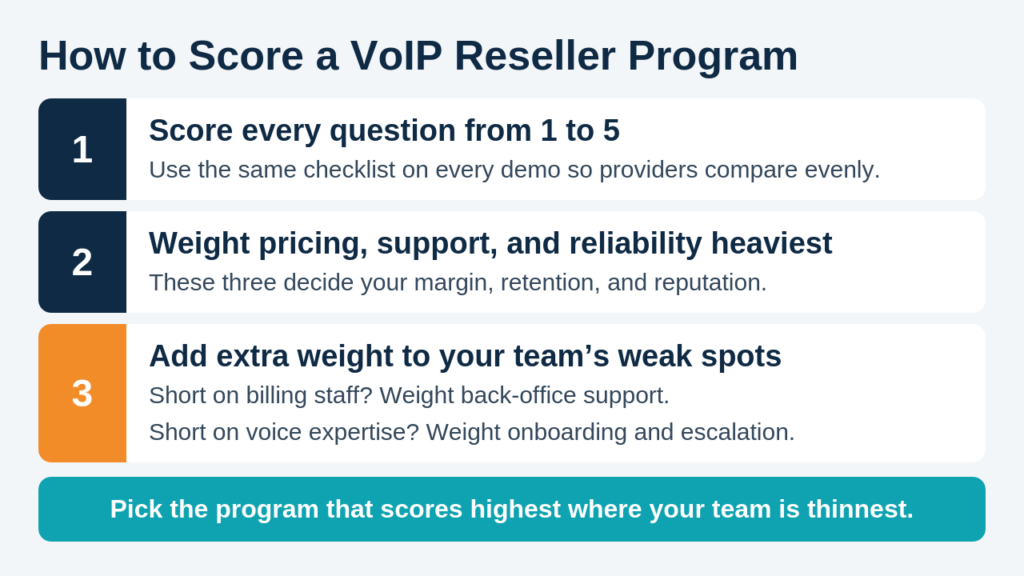
The best VoIP reseller program for your business is the one that scores highest where your team is thinnest. Short on billing staff? Weight back-office support. Short on voice expertise? Weight onboarding and escalation. A clear VoIP reseller program comparison makes those tradeoffs visible before you sign. When you’re ready to benchmark against a complete offering, review a full-service white-label reseller program alongside the others on your shortlist.
Frequently Asked Questions
How do I compare VoIP reseller program pricing fairly?
Build a cost model for the same scenario across every provider, such as 50 seats with business SMS and one contact center queue. Include wholesale rates, onboarding fees, minimums, porting, devices, and tax handling. A side-by-side VoIP reseller program comparison built this way shows your true margin instead of the advertised rate.
Is it hard to switch VoIP reseller providers?
Switching is manageable when the new provider supplies real migration support. Ask a new reseller VoIP provider whether they offer project management, bulk provisioning, and number porting help, then move accounts in phased batches to limit disruption.
What makes the best VoIP reseller program for MSPs?
The best VoIP reseller program for an MSP combines customer ownership, integrated billing and taxation, and strong Tier 2 and Tier 3 backup. That mix lets you add voice to existing IT contracts without hiring a telecom team.
How do white-label margins compare to agent commissions?
White-label programs usually deliver stronger recurring margins than agent programs because you set retail pricing and own the customer relationship, while agents earn a fixed commission. Your actual margin depends on how you package services, your volume tier, and how much back-office work you handle yourself.
How long does it take to see a return?
Resellers moving an existing customer base can be profitable almost immediately. Those starting from scratch typically need about six months to build steady recurring revenue.
Ready to Choose Your VoIP Reseller Provider?
VoIP reseller opportunities keep expanding, and the right VoIP reseller provider should make your business easier to run and more profitable as you grow. Use the checklist, push every provider for specifics, and hold them all to the same standard. SkySwitch gives partners a white-label UCaaS platform with quote-to-cash billing, geo-redundant networks, structured onboarding, and support built for resellers. Get started with SkySwitch to see how the program scores on your checklist.

Jessica is a marketing and sales strategist with deep expertise in VoIP telecommunications. As a Marketing Director, she specializes in channel marketing, account management, and product marketing within the communications industry. Jessica is passionate about helping partners grow through compelling messaging and hands-on support.