
Choosing a VoIP Reseller Provider: The Path to Success

The right VoIP reseller provider is the difference between a side hustle and a scalable, recurring revenue engine.
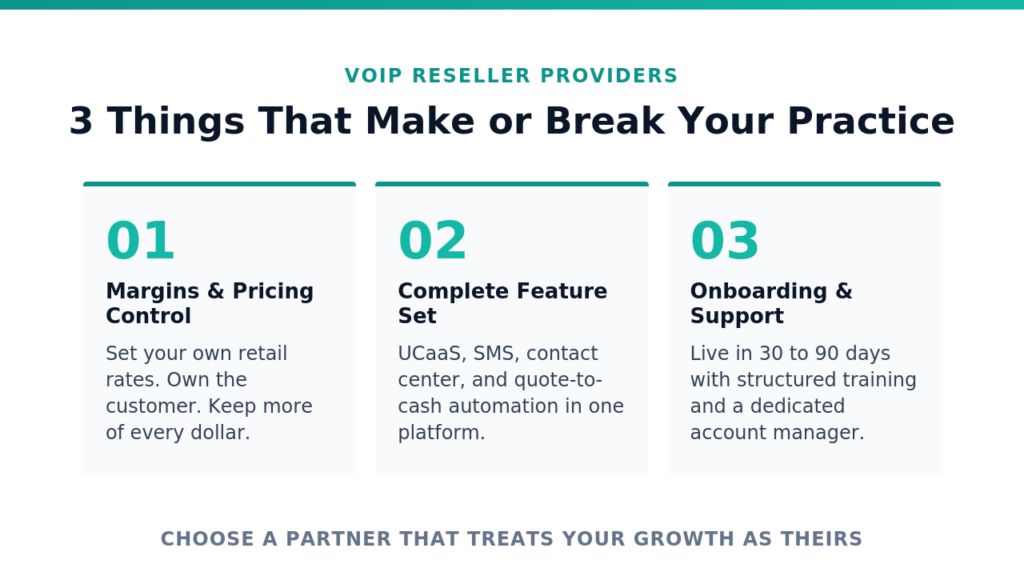
- Margins matter. White-label resellers commonly earn higher gross margins than traditional commission-based agent programs because they own their pricing and customer relationships.
- Features and pricing transparency separate true partners from middlemen. Look for per-seat pricing, automated billing, integrated tax compliance, and a complete UCaaS feature set.
- Onboarding and support determine how fast you start earning. The best programs get you live in 90 days or less with structured training, marketing kits, and dedicated account managers.
- Reliability is your reputation. Geo-redundant networks, real-time QoS monitoring, and proactive incident notifications protect your brand when things go sideways.
Vet two or three providers side by side, request a working demo, and prioritize the one that treats your growth as part of their growth.
Voice over Internet Protocol (VoIP) has become the default communication technology for modern businesses, creating a massive opportunity for resellers. According to Mordor Intelligence, the unified communications as a service market sits at $70.56 billion in 2026 and is projected to reach $221.14 billion by 2031 at a 25.67% CAGR, and VoIP is the foundational layer driving that growth. Hybrid work is fueling the demand. Robert Half data shows 88% of U.S. employers now offer hybrid options, which means your customers need cloud-based voice that works from anywhere.
For MSPs, VARs, system integrators, and IT consultants, VoIP reseller providers offer a way to plug into that demand without building a carrier from scratch. You add a high-margin recurring revenue line, deepen relationships with existing clients, and meet the communication needs your customers are already asking about. Not every VoIP reseller program is built the same, and the partner you choose shapes your margins, customer experience, and long-term growth.
This guide walks through how white-label reselling works, what to look for in a VoIP reseller program, the pricing and feature comparisons that actually matter, and the questions you should be asking before you sign anything.
What Does Reselling White-Label VoIP Services Mean?
Have you ever bought a store-brand item because it cost less than the name brand, only to find out it was the same product in different packaging? That is essentially how white-labeling works. It is the rebranding of an existing product or service with the consent of the original provider. White-label VoIP reselling means you enter an agreement with a platform provider to sell their voice and unified communications services under your own brand.
It’s the model that powers most modern SaaS distribution, and it works because it benefits everyone involved. You skip the infrastructure investment. The provider scales through a partner network. The end customer gets enterprise-grade communication from a trusted local partner.
Why Does the White-Label Model Work for Resellers?
A few benefits make this approach attractive for service-based businesses adding VoIP to their portfolio:
- Risk reduction. You sell a solution that already has proven reliability, customer adoption, and a development roadmap behind it.
- Brand strength. Every successful deployment builds your brand, not someone else’s. Customers come back to you.
- Faster time to market. Instead of building from zero, you customize a turnkey platform and start selling within weeks.
The demand for cloud-based voice has outpaced the supply of providers who can deliver it well. Resellers who move quickly capture the accounts before larger competitors notice.
How Can Becoming a VoIP Reseller Benefit Your Business?
If you already have a customer base, you have the foundation of a profitable VoIP practice. Your existing clients trust you with their technology, and most of them either already use VoIP or are actively looking to upgrade aging phone systems. The decision is rarely whether to add VoIP but rather who they buy it from.
Becoming a VoIP reseller positions you to be that source. Here is what it actually changes for your business.
A New Revenue Source With Attractive Profit Margins
Building a new product means storage costs, skilled labor, tooling, and ongoing maintenance overhead. Reselling white-label VoIP requires none of that. You leverage an existing platform and earn recurring monthly revenue every time a customer renews.
White-label margins on voice services are meaningfully higher than the commissions paid by traditional agent or referral programs. Because you set retail pricing and own the customer relationship, more of every dollar stays in your business. That is the core economic advantage of the white-label model and the reason MSPs and VARs increasingly prefer it over agent agreements.

Expanded Service Offerings Without Operational Drag
The fastest way to grow an established business is to expand what you sell to the customers you already have. Amazon started by selling physical books online. Today, it sells nearly everything, and most of its profit comes from cloud services. Diversification is what kept it relevant.
If you operate as an MSP, telecom interconnect, or IT services provider, adding VoIP and UCaaS to your portfolio is a natural extension. You become the single point of contact for your customer’s IT and communications stack, which strengthens your competitive position and improves retention.
Enhanced Growth With Limited Investment
Growing a VoIP practice doesn’t require a massive capital outlay when you partner with the right provider. The platform, training, billing infrastructure, and support are already built. Your job is to sell, onboard, and support customers.
For MSPs especially, you can extend your existing service model without requiring new specialized engineering hires. The provider handles the underlying network, security updates, and platform development. You focus on customer relationships and revenue growth.
How Do I Choose the Right VoIP Reseller Program?
Provider websites all sound the same, but the operational reality of running on each platform is different. Start by understanding what you actually need, then evaluate programs against those needs.
What Pricing Models Should You Compare?
Pricing transparency is the first filter. A good VoIP reseller program publishes clear wholesale costs and lets you set your own retail prices and packaging. Watch for these structures:
- Per-seat wholesale pricing. You pay a flat wholesale rate per user per month and mark it up however you want. This model is the most predictable and easiest to forecast.
- Usage-based pricing. You pay based on minutes, messages, or features consumed. This model works well for variable-usage customers but requires careful margin tracking.
- Hybrid models. A base subscription plus usage overages. Good for capturing additional revenue from heavy users without surprising lighter ones.
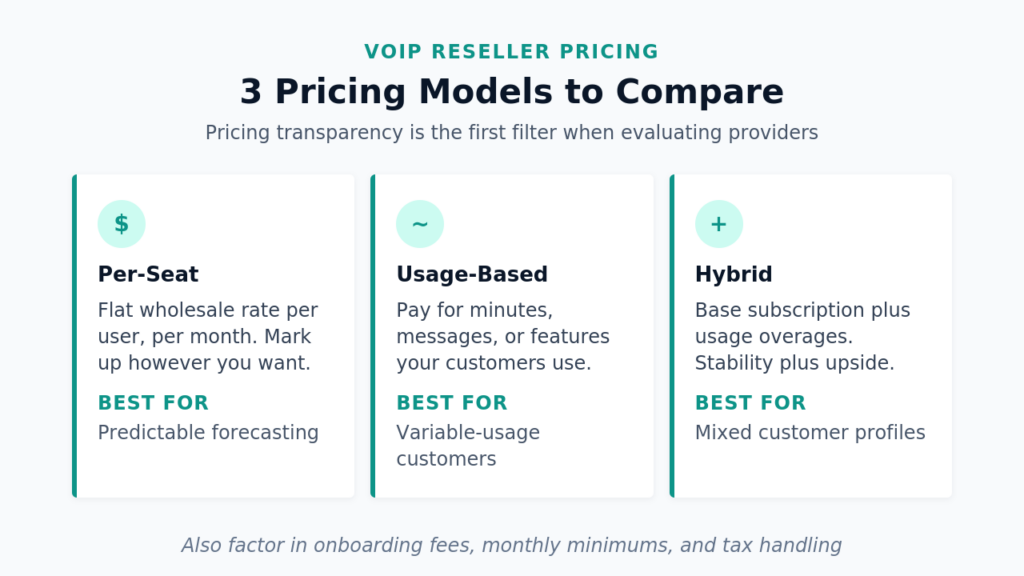
Also factor in onboarding fees, monthly minimum commitments, telecom tax handling, and porting charges. Some providers fold tax compliance into the platform. Others leave it to you, which means licensing a third-party tool on top of your wholesale costs.
What Features Should a VoIP Reseller Program Include?
A complete reseller platform should give you the features your customers expect from any modern phone system, plus the back-office tools you need to run a profitable practice. Here is a checklist worth evaluating against:
- Rapid deployment with comprehensive onboarding. Structured training and setup assistance get you live in weeks, not quarters.
- Low startup investment. Reasonable upfront fees with clear ROI, ideally with rebates as you hit volume milestones.
- Quote-to-cash automation. A unified workflow that quotes, contracts, provisions, and bills without manual reentry.
- Vast integration ecosystem. CRM connectors for Salesforce, HubSpot, Zoho, and others. The more native integrations, the stickier your offering.
- Established hardware buying power. Access to discounted desk phones, headsets, and gateways through the provider’s distributor relationships.
- Geo-redundant network reliability. Multiple data centers with active-active failover so that your customers never lose service when one node has an issue.
- Advanced calling features. Auto attendants, call recording, call queues, voicemail transcription, and SIP trunking included as core capabilities.
- Business SMS and MMS. Modern customer communication channels that resellers can monetize as add-ons.
- Mobile and desktop UC clients. Branded softphones so users can take their extension anywhere.
- Real-time QoS monitoring. Tools that detect latency, jitter, and packet loss before customers complain.
- Custom branding and white-label depth. Customer portals, mobile apps, billing systems, and admin interfaces fully branded as yours.
- Volume pricing tiers. Wholesale costs that decrease automatically as you scale.
A reliable VoIP reseller provider should offer all of these points as part of a comprehensive platform, not as à la carte add-ons that inflate your costs over time.

How Important Is the Quality of Provider Support?
Support quality is what you will care about most six months in. Sales pitches sound great in a demo. The real test is what happens when something breaks at 4 PM on a Friday and your customer is escalating.
Look for providers who answer the phone quickly, escalate intelligently, and proactively notify you when there is a network event. A solid VoIP reseller provider treats your support tickets the way you treat your customer’s. If they can’t show you average response times or named account management, keep looking.
Is Now the Right Time To Become a VoIP Reseller?
The market data points to yes, but the better question is whether your business is ready. Ask yourself the following:
- Do you want predictable recurring revenue? Subscription-based VoIP gives you a forecastable monthly income that traditional project work cannot.
- Do you want to expand without doubling your operational burden? A turnkey reseller platform handles the heavy lifting so you can grow margin without proportional headcount.
- Do you want to be the trusted communications partner for your customers? With the right provider, you become indispensable rather than transactional.
- Do you want a partner that grows with you? The best reseller programs offer both the technology and the structured onboarding, training, and dedicated support that turn good resellers into great ones.
If your answers align with where you want your business to go, the timing is right.
What Onboarding and Training Should You Expect?
Premier VoIP reseller providers deliver training that prepares you for ongoing success. It should start with a thorough onboarding process that pairs you with a dedicated specialist who walks you through every system you will use.
Quality partner training covers all aspects of the platform so you understand exactly what you are selling. Expect to learn:
- Training in billing services and automated billing system configuration
- Tier 1 customer support best practices and escalation paths
- A learning management system with self-paced video courses
- Comprehensive UCaaS platform configuration and administration
- Industry expertise on how to position VoIP against competitive products
Onboarding should not be a one-and-done event. The right partner provides ongoing support and continuing education throughout the life of the relationship. When new features ship, they prepare you to sell them. When the market shifts, they help you adjust. Your provider should give you an actionable training roadmap and a marketing roadmap with brandable assets so you can start generating leads from day one.
Frequently Asked Questions About VoIP Reseller Programs
What profit margins can I realistically expect as a VoIP reseller?
White-label VoIP resellers typically earn 50% to 70% gross margins, depending on how you package and price your services. That is significantly higher than commission-based agent programs because you own the customer relationship and set the retail price.
How long does it take to launch a VoIP reseller business?
Most resellers go live within 30 to 90 days when they partner with a provider that has structured onboarding. The exact timeline depends on your commitment to the training schedule and how quickly you migrate or acquire your first customers. Hosted VoIP resellers with existing customer bases typically reach profitability faster than those starting fresh.
Do I need telecom expertise to become a hosted VoIP reseller?
You don’t need to be a network engineer. Many successful resellers come from MSP, IT consulting, and copier dealer backgrounds and offer level 1 support to their customers. The right provider handles the carrier-grade infrastructure and complex compliance requirements while training you on the customer-facing aspects of selling and supporting VoIP.
What is the difference between white-label and private-label VoIP?
The terms are used interchangeably. Both refer to a model where you sell a provider’s underlying technology under your own brand. The customer interacts only with you, sees your logo, and pays your invoices. Your provider stays invisible.
Build Your Future With the Right VoIP Provider
You have built your business, client base, and brand the hard way. Now is the time to add the highest-margin recurring revenue stream available in the IT and telecom space. The VoIP reseller market is large, growing, and underserved by partners who treat resellers like true partners instead of resale channels.
SkySwitch makes it easy to launch a customizable program with a turnkey partner platform that gives you full control over pricing, branding, and customer relationships. We give you everything you need to build a profitable VoIP practice, from onboarding and billing to ongoing partner support. Get started today and take the next step in becoming a successful VoIP reseller.

Jessica is a marketing and sales strategist with deep expertise in VoIP telecommunications. As a Marketing Director, she specializes in channel marketing, account management, and product marketing within the communications industry. Jessica is passionate about helping partners grow through compelling messaging and hands-on support.