
Cloud and White-Label UCaaS: How MSPs Grow Revenue

Cloud and white-label UCaaS give MSPs and resellers a fast, low-risk path to branded communications and predictable recurring revenue.
- The UCaaS market is climbing toward $70 billion in 2026, and resellers are positioned to capture a slice of that growth as monthly recurring revenue.
- White-label means you own the brand and the customer relationship while a provider handles the infrastructure, security, and updates behind the scenes.
- The model fits how MSPs already work, layering voice, messaging, and collaboration onto the IT services your clients buy from you today.
- The right platform can have you selling in about 30 days, with margins reaching up to 70%, depending on how you package it.
If you’re an MSP or IT reseller looking for a sticky, high-margin revenue stream, cloud and white-label UCaaS is one of the clearest opportunities in the channel right now.
Business communication has moved decisively to the cloud, and the partners who help companies get there are building some of the steadiest recurring revenue in the channel. The unified communications as a service market is projected to reach $70 billion in 2026 and expand at a 25%-plus CAGR through 2031. That demand is showing up in your clients’ budgets, whether they’re replacing aging phone systems or equipping a hybrid workforce.
Cloud and white-label UCaaS lets you meet that demand without building a communications platform from scratch. You put your brand on a proven cloud solution, set your own pricing, and deliver enterprise-grade voice, video, messaging, and collaboration to the small and midsize businesses you already serve. For a UCaaS reseller, it’s a way to add a modern product line, deepen client relationships, and turn one-time projects into dependable monthly income. This guide walks through what the model is, where it fits for MSPs, how to evaluate a provider, and how it all adds up to recurring revenue.
What Is Cloud and White-Label UCaaS?
Before you can sell it, it helps to be clear on what cloud and white-label UCaaS actually means because the term bundles two ideas together. “Cloud” describes how the service is delivered, and “white-label” describes who gets the credit for it. Put them together, and you get a communications product you can brand as your own and deliver entirely over the internet.
Breaking Down the Cloud Side
Unified communications as a service consolidates voice calling, video conferencing, chat, SMS, presence, and file sharing into a single cloud-hosted platform. Instead of installing and maintaining on-premise PBX hardware at every client site, everything runs from the provider’s data centers and reaches users through apps on their desktops and phones. That shift removes overhead for your customers and eliminates the wiring, servers, and maintenance cycles that used to come with business phone systems. Updates and new features roll out automatically, so the platform stays current without anyone scheduling a truck roll.
Breaking Down the White-Label Side
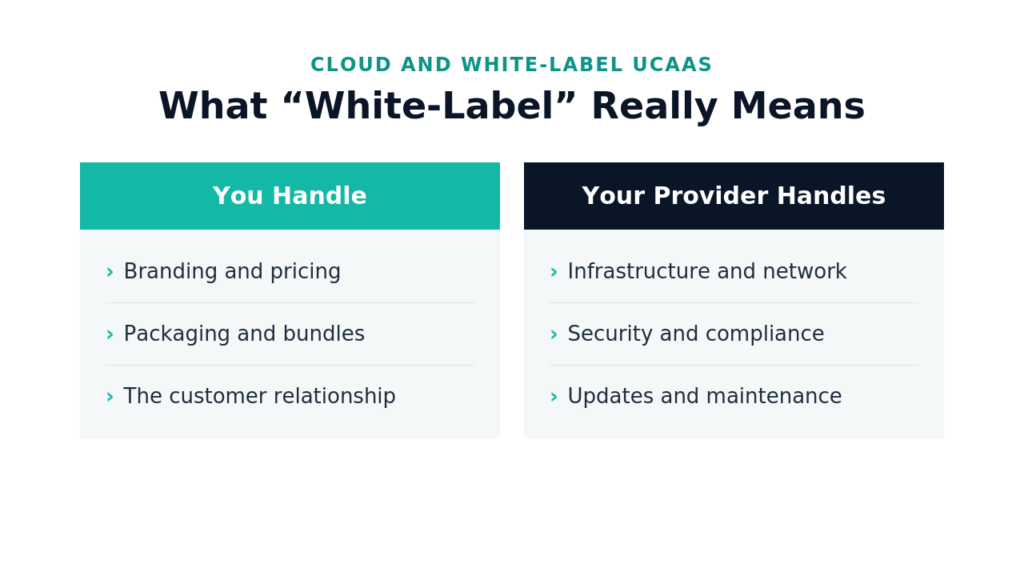
White-label is the part that turns a good product into a business of your own. With a white-label UCaaS arrangement, the provider supplies the technology, security, and back-end support, while you handle branding, pricing, packaging, and the customer relationship. Your clients see your logo, your portal, and your invoice, and they never need to know there’s a wholesale provider behind the scenes. That control lets you build real brand equity instead of reselling someone else’s name.
Why Are MSPs Adding White-Label UCaaS to Their Stack?
Managed service providers are under steady pressure to grow recurring revenue while keeping clients from shopping around. Communications is a natural answer because your customers already trust you with their IT, and they need modern voice, whether they ask for it directly or not. Adding white-label UCaaS turns that trust into a new, recurring line on every invoice.
Recurring Revenue You Can Count On
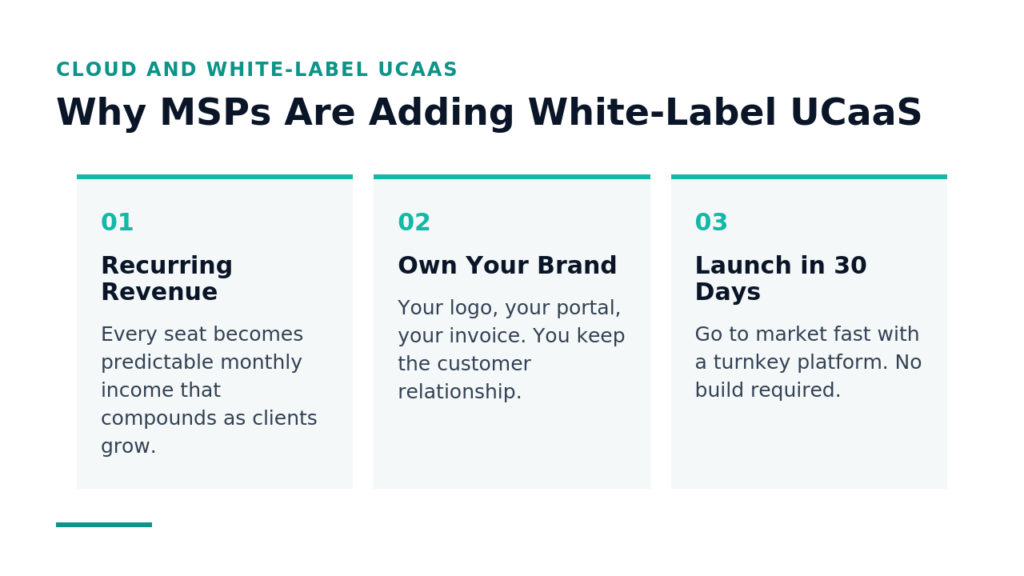
The channel is leaning hard into recurring models, and for good reason. Industry analysts expect managed services revenue to grow almost 9% in 2026, reaching roughly $460 billion globally, as buyers keep shifting toward subscription services. Unified communications fits that pattern perfectly. It’s a service clients pay for every month, it rarely gets cut, and it compounds as you add seats and features. When you’re growing voice revenue as an MSP, each new customer makes your business more valuable and more predictable.
Stronger Margins and Customer Ownership
Because you set the pricing, white-label UCaaS gives you direct control over your margins, which can reach up to 70% depending on how you bundle and package the solution. You decide whether to sell metered minutes, all-in-one seats, or tiered “good, better, best” packages that match each client’s budget. Just as important, you own the customer relationship end to end, from the quote to the invoice to support. That ownership protects you from the commoditization that eats into break-fix and hardware revenue.
A Faster Path to Market Than Building
Building your own communications platform would mean months of development, carrier relationships, compliance work, and ongoing engineering. White-label skips all of that. With a turnkey provider and a structured onboarding program, committed partners can launch a branded UCaaS practice in as little as 30 days and start selling into their existing base. Speed is how you capture demand now instead of watching clients buy voice from someone else while you build.
What MSP Use Cases Does a Cloud Communications Platform Unlock?
A cloud communications platform isn’t a single product so much as a toolkit you can shape to fit each client. Flexibility makes it a strong addition to your MSP communications services because the same platform serves a law office, a retail chain, and a field service company in completely different ways. Here’s where resellers are finding the most traction.
Supporting Hybrid and Mobile Teams
Most of your clients now run some flavor of hybrid work, and their phone systems have to keep up. Among remote-capable U.S. employees, roughly half work hybrid, and a sizable share are fully remote, which means a desk phone tied to a single location no longer cuts it. A cloud platform lets users take their business number anywhere, make and receive calls from a mobile or desktop app, send business SMS, and check voicemail without ever touching office hardware. For sales reps, field techs, and work-from-home staff, mobility keeps everyone reachable and productive.

Bundling Voice Into Existing IT Services
The easiest UCaaS sale is often to a client who already buys IT from you. When you fold voice into the services you provide, you become a true one-stop shop and remove a vendor your client would otherwise have to manage separately. A copier dealer can bundle voice into equipment leases, an IT shop can attach it to managed support agreements, and a security integrator can add it alongside network services. Each bundle raises switching costs and makes your MSP communications services harder to replace.
Powering Customer-Facing Teams
Beyond internal communication, the platform can run the customer-facing operations your clients depend on. Contact center features bring voice, SMS, chat, and email into one queue with skills-based routing, call recording, and auto attendants that send callers to the right place. Front-office businesses like medical practices and real estate firms can use the same tools to manage appointments and follow-ups. When you can meet your customers’ needs across both internal and external communication, you’ve got a far stickier offering.
How Do You Evaluate a White-Label UCaaS Provider?
Not every white-label platform is built the same, and the provider you choose becomes a permanent part of your brand. Since your customers will call you when something breaks, the quality and reliability behind the scenes matter as much as the features on the surface. Use this checklist to separate a true partner from a vendor that just resells access.
- Network reliability and redundancy. Your brand is on the line every time a client picks up the phone, so look for geo-redundant networks with automated failover across multiple data centers. Ask how the provider handles a node outage and whether calls keep flowing when one site goes down.
- Layered support you can lean on. You’ll handle Tier 1 support for your customers, but you want a provider that backs you with responsive Tier 2 and Tier 3 help when issues get technical. Some providers even offer optional branded support, which is valuable if you’re more of a sales and marketing shop than a voice expert.
- A real onboarding program. Reselling UCaaS involves provisioning, billing, and supporting a new product, so a structured onboarding program makes the difference between a fast launch and a stalled one. The strongest providers pair you with a dedicated specialist and a learning path that gets you selling quickly.
- Integrated billing and tax compliance. Telecom billing and tax are genuinely complicated, and getting them wrong is costly. A quote-to-cash system with built-in taxation and a reseller-friendly billing engine lets you quote, provision, and invoice without bolting together separate tools.
- Marketing and migration help. Look for brandable marketing assets that help you go to market faster, plus hands-on migration support if you’re moving customers from another platform. A structured reseller program that invests in your growth signals a provider that wins when you win.
How Does Cloud and White-Label UCaaS Build Recurring Revenue?
Everything comes together in the business model. Cloud and white-label UCaaS is a recurring revenue engine that grows in the background as your client base expands. Understanding how the money works helps you price with confidence and plan for scale.
Predictable Monthly Income That Compounds
Every seat you sell becomes monthly recurring revenue, and unlike project work, it keeps paying long after the sale closes. As clients add employees, open locations, or adopt new features like business SMS or contact center, your revenue per account climbs without a new acquisition cost. Over time, a book of recurring voice accounts becomes one of the most valuable assets on your balance sheet, both for cash flow and for the multiple it commands if you ever sell. A cloud communications platform you control is what makes that compounding possible.

Packaging That Protects Your Margins
How you package the solution determines how much of that revenue you keep. Many resellers build tiered bundles that map to customer size and needs, which simplifies the sale and nudges clients toward higher-value plans. Because you own pricing, you’re free to attach add-ons like SD-WAN, virtual fax, or Microsoft Teams integration that raise both value and margin.
Frequently Asked Questions About White-Label UCaaS
Still weighing the opportunity? Here are quick answers to the questions resellers ask most.
What’s the difference between cloud UCaaS and white-label UCaaS?
Cloud UCaaS describes the delivery model where communication tools live in the cloud rather than on on-site hardware. White-label adds the branding layer, letting you sell that cloud service under your own name. Cloud and white-label UCaaS combine both, so you deliver a modern platform and get all the brand credit.
How quickly can I start selling?
With a turnkey provider and a focused onboarding program, committed partners can launch in about 30 days. The full training path may run longer as you master provisioning and billing, but you don’t have to wait to start signing customers.
Do I need telecom experience to become a UCaaS reseller?
No. Plenty of successful resellers come from IT, managed services, or office equipment backgrounds with no prior voice experience. A strong provider supplies the training, support, and tools you need to launch as a UCaaS reseller and grow from there.
What features should a white-label platform include?
At a minimum, look for voice calling, mobile and desktop apps, business SMS, video meetings, auto attendants, and call recording, with add-ons like contact center, SD-WAN, and virtual fax. Compliance coverage, such as 10DLC, STIR/SHAKEN, and HIPAA-ready options, matters too, especially for regulated clients.
Build a Communications Practice That Carries Your Brand
Cloud and white-label UCaaS gives MSPs and resellers a rare combination: strong market demand, recurring revenue, healthy margins, and a product that makes you stickier with every client you serve. The model lets you deliver enterprise-grade communications under your own brand without taking on the cost and complexity of building a platform yourself. Choose a provider with a reliable, geo-redundant network, real support, and a billing engine built for resellers, and you’ve got the foundation for a communications practice that grows for years.
That’s exactly what SkySwitch was built to deliver, with a white-label UCaaS platform, hands-on onboarding, and long-term partner support designed for resellers. Get started today to build your branded communications business and start earning recurring revenue.

Jessica is a marketing and sales strategist with deep expertise in VoIP telecommunications. As a Marketing Director, she specializes in channel marketing, account management, and product marketing within the communications industry. Jessica is passionate about helping partners grow through compelling messaging and hands-on support.