
White-Label Network Assessment Tools for UCaaS Resellers

A network assessment tool is the cheapest insurance a UCaaS reseller can buy because the client’s network is the one part of your deployment you don’t control.
- Most “the phone system is broken” tickets are network problems. Jitter, packet loss, and SIP ALG interference mimic platform failures exactly.
- A speed test is not a VoIP network assessment. Raw bandwidth says almost nothing about whether a connection can carry 12 simultaneous calls cleanly.
- Assessment belongs in your sales process, not only your install checklist. Testing before you quote lets you size the deployment and price remediation as billable work.
- White-label assessment tools build credibility. A branded readiness report positions you as the network expert rather than the reseller hoping for the best.
Run the assessment before you write the proposal, not after the phones arrive.
Every reseller has a story about the deployment that went sideways. The platform provisioned fine, the handsets shipped on time, and then week two brought choppy audio, one-way calls, and a client who wanted to talk about the contract. Nine times out of ten, the phone system worked exactly as designed. The network underneath it didn’t.
That gap is what a network assessment tool exists to close. Before a single device ships, it tells you whether a client’s connection can actually carry the calls you’re proposing to sell them. The stakes keep climbing too. Uptime Institute’s 2026 outage analysis found that more than half of surveyed organizations said their most recent major outage cost over $100,000, and that failures tied to fiber and connectivity are becoming more prominent and more likely to cause extended disruptions.
When voice moves to the cloud, your client’s internet connection becomes part of your product. Building a profitable white-label UCaaS practice means owning that before the first invoice goes out.
What Is a Network Assessment Tool, and Why Does UCaaS Readiness Depend on It?
A network assessment tool is a diagnostic application that runs from inside a client’s network and simulates real voice traffic across their connection. Rather than measuring how fast a file downloads, it generates synthetic call flows and measures how cleanly they survive the round trip.
UCaaS readiness is a different question from general internet performance. A law firm can stream video all day and still deliver terrible call quality because voice is uniquely sensitive to timing. Data traffic tolerates a delayed packet. A conversation does not.
What a Network Assessment Tool Actually Measures
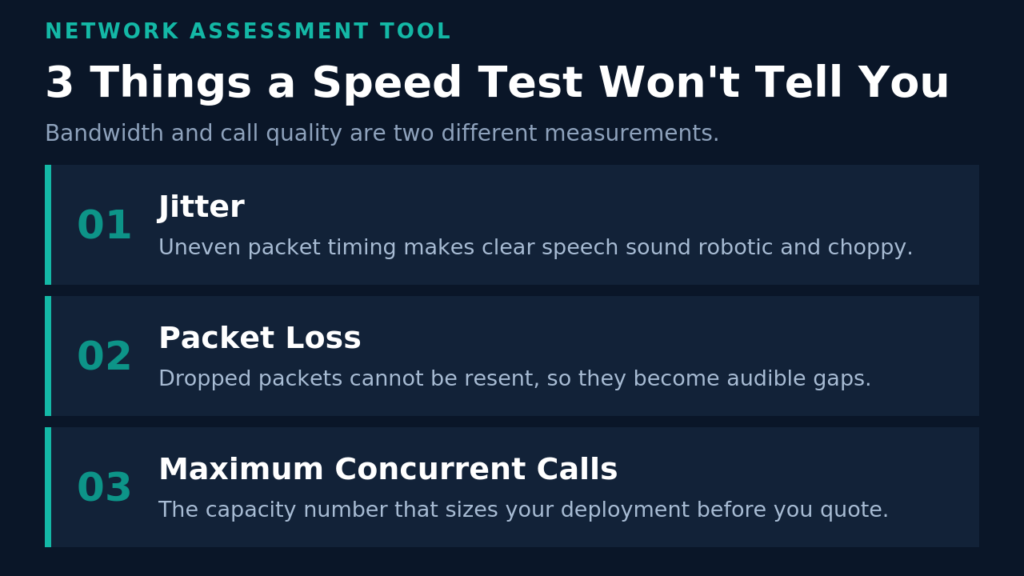
A proper assessment simulates concurrent calls using a specific codec, then measures upstream and downstream jitter, packet loss, round-trip latency, and the maximum number of simultaneous calls a connection sustains before quality degrades. Good tools also detect SIP ALG, a firewall feature meant to help voice traffic that instead breaks it with alarming regularity. Better ones add a route test, tracing the path to the platform to surface a bad hop at the ISP level.
Why a Speed Test Isn’t a VoIP Network Assessment
Speed tests measure peak throughput under ideal conditions, which is useful for file transfers and useless for predicting call quality. A connection advertising 300 Mbps can still deliver unusable voice if jitter is high or the upstream is congested during business hours.
Voice barely uses bandwidth, which is why “we have fast internet” is never an answer to the readiness question. What voice needs is consistency, which is exactly what a speed test can’t see. It’s also why a VoIP network assessment should run more than once, since a test at 7 a.m. only tells you about an empty office.
What Happens When You Skip the VoIP Network Assessment?
Skipping assessment doesn’t save time. It moves the time from a controlled 30-minute test into an uncontrolled troubleshooting cycle, and moves the cost from your sales process into your support queue. The migration wave making this urgent isn’t slowing down either. Metrigy’s Workplace Collaboration MetriCast reported that the on-premises PBX and UC market shrank 4.6% in 2025, with a steeper decline forecast for 2026. Those seats are going somewhere, and each one lands on a network someone has to qualify.
The Support Ticket Spiral
When quality problems surface after go-live, you’re diagnosing blind. Your client reports “the phones are bad,” which could mean a failing router or a neighbor saturating a shared circuit, and without a baseline, you can’t prove the network was ever healthy. Every hour spent there is unbillable because the client believes they paid for a working phone system. For a small MSP, three or four bad deployments can consume the margin from a dozen good ones.
The Trust You Can’t Rebuild
Phone systems are the most visible technology in a small business. When email is slow, people grumble; when calls drop, customers hang up, and everyone knows by lunchtime. A reseller who catches a bandwidth problem before install earns real authority, while the one who finds it afterward looks like they sold something broken. Your brand is on that phone system, which is why an MSP network assessment belongs in your standard operating procedure, not your emergency toolkit.

What Should Every MSP Network Assessment Measure?
Not every tool reports the same things, and the gaps matter. If you’re evaluating options or building a checklist for your technicians, these are the six measurements that determine whether a site is ready.
- Latency. The long-standing industry benchmark, set by ITU-T Recommendation G.114, is to keep one-way mouth-to-ear delay under 150 milliseconds, the point below which interactivity stays essentially transparent to the caller. The same standard treats 400 ms as the outer planning limit, and anything near that ceiling produces the awkward talk-over that makes conversations exhausting.
- Jitter. Variation in packet arrival timing. Packets that arrive out of rhythm get buffered or discarded, producing the robotic, stuttering audio clients describe as “breaking up.”
- Packet loss. Missing packets can’t be retransmitted in a real-time call, so they become gaps in the audio. Even a low single-digit loss is audible, and a loss that fluctuates through the day points to congestion rather than a broken circuit.
- Maximum concurrent calls. The number that sizes the deployment. A connection that handles four clean calls and falls apart at nine tells you exactly which sites need an upgrade before you quote seats.
- SIP ALG detection. Firewall features that inspect and rewrite SIP traffic cause registration failures, one-way audio, and dropped calls. Catching this before install saves a support cycle nearly every time.
- Route quality. Tracing the path from client site to platform shows whether a problem sits inside the building or out at the carrier, which determines who fixes it.
How Do You Build Voice Quality Testing Into Your Deployment Process?
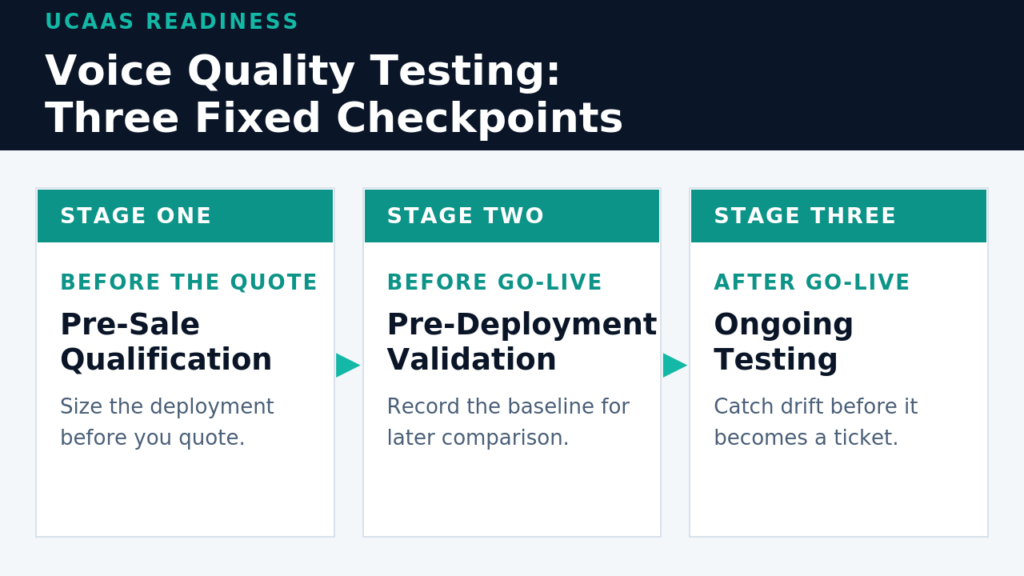
The resellers who get the most from assessment aren’t testing occasionally. They’ve built voice quality testing into three fixed points in the customer lifecycle, so it happens automatically rather than when someone remembers. Strong partner onboarding programs establish that habit during technician training, before bad habits set in. Once you’ve tested 50 sites, you also start recognizing patterns by ISP and region, which becomes a real advantage locally.
Stage One: Pre-Sale Qualification
Run the assessment during discovery, before you build the proposal. You’ll size the deployment accurately, spot the sites needing remediation, and price that work as a line item instead of absorbing it later. A readiness report also signals technical homework that the competing quote almost certainly skipped. If a result comes back marginal, you have options rather than surprises: a circuit upgrade, SD-WAN, a phased rollout, or a codec change.
Stage Two: Pre-Deployment Validation
Test again immediately before go-live, since circuits get reconfigured and firewalls updated between discovery and install day. This second test becomes your baseline, so when complaints surface in month three, you can compare against a documented healthy starting point. Sharing a short readiness summary with the client beforehand sets expectations and gives you something concrete to point back to.
Stage Three: Ongoing Voice Quality Testing
Networks drift. A client adds 30 employees, installs a cloud backup that saturates the upstream nightly, or switches ISPs without telling you, and periodic testing catches those changes before they become tickets. Reactive testing matters just as much: an assessment run during an active complaint turns vague frustration into specific data in about 10 minutes.
Which Network Optimization Best Practices Improve UCaaS Readiness?
Assessment tells you where you stand. Optimization is what you do about it, and a handful of adjustments resolve most marginal results without a new circuit. Start with Quality of Service on the client’s router, prioritizing voice above everything else, then work through the environmental factors that cause more problems than most technicians expect:
- Disable SIP ALG on the firewall, the highest-yield fix in cloud voice deployments.
- Move critical users to wired connections, since Wi-Fi adds variability that no amount of bandwidth compensates for.
- Segment voice onto its own VLAN to insulate calls from bandwidth-heavy applications.
- Verify upstream capacity specifically because asymmetric connections often have less upload headroom than marketing suggests.
- Confirm required SIP and media ports are open before install day, not during it.
Where a site needs real resilience, SD-WAN with cellular failover keeps voice running through a circuit outage and gives you a natural upsell alongside the UCaaS features you’re already reselling. Strong UCaaS readiness is usually a configuration outcome, not a bandwidth purchase.
How Does a Network Assessment Tool Become a Revenue Driver?
The obvious value of assessment is avoided cost. The more interesting value is what it lets you charge for, since a network assessment tool surfaces problems with real solutions, and those solutions are billable services. Branding compounds that. A network assessment tool you can white-label with your own logo and domain keeps the whole experience inside your brand. The client runs a test on your portal, receives your report, and buys your remediation, with no third-party name anywhere in the workflow. The stronger white-label partner programs bundle that tooling in rather than metering it as a paid add-on.
The market backdrop supports the investment. IMARC Group valued the global UCaaS market at $90.3 billion in 2025, projecting a 17.12% CAGR through 2034. That’s a lot of deployments landing on untested networks, and choosing the right white-label platform partner determines whether tools like this come standard or become another vendor bill.
Frequently Asked Questions
How long does a network assessment take to run?
Most browser-based tools finish in three to five minutes, covering route, capacity, and simulated call tests. The real time investment is coordinating client access, not the test itself.
Do I need to install software on the client’s network?
Many tools run from a browser with a small plugin or utility download and no permanent installation. That’s what makes them practical for pre-sale qualification, when your access is limited.
What internet speed does a client actually need for VoIP?
Less than most people assume. A single call uses a small fraction of a modern connection, so the real constraints are jitter, packet loss, and upstream capacity at peak hours rather than headline speed.
Should I test every site or only the ones I’m worried about?
Test every site. The deployments that fail are rarely the ones you’d flag in advance, and five minutes per location costs far less than one bad install.
Can a network assessment tool help with troubleshooting after go-live?
Yes, and this is where many resellers find the most day-to-day value. A test run from the client network during an active complaint tells you in minutes whether the problem sits inside the building or upstream at the carrier.
Make Network Assessment Standard Practice
The resellers who scale cleanly aren’t the ones with the best troubleshooting skills. They’re the ones who removed the need for troubleshooting by qualifying every site before they sold it. A network assessment tool changes the economics of every deployment, converting unpredictable support costs into a predictable, billable scope. If you’re building a branded voice practice, look for a platform partner that treats these tools as standard equipment rather than a line item.
SkySwitch gives white-label partners a brandable network assessment tool alongside a geo-redundant platform, QoS monitoring, and the training to put both to work under your own brand. Get started with SkySwitch and launch your branded UCaaS offering in as little as 30 days.

Jessica is a marketing and sales strategist with deep expertise in VoIP telecommunications. As a Marketing Director, she specializes in channel marketing, account management, and product marketing within the communications industry. Jessica is passionate about helping partners grow through compelling messaging and hands-on support.