
Best Contact Center Solutions: CCaaS vs VoIP vs UCaaS

The best contact center solutions for your clients usually come down to choosing the right layer of the cloud communications stack rather than simply picking a brand.
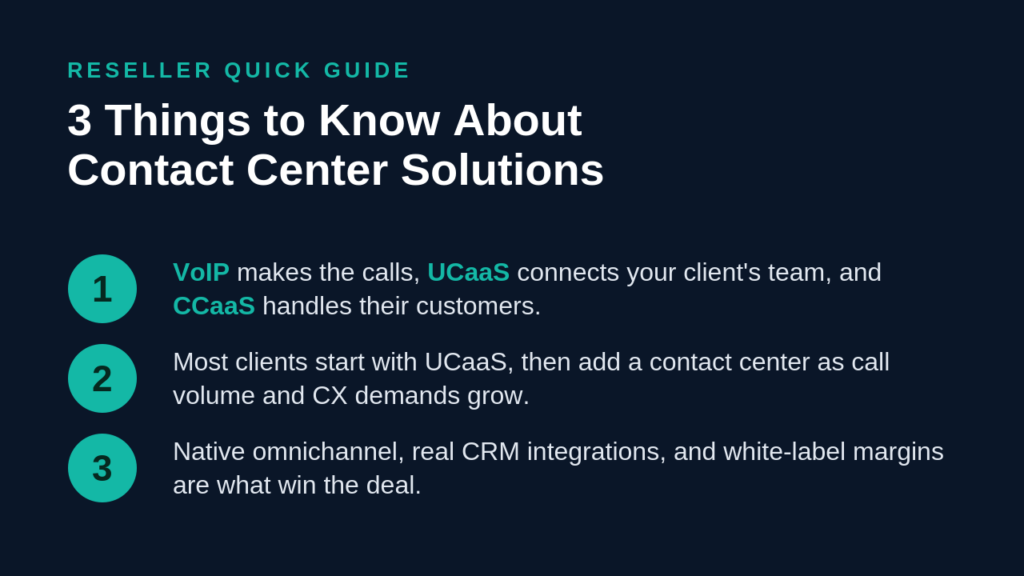
- VoIP is the calling technology underneath everything, UCaaS unifies internal team communication, and CCaaS is purpose-built for customer-facing teams.
- Most small and midsize clients start with UCaaS and add contact center capabilities as call volume and customer-experience demands grow.
- For resellers, the real differentiators are native omnichannel, deep CRM integrations, white-label branding, and the margins your platform lets you keep.
- Picking a provider that owns and engineers its platform, rather than passively reselling someone else’s, protects both your brand and your uptime.
Lead with your client’s customer-experience goals, then match them to VoIP, UCaaS, or a full CCaaS layer, so you sell the right solution instead of the most expensive one.
If you’re trying to sort out the best contact center solutions to resell, the confusion almost always traces back to three acronyms used interchangeably: VoIP, UCaaS, and CCaaS. They’re related and overlap, but they’re not the same thing. Getting the distinction right lets you recommend the correct communications solution to each client, delivered through the white-label platform you partner with.
The global contact center as a service market was worth $6.8 billion in 2025 and is projected to reach $32.7 billion by 2033, growing more than 22% a year. That momentum means your clients will ask about contact center software whether you bring it up or not, and you want to be the one who explains it clearly.
This guide breaks down CCaaS vs VoIP vs UCaaS in plain terms and points to the features and partner traits that separate the best contact center solutions from the ones that create support headaches later.
Why Do the Best Contact Center Solutions Start With VoIP, UCaaS, and CCaaS?
Before you can recommend the best contact center solutions, you and your client need to speak the same language. These three terms describe different layers of the same cloud stack, and each solves a different problem. Here’s how they break down.
What Is VoIP?
Voice over Internet Protocol (VoIP) is the foundation. It carries calls over the internet instead of legacy copper lines and on-premise PBX hardware, which makes cloud calling cheaper and more flexible than a traditional phone system. It’s also the calling engine sitting underneath both UCaaS and CCaaS. On its own, VoIP handles voice well but doesn’t bundle the collaboration or customer-service tools modern businesses expect.
What Is UCaaS?
Unified Communications as a Service (UCaaS) wraps VoIP calling together with video meetings, team chat, SMS, presence, and file sharing in one cloud platform. The job of UCaaS is internal: it helps your client’s employees communicate and collaborate, whether they’re in the office, at home, or remote. Demand is climbing fast, with the UCaaS market projected to grow from about $70.56 billion in 2026 to $221 billion by 2031, a clip above 25% a year. If you want a deeper breakdown, our guide to what a UCaaS platform includes walks through the full feature set.
What Is CCaaS?
Contact Center as a Service (CCaaS) is purpose-built for customer-facing teams. Where UCaaS is about how employees talk to each other, CCaaS is about how they serve customers at volume across voice, SMS, web chat, email, and social channels. It adds the tools agents and supervisors need, including skills-based routing, queue management, auto attendants, call recording, coaching, and real-time dashboards. A true contact center platform delivers omnichannel natively, so an agent can see a customer’s full history no matter which channel they came in on.
CCaaS vs VoIP vs UCaaS: How Do They Compare?
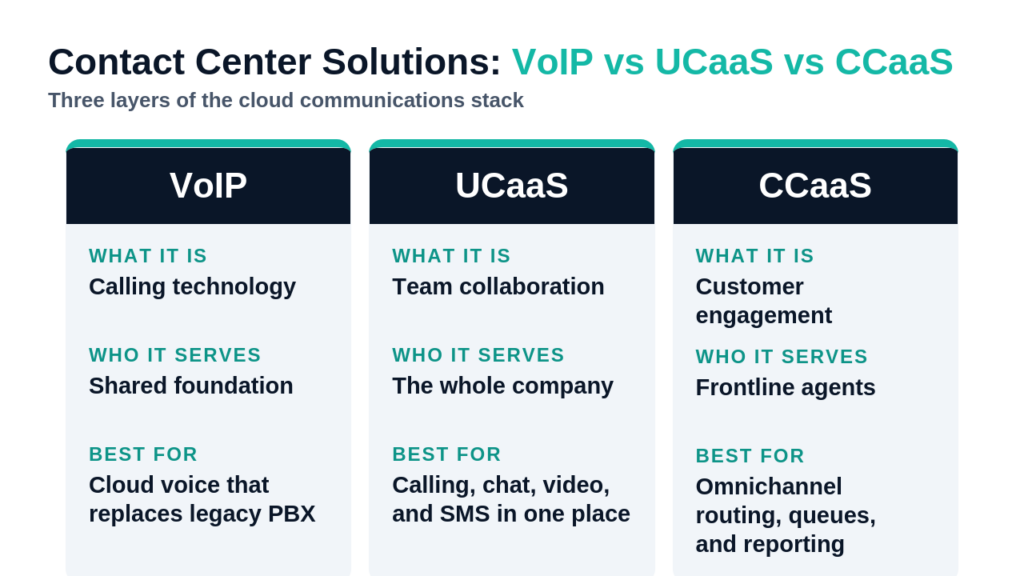
The easiest way to keep these straight is to remember what each is for: VoIP is the calling technology, UCaaS is for internal collaboration, and CCaaS is for customer engagement. They share the same VoIP backbone and many of the same cloud benefits, which is why they get muddled.

Where They Overlap
All three are cloud-delivered, subscription-based, and built to replace expensive on-premise hardware. They scale on demand, they’re managed through a web portal, and they all lean on VoIP for voice. Both UCaaS and CCaaS integrate with CRMs and other business apps, and both let your clients pay for what they use instead of sinking capital into equipment. For resellers, that shared foundation is good news: one platform relationship can cover multiple layers of the stack.
Where They Differ
The difference is scope and audience. UCaaS serves the whole company, while CCaaS serves the agents and supervisors handling high interaction volume. A contact center layer adds specialized capabilities like skills-based routing, callback-in-queue, post-call surveys, and workforce management that general UCaaS tools usually lack, and seats often cost more because of them.
One technical distinction is worth getting right: omnichannel routing across voice and chat is a native contact center function, not something you bolt on through an API. APIs are bridges to outside tools like CRMs and databases; they don’t store customer context or replace a true contact center engine.
That line is blurring, though. Many platforms now offer integrated UCaaS and CCaaS from a single provider on one bill, so internal staff and customer-facing agents work from connected systems instead of siloed apps. It spares your client a second vendor and a separate setup, which makes it one of the cleaner upgrades you can offer as they grow.
Which Contact Center Software Features Should Resellers Prioritize?
Once a client decides they need contact center software, your job is steering them toward the capabilities that move the needle on customer experience, not a bloated feature list they’ll never touch. These features consistently define the best contact center solutions worth reselling.
- Native omnichannel, not bolted-on channels. The platform should handle voice, SMS, web chat, email, and social from one agent interface, with full interaction history following the customer across channels. When channels are stitched together after the fact, agents lose context and customers repeat themselves.
- Smart routing and queue management. Skills-based and language-based routing, auto attendants, callback-in-queue, and custom routing rules keep customers from bouncing around or waiting on hold. This is the difference between a real contact center and a glorified phone tree.
- Deep CRM integrations. Tight connections to CRMs like Salesforce, HubSpot, Zoho, and Shopify let agents see who’s calling and why before they pick up. Screen pops and click-to-call shave handle time and personalize every interaction. The CRM stores the customer context; the integration surfaces it at the right moment.
- Quality assurance and coaching tools. Call recording, silent monitoring, post-call surveys, and AI transcription and summarization give supervisors the visibility to coach agents and prove value to the client. AI features are increasingly built into modern platforms, so look for them as standard rather than a premium add-on.
- Reporting and real-time dashboards. Standardized and customizable reports, plus live agent and queue dashboards, let your clients optimize staffing and response times. Data is what turns a contact center from a cost center into a growth engine.
- White-label branding and self-service provisioning. This one’s for you. The platform should let you brand everything as your own and provision new seats and features in minutes, so you control both the customer relationship and your margins.
If you want to go a level deeper on the underlying platform capabilities, our breakdown of core UCaaS features to evaluate is a useful companion to this list.

How Should Resellers Evaluate CCaaS Providers?
Choosing among CCaaS providers isn’t only about features. As a reseller, you’re putting your brand on someone else’s technology, so the platform behind the logo matters as much as the logo. A few traits separate the CCaaS providers worth building a business on from the ones that will leave you exposed.
Reliability and Platform Ownership
Look for providers that run geo-redundant infrastructure with automatic failover, so a problem at one data center doesn’t take your clients offline. Just as important is whether the provider actually owns and engineers its platform. The strongest players build proprietary automation, routing, and management tools on top of a proven core switch instead of passively reselling stock technology. That investment lets you scale without spending your week firefighting.
White-Label Depth and Margins
Your profitability depends on how much room the platform gives you. The best contact center solutions for resellers are fully brandable and let you set your own pricing and packages, with the potential to earn up to 70% margins depending on how you bundle. Be wary of providers that own the end-customer relationship for you or send you SPIFs instead of letting you invoice clients directly. You want to control the account, not rent it.
Speed to Launch and Support
Time to revenue matters. With the right partner and real commitment, you can launch a white-label contact center practice in as little as 30 days, then keep building. Equally critical is the support behind you. Confirm there’s Tier 2 and Tier 3 backing, compliance help for things like 10DLC, STIR/SHAKEN, and FCC obligations such as Form 499-A and USF contributions, plus onboarding that gets you selling. If you’re earlier in the journey, our guide to building a reselling business covers the fundamentals.
Frequently Asked Questions About Contact Center Solutions
Is CCaaS the same as contact center software?
Essentially yes, with a cloud twist. CCaaS is contact center software delivered as a cloud subscription instead of on-premise hardware. Your clients get the routing, omnichannel, and reporting tools of a traditional contact center without the upfront equipment cost, and you provision and manage it all remotely.
Do my clients need UCaaS, CCaaS, or both?
It depends on their priorities. Clients focused on internal collaboration usually start with UCaaS, while those with support or sales teams handling high volume need CCaaS. A contact center isn’t only for big call centers either. Medical offices, law firms, and other small front-office teams benefit too, especially when the software is feature-rich without enterprise-tier pricing. Plenty land on both, and walking them through adding a contact center to an existing UCaaS setup is one of the easier upsells you’ll make.
Can I resell the best contact center solutions under my own brand?
Yes. With a true white-label platform, your customers never have to know there’s a provider behind the curtain. You brand the portals, set pricing, own the billing relationship, and keep the margin. That’s the core appeal of reselling contact center software rather than someone else’s brand.
How do CCaaS providers handle omnichannel?
The strongest CCaaS providers deliver omnichannel natively, unifying voice, SMS, chat, email, and social in one agent view with shared customer history. Be cautious of platforms that lean on external integrations to fake omnichannel, since that’s where context gets lost and customer experience suffers.
Choosing the Right Contact Center Solution for Your Clients
The best contact center solutions are the right combination of VoIP, UCaaS, and CCaaS matched to what your client is trying to accomplish. Get that diagnosis right, and you sell more confidently, deliver better outcomes, and keep clients longer. Lead with their customer-experience goals, prioritize native omnichannel and real integrations, and choose a platform partner that protects your brand with geo-redundant infrastructure and room to grow your margins.
As a white-label UCaaS and contact center platform built specifically for resellers, SkySwitch gives you carrier-grade omnichannel, deep integrations, and the branding and margin control you need to win and keep clients. Get started with SkySwitch to start reselling contact center solutions under your own brand.

Jessica is a marketing and sales strategist with deep expertise in VoIP telecommunications. As a Marketing Director, she specializes in channel marketing, account management, and product marketing within the communications industry. Jessica is passionate about helping partners grow through compelling messaging and hands-on support.