
Benefits of a Flexible Communications Platform for MSPs

A flexible communications platform empowers MSPs to serve diverse client needs while maintaining control over pricing, branding, and profitability.
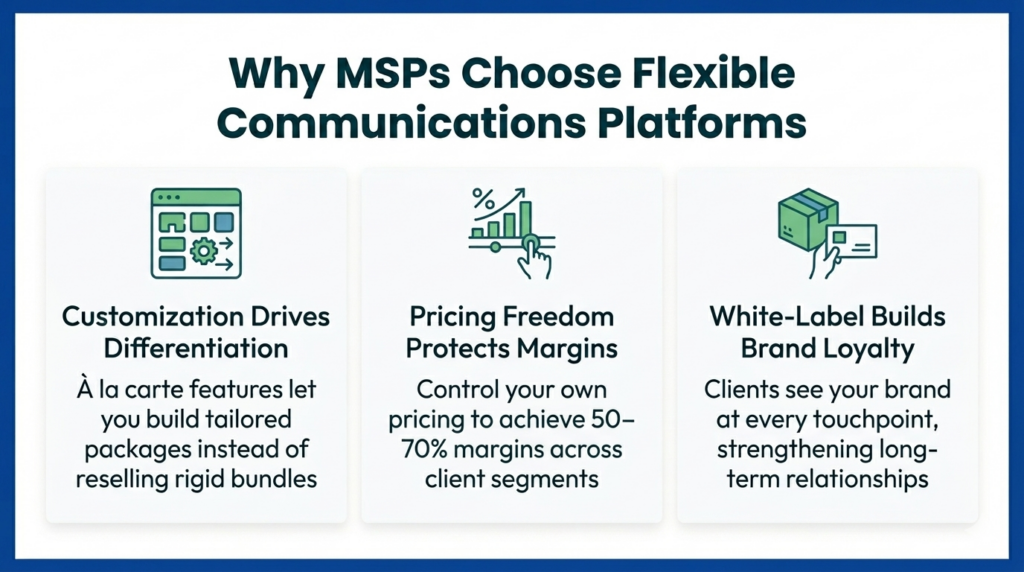
- Customizable service packages let you tailor solutions for healthcare practices, legal firms, retail chains, and remote-first startups using the same underlying technology.
- White-label capabilities mean your clients see your brand at every touchpoint, strengthening loyalty and long-term relationships.
- Scalable infrastructure grows with your business without requiring you to invest in costly hardware or hire specialized telecom staff.
- Pricing freedom enables margins of 50–70% when you control how you bundle and price unified communications solutions.
When evaluating UCaaS partnerships, prioritize platforms that give you flexibility rather than forcing you into rigid packages that limit your ability to compete.
The global UCaaS market reached $87.39 billion in 2024 and is projected to grow at nearly 20% annually through 2030. That growth presents a massive opportunity for MSPs, but capturing it requires more than simply adding voice services to your portfolio. Success depends on finding a flexible communications platform that adapts to the way you do business, rather than forcing you to adapt to its limitations.
What Makes a Flexible Communications Platform Essential for MSPs?
Every MSP serves a unique mix of clients. A dental practice in the suburbs has different communication requirements than a regional logistics company or a fast-growing tech startup. Platform flexibility determines whether you can profitably serve all of them or find yourself constantly turning away business because your technology can’t accommodate the variations.
Adapting to Diverse Client Requirements
Your healthcare clients need HIPAA-compliant messaging and secure video consultations for telehealth appointments. Your legal clients prioritize call recording, voicemail transcription, and detailed call logs for compliance documentation. Meanwhile, your retail clients want business SMS capabilities for appointment reminders and promotional campaigns.
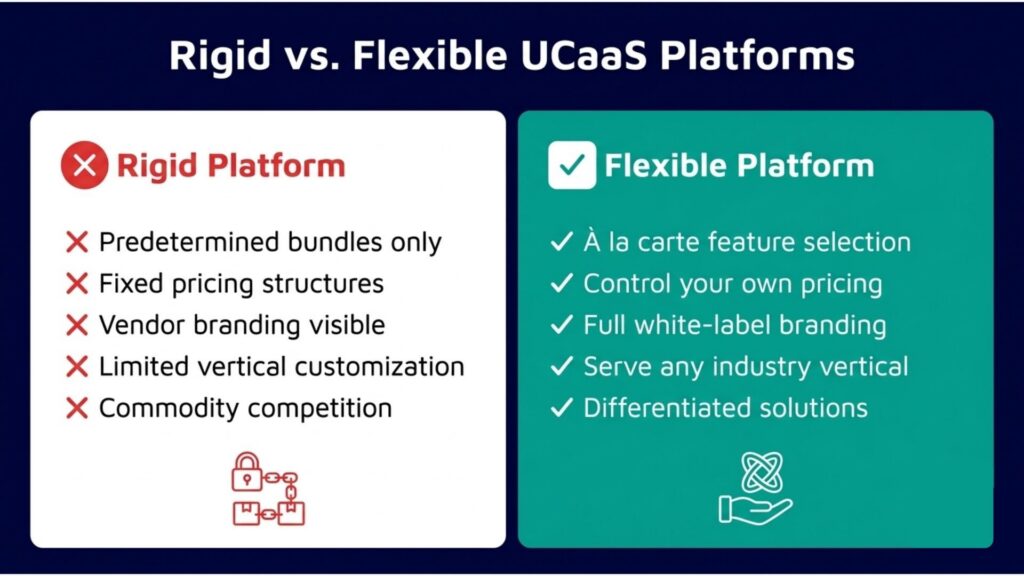
A rigid platform forces you to choose which market segments you can serve. A flexible communications platform lets you configure each deployment to match the specific workflows and compliance requirements of that particular client. The underlying technology remains consistent, but the feature mix, user interface, and integration points can vary based on what each business actually needs.
Some clients want comprehensive unified communications solutions that include voice, video, messaging, and contact center functionality. Others simply need reliable cloud-based phone service with basic collaboration tools. Platform flexibility means you’re not pushing oversized solutions onto businesses that don’t need them, and you’re not leaving money on the table when clients have more sophisticated requirements.

Enabling Customizable Service Packages
The most profitable MSPs create tiered service offerings that address different price points and functionality needs within their target markets. Bronze, Silver, and Gold packages give your sales team clear options to present, while allowing room for customization when a prospect’s requirements don’t fit neatly into predefined categories.
Creating these packages requires a platform that supports à la carte feature selection rather than forcing you to resell predetermined bundles. When you control which features go into each tier, you can strategically engineer your margins. Basic packages might carry lower margins but attract price-sensitive clients who can upgrade later. Premium packages deliver higher margins while providing the advanced features your most sophisticated clients demand.
This kind of customizable UCaaS packaging transforms you from a commodity reseller into a solutions provider. You’re not competing solely on price because your offerings aren’t identical to what everyone else is selling. Your packages reflect your understanding of your specific market and the unique value you bring to client relationships.
How Does Platform Flexibility Drive MSP Profitability?
Platform flexibility directly impacts your bottom line. The right communications platform creates profit opportunities at every stage of the client lifecycle, from initial sale through ongoing support and expansion.
Margin Control Through Pricing Freedom
When your platform provider dictates retail pricing, you become a pass-through agent competing against every other reseller with identical offerings. Flexible platforms let you set your own prices based on your market positioning, competition, and desired profit margins.
This pricing freedom proves valuable when serving different client segments. Enterprise clients with complex requirements expect to pay premium rates for customized solutions and white-glove support. Small businesses shopping primarily on price can still be profitable if you’ve designed entry-level packages with appropriate margins. The key is having technology that supports both approaches rather than forcing uniform pricing across your entire customer base.
MSPs working with flexible white-label platforms typically achieve margins ranging from 50–70%, depending on how they structure their offerings. Those margins compound as your client base grows because recurring monthly revenue from communications services adds stability and valuation to your business.
Scalable Growth Without Infrastructure Burden
Traditional telecommunications required significant capital investment in equipment, facilities, and specialized personnel. Building out voice infrastructure meant hiring engineers, maintaining hardware, and managing carrier relationships that consumed resources better spent on sales and customer success.
Cloud-based unified communications solutions eliminate these requirements while preserving your ability to scale. Adding new clients doesn’t require purchasing additional servers or expanding data center capacity. Your platform provider handles the technology infrastructure, software updates, security patches, and carrier management while you focus on winning and serving customers.
As your client base grows, fixed costs don’t increase proportionally with revenue because you’re not building out physical capacity. The flexible platform automatically scales to accommodate your growth, whether you’re adding ten seats this month or a thousand next quarter.
Key Features of a Flexible Communications Platform
Not all platforms deliver the same level of flexibility. When evaluating potential partners, look for these capabilities that impact your ability to meet diverse MSP needs:
- White-label branding lets you customize portals, mobile apps, and all client-facing interfaces with your company identity. Your clients should see your brand throughout their experience, not your vendor’s.
- À la carte feature selection allows you to enable or disable specific capabilities for each client deployment. Avoid platforms that force you to sell everything or nothing.
- Flexible billing integration works with your existing invoicing systems and supports the pricing models you want to offer. Look for automated taxation engines that handle the complexity of telecom billing compliance.
- API access enables custom integrations with CRM systems, business applications, and vertical-specific software your clients already use.
- Multi-tier support structures provide the escalation paths you need without requiring you to maintain deep telecom expertise in-house.
- Geo-redundant infrastructure ensures reliability without making you responsible for disaster recovery planning and execution.
These features work together to give you operational control while leveraging your platform partner’s scale and expertise. The best flexible platforms feel like extensions of your business rather than third-party vendors you’re reselling.
Why Do Diverse Client Needs Require Unified Communications Solutions?
The businesses you serve face complex communication challenges that point solutions can’t address. Unified communications solutions consolidate voice, video, messaging, and collaboration tools into integrated platforms that simplify management while expanding functionality.
Industry-Specific Requirements Create Complexity
Healthcare organizations need communication platforms that comply with patient privacy regulations while enabling the telehealth capabilities that have become standard patient expectations. Legal firms require detailed call documentation and secure messaging that supports attorney-client privilege. Financial services companies face their own regulatory requirements around recorded communications and data retention.
A flexible communications platform lets you serve all these verticals from a single technology foundation. You’re not maintaining separate solutions for different industries or turning away prospects because your platform can’t meet their compliance requirements. Instead, you configure each deployment with the features and security controls appropriate to that client’s industry and specific needs.
Organizations should evaluate whether potential providers offer features supporting specific vertical needs. This vertical awareness separates successful MSPs from those struggling to differentiate their offerings.
Remote and Hybrid Workforce Demands
Employees expect to work productively from anywhere, which means businesses need platforms supporting seamless transitions between office, home, and mobile environments.
Flexible communications platforms accommodate this reality through multi-device support, mobile applications, and softphone capabilities that let users take their business phone numbers anywhere. Quality of service monitoring helps you identify and resolve connectivity issues before they impact productivity. Integration with collaboration tools keeps distributed teams connected without requiring them to juggle multiple applications.
According to research, 55% of workers prefer hybrid arrangements, making robust remote capabilities essential. Platforms that treat mobility as an afterthought will struggle to meet the expectations of modern businesses and their employees.

What Should MSPs Look for in a Flexible UCaaS Partner?
Choosing the right platform partner determines how effectively you can leverage flexibility to grow your business. Technical capabilities matter, but partnership quality and support structures often prove equally important for long-term success.
White-Label Capabilities That Protect Your Brand
True white-label partnerships let you present unified communications solutions as your own branded offerings. Look for partners who enable deep customization of client-facing interfaces, support materials, and even the terminology used throughout the platform.
Brand ownership strengthens client relationships and increases switching costs. When clients think of you as their communications provider rather than recognizing a third-party brand, you maintain control of those relationships through whatever changes the market brings.
Training and Support That Enable Success
The learning curve for reselling communications services can be steep, especially if your team doesn’t have telecom backgrounds. Effective platform partners provide comprehensive onboarding that covers technical implementation, sales positioning, billing management, and ongoing support processes.
Look for partners offering structured training programs, extensive knowledge bases, and accessible support teams who understand MSP needs. Some platforms provide first-order assistance where their sales engineers join your initial client calls, helping you build confidence and close deals while you’re still learning the product.
Reliability and Redundancy You Can Trust
Your clients depend on their communication systems for essential business operations. Outages directly damage your reputation and strain client relationships. Platform flexibility loses its value if the underlying infrastructure can’t deliver consistent reliability.
Evaluate potential partners’ infrastructure, including geo-redundant data centers, automatic failover capabilities, and demonstrated uptime track records. The best platforms maintain multiple active service nodes across different geographic regions, ensuring that localized issues don’t cascade into widespread outages.
Frequently Asked Questions
How does platform flexibility differ from having lots of features? Features determine what your platform can do; flexibility determines how you can configure and package those features. A platform with extensive features but rigid bundling may force you to sell capabilities clients don’t need. A flexible platform lets you enable exactly the features each client requires, creating tailored solutions rather than one-size-fits-all packages.
Can a flexible communications platform work with my existing billing systems? Yes, though integration capabilities vary between providers. Look for platforms offering API access and pre-built integrations with popular billing and PSA tools. Automated taxation engines that handle telecom-specific compliance requirements save administrative headaches compared to managing those complexities manually.
What margin should MSPs expect when reselling flexible UCaaS solutions? Margins typically range from 50–70% for MSPs with pricing freedom, depending on market positioning and service tier. Entry-level packages may carry lower margins to remain competitive, while premium offerings with advanced features and dedicated support can command higher rates. The key is having platform flexibility that supports strategic pricing decisions.
How long does it take to onboard with a new white-label UCaaS platform? Comprehensive onboarding programs typically run 30–90 days, including technical training, billing setup, branding customization, and initial sales preparation. Some partners offer accelerated paths for experienced resellers, while others provide extended support for teams new to telecommunications.
Build Your UCaaS Practice on a Foundation of Flexibility
The MSPs capturing the most value from unified communications have partnered with platforms that give them flexibility to serve diverse client needs rather than forcing them into predetermined boxes. That flexibility translates into stronger client relationships, healthier margins, and sustainable growth trajectories.
SkySwitch delivers the flexible communications platform that MSPs need to compete. From white-label branding and à la carte feature selection to comprehensive training and geo-redundant infrastructure, we provide everything required to build a profitable UCaaS practice under your own brand. Get started with SkySwitch to discover how platform flexibility can transform your communications business.

Jessica is a marketing and sales strategist with deep expertise in VoIP telecommunications. As a Marketing Director, she specializes in channel marketing, account management, and product marketing within the communications industry. Jessica is passionate about helping partners grow through compelling messaging and hands-on support.