
What Makes a Turnkey Communications Platform Ideal for SMB Partners?

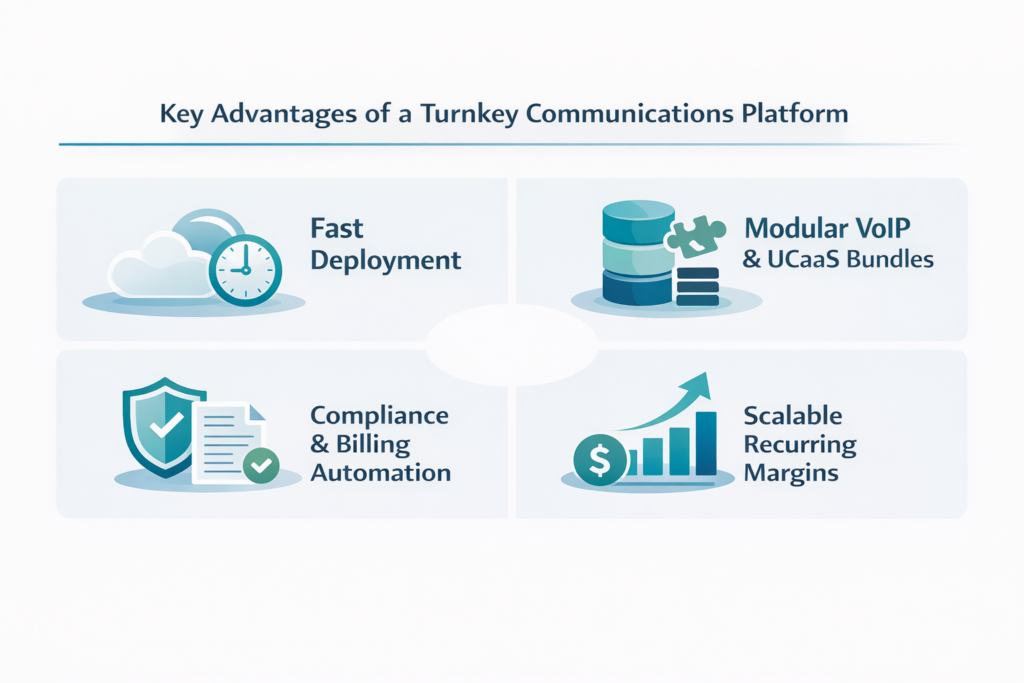
A turnkey communications platform combines modular VoIP and UCaaS features, fast provisioning, white-label branding, and integrated business tools to help resellers serve SMB clients profitably with minimal operational burden.
- SMB partners can customize service bundles without building infrastructure from scratch.
- Cloud-native architecture eliminates hardware investments and reduces time-to-revenue to days, not months.
- Integrated quoting, billing, and provisioning tools cut administrative overhead by consolidating workflows.
- Flexible pricing control lets resellers maintain healthy margins while meeting diverse client budgets.
Resellers seeking sustainable growth should evaluate platforms that prioritize modularity, speed, and partner support over feature bloat.
Building a successful communications reselling business requires more than just access to good technology. The platform powering your services shapes everything from how quickly you can onboard new clients to how much profit you retain at the end of each month. For MSPs, system integrators, and IT providers targeting small and medium-sized businesses, choosing a turnkey communications platform can mean the difference between scalable growth and operational gridlock.
The unified communications market reached $66.42 billion in 2025 and continues expanding as organizations consolidate their voice, video, and messaging tools. SMBs represent a particularly attractive segment because they need sophisticated communication capabilities but lack the IT resources to manage complex systems independently. These traits create an ideal scenario for reseller partners who can bridge that gap with streamlined, ready-to-deploy solutions.
What Defines a Turnkey Communications Platform?
A turnkey communications platform delivers all the components resellers need to sell, provision, and support cloud communication services under their own brand. Unlike piecemeal solutions that require assembling multiple vendors, a turnkey approach packages voice, video conferencing, messaging, and collaboration tools with the business infrastructure to effectively manage them.
The concept addresses a challenge facing SMB partners: technical complexity creates friction. Traditional telecommunications required specialized knowledge in carrier relationships, regulatory compliance, network architecture, and billing systems. Each of these domains demanded expertise that distracted from the core work of serving clients and growing the business.
Modern turnkey platforms shift that burden to the provider. Resellers access enterprise-grade technology through unified interfaces designed for efficiency rather than complexity. The platform handles infrastructure maintenance, software updates, compliance requirements, and technical support escalation. Partners focus on understanding client needs and delivering solutions that solve real business problems.
This model proves especially valuable for serving SMB clients. Smaller organizations typically lack dedicated IT departments and rely on external partners for technology guidance. When a flexible communications platform invisibly handles backend complexity, partners can position themselves as trusted advisors rather than technical intermediaries struggling to keep systems running.
Why Do SMB Partners Need Turnkey Solutions?
The SMB market presents unique characteristics that make turnkey platforms particularly appealing. Understanding these dynamics helps partners evaluate whether a given platform truly serves their needs.
Speed to Revenue Matters More Than Ever
SMB clients move quickly. With hybrid work now the dominant model for engaged employees, organizations expect communication tools to be deployed rapidly. When a growing accounting firm needs phone service for five new employees, or a medical practice wants to add video consultations, they expect implementation within days, not weeks. Partners who can’t deliver fast solutions lose deals to competitors who can.
A turnkey communications platform compresses deployment timelines. Auto-provisioning capabilities mean phones arrive preconfigured and ready to use. Cloud-based architecture eliminates installation delays associated with on-premise equipment. Self-service portals let partners add users, modify features, and adjust configurations without waiting for support tickets to resolve.
This speed advantage compounds over time. Partners serving multiple SMB clients simultaneously can’t afford extended implementation cycles that consume resources without generating revenue. The faster each client moves from signed contract to paying customer, the more capacity exists to pursue new business.

Flexibility Enables Custom Solutions
SMB clients span enormous diversity. A five-person law firm has different communication needs than a fifty-person construction company or a hundred-person healthcare organization. Cookie-cutter packages fail to address this reality, forcing partners to either oversell features clients don’t need or lose deals to providers offering more appropriate options.
Platforms supporting modular VoIP and UCaaS bundles let partners construct tailored offerings for each client segment. Basic packages might include just voice and voicemail for cost-conscious buyers. Mid-tier options add video conferencing and team messaging for collaboration-focused organizations. Premium bundles incorporate contact center capabilities, advanced analytics, and extensive integrations for clients requiring comprehensive solutions.
This modularity extends beyond features to pricing structures. Partners maintain control over what they charge, creating bundles like “Basic,” “Professional,” and “Enterprise” tiers that reflect value delivered rather than arbitrary cost structures. When partners control pricing, they can respond competitively to local market conditions while protecting the margins necessary for sustainable business operations.
Reduced Overhead Protects Profitability
Every hour spent on administrative tasks is an hour not spent acquiring new clients or strengthening existing relationships. MSP VoIP resellers often struggle with the operational burden that erodes profitability even when revenue grows.
Turnkey platforms address overhead through integration. Rather than juggling separate systems for quoting, provisioning, billing, and support, partners work within unified environments where data automatically flows between stages. Quote acceptance triggers account creation. Device orders auto-provision to specific user configurations. Usage data feeds directly into billing systems. This workflow automation eliminates manual data entry, reduces errors, and frees time for high-value activities.
Compliance management is another overhead reduction. Telecom regulations around STIR/SHAKEN attestation, E911 services, 10DLC registration for business texting, and taxation create an administrative burden. When the platform provider handles these requirements, partners avoid the specialized expertise and ongoing attention that compliance demands.
What Are the Essential Features of a Turnkey Communications Platform?
Not every platform claiming turnkey status delivers equal value. Partners evaluating options should assess specific capabilities that distinguish platforms genuinely designed for reseller success from those simply offering white-label stickers on basic services.
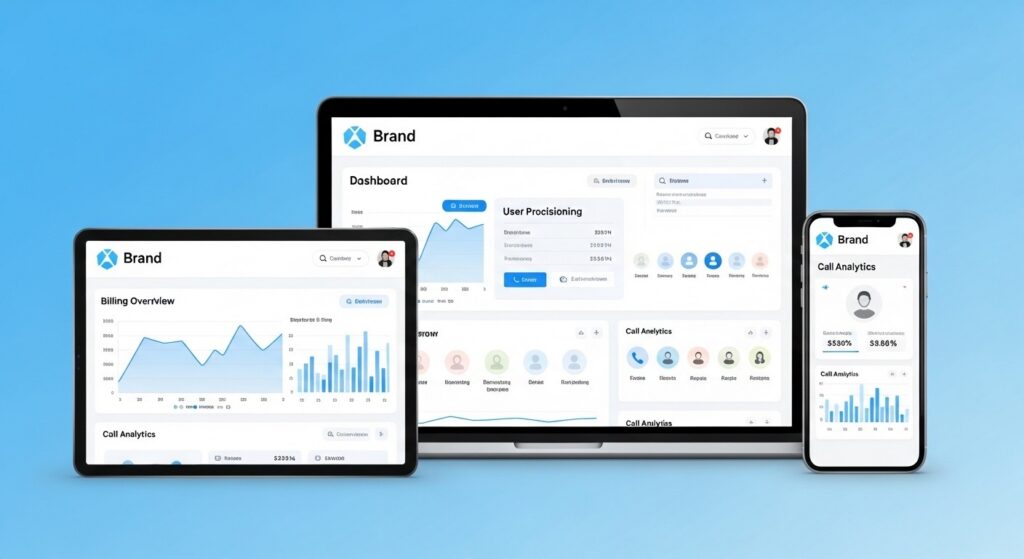
White-Label Branding Control: Complete customization of customer-facing interfaces ensures clients see only the partner’s brand throughout their experience. This includes login portals, mobile applications, billing statements, and support communications. Strong white-label capabilities build brand equity with every client interaction rather than diluting it through co-branding or vendor visibility.
Integrated Quote-to-Cash Workflows: The path from initial quote to recurring payment should flow through connected systems rather than requiring manual handoffs. Look for platforms offering built-in quoting tools, automated provisioning triggers, tax-compliant billing, and payment processing. Each integration point that requires manual intervention introduces the potential for delays and errors.
Self-Service Provisioning Capabilities: Partners shouldn’t need to submit tickets for routine tasks like adding users, changing feature configurations, or ordering hardware. Administrative portals with full provisioning authority let partners respond immediately to client needs without waiting in support queues.
Geo-Redundant Network Infrastructure: Reliability differentiates professional services from amateur operations. Multiple data centers with automatic failover ensure client communications continue even when individual facilities experience issues. Partners should understand their platform’s redundancy architecture and uptime commitments.
Comprehensive Device Marketplace: Hardware procurement often creates friction in deployments. Platforms offering integrated device stores with competitive pricing, pre-configuration services, and drop-shipping simplify the equipment component of every sale. Auto-provisioning that pairs devices with specific user accounts before shipment eliminates on-site configuration requirements.
Tiered Support Options: Different partners have different support philosophies. Some prefer handling all client interactions directly, while others want to offload technical troubleshooting. Platforms supporting flexible support models let partners choose their preferred approach, whether that means using provider resources for Tier 2 and Tier 3 issues or accessing white-labeled Tier 1 support services.
How Do Modular VoIP and UCaaS Bundles Serve Diverse Clients?
Unified comms for SMBs encompasses organizations with vastly different requirements and budgets. Modular platforms let partners address diversity without maintaining multiple product lines or vendor relationships.
Consider the typical range of SMB communication needs. A retail shop might need just reliable voice service with basic voicemail and call forwarding. A professional services firm wants video conferencing for client meetings and team collaboration tools for project coordination. A customer service organization requires contact center functionality with queue management, call recording, and performance analytics.
Modular architecture means each of these clients can receive appropriately scoped solutions from the same platform. Partners assemble features based on actual requirements rather than forcing clients to pay for capabilities they will never use. This precision creates better client outcomes because budgets stretch further when every dollar addresses genuine needs.
The approach also supports organic growth within accounts. Clients starting with basic voice service can add collaboration features when they hire remote workers. Contact center capabilities activate when customer service demands increase. Each expansion represents additional recurring revenue without requiring platform migration or complicated integration projects.
Partners benefit from streamlined expertise as well. Rather than learning multiple vendor systems with different interfaces, provisioning workflows, and support processes, partners develop deep knowledge of a single platform. This concentrated expertise translates to faster problem resolution, more confident sales conversations, and reduced training requirements for new team members.
The Business Case: Margins, Scalability, and Customer Retention
Ultimately, platform choice impacts business outcomes that matter most to partners: how much profit each client generates, how easily the business scales, and how likely clients are to remain long-term.
Healthy Margins Require Pricing Control
Turnkey platforms typically operate on wholesale models where partners purchase services at set rates and sell at prices they determine. This structure supports margins ranging from 40–70% depending on how partners package and position their offerings. Partners who understand their markets can optimize pricing for competitiveness while protecting profitability.
Volume-based pricing tiers further improve economics as businesses grow. Partners reaching higher seat counts access lower per-seat costs without needing to renegotiate contracts. This built-in scaling incentive rewards growth while automatically improving margins.
Operational Efficiency Enables Scaling
Growth requires operational leverage, meaning each additional client should not demand proportionally more administrative effort. Platforms with strong automation, self-service tools, and integrated workflows let partners add clients without adding equivalent headcount.
This leverage becomes critical as partner businesses mature. Early-stage operations often tolerate manual processes because volumes are manageable. But partners aspiring to scale need platforms designed for growth from the beginning rather than those requiring process reinvention at each growth stage.
Stickiness Protects Revenue Streams
Communication services integrate deeply into client operations. Phone numbers are published on marketing materials. Workflows are built around specific features. Employees develop habits with particular interfaces. This integration creates switching costs that protect recurring revenue once clients deploy solutions.
Turnkey platforms enhance this natural stickiness by offering breadth. Clients getting voice, video, messaging, collaboration tools, and contact center services from a single provider have multiple reasons to maintain the relationship. Each additional service increases switching complexity and reduces the likelihood that clients will evaluate alternatives.
Frequently Asked Questions
What should a flexible communications platform look like for MSP resellers? A flexible platform offers modular feature selection, customizable service bundles, white-label branding across all client touchpoints, and pricing control that lets partners adapt to local market conditions. The infrastructure should handle voice, video, messaging, and collaboration with options to add contact center capabilities, business texting, and integrations with common business applications. Partners should be able to provision services, manage accounts, and access reporting through unified administrative interfaces without relying on provider support for routine tasks.
How quickly can partners deploy a turnkey communications platform to new SMB clients? Well-designed turnkey platforms support deployment timelines measured in days rather than weeks. Auto-provisioning capabilities mean preconfigured devices can ship directly to client locations, ready for immediate use. Cloud-based architecture eliminates installation dependencies on physical infrastructure.
What margin potential exists with turnkey UCaaS and VoIP reselling? Partners typically achieve margins between 40% and 70% depending on packaging strategy, market positioning, and volume. Wholesale pricing models give partners flexibility to optimize their specific situation. Volume discount tiers improve economics as partner businesses grow, with higher seat counts unlocking lower per-seat costs. Additional revenue opportunities exist through hardware sales, professional services, and premium add-on features that complement core communication services.
How do turnkey platforms handle regulatory compliance for telecom services? Reputable turnkey providers manage compliance requirements, including STIR/SHAKEN attestation for call authentication, E911 emergency service obligations, 10DLC registration for business text messaging, HIPAA compliance for healthcare clients, and telecommunications tax calculation and remittance. This compliance management removes administrative burden from partners who would otherwise need specialized expertise to navigate complex and evolving regulations.
Partner with a Platform Built for Your Success
Selecting the right turnkey communications platform shapes a business’s long-term trajectory. Partners serving SMB clients need solutions combining technical capability with operational efficiency, delivered through models that protect healthy margins while supporting sustainable growth.
The characteristics outlined here provide evaluation criteria for platform assessment. Modularity that enables custom solutions. Speed that compresses time-to-revenue. Integrated workflows that reduce overhead. Support structures that match partner preferences. Reliability infrastructure that protects client operations.
SkySwitch delivers a comprehensive white-label UCaaS platform designed specifically for reseller success. From structured onboarding programs to integrated quoting and billing tools, our platform provides everything partners need to build profitable communication practices serving SMB clients. Get started with SkySwitch to discover how a turnkey approach can transform your reselling business.

Jessica is a marketing and sales strategist with deep expertise in VoIP telecommunications. As a Marketing Director, she specializes in channel marketing, account management, and product marketing within the communications industry. Jessica is passionate about helping partners grow through compelling messaging and hands-on support.