
White-Label Communications for UCaaS Resellers

White-label communications for UCaaS resellers is the difference between earning a commission on someone else’s product and owning a branded, recurring revenue line you control.
- The global UCaaS market sits near $106 billion and is forecast to more than triple by 2033, with much of that growth flowing through partners who already own local customer relationships.
- White-label reselling puts your brand on the client experience, your pricing on the invoice, and your company in the support seat. Agent programs do none of that.
- AI moved from roadmap item to line item. Conversational agents living inside the phone system are now something you can sell, configure, and bill under your own name.
- Platforms worth your time compete on the operational layer, meaning billing, taxation, provisioning, and compliance, because calling features have largely converged.
If you already have an installed base and a support desk, white-label communications is the fastest recurring revenue line you can add without hiring a voice engineer.
If you’ve spent years selling managed IT, connectivity, or office equipment, you already own what voice vendors spend fortunes trying to buy: trust with a local business owner who takes your call. That’s the whole premise behind white-label communications for UCaaS resellers. You keep the brand and the customer relationship, and a cloud communications platform partner runs the switch, the carrier agreements, and the compliance machinery behind the scenes.
The timing helps. Grand View Research values the global UCaaS market at about $106 billion in 2025, climbing to $404 billion by 2033. That’s a lot of phone systems changing hands, and a meaningful share of those deals close through regional providers rather than national carriers. The question is whether your partnership lets you keep the profit.
What Does White-Label Communications for UCaaS Resellers Involve?
In practice, white-label communications for UCaaS resellers means you buy platform capacity at wholesale, package it however you want, and sell it as your own product. Your customers see your logo on the portal and the softphone app, your name on the invoice, and your team on the phone when something breaks. They never encounter the platform provider underneath.
For a ground-level definition of the model and its terminology, start with a full platform feature overview. What follows is the reseller’s version of the story.
Who’s Actually Selling UCaaS Today
The profile is consistent: MSPs adding voice to a managed services stack, integrators and interconnects migrating customers off aging premise equipment, ISPs bundling voice with connectivity, and VARs who want revenue that recurs instead of arriving in lumpy hardware cycles. Office equipment dealers have become an interesting segment, since a five-year copier lease is a natural place to attach a phone system.
What they share is an installed base and a service relationship, the real prerequisite for profitably reselling UCaaS. You aren’t cold-calling strangers about a phone system. You’re talking to a client who already trusts your technology judgment, and close rates reflect that.
What You Own Versus What the Platform Runs
The platform owns infrastructure, and you own everything the customer touches. The provider handles data centers, carrier interconnects, fraud monitoring, feature development, and regulatory obligations like 10DLC and STIR/SHAKEN. You handle branding, packaging, pricing, sales, provisioning, and first-line support.
The customer record is the piece that matters most. In a true white-label arrangement, that account belongs to you. You invoice directly, you set renewal terms, and you decide when to expand into contact center, SMS, or fax. If a provider’s contract assigns the end customer to them, you’ve signed something other than a reseller agreement, whatever the marketing page calls it.
White-Label UCaaS vs. Generic VoIP Reseller Programs
Plenty of vendors advertise partner programs, and the pages look interchangeable. The economics underneath them are not. A generic VoIP reseller or agent program pays a commission on revenue that belongs to the vendor. A white-label communications platform sells you wholesale access and lets you build a business on top of it. Here’s how they compare on the decisions that affect your P&L three years in.
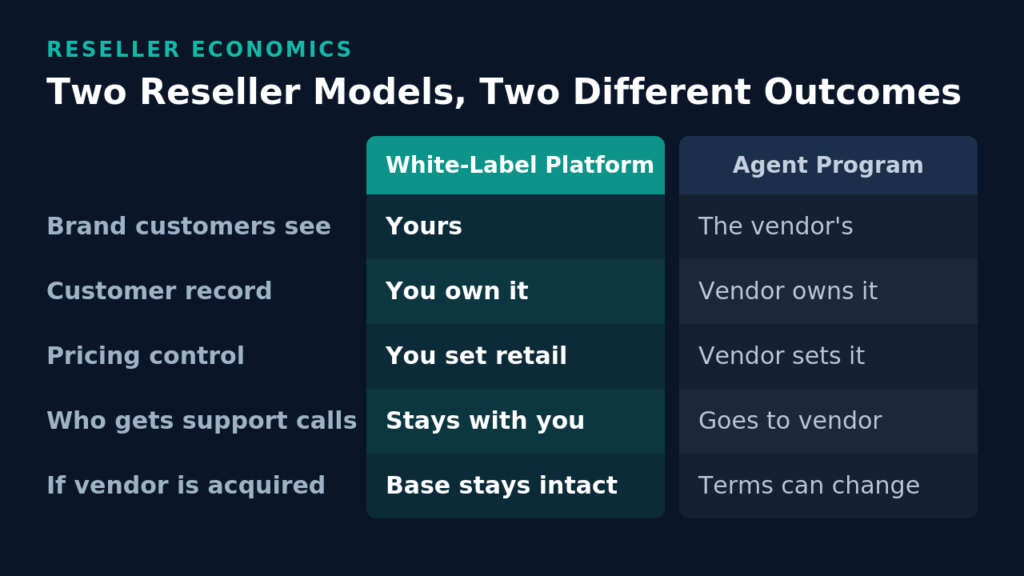
| Consideration | White-Label UCaaS Platform | Generic VoIP Reseller or Agent Program |
| Whose brand the customer sees | Yours, across portal, apps, and invoices | The vendor’s, with your name as a referral partner |
| Who owns the customer record | You, including renewals and expansion | The vendor, in most agreements |
| Pricing control | You set retail pricing and package tiers | Vendor sets pricing, you take a set commission |
| Economics | Margin you define through the wholesale-to-retail spread | Commission percentage that the vendor can revise |
| Billing and taxation | Handled in-platform, branded to you | Vendor invoices your customer directly |
| Support relationship | You handle Tier 1, platform escalates behind you | Customer calls the vendor, sometimes without telling you |
| Roadmap influence | Feature releases you can package and price | Whatever the vendor decides to bundle |
| If the vendor is acquired | Your brand and base stay intact | Compensation terms can change or disappear |
Where Generic Programs Cost You Later
The commission model looks attractive early because it asks almost nothing of you. The problems surface around customer 20 or 30, when you realize you’ve built a book of business whose value sits on someone else’s balance sheet. If that vendor is acquired or reworks its comp plan, you find out exactly what you own. A wholesale reseller program structure avoids that outcome by putting the base, pricing, and renewal terms in your name from day one.
There’s a subtler cost too. Every time a client calls the vendor’s support line instead of yours, the vendor gets a relationship touchpoint, and you get nothing. Reselling UCaaS under your own brand keeps those interactions inside your business, and the criteria for evaluating a voice partner usually come back to this one question of ownership.
Which AI-Enhanced Business Communications Can You Sell Today?
AI stopped being a differentiator conversation and became a purchase conversation. Per small business technology research, 58% of SMBs now use generative AI, up from 40% a year earlier. Your clients are already buying AI tools. The only question is whether the communications piece comes from you or from a vendor who then starts asking about their phone system.

AI-enhanced business communications give you something concrete to sell into that demand, and the strongest version is native to the platform rather than stitched on through a third party.
Conversational AI Agents Inside the Phone System
The headline capability is a conversational agent assigned a number or registered as an extension in the customer’s PBX, so it deploys as easily as any other extension. It handles caller intent detection and routing, books appointments, answers repetitive questions about hours, pricing, and policies, qualifies inbound leads, and covers after-hours without added headcount.
For you, the appeal is economic. When conversational AI agents built into the platform come from the same provider as the phone system, there’s no middleware, no second support line, and no third-party margin between you and the customer. That’s how partner margins reach up to 70% on a service that would otherwise be a thin passthrough. A drag-and-drop builder lets you deploy without an AI engineer, and human escalation stays available at every step, which matters because no owner wants to hear that a machine is replacing their front desk.
The Supporting AI Layer
Around the agent sits a stack of quieter features that raise the value of every seat you sell. Contact center deployments get post-call transcription, summarization, sentiment detection, and topic identification across up to 100% of conversations, plus live agent assist and automated wrap-up notes. On the UC client side, voicemail and live call transcription give users a searchable record without extra software.
None of it requires a separate vendor conversation, which is the part worth emphasizing in a proposal.
Verticals Where AI Conversations Open Doors
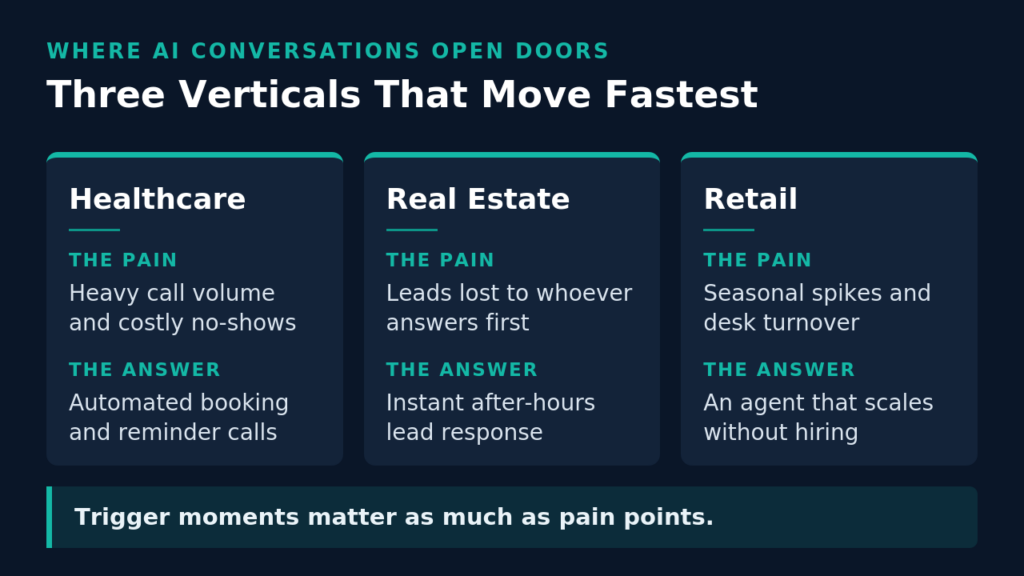
Three segments move the fastest. Healthcare practices feel phone volume and no-show rates immediately, so automated scheduling and reminders make the ROI math easy. Real estate brokerages lose leads to whoever responds first, which makes instant after-hours response an obvious sale. Retail gets hammered by seasonal spikes and service desk turnover, and an agent that scales without hiring is a clean answer.
Trigger moments matter as much as pain points. A practice adding locations, a brokerage growing listings without adding agents, and a retailer heading into peak season are the conversations where AI-enhanced business communications go from interesting to urgent.
What to Look for in a White-Label UCaaS Provider
In the 2026 IT industry outlook, 84% of technology professionals expect AI investment to rise this year, with operational efficiency and reaching new customer segments leading the growth drivers. Both depend more on a white-label UCaaS provider’s back office than on its calling features. Use this list when you compare options.
- True brand invisibility. Your customer should never see the upstream provider’s name on a portal, app, invoice, or support call. Ask to see the branded portal before you sign.
- Customer ownership in writing. Confirm that you invoice directly and the account is contractually yours, including at renewal and in the event the provider is acquired.
- Quote-to-cash automation. Quoting, provisioning, rating, invoicing, and taxation should live inside the platform. Run any of it on spreadsheets, and labor eats your margin.
- Compliance handled at the platform layer. HIPAA-capable configurations, 10DLC, STIR/SHAKEN, Kari’s Law, and RAY BAUM’s Act should be inherited, not rebuilt per client.
- Native AI rather than a bolt-on. Ask whether AI is engineered into the platform or resold from a third party. The answer determines your margin and your support burden.
- A geo-redundant network with transparent status reporting. Your brand absorbs every outage, so you need redundancy across nodes and proactive notification when something shifts.
- Onboarding that produces revenue rather than certificates. A structured program with a dedicated specialist should have you selling in about 30 days, with deeper training continuing alongside your first deals.
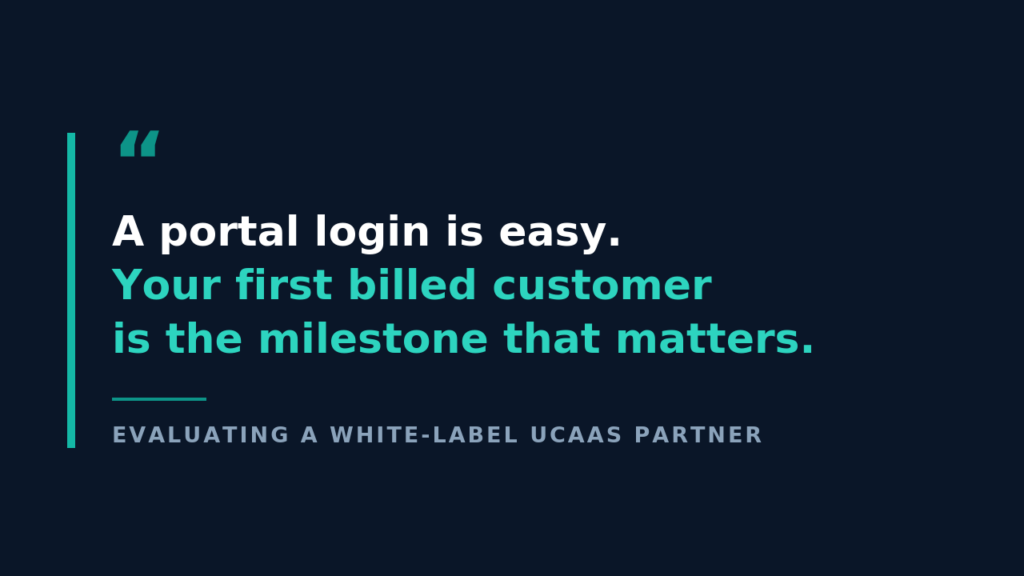
That last point separates programs more than anything else. A portal login is easy. Your first billed customer is the milestone that matters, so review the path to becoming a reseller before you weigh anyone’s onboarding claims.
Frequently Asked Questions
What’s the difference between a white-label communications platform and a private-label one? Nothing meaningful. The terms are used interchangeably here. Both describe selling another company’s infrastructure under your own brand, with the provider staying invisible to your customer.
How long does it take to start selling white-label UCaaS? Committed partners can begin selling in about 30 days. Full onboarding runs longer, usually nine to twelve weeks, but that training continues while you’re already quoting and closing.
Do I need voice engineers on staff to resell UCaaS? No. A well-built UCaaS reseller platform handles infrastructure, carrier management, and escalated support. You need someone comfortable with provisioning and basic troubleshooting, which most MSPs already have.
Can I sell AI features without an AI specialist? Yes, when the AI is native to the platform. No-code builders let you configure call flows and agent behavior visually, and professional services are usually available for more complex deployments.
What happens to my customers if I switch platform providers later? That depends on your agreement. In a genuine white-label arrangement, you own the customer records and phone numbers, which makes migration possible. In agent programs, customers usually stay with the vendor.
Getting Started With White-Label Communications for UCaaS Resellers
The businesses winning at voice in 2026 picked a partner that automates the operational layer, hands over the customer relationship without asterisks, and ships AI inside the platform rather than as a margin-thinning add-on.
SkySwitch was built for that model, with a fully brandable UCaaS reseller platform, in-platform billing and taxation, a geo-redundant network, and native AI that your customers can deploy like any other extension. Get started with SkySwitch, and we’ll walk you through the platform, the margins, and the path to your first customer.

Jessica is a marketing and sales strategist with deep expertise in VoIP telecommunications. As a Marketing Director, she specializes in channel marketing, account management, and product marketing within the communications industry. Jessica is passionate about helping partners grow through compelling messaging and hands-on support.