
UC vs. UCC: What the Heck is the Difference?

UC vs UCC vs UCaaS: Which Model Fits Your SMB Clients?
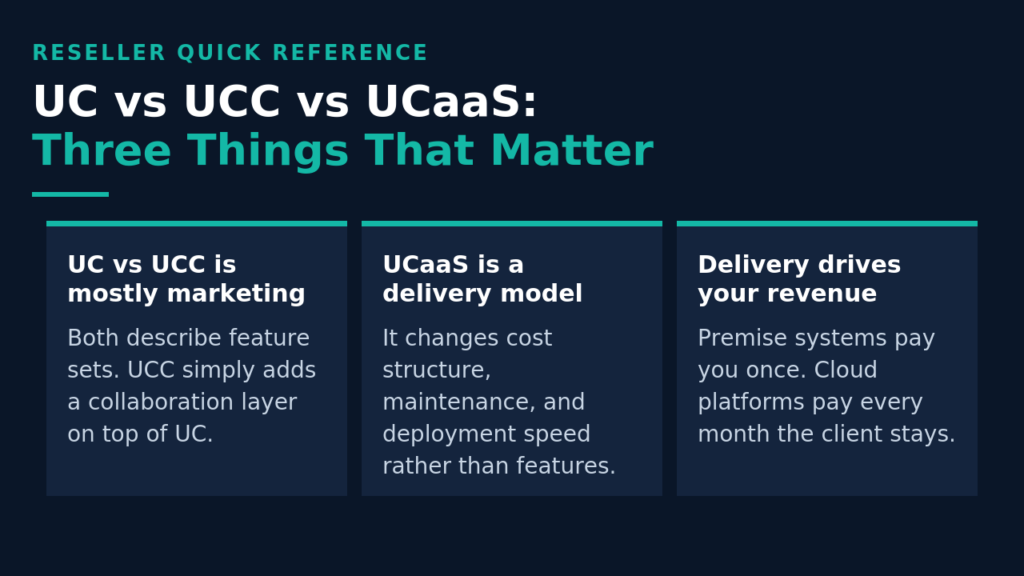
The distinction between UC and UCC is mostly vendor marketing, but the distinction between either of them and UCaaS is the one that decides your margins.
- UC describes the merging of voice, messaging, and presence into a single experience.
- UCC adds a collaboration layer on top: screen sharing, file sharing, and team messaging built around getting work done together.
- UCaaS is not a feature set at all. It is a delivery model, which is why it belongs in a different column entirely.
- Your clients are not shopping for acronyms. They are shopping for fewer tools, lower overhead, and a phone system that works from anywhere.
Stop selling the vocabulary and start selling the deployment model because that’s where the recurring revenue actually lives.
Ask ten people in telecom what separates UC from UCC, and you will get ten answers. Ask where UCaaS fits, and the room goes quiet. The acronym soup matters more now than it did a decade ago because the way your clients work has shifted underneath the terminology. Gallup’s tracking of hybrid work arrangements found that as of February 2026, 52% of remote-capable U.S. employees work hybrid and another 26% work exclusively remote, leaving just 22% fully on-site. When roughly eight in ten of your clients’ knowledge workers spend part of the week away from a desk, UC vs UCC stops being a vocabulary quiz and becomes a product decision.
This guide covers what each term means today, why the cloud reframes the comparison, and how to match the right white-label communications platform to each client you serve.
What’s the Real Difference Between UC vs UCC?
Here is the honest answer most vendors won’t give you: there is very little meaningful difference, and what difference exists was largely manufactured by marketing departments trying to make last year’s product sound obsolete.
Unified Communications describes the merging of voice, messaging, and presence into one experience. Unified Communications and Collaboration describes that same thing, plus a collaboration layer. Industry reference material defines UCC as technology that takes the methods used in unified communications and collaboration services and surfaces them through a single interface. You’ll notice it describes UCC as an extension of UC rather than a separate category.
Where the Terms Actually Came From
UC grew out of “unified messaging,” a 1990s term for consolidating voicemail, email, and fax into a single inbox. As the technology matured, it absorbed video, instant messaging, and presence, and the industry renamed it unified communications.
Then collaboration tools took off. Screen sharing, document co-editing, and persistent team channels became table stakes. Vendors who had spent years selling “UC” needed a way to signal their newer products did more, so they appended a second C. Buyers have been squinting at it ever since.
What the Collaboration Layer Genuinely Adds
To be fair, there is a real conceptual split underneath the marketing. Communication is the exchange of information. Collaboration is shared work on a shared output. A phone call is communication. Three people editing the same proposal during that call is collaboration.
That distinction shows up in your clients’ actual pain. Gallup found that decreased team collaboration ranked among the top challenges hybrid employees reported, alongside reduced cross-functional communication. Those are collaboration problems, not dial-tone problems. When a prospect says their remote staff feels disconnected, they are describing exactly the gap the second C is meant to close.
How Does UCaaS Reframe the UC vs UCC Debate?
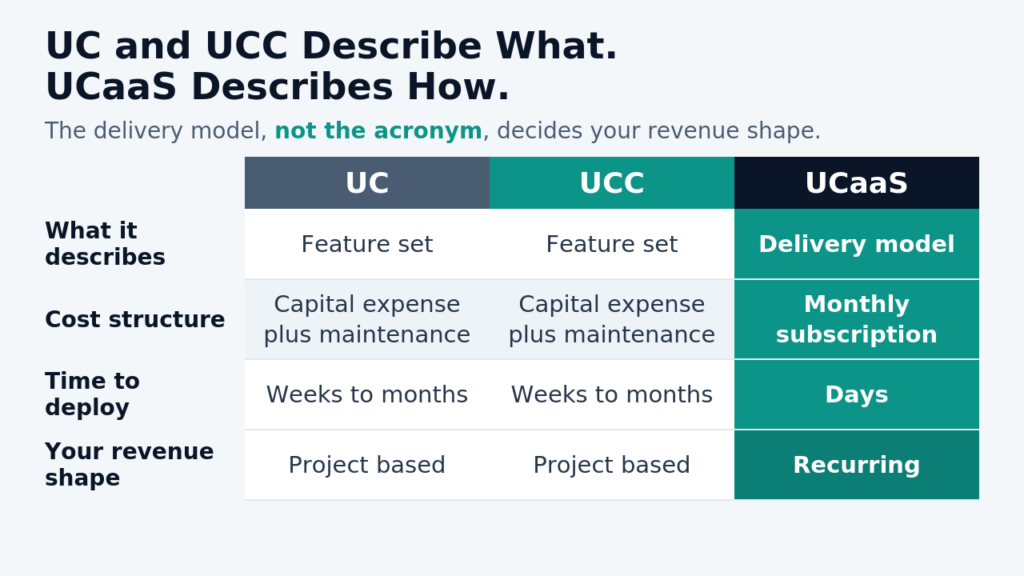
UC and UCC describe what a system does. UCaaS describes how it is delivered. Putting all three on the same axis is a category error, and once you see it, the sales conversation gets simpler.
Unified Communications as a Service means the platform is hosted, maintained, and upgraded by a provider and sold on a monthly recurring subscription. The customer does not buy servers, schedule firmware upgrades, or budget for a hardware refresh every five to seven years. Whether the feature set is called UC or UCC is beside the point because most cloud platforms ship both anyway.
Deployment Model Is the Real Dividing Line
An on-premise system requires capital expenditure up front, hardware in a closet, and someone competent to maintain it. A cloud platform converts that into a predictable monthly operating expense with provisioning that takes hours rather than weeks. For an SMB with no dedicated telecom staff, that dwarfs any argument about whether persistent chat qualifies as “collaboration.”
The money follows that logic. Precedence Research values the global UC&C market at $74.05 billion in 2025, growing toward $304.37 billion by 2035, with cloud deployment already accounting for 69% of the market and SMBs the fastest-growing organization segment at a 13.7% CAGR. Cloud is the default now, and SMBs are moving fastest.

Why “UCaaS vs UC” Is the More Useful Comparison
For a reseller, UCaaS vs UC is a far more productive framing than UC vs UCC. The first comparison changes how a customer buys, who maintains the system, what they pay monthly, and whether you earn recurring revenue or a one-time install fee. It also determines what kind of white-label reseller program you need behind you. The second comparison only changes which bullet points appear on a datasheet.
Selling a premise-based system is a project. Selling a cloud platform is an annuity. Our breakdown of unified communications as a service for reseller businesses covers the model in depth.
UC vs UCC vs UCaaS: A Side-by-Side Comparison Framework
When a prospect asks you to explain all this, a table beats three paragraphs. Here is the framework, organized by the dimensions that influence a buying decision rather than by feature checklists.
| Dimension | UC | UCC | UCaaS |
| What it describes | Feature set | Feature set | Delivery model |
| Core capabilities | Voice, messaging, presence, video | UC plus screen share, file share, team channels, shared workspaces | Either feature set, delivered from the cloud |
| Where it runs | Typically on-premise or hosted | On-premise, cloud, or hybrid | Provider’s cloud infrastructure |
| Cost structure | Capital expenditure plus maintenance | Capital expenditure plus maintenance | Monthly recurring subscription per user |
| Who maintains it | Customer or their IT partner | Customer or their IT partner | The platform provider |
| Time to deploy | Weeks to months | Weeks to months | Days |
| Scaling up or down | Requires hardware planning | Requires hardware planning | Self-service provisioning |
| Best fit | Stable single-site orgs with paid-off hardware | Collaboration-heavy teams with internal IT | Distributed, growing, or IT-light businesses |
| Reseller revenue shape | Project-based | Project-based | Recurring |
The last row matters most. Two of these columns pay you once. One pays you every month for as long as the customer stays.
Which Communications Model Fits Each SMB Client?
Not every client belongs in the same column, and pretending otherwise costs you credibility. Use these profiles as a qualifying matrix during discovery. Most prospects map onto one within five minutes of conversation.
| Client profile | Signals to listen for | Where they belong |
| Single site, paid-off PBX, stable headcount | “Our phones work fine.” No growth plans, no remote staff, hardware mid-depreciation. | Leave it alone for now. Set a reminder for their refresh date. |
| Aging hardware nearing refresh | Rising maintenance calls, end-of-life notices, a quote for new hardware sitting on a desk. | Prime UCaaS migration candidate. The refresh cycle, not the sticker price, decides this. |
| Distributed or hybrid workforce | Staff using personal cells for business calls, complaints about disconnection, multiple locations. | Cloud platform with strong mobile and collaboration features. |
| Collaboration-heavy teams | Tool sprawl, separate apps for chat, meetings, and file sharing, shadow IT. | Full UCC feature set, consolidated onto one platform. |
| Customer-facing operations | Queue complaints, no call reporting, agents juggling channels. | Add contact center capability on top of the core platform. |
| Fast-growing SMB | Frequent onboarding, seasonal swings, new locations planned. | Self-service provisioning is the deciding feature. |

The aging-hardware row deserves emphasis. A client with a healthy, fully depreciated system is hard to move on cost alone, and pushing anyway damages trust. A client staring down a hardware quote is a different story. Timing outreach to the refresh window converts far better than blanket prospecting.
5 Things to Look for in a Unified Communications Platform
If you’re building a practice on cloud delivery, the platform underneath you determines your economics for years. These five criteria separate a partner-friendly unified communications platform from one that caps your growth.
- White-label control that is genuinely yours. Put your logo, colors, and domain on the portals, clients, and invoices. If customers can tell who the underlying provider is, you are building someone else’s brand equity. Private-label and white-label mean the same thing here, and both should mean full control.
- Self-service provisioning without a support ticket. Adding a seat, porting a number, or enabling a feature should take minutes inside a portal. Every workflow that requires emailing the provider and waiting is a tax on your margin and a delay your customer feels.
- A la carte add-ons rather than forced bundles. A rigid package structure forces you to either overcharge some customers or leave capability on the table with others. Look for a platform where contact center, business texting, virtual fax, and network add-ons attach individually so you can build tiers that fit your market.
- Integrated quoting, billing, and taxation. Telecom billing and regulatory filing are where inexperienced resellers get buried. A platform natively handling quote-to-cash and tax calculation removes an entire back-office function you would otherwise have to staff.
- Real onboarding and ongoing support. Technology is the easy part. Success depends on how well you are trained to sell, provision, bill, and support the product. Ask any prospective provider what their onboarding actually includes and how long before you can sell confidently.
Our guide on choosing a white-label UCaaS provider covers how to evaluate each of these criteria during vendor conversations, and the case for private-label UCaaS for MSPs lays out the economics.
How Should You Sell Business Communications Solutions Without the Acronyms?
Your clients don’t care about terminology, and leading with it makes you sound like a vendor instead of an advisor.
No SMB owner has ever said, “We need to migrate from UC to UCC.” They say their team wastes time switching between apps, their receptionist can’t transfer calls to people working from home, or they are paying for three tools that overlap. Those are the sentences to sell against, and consolidation onto a single cloud platform solves every one of them.
When you do need to explain things, keep it to one line each. Unified communications means their channels live in one place. Collaboration means their people can work together inside those channels. As a service means you handle the infrastructure and they pay monthly. That explanation takes 15 seconds.
The best positioning for business communications solutions is almost always subtraction rather than addition. You are removing a phone system from their closet, a maintenance contract from their budget, two or three redundant apps from their stack, and the question of who to call when something breaks. Framing your offer around what disappears lands better than a feature comparison, particularly with owners who are not technical. If voice quality is the sticking point, our take on why business voice calling still matters is a useful conversation starter.
Frequently Asked Questions
Is there any real difference between UC vs UCC? Functionally, very little. UCC is best understood as unified communications with an explicit collaboration layer rather than a separate category. Most platforms include both, so the terms get used interchangeably. The distinction is more useful for describing a customer’s pain point, meaning communication gaps versus collaboration gaps, than for describing a product.
Is UCaaS the same as UCC delivered from the cloud? Essentially, yes. UCaaS refers to the delivery model, so a cloud-delivered UCC platform is UCaaS. It deserves its own term because delivery changes cost structure, maintenance burden, and deployment timeline far more than any feature difference does.
Should I explain UC vs UCC to my customers? Only if they ask. Leading with acronyms confuses buyers and stalls deals. Lead with the outcome, meaning fewer tools, lower overhead, and communications that work from anywhere.
Do SMBs still buy on-premise systems? Some do, particularly single-site businesses with capable internal IT and hardware that is paid off and healthy. That population is shrinking. Cloud deployment already represents the clear majority of the UC&C market, and SMBs are the fastest-growing segment adopting it.
What about CPaaS and CCaaS? They solve different problems. CPaaS provides programmable APIs that developers embed into their own applications. CCaaS covers customer-facing contact center operations like queuing, routing, and agent management. UCaaS handles internal and general business communications, and customers often need a contact center layer on top of it.
Ready to Build a Cloud Communications Practice?
The UC vs UCC debate will outlive all of us because there will always be a vendor with a reason to invent a new label. What won’t change is the underlying shift: businesses want fewer tools, less hardware, and communications that follow their people anywhere. Resellers who position around that reality rather than terminology build durable recurring revenue.
SkySwitch gives MSPs, VARs, system integrators, and telecom resellers a fully white-label platform to sell under their own brand, backed by geo-redundant infrastructure, self-service provisioning, integrated billing, and onboarding that can have committed partners selling in as little as 30 days. Get started with SkySwitch and see what a complete reseller ecosystem looks like.

Jessica is a marketing and sales strategist with deep expertise in VoIP telecommunications. As a Marketing Director, she specializes in channel marketing, account management, and product marketing within the communications industry. Jessica is passionate about helping partners grow through compelling messaging and hands-on support.