
AI in Business Communications: How Resellers Stay Competitive

AI for SMB communications has moved from hype to baseline expectation, and the resellers who package it well are winning more deals and keeping customers longer.
- SMB AI adoption is accelerating, giving resellers a timely reason to open new conversations and upsell existing accounts.
- The real opportunity is bundling AI-ready VoIP and UCaaS into solutions customers actually use every day.
- AI communications tools work best when they’re native to the platform instead of bolted on, so platform choice matters more than ever.
- Owning the customer relationship, billing, and support turns an AI trend into predictable recurring revenue.
If you choose an AI-ready white-label platform now, you’ll be positioned to lead the conversation instead of chasing it later.
AI for SMB communications is becoming the baseline that customers expect from their phone, messaging, and collaboration tools. The AI in telecommunications market is projected to climb from $4.6 billion in 2025 to $46.2 billion by 2033, a clear signal of how quickly intelligence is being built into the networks you sell every day.
For MSPs, system integrators, and VARs, that shift is an opening rather than a threat. The customers you already serve are actively looking for smarter communications, and the right white-label reseller platform lets you meet that demand without building anything from scratch. This guide breaks down what AI for SMB communications really means, where it fits into VoIP and UCaaS, and how you can use it to stay competitive.
What Does AI for SMB Communications Mean for Resellers?
AI for SMB communications refers to artificial intelligence woven directly into the voice, messaging, and collaboration tools that small and midsize businesses use to run their day. In practice, that looks like smarter call routing through auto attendants, voicemail transcription, automatic call summaries, sentiment and performance analytics, and automated SMS responders that handle routine questions. None of it requires a customer to become a data scientist. The intelligence runs quietly inside the platform.
For resellers, you’re not selling “AI” as a standalone product. You’re selling outcomes. Fewer missed calls, faster follow-ups, and less manual busywork are the things that actually close deals, and AI features make those outcomes possible. When you frame the conversation around business results instead of technology, you turn a buzzword into a practical reason to buy. That approach also mirrors what’s already happening on the ground, where AI adoption among small businesses is creating natural openings for broader UCaaS discussions.
Why Are SMBs Adopting AI Communications Tools Right Now?
Adoption isn’t theoretical anymore, and that changes the sales math for resellers. Recent U.S. Chamber of Commerce research found that nearly 60% of small businesses use AI and that 96% of small business owners plan to adopt emerging technologies. The education barrier is dropping, and the buying intent is already there, which means AI communications tools are an easier conversation to start than they were even a year ago.
Lean Teams Need Force Multipliers
Small businesses run lean by necessity, and that’s why AI is so appealing to them. AI communications tools let a five-person office answer more calls, follow up faster, and present itself as a much bigger operation. A solo front desk can lean on automated responders and smart routing to avoid dropping leads after hours. When you can show a prospect how these tools help them do more without hiring, you’re speaking directly to their biggest constraint.

Customer Expectations Have Shifted
End customers now expect fast, accurate responses across whatever channel they reach out on. That pressure flows straight down to the SMBs you serve. AI tools that handle routine questions, route calls intelligently through auto attendants, and surface customer context to agents help small businesses keep pace without adding headcount. Resellers who position these capabilities as a way to protect customer relationships, not replace them, will find a receptive audience.
Where Does AI VoIP Fit into Your UCaaS Stack?
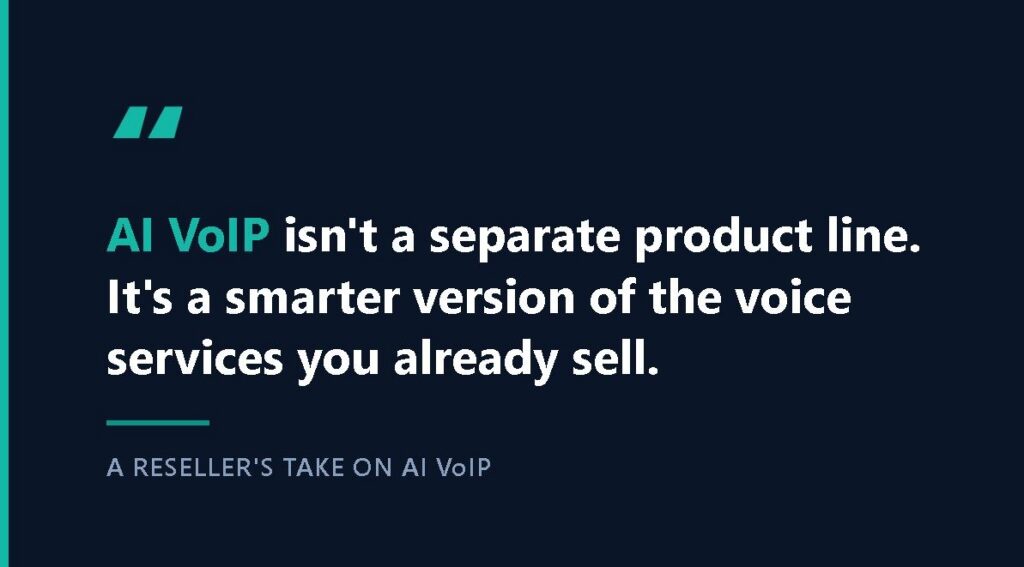
AI VoIP simply means voice over IP with intelligence layered in. Transcription, call summaries, smarter routing, and analytics that turn raw call data into something useful are all part of the picture. For a reseller, AI VoIP isn’t a separate product line so much as a smarter version of the voice services you already sell, which makes it a natural extension of your existing offering.
Native AI VoIP Features Beat Bolt-Ons
The most reliable AI VoIP experiences are built into the platform rather than stitched together from a handful of separate vendors. Native transcription and summarization inside a contact center, for example, means agents see full context without juggling extra tools or logins. Omnichannel views that bring voice, SMS, chat, and email into a single screen are a native contact center capability, not something an external integration bolts on after the fact. That distinction matters when you’re setting expectations, and it’s also why voice APIs are reshaping modern UCaaS for resellers who want to differentiate.

Where APIs Fit, and Where They Don’t
APIs are the bridges that connect the phone system to the other tools a business runs, like CRMs and databases, so a call can trigger a record lookup or enable click-to-call. APIs don’t store customer context; the CRM does. The API just moves information between systems so the right details show up at the right moment. Keeping that distinction clear helps you set accurate expectations with customers and avoid overpromising. As AI features continue to become standard inside modern UCaaS platforms, the resellers who understand how these pieces actually connect will sell with far more credibility.
How Can Resellers Stay Competitive with AI for SMB Communications?
Staying ahead requires a few deliberate moves that turn the AI trend into revenue you control. Here’s a practical playbook.
- Lead with AI as a conversation opener. Missed calls, after-hours coverage, and slow follow-ups are pain points every SMB feels. Use them as entry points that naturally expand into a broader UCaaS discussion.
- Bundle the outcome, not the buzzword. Package AI-ready features into tiered offerings like Bronze, Silver, and Gold so customers buy clear results instead of jargon they have to decode.
- Choose a platform that owns its roadmap. Features engineered on top of a proven core switch keep improving over time, which protects the brand you’re putting on the line.
- Own the customer relationship. Bill customers directly and provide branded support so the AI trend becomes recurring revenue you control rather than a one-off sale.
- Keep compliance in the story. SMBs worry about data privacy and shifting regulations, so position yourself as the partner who handles 10DLC, STIR/SHAKEN, and a geo-redundant network on their behalf.
- Move first. Launching quickly, in as little as 30 days with commitment, means you’re already selling while slower competitors are still evaluating their options.
Each of these plays builds on the fundamentals of successfully reselling UCaaS and VoIP. AI just raises the stakes and rewards the resellers who act with intention.
What Should You Look for in an AI-Ready UCaaS Platform?
Not every white-label platform is built to support this next wave, so it pays to evaluate carefully before you commit. The goal is a platform that delivers AI-ready capabilities today while investing in what’s coming next, all under your brand. A few things to prioritize:
- Native AI features like transcription, summarization, and smart routing through auto attendants, rather than third-party add-ons you have to manage separately.
- True white-label control so the solution looks and feels like your business, not someone else’s.
- Deep CRM and application integrations so customer context automatically flows into calls.
- A forward-looking voice AI roadmap, including an emerging voice AI API, so your offering keeps maturing.
- Geo-redundant infrastructure plus built-in billing, onboarding, and compliance support.
The platforms best positioned for the future of unified communications are treating AI as a core engineering investment, not a marketing checkbox. That same mindset shows up in strong white-label contact center strategies, where native capabilities consistently outperform patchwork solutions.
FAQs About AI for SMB Communications
Is AI VoIP secure enough for small businesses? Security depends heavily on the platform behind it. Look for geo-redundant infrastructure, 10DLC compliance, STIR/SHAKEN for caller verification, and clear data-handling practices. When AI VoIP features run on a platform with a strong compliance posture, small businesses get smarter communications without taking on extra risk.
Do resellers need to be AI experts to sell these tools? No. The value you sell is outcomes, not algorithms. A good white-label platform handles the underlying technology, so your job is matching the right features to each customer’s pain points and supporting the relationship over time. Plain-language conversations about saving time and capturing more leads will always beat technical jargon.
Will AI replace the human side of customer communication? For most SMBs, AI handles routine tasks so people can focus on high-value conversations. Position it as a force multiplier that frees up staff, not a replacement for them. That framing resonates far better with small business owners who care deeply about customer relationships.
How do AI communications tools tie into existing systems? Through native integrations and APIs that connect the phone system to CRMs and other business apps. The CRM stores the customer context, while the platform surfaces that information during calls and intelligently routes interactions. The cleaner those connections are, the more seamless the experience feels to the end user.
Staying Competitive Starts With the Right Platform
AI for SMB communications is shifting from a nice-to-have into a default expectation, and the resellers who win will be the ones who package it cleanly, own the customer relationship, and lean on a platform that keeps innovating. You don’t need to build AI yourself. You need a partner that builds it for you and lets you brand it as your own.
SkySwitch gives resellers a white-label UCaaS platform with native AI-ready features, a voice AI API on the horizon, and the billing, onboarding, and geo-redundant infrastructure to back it all up. Get started today and start selling smarter communications under your own brand.

Jessica is a marketing and sales strategist with deep expertise in VoIP telecommunications. As a Marketing Director, she specializes in channel marketing, account management, and product marketing within the communications industry. Jessica is passionate about helping partners grow through compelling messaging and hands-on support.