
AI for SMB Communications: A Reseller’s Complete Guide

AI is no longer an enterprise-only advantage, and small businesses now expect their communications tools to think, summarize, and route as well as they connect.
- Small business AI adoption has more than doubled in two years, turning “AI communications” into an active buying conversation rather than a future one.
- The biggest near-term wins come from features your customers already understand: call summaries, smarter routing, and unified customer context across channels.
- AI-powered UCaaS deepens recurring revenue because intelligent features make your solution stickier and harder to replace.
- The reseller opportunity is wide open, since most generalist guides ignore how MSPs and VARs can actually package and sell these capabilities.
If you want to stay your customers’ go-to communications advisor, now is the time to build an AI-ready offering rather than waiting for them to ask.
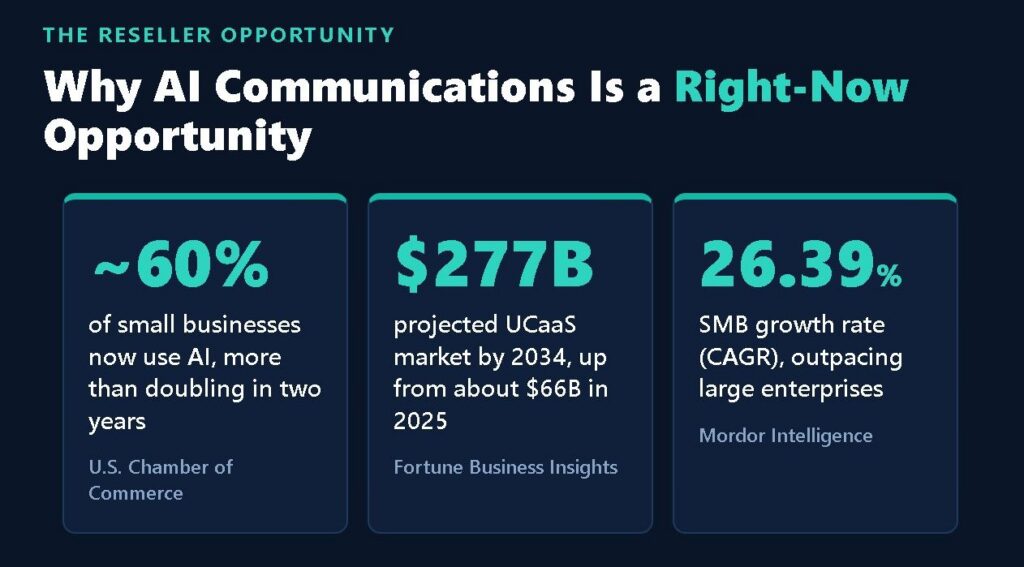
Small businesses are adopting artificial intelligence faster than almost anyone predicted, and that shift is rewriting what your customers expect from their phone systems. According to the U.S. Chamber of Commerce, nearly 60% of small businesses now use AI in some form, and 96% plan to adopt emerging technologies in the years ahead. For resellers, AI for SMB communications has moved from a “someday” idea to a “right now” opportunity because the companies you serve want smarter, faster, more connected ways to talk to their customers, and they’re looking to a trusted technology partner to deliver it.
This guide breaks down what AI business communications actually means, which features matter, where the revenue is, and how to roll it out without overcomplicating your business.
What Does AI for SMB Communications Actually Mean?
AI for SMB communications is the practical application of artificial intelligence to the everyday phone, messaging, and customer-interaction tools that small and midsize businesses already rely on. Instead of treating a phone system as plumbing that simply moves calls from one place to another, AI turns those same conversations into a source of summaries, insights, and automation. The goal is to give lean teams more leverage so a five-person front office can operate like a much larger one.
When building toward a white-label reseller program, the important thing is that AI business communications isn’t a separate product category bolted on from the outside. The smartest AI capabilities are built directly into modern UCaaS platforms, which means you can layer intelligent communications into the same voice solution you already sell. That keeps your offering simple to package, bill, and support.
From Connecting Calls to Understanding Them
For decades, a business phone system had one job: make sure calls connected and features worked. It was important but limited. AI changes the job description by helping the system understand what happens during a conversation, not only route it.
A modern, AI-powered UCaaS platform can transcribe a call, summarize the key points, surface the right customer record, and flag follow-up actions. None of that requires your customer to become a technologist. It happens inside the same client and portal they use every day, which is exactly why intelligent communications resonate with time-strapped small business owners.
How Is This Different From Old Automated Menus?
Buyers often confuse new AI features with the automated phone menus they already know. Auto attendants follow a fixed script and route based on the button a caller presses. They’re useful, but they don’t understand intent or context.
AI-driven features go further by interpreting what a caller actually needs and acting on it during the interaction. That might mean transcribing and summarizing a voicemail, capturing the follow-up items, or pulling up account history so an agent never has to ask a customer to repeat themselves. The difference is the gap between a recording and a genuinely smart assistant.
Why Are Small Businesses Adopting AI Communications So Fast?
The pace of adoption is economics. Small businesses are under constant pressure to do more with fewer people, and AI lets them stretch limited staff across more customer conversations without sacrificing responsiveness. When 96% of small business owners say they plan to adopt emerging technologies, that’s a clear signal that demand is already in your customer base.
The underlying market is expanding right alongside that demand. The UCaaS market is on track to grow from about $66 billion in 2025 to roughly $277 billion by 2034, according to Fortune Business Insights. That growth tells you the migration from premises-based phone systems to cloud communications is far from over, and AI is now the headline reason businesses upgrade.
Where Do Resellers Fit In This Shift?
Resellers sit in the perfect spot to capture this momentum because small businesses rarely want to evaluate AI platforms on their own. They want a knowledgeable local partner who can recommend the right capabilities, set them up, and stand behind them. That advisory role is hard to outsource and even harder to commoditize.
Research from Mordor Intelligence shows that small and midsize businesses are closing the adoption gap in the UCaaS market, growing faster than large enterprises at a 26.39% CAGR as self-service portals and mobile clients erase the need for on-site hardware. That is your addressable market, and AI is the differentiator that helps you win it instead of competing on price alone. The trends shaping the future of unified communications point in the same direction: platforms that bake in intelligence will pull ahead of those that only connect calls.
Which AI Capabilities Should You Be Ready to Sell?
Before you can effectively position AI for SMB communications, you need to know which features deliver obvious, explainable value. Your customers don’t buy “AI.” They buy fewer missed calls, shorter handle times, and cleaner follow-up. The capabilities below translate directly into outcomes a small business owner cares about, and most are already part of a capable AI phone system rather than expensive add-ons.
Here are six AI capabilities worth understanding and packaging:
- AI call summaries and transcription. After a call ends, the system produces a written transcript and a short summary of what was discussed and decided. That saves agents from scribbling notes and gives managers a searchable record of customer conversations. For busy teams, this single feature often justifies an upgrade on its own.
- Voicemail-to-text. Missed calls become readable, prioritizable messages instead of a queue of audio recordings. Owners and field staff can triage voicemails between jobs without stopping to listen to each one. It’s a small feature with an outsized impact on responsiveness.
- Intelligent call routing. Beyond a fixed menu, smart routing uses skills, availability, and context to send each caller to the person most likely to help them quickly. Fewer transfers mean happier customers and shorter calls. This aspect is where an AI phone system starts to feel meaningfully better than a legacy setup.
- AI-assisted customer context. When a known customer calls, the right account record can automatically pop onto the agent’s screen. The intelligence lives in the integration that surfaces the data at the right moment, while the customer history itself stays in the CRM where it belongs. That distinction matters when you explain how the pieces fit together.
- Conversation analytics. Aggregated insights from calls, texts, and chats help a business spot patterns: peak hours, common questions, and recurring issues. Owners use this data to staff smarter and fix problems before they grow. It turns everyday communication into a planning tool.
- Built-in compliance and security guardrails. As AI touches more customer data, businesses need confidence that interactions stay private and properly governed. Platforms that bundle strong security and compliance features make AI adoption far less intimidating for cautious SMBs. This category is increasingly a deciding factor, not an afterthought.
A practical way to introduce these features is to map each one to a pain point your customer has already complained about. If they hate writing call notes, lead with summaries. If they miss after-hours calls, lead with voicemail-to-text and routing.
How Does AI Improve Customer Experiences Over the Phone?
The clearest payoff of AI voice communications shows up in the customer experience, where small frustrations add up fast. Long hold times, repeated transfers, and agents who ask the same questions over and over all erode trust. AI tackles these friction points by making the first layer of every interaction more responsive and better informed.
When customer context automatically surfaces, an agent can greet a caller already knowing who they are and why they’re likely calling. That removes the dreaded “can you repeat your account number” moment and shortens the path to a resolution. The conversation feels personal even when the team behind it is small.

What About Connecting Voice, Text, and Chat?
A big part of a modern customer experience is meeting people on whatever channel they choose. Bringing voice, SMS, web chat, and email into a single view is a native capability of a true contact center platform, not something you have to stitch together with custom code. Agents see the full thread of a relationship in one place, regardless of how each message arrived.
Here, intelligent communications and AI features compound each other. A unified interaction history plus AI summaries means an agent can pick up any conversation with full context in seconds. If you want to go deeper on packaging this for customers, these white-label contact center strategies are a useful next read.
Keeping AI Voice Realistic for SMB Buyers
It’s worth setting honest expectations with customers about AI voice communications. The technology is advancing quickly, and the most reliable wins come from augmenting your customer’s team rather than removing it. Position AI as a way to handle routine work and arm staff with better context, so the human conversations that matter get the attention they deserve. That framing builds trust and avoids overpromising on capabilities that are still maturing across the industry.
What’s the Opportunity in AI for MSPs?
AI for MSPs is one of the most underrated growth stories in the channel right now, and it works on two levels. First, MSPs can use AI-powered communications internally to handle their own client calls, tickets, and after-hours coverage more efficiently. Second, and more importantly for revenue, they can resell these capabilities to the small businesses they already serve.
That second motion is where the recurring revenue lives. An MSP that already manages a client’s network and security is the natural choice to also modernize their phone system. Adding AI for MSPs turns a one-time hardware conversation into a monthly, margin-rich service relationship, and a flexible communications platform makes it easy to tailor offerings client by client.
Why MSPs Win the AI Communications Conversation
MSPs have a trust advantage that pure-play vendors can’t match. You already understand your clients’ systems, their data, and their day-to-day headaches. When AI raises questions about integration, security, and change management, you’re the partner who can answer them.
That advisory position is durable. Clients don’t casually switch trusted partners, especially when those partners are helping them safely adopt new technology. A well-run partner program gives you the tools, training, and economics to make this motion repeatable, and you can see how a strong partner program drives long-term retention and growth.
How Do You Roll Out AI-Powered Communications?
The biggest mistake resellers make with AI for SMB communications is trying to launch everything at once. A focused, phased rollout almost always beats a big-bang approach, both for you and for your customers. The most successful partners start with one high-value capability, prove it, and expand from there.
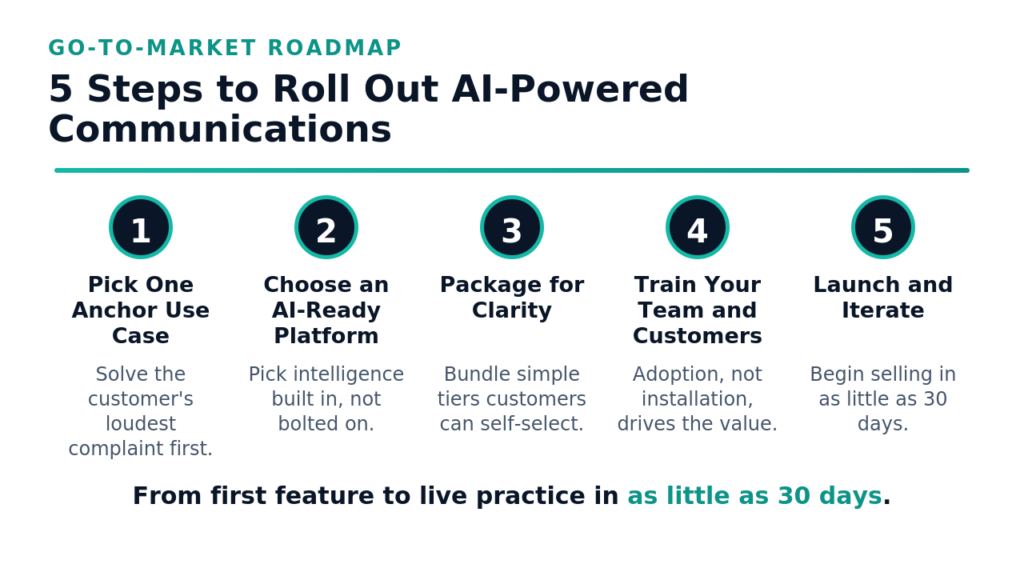
Here’s a practical roadmap to get to market quickly:
- Pick one anchor use case. Choose the AI feature that solves your customers’ loudest complaint, often call summaries or voicemail-to-text. Leading with a single, obvious win makes the value impossible to miss.
- Choose an AI-ready platform. Select a UCaaS solution where intelligent features are built in, not bolted on, so you can scale capabilities without rebuilding anything. The underlying voice APIs power intelligent features that let you extend and customize as customer needs grow.
- Package for clarity. Bundle AI capabilities into simple tiers, such as Basic, Standard, and Pro, so customers can self-select. Clear packaging speeds sales cycles and reduces support questions later.
- Train your team and your customers. Make sure your staff can confidently demo the features and that customers know how to use them. Adoption, not installation, is where AI value is realized.
- Launch and iterate. With a turnkey, white-label platform and the right onboarding, committed partners can begin selling a modern voice practice in as little as 30 days. From there, you add capabilities as customers grow more comfortable.
Self-service provisioning, native platform automation, and integrated billing make this roadmap realistic for a small reseller. They remove the operational drag that would otherwise make AI feel like a heavy lift.
What’s the ROI of AI-Powered UCaaS for Resellers?
The return on AI-powered UCaaS shows up in revenue, retention, and efficiency. On revenue, cloud-based reselling runs on a monthly recurring model, and intelligent features let you command healthier pricing because you’re selling outcomes, not minutes. Margins on a well-packaged white-label offering can reach up to 70%, depending on how you build your bundles.
On retention, AI makes your solution stickier. Once a customer relies on call summaries, smart routing, and unified customer history, switching providers means giving up workflows their team now depends on. That hurdle raises switching costs in your favor and protects your recurring base.

Where Do the Cost Savings Come From?
The efficiency story is grounded in the fundamentals of cloud communications, not in any single AI claim. Moving customers off premises-based hardware eliminates the overhead of maintaining and upgrading on-site PBX equipment. Self-service provisioning and native automation reduce the manual work your own team has to do per customer.
Layered on top, AI features help your customers’ lean teams handle more conversations without adding headcount, which is the outcome small businesses care about most. When you can show a prospect how AI for SMB communications saves their staff hours every week while improving the customer experience, the ROI conversation gets a lot easier. That combination of cloud economics and intelligent features is what makes AI-powered UCaaS a compelling long-term bet for resellers.
Frequently Asked Questions About AI for SMB Communications
Is AI for SMB communications only for tech-savvy businesses? No. The most valuable features, like call summaries and voicemail-to-text, work in the background of tools customers already use. A small business owner doesn’t need to understand AI to benefit from it, which is why adoption is climbing across traditionally cautious industries.
Does adding AI mean replacing my customer’s phone system? Not usually. Because intelligent features are increasingly native to modern UCaaS platforms, customers can adopt AI by upgrading their existing cloud communications rather than ripping anything out. For businesses still on premises-based hardware, it’s a natural moment to migrate to the cloud.
How is an AI phone system different from a standard VoIP setup? A standard VoIP system focuses on connecting calls reliably. An AI phone system adds a layer of understanding on top, transcribing, summarizing, routing intelligently, and surfacing customer context, so the same call produces more value with less manual effort.
Will AI handle customer data securely? It can, provided the platform is built with security and compliance in mind. As AI touches more interactions, businesses should choose solutions that bundle strong data protection and governance, and resellers should be ready to confidently speak to those safeguards.
How quickly can a reseller start selling AI-powered communications? With a turnkey white-label platform and a focused rollout plan, committed partners can launch a modern voice practice in about 30 days. Starting with one anchor feature and expanding from there is the fastest path to revenue.
Build Your AI-Ready Communications Practice
AI for SMB communications has crossed the line from emerging trend to active customer demand, and the resellers who build an intelligent, AI-powered offering now will own the relationships that matter for the next decade. The opportunity rewards partners who can advise, package, and support, which is precisely the role MSPs, VARs, and system integrators are built to play. The technology is ready, the market is growing, and your customers are already asking the questions.
SkySwitch gives you everything you need to deliver intelligent, white-label communications under your own brand, from a turnkey UCaaS platform to onboarding, training, and the support to back it all up. Adding AI-powered communications to your portfolio builds a stickier, more profitable business. Get started with SkySwitch today and turn the AI opportunity into recurring revenue.

Jessica is a marketing and sales strategist with deep expertise in VoIP telecommunications. As a Marketing Director, she specializes in channel marketing, account management, and product marketing within the communications industry. Jessica is passionate about helping partners grow through compelling messaging and hands-on support.