
AI Communications for SMBs: A Practical Feature Checklist

AI communications for SMBs has moved from a future add-on to an active buying conversation, and resellers who can define it plainly and demo it fast will win the 2026 upgrade cycle.
- Nearly six in ten small businesses already use generative AI somewhere, but almost none have pointed it at the phone system, where the most repetitive work happens.
- The features that close deals are intelligent call routing, transcription, call summaries, analytics, and automation that writes back into the tools clients already use.
- SMB buyers prefer AI switched on inside a platform they already trust over a separate tool with its own login, contract, and support line.
- Predictable pricing and clear answers on data handling matter as much as capability, especially for clients with no IT staff.
Build one standardized feature checklist you can walk a prospect through in 15 minutes, then sell the platform that lets you demo every item on it without stitching together an integration.
Your clients already use AI to draft marketing emails, clean up their books, and write job postings. What almost none of them have done is aim any of it at the phone, where the most expensive and repetitive work in a small business still happens every day. Nearly six in ten small businesses now report using generative AI, up from 40% the year before, so the question has shifted from whether AI belongs in the business to which system it should touch next.
That opening belongs to you. AI communications for SMBs is the most concrete answer an owner can act on because the pain is measurable: missed calls, voicemail nobody returns, staff answering the same five questions all day. This guide covers what the category includes, which features matter at the point of sale, and how to evaluate a white-label communications platform before building an offer.
What Does AI Communications for SMBs Actually Cover?
The term gets used loosely, which works against you in a sales conversation. When a prospect hears “AI phone system,” they picture either a magic robot receptionist or the automated menu that made them hang up last week. Clearing that up early is half the sale.
AI communications for SMBs describes capabilities layered onto a cloud voice platform, where machine intelligence handles or assists with conversations across voice, text, and chat. It sits on top of standard unified communications functionality rather than replacing it. Your client keeps their numbers, extensions, auto attendants, and queues, and the AI adds a layer that understands what a caller wants, acts on it, and documents what happened.
The Three Layers Your Clients Are Buying
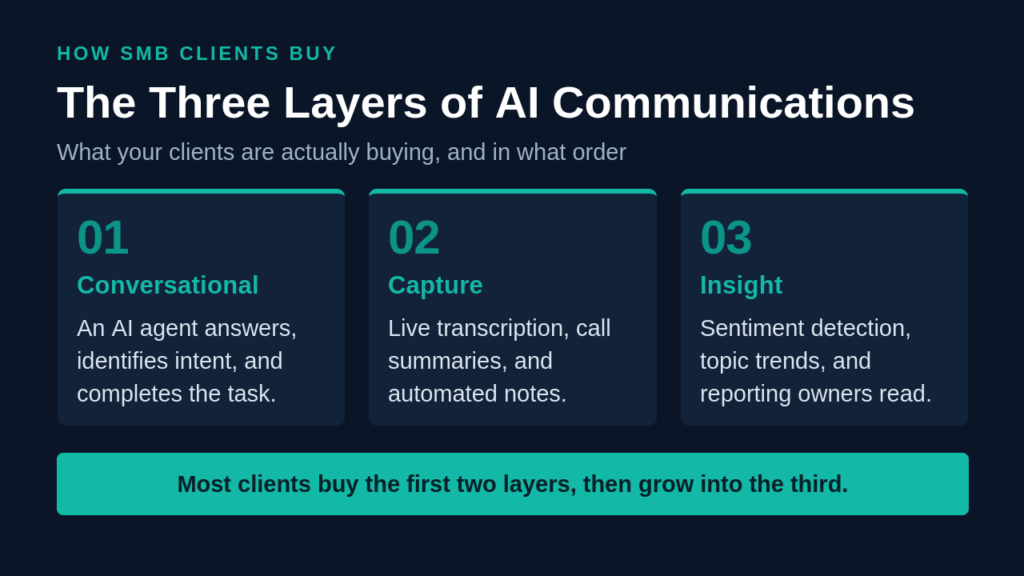
Breaking the category into tiers helps because clients rarely need all three on day one, and pricing them separately protects your margin. The first tier is conversational handling, where an AI agent answers, identifies intent, and completes a task like booking an appointment. The second is capture, and it includes transcription, summaries, and automated notes. The third is insight, such as sentiment detection, topic trends, and reporting on what customers keep calling about. Most clients get value from the first two, then grow into the third.
Why the Definition Matters at the Point of Sale
A prospect who can’t articulate what they’re buying will stall the deal, no matter how good your demo was. Clean language positions you as the advisor rather than the order taker, and it heads off the comparison shopping that starts when a buyer assumes every AI phone system for small business use is the same product. The differences show up fastest in deployment time and billing.
Why Are SMBs Buying AI Communications Now?
Small businesses spent three years watching larger companies absorb the cost of failed AI pilots, and that patience is paying off. The tools got cheaper, simpler, and far more likely to be built into software they already own. The adoption data shows how much room is left in the market. Federal Reserve researchers tracking business surveys found that about 18% of U.S. firms had adopted AI as of year-end 2025, with more than 20% expecting to start in the first half of 2026. That large group is shopping with no incumbent vendor in this category.
The Staffing Math Behind the Demand
Here is the constraint shaping every SMB conversation this year. IDC found that 40% of nearly 3,000 SMBs surveyed have no full-time IT employee, and a third named a lack of IT staff as a top challenge. These businesses won’t configure a voice AI platform themselves and troubleshoot it when a call flow breaks.
That pain point is your value proposition. You’re not selling software. You’re selling the fact that someone competent will set it up, connect it to what they already use, and pick up the phone when it misbehaves.

Embedded Beats Bolt-On
The same research found SMBs seeing real results are turning on AI already inside platforms they use daily, rather than adding standalone point solutions. The logic is obvious once a client says it out loud: no new interface, no second implementation, no additional vendor to vet.
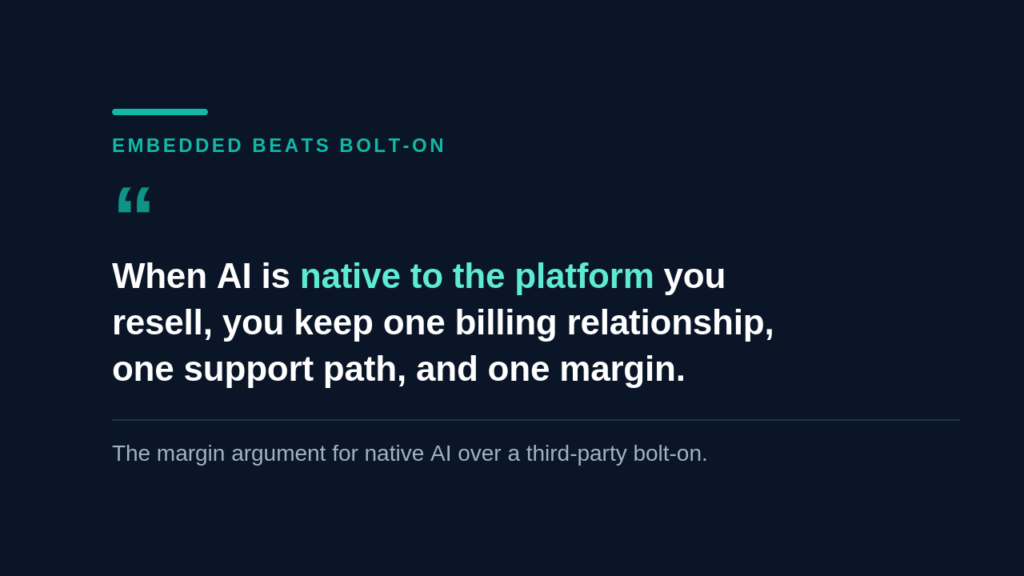
The economics work the same way for you. When AI is native to the platform you resell, you keep one billing relationship, one support path, and one margin. When it’s a third-party layer on top of your voice service, you inherit thin margins, a second support queue, and a finger-pointing problem the first time something breaks mid-call.
Which Features Matter Most in Small Business Communications?
Feature lists are long and mostly noise. These four categories come up in real evaluations, roughly in order of how much clients care.
AI Call Routing and Caller Intent Detection
Traditional routing asks the caller to translate their problem into a menu number. AI routing asks what they need, listens, then sends the call to the right person or workflow without anyone pressing a key. The strongest implementations deploy as a number or extension inside the existing phone system, so the agent provisions like any other endpoint your team knows. Human escalation stays available throughout, which is the reassurance nervous buyers need before signing.
Transcription and Automated Call Summaries
Transcription is the easiest feature to demo and gets the fastest reaction. Live transcription creates a searchable record of every conversation, serving compliance, training, and the everyday problem of remembering what a customer said three weeks ago. Voicemail transcription lets a busy owner scan messages instead of playing them. Summaries condense a call into a few lines with key details pulled out, and automated wrap-up notes remove real after-call work from a team that never had time for it.
Conversation Analytics and Sentiment
Analytics is where AI UCaaS produces insight rather than just efficiency. Sentiment detection flags conversations that went badly, and topic identification surfaces what customers keep asking about, often revealing a broken process nobody had visibility into. Note that sentiment, agent assist, and smart wrap-up are usually contact center capabilities rather than core platform features, so scope them accordingly. Be honest about who needs this: a four-person plumbing outfit does not yet, but a 20-seat clinic does.
Workflow Automation and Integrations
This category is where SMB communication tools stop being a phone system and start being infrastructure. Calendar integration means the AI books the appointment instead of promising a callback. CRM integration means that the call, summary, and disposition automatically land in the customer record. SMS integration lets a voice conversation continue by text from the same agent. Set expectations correctly. An integration is a bridge between the phone system and the application holding the data, and the CRM stays the system of record.

Your 2026 AI Communications for SMBs Feature Checklist
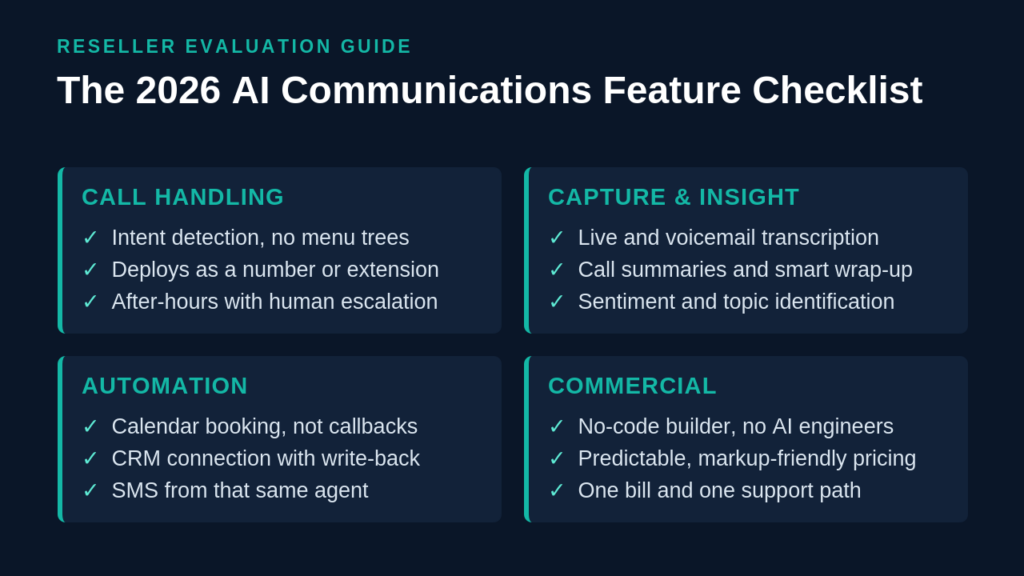
Put this list in your discovery deck and walk prospects through it when you evaluate SMB communication tools. If a platform cannot check most of these boxes natively, you’ll integrate your way to a thinner margin.
Call handling
- Conversational agent that deploys as a number or PBX extension
- Caller intent detection with intelligent routing, no menu trees required
- Receptionist, customer service, and sales roles available out of the box
- After-hours coverage with no added headcount, plus human escalation at any point
- Unlimited concurrent calls without seat additions
Capture and insight
- Live call transcription and voicemail transcription
- Automated call summaries and smart wrap-up with disposition suggestions
- Sentiment detection and topic identification across conversations
- Reporting that a non-technical owner can actually read
Automation and integration
- Calendar integration for real appointment booking
- CRM connection with automatic write-back
- SMS integration from the same agent
- Multi-lingual detection with mid-conversation switching
Commercial
- No-code builder so you can deploy without dedicated AI engineers
- Predictable pricing you can mark up cleanly
- One bill and one support path for the customer
- Documented answers on data handling and retention
How Should You Package and Price AI UCaaS for SMB Clients?
Capability gets you shortlisted. Packaging gets you paid. Small business buyers are sensitive to costs they cannot forecast, and IDC’s research names unpredictable pricing as a primary source of broken trust when a bill triples after crossing an invisible usage tier. Per-minute pricing with volume-based discounting solves most of that. Your cost of goods is legible, your margin is legible, and the client is not surprised. On a platform where AI is engineered in rather than resold, partner margins can reach up to 70%.
Bundle It or Sell It À La Carte
Both work. Bundling AI into a premium tier lifts average revenue per seat and simplifies quoting. Selling à la carte lets you land it as a targeted fix for one problem, usually after-hours coverage or appointment no-shows, then expand. Either way, keep control of the markup and the customer relationship. That control is the point of the white-label reseller model, and it separates recurring revenue from an agent commission someone else can reprice.
Frequently Asked Questions
What is AI communications for SMBs?
It describes AI capabilities built into a cloud communications platform that handle or assist with conversations across voice, text, and chat. For a small business, that means an AI agent that answers calls and identifies caller intent, plus transcription, summaries, and analytics around it.
Do small businesses need a separate AI vendor for this?
No, and steering them toward one is usually a mistake. These capabilities are increasingly native to modern platforms, meaning no middleware, no second support line, and no third-party margin in the price. Clients with lean IT staff prefer switching on a feature inside a platform they already use.
How long does it take to deploy an AI phone system for small business clients?
With a no-code builder, a receptionist or customer service configuration can often be built and published in a single working session. Complexity comes from integrations and call flow design rather than the AI itself, so budget project time for discovery.
Will AI replace the client’s front-desk staff?
That framing will lose you deals. The value is offloading repetitive, high-volume interactions so staff can handle work requiring judgment. Human escalation should always be available, and the best ROI stories come from businesses that redeployed staff rather than cut them.
Which verticals are the easiest sell right now?
Healthcare, real estate, and retail all have quantifiable pain. Practices feel it in appointment no-shows, agencies lose leads to faster responding competitors, and retailers face seasonal spikes they cannot staff for. Each has a number attached, which shortens the cycle.
Getting Started With AI Communications for Your SMB Clients
The category is early enough that most prospects have no incumbent vendor and mature enough that the technology works. That status won’t last. Resellers who standardize their checklist now, get comfortable demoing these small business communications features, and build a repeatable packaging model will be positioned before the market fills in behind them.
The platform makes it repeatable, so look for AI engineered into the core features rather than resold from somebody else. SkySwitch builds its AI Agent and supporting AI stack directly into its white-label UCaaS platform, giving partners native capability, one billing relationship, and margins worth building a practice on. Get started with SkySwitch to see the platform, the margins, and the path to your first AI customer.

Jessica is a marketing and sales strategist with deep expertise in VoIP telecommunications. As a Marketing Director, she specializes in channel marketing, account management, and product marketing within the communications industry. Jessica is passionate about helping partners grow through compelling messaging and hands-on support.