
AI-Powered Business Phone Systems: What SMBs Need to Know Before Upgrading

AI-powered business phone systems are worth the upgrade when the intelligence is engineered into the platform itself, not bolted on through a third-party tool.
- Adoption is lopsided. Large firms are running well ahead of small ones on AI, which means your SMB clients are behind and know it.
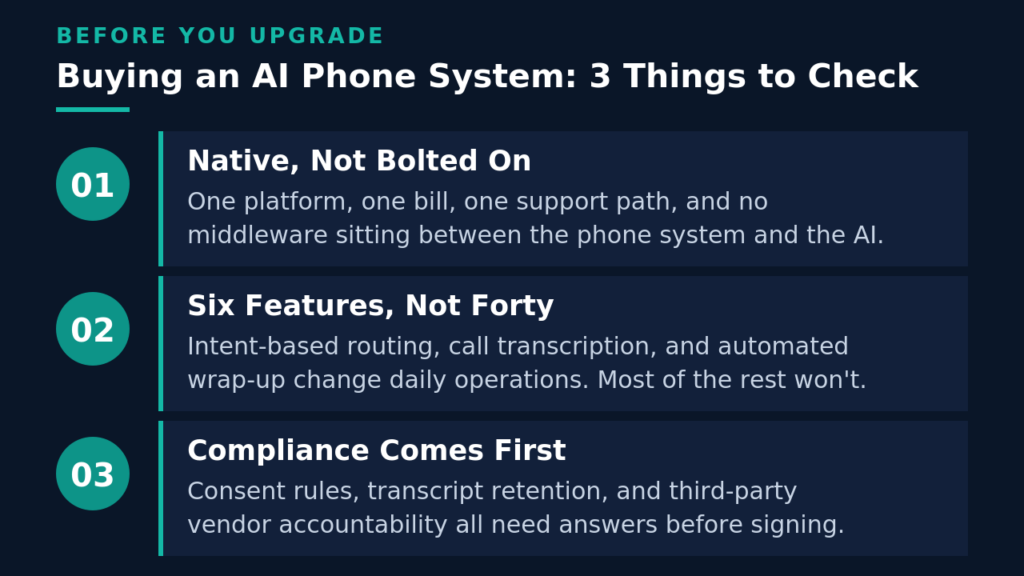
- Native beats integrated. One platform, one bill, one support path, and no middleware sitting between the phone system and the AI.
- Compliance is the part nobody explains. Outbound AI voice sits under existing telecom rules, and recording plus transcription introduces data questions most SMBs have never considered.
- The buying conversation is about workload, not technology. Clients care about missed calls, after-hours coverage, and staff time, so lead there.
Start your client conversations with a single department and measurable problem, then expand once the first win is on paper.
Your SMB clients are starting to ask about AI on their phone system, and most of them can’t tell you what they actually want it to do. That gap is your opening. Census Bureau survey data put overall business AI use between 17% and 20% from December 2025 through May 2026, with 37% of firms with 250+ employees reporting use compared with under 20% of firms with four or fewer employees.
Small businesses aren’t refusing AI. They’re waiting for someone to package it in a way that fits how they operate. AI-powered business phone systems are the easiest place to begin that conversation because the phone is already the system every small business depends on to make money. Here is what your clients need to understand before they upgrade and how you position a modern cloud communications platform as the answer.
What Are AI-Powered Business Phone Systems?
AI-powered business phone systems are cloud phone platforms that use natural language understanding to interpret what a caller says, act on it, and generate structured records of the conversation afterward. The distinction that matters is between systems that follow a script and systems that understand intent. A menu tree waits for a keypress. A conversational agent listens to “I need to move my Thursday appointment to next week” and handles it without ever presenting a list of options.
That difference is easy to demo and hard to argue with, which is why it converts well in front of a skeptical owner.
How an AI Phone System Differs From Traditional Auto Attendants
Auto attendants have been standard on hosted voice for two decades, and they work fine for simple, predictable call flows. The limitation is rigidity. Every path has to be mapped in advance, and any caller whose need falls outside the map either gets routed wrong or gives up. An AI phone system handles the unmapped cases, which in most small businesses is the majority of inbound volume.
The second difference is what happens after the call ends. A traditional system logs a duration and a number. An AI system produces a transcript, summary, and disposition, which turns every call into searchable business data instead of a line item on a bill.
Why “Native” Matters More Than the Feature List
Most AI voice tools on the market are separate products that connect to a phone system through an integration layer. That means two vendors, two invoices, two support numbers, and a handoff point that breaks. When a call drops mid-conversation, your client calls you, and you get to figure out which vendor owns the failure.
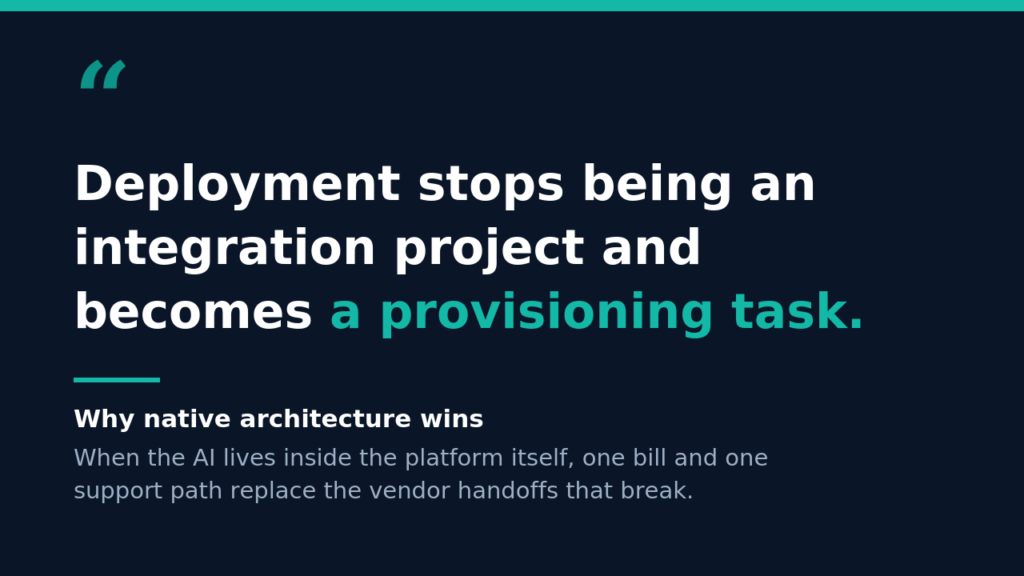
When the AI lives inside the cloud-based unified communications platform itself, the agent gets assigned a number or registered as an extension in the customer’s PBX. Deployment stops being an integration project and becomes a provisioning task, which is the whole ballgame for a reseller supporting dozens of small accounts.
Which Business Phone AI Features Actually Matter?
Vendors will hand your clients a list of 40 capabilities. Most SMBs will use six. Focus the evaluation on the ones that change daily operations rather than the ones that demo well, and be honest with clients about which features they will realistically turn on in year one.
Here are the business phone AI features worth insisting on:
- Caller intent detection and AI call routing. The agent identifies why someone is calling and either routes them or handles it outright. AI call routing removes the most friction because it eliminates the menu.
- Call transcription. Every conversation becomes text. Call transcription supports training, dispute resolution, and searchable history, and clients consistently underestimate it before they have it.
- Summarization and automated wrap-up. Post-call notes and disposition suggestions written automatically. This feature is where staff time savings show up first.
- Sentiment and topic detection. Patterns across conversations surface what customers keep complaining about.
- Appointment booking and calendar sync. For any practice, agency, or service business, this feature is the most valuable automation on the list.
- Multi-lingual handling and SMS. One agent covering voice and text, switching languages mid-conversation without a separate deployment.
A platform where these AI capabilities live inside the UCaaS stack gives you a much cleaner story than assembling the same outcomes from three vendors. It also gives your client one place to go when something needs to change.
How Do Different Departments Use an AI Business Phone System?
The mistake most resellers make is pitching an AI business phone system to the whole company at once. Departments have different pain points, budgets, and tolerances for automation. Segment the conversation, and the deal gets easier to close.

Front Office and Reception
This department is the fastest win and the easiest ROI story. An AI receptionist answers overflow and after-hours calls, books appointments, confirms details, and handles routine questions about hours, location, and services. For medical practices, no-show reduction is the number that lands because it maps to revenue that the client has already lost and can name.
The pitch isn’t to replace the front desk. It’s letting the front desk stop answering the same four questions 90 times a week.
Sales Teams
Speed to lead decides most competitive deals, and small sales teams are structurally bad at it because the people who should respond are usually with a customer. An AI agent engages inbound inquiries immediately, qualifies intent, and hands warm prospects to a live rep. Real estate brokerages feel this pain acutely, since leads arrive at all hours while agents sit in showings.
Customer Support
Support is where transcription, sentiment detection, and live agent assist do the most work. Routine status and policy questions get handled without a queue, and complex issues reach a human faster because the simple traffic is gone. If your client already runs queues and skills-based routing, the AI layers into that setup rather than replacing it. Understanding how contact center and UC platforms differ helps you scope the right product for the account.
What Changes When You Upgrade From a Traditional System?
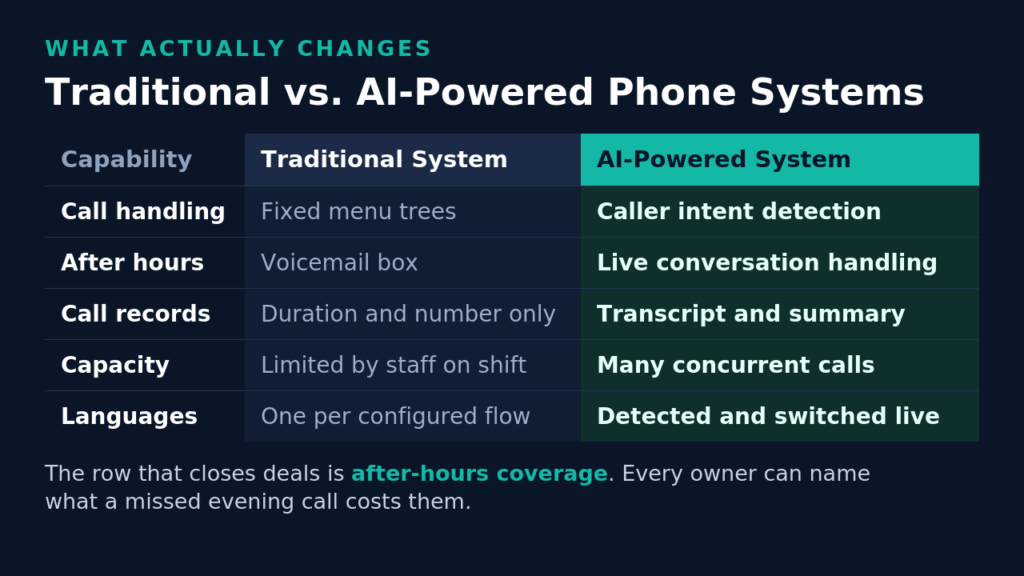
Clients evaluating an upgrade need to see the delta plainly. Here is how a conventional cloud phone system compares with an AI-enabled one across the areas SMBs ask about most.
| Capability | Traditional cloud phone system | AI-powered business phone system |
| Call handling | Menu trees and fixed routing rules | Caller intent detection with intelligent routing |
| After-hours coverage | Voicemail or answering service | Live conversational handling, no added headcount |
| Call records | Duration, number, optional recording | Full transcript, summary, and disposition |
| Concurrent capacity | Limited by staff and seat count | Handles many simultaneous conversations |
| Appointment booking | Manual callback | Booked and confirmed during the call |
| Insight into call topics | Manual review of recordings | Automated sentiment and topic detection |
| Setup effort | Provisioning and call flow config | Provisioning plus no-code agent building |
| Languages supported | One per configured flow | Automatic detection and mid-call switching |
The row that closes deals is usually after-hours coverage because every SMB owner can immediately name what a missed evening call costs them.
What Security and Compliance Questions Should SMBs Ask?
This is the section your competitors skip, and it’s the one that builds trust with a cautious buyer. Get ahead of it.
Outbound AI voice is regulated. The FCC ruled in February 2024 that calls made with AI-generated voices count as “artificial” under the Telephone Consumer Protection Act, which means existing consent, identification, and opt-out requirements apply. Inbound answering is a different situation than outbound campaigns, so make sure your client knows which side of that line their use case sits on.
Recording and transcription create records. Once conversations become text, they are discoverable, storable, and subject to whatever retention obligations your client already carries. Ask where transcripts live, how long they are kept, who can access them, and whether the data trains anything. Recording consent rules also vary by state.
Regulated verticals need extra scrutiny. Healthcare clients need AI handling inside the same compliance envelope as the rest of their voice service. If you sell into practices, understand how HIPAA-compliant voice services work before you scope the deal.
Third-party AI risk is your risk. The NIST AI Risk Management Framework explicitly calls for policies addressing AI risks arising from third-party software and supply chain relationships, along with monitoring of third-party AI components over time. Translated for a small business: the fewer vendors in the chain, the fewer places accountability can disappear. A native platform gives you one entity to hold responsible.

What Should Clients Ask Before They Sign?
Give your clients a short list they can take into any vendor conversation. It positions you as the advisor rather than the salesperson, and it tends to expose weaknesses in competing proposals.
- How is the AI deployed, as a native extension or through a separate integration?
- Who answers the phone when the AI misbehaves at 4 p.m. on a Friday?
- Can a caller reach a human at any point, and how is that escalation configured?
- How is it priced, and does the cost scale predictably with call volume?
- What happens to transcripts and recordings, and for how long?
- How long does a change to the call flow take, and can our team make it ourselves?
That last question separates real products from demos. A no-code, drag-and-drop builder means you can adjust a client’s flow in an afternoon instead of filing a professional services request.
How Do MSPs and Resellers Introduce AI to Existing Accounts?
Bring AI-powered business phone systems into the conversation when a client is expanding hours, opening a location, complaining about front-desk turnover, or heading into a seasonal volume spike. Those are the moments when the cost of the status quo is already on their mind.
Start narrow. One department, one measurable outcome, 30 days of data. Once the client can see the transcripts and the after-hours capture, expanding becomes a conversation about scope rather than a debate about whether AI works.
The economics work in your favor when the AI is native. Per-minute pricing with volume discounts means a predictable cost of goods, you set your own markup, and you keep the customer relationship. Because you are selling under your own brand, the AI strengthens your offering rather than introducing another vendor logo into your accounts. Committed partners can be up and selling a white-label voice practice in as little as 30 days.
Frequently Asked Questions
Will an AI phone system replace our receptionist?
No, and you should not sell it that way. The realistic framing is offloading repetitive, low-value interactions so staff can handle the work that requires judgment. Human escalation stays available at every point in the call flow.
How accurate is call transcription in real conditions?
Modern speech recognition handles clear business conversations well, though accuracy varies with background noise, accents, and industry-specific vocabulary. Run a pilot on the client’s actual call traffic before promising anything.
Do AI-powered business phone systems require an IT team?
Not with a no-code builder. Call flows are assembled through a drag-and-drop interface, so you or the client can configure and adjust agents without dedicated AI engineers. More complex builds may warrant professional services.
Is AI call routing better than a standard auto attendant?
For most SMBs, yes, because AI call routing understands unscripted requests instead of requiring the caller to match their need to a preset menu option. Simple, low-volume call flows may still be served fine by a standard auto attendant.
What does an AI business phone system typically cost?
Pricing is usually per minute of AI handling rather than per seat, so the cost tracks with actual usage. That model suits SMBs with uneven call volume and lets you build a predictable margin into your packaging.
Bringing AI Into Your Communications Offering
AI-powered business phone systems have moved from novelty to buying criteria faster than most channel partners expected, and your clients are going to ask. The partners who win these conversations can explain the architecture, handle the compliance questions honestly, and start small with a measurable outcome instead of overselling a platform-wide transformation.
SkySwitch builds AI directly into its white-label UCaaS platform, so you can sell, configure, and bill the AI Agent under your own brand with one support channel and one billing relationship. Get started with a conversation about what adding native AI would look like in your UCaaS lineup.

Jessica is a marketing and sales strategist with deep expertise in VoIP telecommunications. As a Marketing Director, she specializes in channel marketing, account management, and product marketing within the communications industry. Jessica is passionate about helping partners grow through compelling messaging and hands-on support.