
White-Label UCaaS for MSPs: Packaging AI Communications

White-label UCaaS for MSPs has shifted from a voice resale play into an AI-enabled communications practice you can brand, price, and support yourself.
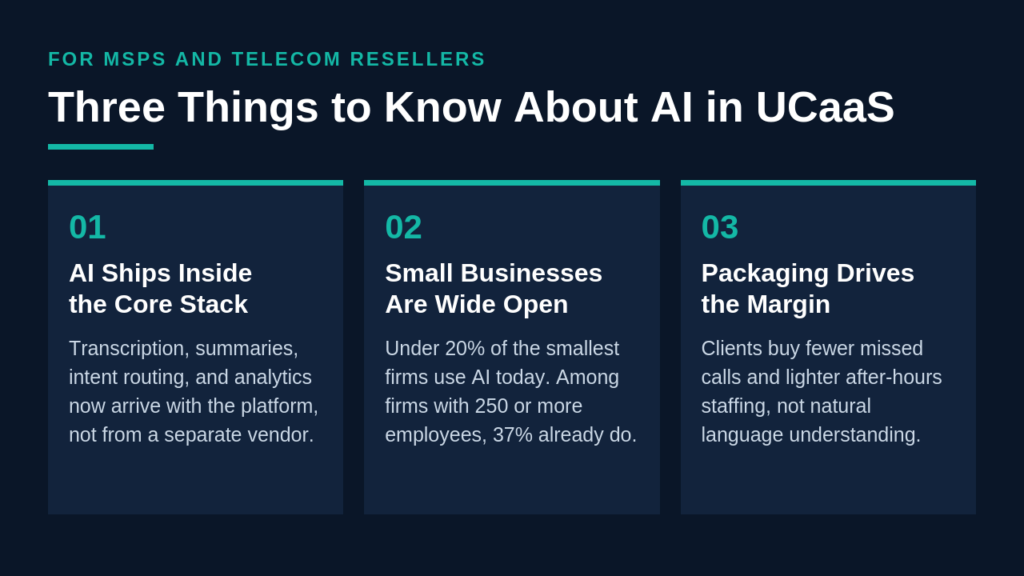
- Features that were enterprise-only two years ago now ship inside mainstream UCaaS platforms, including call transcription, automated summaries, intent-based routing, and conversation analytics.
- Your SMB clients are the slowest AI adopters in the market, which puts you in a position to introduce it rather than react to it.
- Native AI beats bolt-on AI on margin, deployment speed, and support because you keep one platform, one bill, and one support path instead of stacking a third-party vendor on top.
- Packaging beats feature lists, since clients buy fewer missed calls and less after-hours staffing, not natural language understanding.
Pick a platform where AI lives in the core stack, then build your tiers around outcomes clients can measure.
Your clients aren’t asking whether AI belongs in their phone system anymore. They’re asking whether you can deliver it, support it, and explain what it costs. That raises the bar for any cloud communications platform you resell.
As of May 2026, roughly one in five U.S. businesses reported using AI in a business function, according to Census Bureau data. Adoption reaches 37% among firms with at least 250 employees but sits under 20% for firms with four or fewer. Your typical SMB client sits on the low end of that curve, having heard about AI for three years and implemented almost none of it, largely because nobody they trust has handed them something simple enough to say yes to.
That gap is the opportunity. White-label UCaaS for MSPs lets you deliver AI-enabled communications under your own brand without building anything, hiring AI engineers, or adding a second vendor to an account you own.
What Does White-Label UCaaS for MSPs Include in 2026?
UCaaS for MSPs once meant hosted voice with a logo swap. The provider still owns and maintains the infrastructure while you brand it, price it, bill it, and own the customer relationship, but the bundle you’re branding has grown considerably.
The Core Communications Stack
The foundation hasn’t moved much: hosted voice with auto-attendants, call queues, and time-based routing, plus video meetings, team chat, presence, and mobile and desktop clients so that an extension follows a user anywhere. Business SMS and MMS have gone from add-on to expected, and contact center capability rounds out the offering for clients with real inbound volume.
Around that core sits the part that determines whether you make money: CRM integrations, quality-of-service monitoring, provisioning workflows, quoting and billing, and a partner portal that manages every client from one place. An MSP UCaaS platform only scales if the back office scales with it, and great end-user features paired with manual provisioning will cap your growth around a few dozen accounts.
What “White-Label” Buys You
White-label and private-label mean the same thing here. Your clients see your logo on the portal, your name on the invoice, and your team on the support line. That’s different from an agent or referral arrangement, where you hand off the customer, collect a commission, and lose visibility into the account.
Ownership is the whole point of white-label communications for MSPs. When you own pricing, you own margin; when you own the relationship, you own renewals and upsells, and you set the packaging. Two MSPs on one platform can build completely different offers and both be right.
Why Are MSPs Adding AI-Enabled Communications Right Now?
Two forces are pushing UCaaS for MSPs up the priority list. Distributed work became infrastructure rather than a trend, and AI moved from demo to line item.
Work location patterns have been stable since 2022. Gallup found that hybrid work has leveled off rather than collapsed, with about half of remote-capable U.S. employees in hybrid arrangements. More useful for your sales conversations: among fully on-site employees, the share who say their team is spread across different work locations climbed from 13% in 2023 to 27% in 2025. Even companies that brought everyone back have teams that aren’t in the same building, and a desk-bound phone system doesn’t serve that reality.
The market is also expanding fast enough to support new entrants. Grand View Research values the global UCaaS market at $106.4 billion in 2025, projecting $404.2 billion by 2033 at a 17.7% CAGR, and names AI integration as a primary growth driver. Managed service provider communications offerings with intelligent features are winning more evaluations, and the ones without them get compared on price alone.
Which AI Communications Features Should You Lead With?
Not every AI capability sells equally well to an SMB. Some are useful but hard to demo. Others solve a problem the owner already complains about. Lead with the second group. These four features open doors:
- Call transcription and automated summaries. Every call produces a searchable text record and a short summary of what happened. Sales teams stop losing details between calls, and managers get visibility without listening to recordings. It’s the easiest feature to demo and the fastest to get a reaction.
- Intelligent routing and caller intent detection. Instead of pushing callers through a rigid menu tree, the system identifies why someone is calling and routes accordingly, which eliminates the transfer chain that frustrates customers and burns staff time at multi-location clients.
- Conversational AI agents. A configurable agent deployed as a number or extension in the client’s phone system, filling receptionist, customer service, or sales roles. It answers questions about hours and pricing, books appointments, qualifies leads, and covers after-hours without added headcount. Human escalation stays available, so you’re pitching offloaded busywork, not replacing staff.
- Conversation analytics and smart wrap-up. Transcription across a high share of conversations surfaces patterns: which questions repeat, where calls go sideways, and which agents need coaching. Automated call notes and disposition suggestions cut after-call work for contact center clients. For you, it’s a retention tool, since walking into a quarterly review with data makes renewal conversations short.
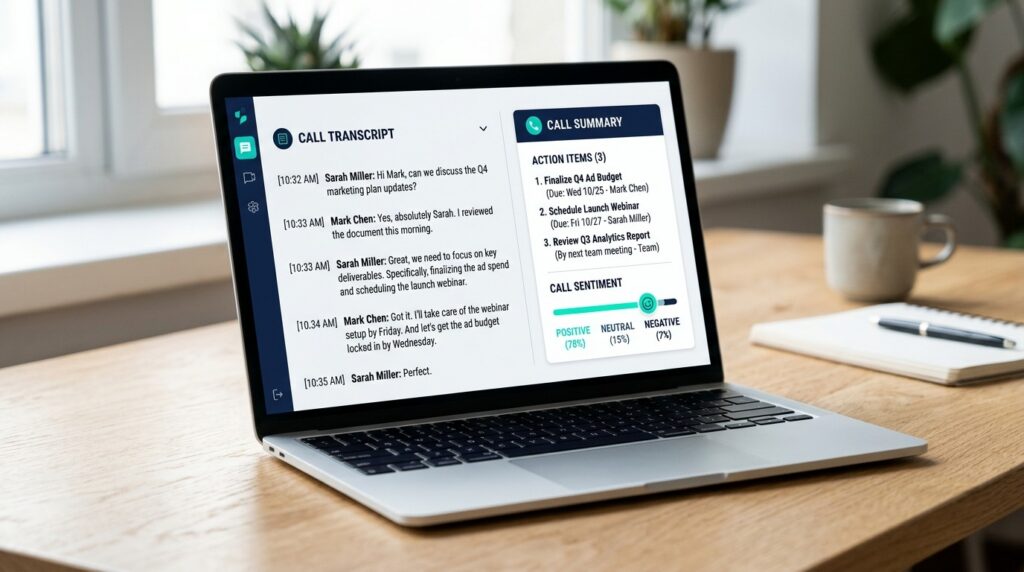
Voicemail and live call transcription inside the desktop and mobile client round out the stack. Individually, they’re small, but together they change how a client experiences the phone system, which is why bundling them into your base tier beats charging separately. Our breakdown of AI tools that streamline MSP communication covers the operational side.
How Do You Package and Price AI-Enabled Communications?
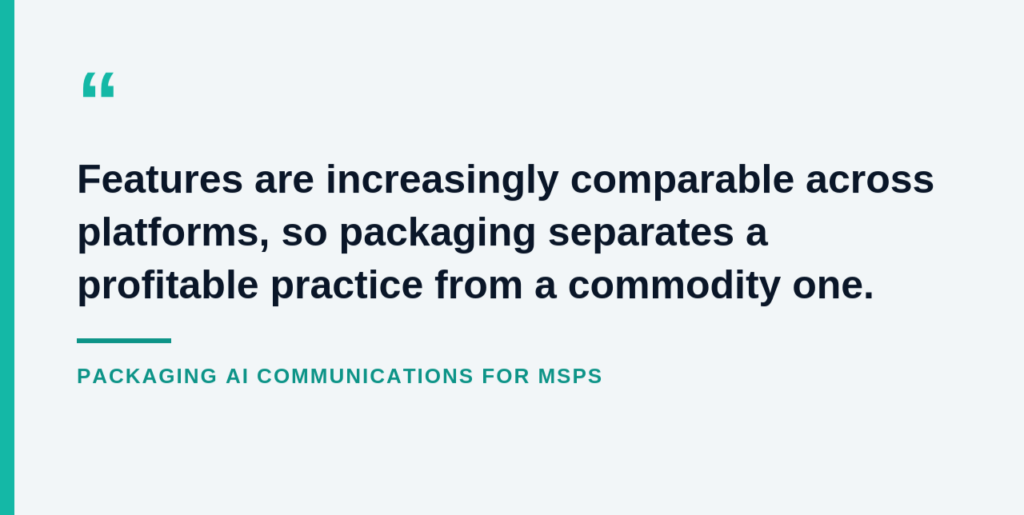
Packaging is where MSPs leave money on the table. Features are increasingly comparable across platforms, so packaging separates a profitable practice from a commodity one.
Build Tiers Around Outcomes, Not Capabilities
A three-tier structure works for most SMB markets. Your base tier is the core stack with voicemail transcription. Your middle tier adds call transcription, summaries, and analytics. Your top tier includes a conversational agent configured for the client’s use case. Name the tiers after what they do for the business rather than what’s technically inside them.
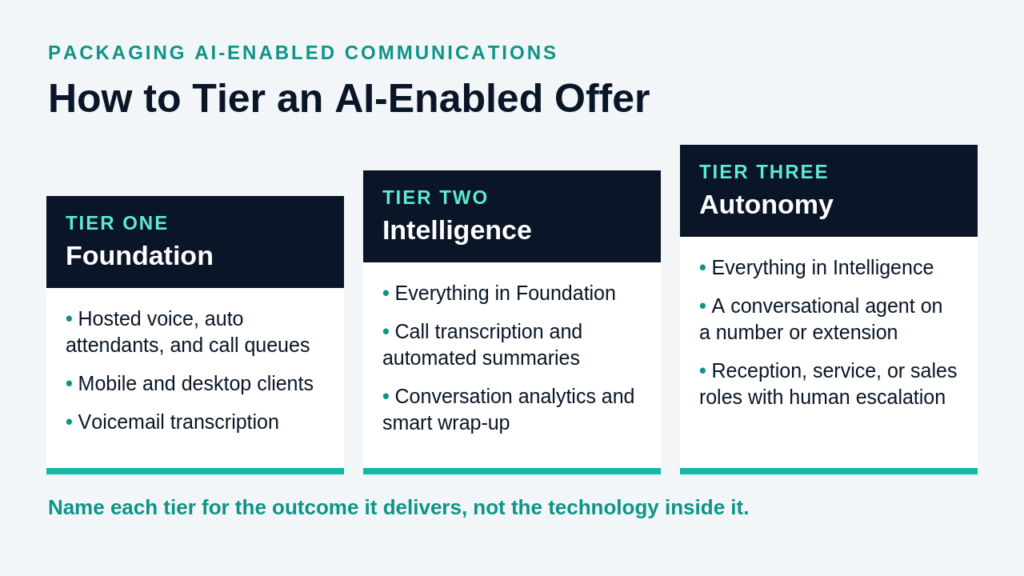
The outcome framing will speak to your clients. A dental practice doesn’t want natural language understanding. It wants fewer no-shows and a front desk that isn’t fielding the same three questions all day. A brokerage wants leads answered at 9 p.m. instead of Monday morning, and a multi-location retailer wants seasonal call spikes covered without seasonal hires. Sell the result, then explain the mechanism if they ask.
Understand the Cost Model Before You Quote
Conversational AI is typically priced per minute rather than per seat, which is different math than the rest of your bundle. Predictable cost of goods means predictable margin, but model realistic call volume before you commit to a flat monthly price. Volume discounts usually apply across your whole base, so the tenth AI client is more profitable than the first.
The economics depend heavily on whether AI is native to the platform or resold from a third party. When conversational AI agents are built into the platform you already sell, there’s no middleware, no second support line, and no outside vendor taking a cut before you do, which makes partner margins of up to 70% realistic. Stack a separate AI voice vendor on top, and you split your margin twice while explaining why two companies are involved when something breaks.
What Should You Look for in White-Label UCaaS for MSPs?
Platform evaluations tend to fixate on feature checklists, and features converge over time. What makes an MSP UCaaS platform profitable in year three is harder to spot in a demo. Ask about these items before you sign anything:
- Time to first revenue. With focused commitment, a UCaaS reseller for MSPs program built for the channel can have you launched in 30 days.
- Back-office automation. Quote-to-cash, self-service provisioning, automated billing, and telecom taxation inside the platform.
- Network architecture. Geo-redundant infrastructure with automated failover, because your brand is on the line when a client’s phones go quiet.
- Compliance coverage. HIPAA-capable configurations, 10DLC registration, STIR/SHAKEN, Kari’s Law, and RAY BAUM’s Act.
- Support depth. Whether Tier 2 and Tier 3 escalation exists, how fast it responds, and whether branded Tier 1 support is offered.

Onboarding quality deserves its own scrutiny. A UCaaS reseller for MSPs succeeds or stalls based on how well the platform teaches you to sell, provision, and bill the service, rather than only how to configure it. Look for structured training, a real knowledge base, sales coaching on early calls, and brandable marketing assets. Recurring revenue is why most MSPs pursue this opportunity, and a well-built partner program for communications resellers shortens the ramp between signing on and getting paid.
One thing that’s easy to miss: find out who controls the platform roadmap. Some providers pass through a third-party switch and can’t change anything, while others run a proven core and build extensively around it, adding capabilities partners ask for. That difference shows up the moment a client needs something right now. If you’re weighing basic hosted voice against a fuller offering, the comparison between cloud PBX and full UCaaS deployments is worth reading first.
Frequently Asked Questions
Is white-label UCaaS for MSPs profitable for a smaller shop? Yes, and often more so than for large resellers because you set your own pricing and keep the full spread between wholesale cost and retail price. Smaller MSPs frequently win on responsiveness, which is what SMB buyers say they want. The real variable is whether the platform automates enough of the back office that adding customers doesn’t add labor.
Do I need technical AI expertise to sell AI communications? No. Modern platforms use no-code, drag-and-drop builders for configuring conversational agents, so deployment is closer to setting up a call flow than writing software. You mainly need to understand your client’s business well enough to design a sensible conversation path. Professional services are typically available for anything complex.
How is a conversational AI agent different from an auto-attendant? An auto-attendant routes callers through a predefined menu structure. A conversational agent understands what the caller is asking in natural language, answers directly, books appointments, captures information, and routes based on intent rather than keypress. Many clients run both, with the agent taking open-ended inquiries and the auto-attendant handling department routing.
Where to Start
The resellers pulling ahead in managed service provider communications picked a platform where AI is part of the core product, built tiers they can explain in a sentence, and started having outcome conversations with clients frustrated by their phone system. That motion is repeatable, and it doesn’t require you to become an AI company.
White-label communications for MSPs work best when the platform behind you is invested in your growth instead of your volume. SkySwitch gives you a private-label UCaaS platform with native AI, automated billing and provisioning, geo-redundant infrastructure, and onboarding built to get you selling in 30 days. Get started with SkySwitch, and we’ll map out what your first AI-enabled customer could look like.

Jessica is a marketing and sales strategist with deep expertise in VoIP telecommunications. As a Marketing Director, she specializes in channel marketing, account management, and product marketing within the communications industry. Jessica is passionate about helping partners grow through compelling messaging and hands-on support.